LG Corp Stock: Revenue Flat Four Years, Profit Down by Half
=> What I set to 100 and what came back
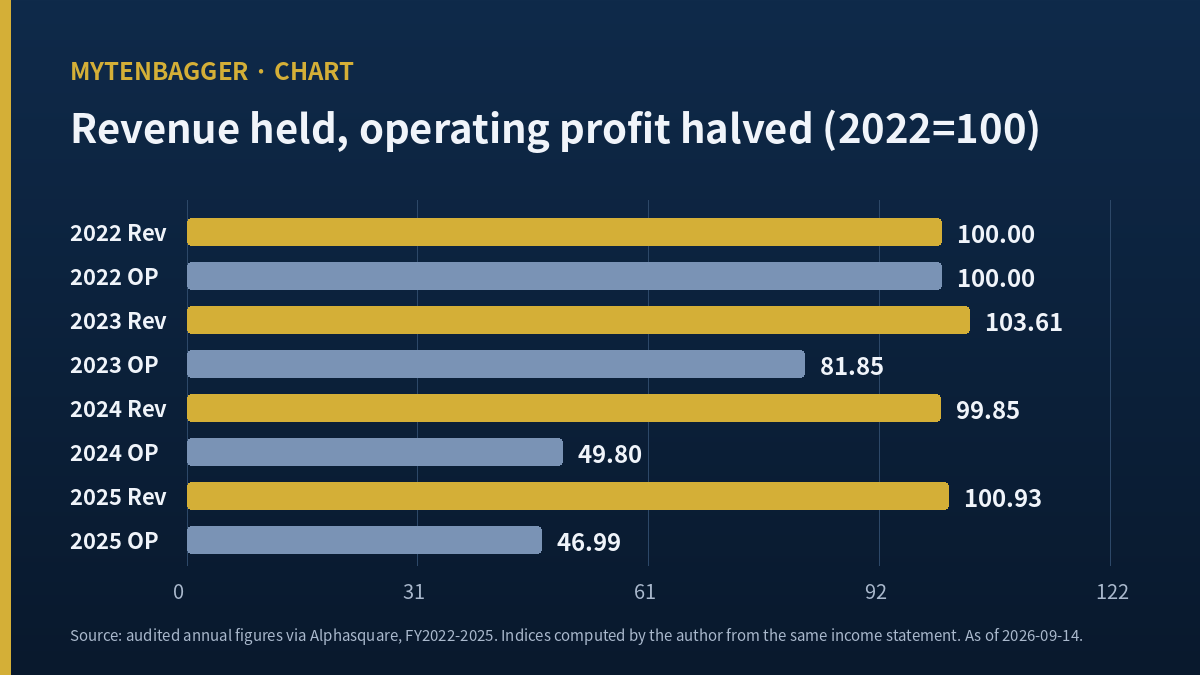
=> Base year 2022 = 100 for both lines of this company’s own income statement
=> 2025 revenue index: 100.93. Four years, and the top line came back to where it left
=> 2025 operating profit index: 46.99. The same four years cut it by slightly more than half
=> Loews Corporation on the identical base: revenue 131.40, operating profit 192.02
=> First half of 2026 operating profit: 946.8 billion won, or 103.80 percent of all of 2025
=> My position: none, no order placed, watching
Here is the whole of my question about LG Corp stock in two numbers. I set fiscal 2022 to 100 on two lines of the same income statement and looked at where 2025 landed. Revenue came back at 100.93. Operating profit came back at 46.99. The company sold almost exactly what it sold four years earlier and kept less than half as much from doing it.
LG Corp (KRX: 003550) is a Korean holding company listed on the KOSPI, the senior board of the Korea Exchange, where it is classified under other financial businesses. It was founded on January 5, 1947 and listed on February 13, 1970. Its own payroll is 193 people as of June 2026. The September 14, 2026 close puts one share at roughly 84 dollars.
Contents
The four-year table behind the LG Corp stock question
These are the audited annual figures as carried on Alphasquare, in billions of Korean won, which is the reference currency throughout this piece.
| Fiscal year | Revenue | Operating profit | Net profit |
|---|---|---|---|
| 2022 | 7,185.99 | 1,941.38 | 2,115.75 |
| 2023 | 7,445.34 | 1,589.01 | 1,414.26 |
| 2024 | 7,175.51 | 966.84 | 790.48 |
| 2025 | 7,252.55 | 912.17 | 1,000.12 |
Indexed to 2022, revenue reads 100, 103.61, 99.85, 100.93. Operating profit reads 100, 81.85, 49.80, 46.99. Every one of those index values is my own division, and I am stating that up front because the indices are the entire argument of this piece.
Why the two lines of LG Corp stock came apart
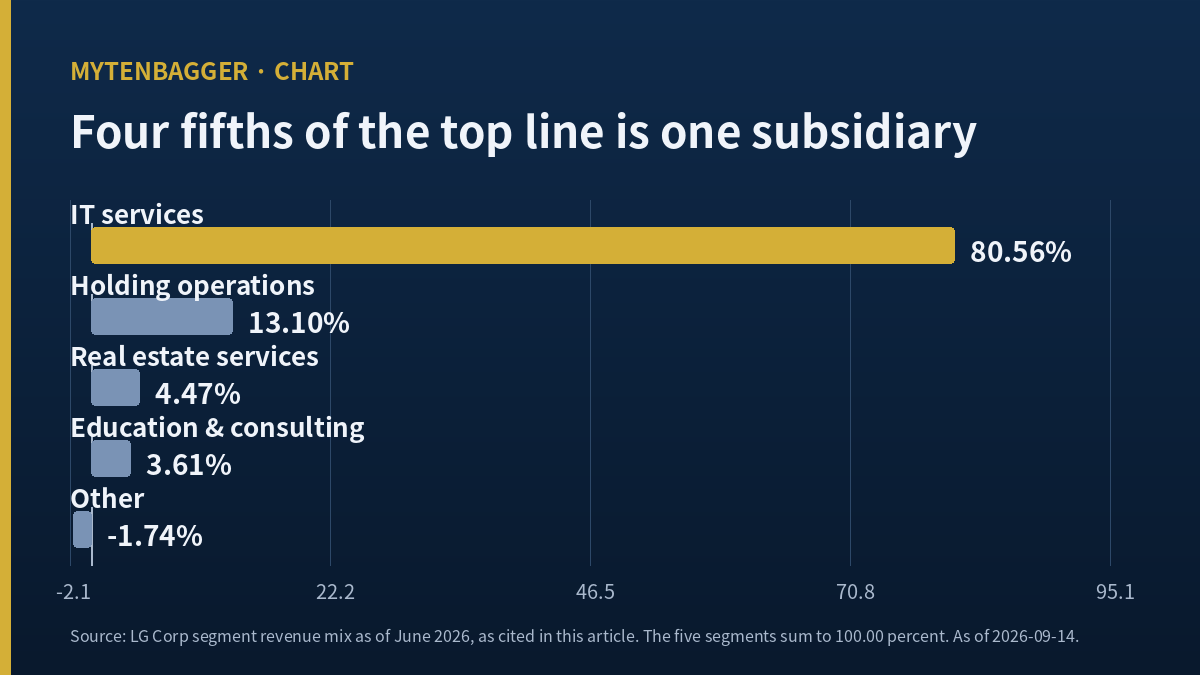
A holding company’s revenue line is a scope question. This one consolidates the subsidiaries it controls and equity-accounts the ones it does not, so what appears as revenue is not the group people picture when they hear the name. As of June 2026 the revenue mix runs: IT services 80.56 percent, holding operations 13.10 percent, real estate services 4.47 percent, education and management consulting 3.61 percent, other negative 1.74 percent. The five add to 100.00 percent exactly.
The disclosed stakes as of December 2025 explain how that mix is built. LG CNS 45.00 percent. LG Uplus 38.30 percent. LG Electronics 35.30 percent. LG Chem 34.90 percent. LG H and H 34.70 percent. The IT services arm carries the highest stake on the list and it is the one whose sales flow through the top line in full.
So the flat revenue index is largely one subsidiary’s trajectory, and the halved operating profit index is something else moving underneath it. I have not decomposed the operating profit line into its parts, and I want to be exact about that: I know what the revenue line mostly is, and I do not know with the same confidence what took operating profit from 1,941.38 to 912.17.
What the first half of 2026 did to that story
First quarter 2026 revenue was 1,800.62 billion won with operating profit of 413.83 billion. Second quarter revenue was 2,139.62 billion with operating profit of 532.98 billion. The two quarters together produced 946.81 billion of operating profit, which is 103.80 percent of the entire 2025 result. Half a year beat a full year.
Revenue over the same six months was 3,940.24 billion, or 54.33 percent of the 2025 annual figure. So the top line ran at roughly its normal pace and the profit line did not. Whatever pushed operating profit down through 2023 and 2024 appears to have reversed inside two quarters, and it reversed without a matching move in sales.
The separately reported holding-company quarter
Korean press reported the parent-only second quarter as operating revenue of 123.0 billion won, up 3.6 percent year on year, with operating profit of 45.0 billion, up 10.9 percent (Financial News, August 15, 2026). That is a different reporting basis from the group table above and I am not mixing the two. I note it because it shows how small the holding entity is on its own next to the group figures.
The third line went its own way again
There is a net profit column in that table and it does not follow either of the other two. On the same 2022 base it reads 100, then 66.84, then 37.36, then 47.27. It fell further than operating profit did through 2024 and then it turned up a year earlier, rising 26.52 percent in 2025 while operating profit was still slipping 5.65 percent.
The size relationship flips as well. In 2022 net profit came to 108.98 percent of operating profit. In 2023 it was 89.00 percent and in 2024 it was 81.76 percent. In 2025 it went back above the operating line at 109.64 percent. For a company that equity-accounts most of the group, that oscillation is what I would expect from income that arrives below the operating line and never passes through it, but expecting something is not the same as having checked it, and I did not open the notes that would settle it.
The same flip inside the first half of 2026
First quarter net profit of 378.97 billion won came to 91.58 percent of that quarter’s operating profit. Second quarter net profit of 533.84 billion came to 100.16 percent of its operating profit. The quarter that carried the bigger operating number is also the quarter where the lower line caught back up, which is the 2025 pattern repeating inside six months.
Figures I checked and then left outside the argument
Three of them. The trailing earnings per share of 4,628 won multiplied by the estimate ratio gives an estimated 7,763 won, a rise of 67.74 percent, which is a bigger jump than anything in my index tables and which I am not willing to carry because I do not know how many houses stand behind the estimate. The dividend of 3,100 won per share against the September price gives a yield I could compute in one line, and I left it out because the 2026 dividend has not been declared. The headcount of 193 is a striking number next to revenue of 7.25 trillion won, and it is striking precisely because it describes the holding entity and not the group, so it decorates the piece without advancing it.
A US holding company measured the same way
For a check outside Korea I took Loews Corporation (NYSE: L), a US holding company that also runs consolidated operating subsidiaries instead of holding a pile of minority stakes. I did not put margins side by side, because the two groups consolidate different kinds of businesses and a margin comparison would be comparing two differently built ratios. What travels across the border is each company measured against its own starting point.
| Fiscal year (2022 = 100) | LG Corp revenue | LG Corp operating profit | Loews revenue | Loews operating profit |
|---|---|---|---|---|
| 2022 | 100 | 100 | 100 | 100 |
| 2023 | 103.61 | 81.85 | 113.22 | 163.43 |
| 2024 | 99.85 | 49.80 | 124.68 | 163.79 |
| 2025 | 100.93 | 46.99 | 131.40 | 192.02 |
Loews went from 14,044 million dollars of revenue and 1,378 million of operating profit in 2022 to 18,454 million and 2,646 million in 2025. Both of its lines rose, and the profit line rose faster than sales. The Korean company held sales still and gave up profit. Those are opposite outcomes on an identical construction.
I am keeping Loews out of the valuation part of this piece for one specific reason. Its screen carries a market value of 22.3 billion dollars, but its quoted price of 109.24 dollars on September 14, 2026 multiplied by the 244.43 million shares the same screen lists comes to about 26.7 billion. I could not reproduce the company’s market value from its own page, so I use only the income statement, the 109.24 dollar quote, the price to earnings ratio of 13.33 and earnings per share of 8.16 dollars, which do reconcile with each other against the prior close.
What the sell side has written on LG Corp stock
Four houses have numbers on this name and they do not agree with each other. Kiwoom Securities analyst Ahn Young-jun moved from 115,000 won to 200,000 won, a rise of 73.9 percent, in work reported on June 1, 2026, citing a net asset value of 37.5 trillion won and a narrowing of the discount applied to it from 45 percent to 40 percent. Heungkuk Securities analyst Park Jong-ryul moved from 135,000 won to 150,000 won. Mirae Asset Securities analyst Ryu Je-hyun moved from 120,000 won to 140,000 won. Hana Securities analyst Choi Jung-wook carries 140,000 won. The last three were reported together on August 15, 2026.
In dollars at the rate in the footnote, the spread runs from about 104 to about 149. The top figure is 42.9 percent above the bottom one. I did not reverse the Kiwoom valuation out of its stated discount rate to recover a per-share asset figure, and I am putting that omission on the record here: the arithmetic is available, I simply did not build on it.
The vendor screen I use carries a trailing price to earnings ratio of 24.31 and a forward ratio of 14.49 on earnings per share of 4,628 won trailing and 7,763 won estimated. Both ratios were computed on the previous session’s close, one trading day before the close I use in this piece, so they are one day stale against my own price and I have not restated them.
What else moved around LG Corp stock this summer
The shares rose 18.7 percent between August 1 and August 14, 2026. On August 13, 2026 the chairman signed a memorandum with Nvidia covering humanoid robotics, AI factories and mobility, with a next-generation humanoid promised for the first quarter of 2027. The group’s AI research arm and its Exaone model placed first in the initial evaluation of a Korean national AI project in January 2026.
On returns to holders, the company has said it aims to keep the payout ratio inside 70 percent, to return at least 60 percent of separate adjusted net profit, and to hold the dividend near 3,100 won per share. The five-year average payout has been 68 percent and the prior year’s dividend total was 478.2 billion won (reported August 28, 2026). Three cancellations of treasury shares have run since May 2025, the most recent recorded on the corporate registry screen in June 2026.
Two of the stakes listed earlier have their own entries in this journal. The IT services subsidiary, the one whose sales dominate the consolidated top line, produced three different verdicts depending on which benchmark I measured it against, which is a question about measurement tools and not about the parent’s income statement. The chemicals affiliate looked cheap against the value of what it owns while its credit was being cut; that one turned on rising debt, and this piece does not touch either company’s balance sheet.
What I could not verify about LG Corp stock
- Every index value in this piece is my own division. None of them is printed on any screen I used.
- I did not decompose the operating profit line, so I cannot say what took it from 1,941.38 to 912.17.
- The revenue mix percentages are dated June 2026 and the stake percentages December 2025. They are six months apart.
- I did not verify whether any stake changed after December 2025.
- The 2026 half-year figures are unaudited as far as I know, and I did not confirm their review status.
- The parent-only quarterly figures come from a press summary and not from the filing itself.
- I did not read any of the four brokerage reports in full. All four valuations reach me through press summaries.
- The Kiwoom net asset value of 37.5 trillion won is a figure I am quoting, not one I rebuilt.
- The publication date of the Hana valuation is the date of the article that carried it, which may not be the date of the report.
- Four estimates is a small sample and three of them arrived in the same news cycle.
- The index construction hides that difference, it does not remove it.
- Loews figures are annual fiscal periods; I did not use its trailing twelve-month column.
- I could not reconcile the Loews market value with its own quoted price and share count, and I dropped both from this piece.
- A sample of one peer proves nothing about holding companies in general.
- I chose a peer whose lines run opposite to this one. A peer chosen for contrast makes the contrast look sharper than a random draw would.
- The 18.7 percent August move is quoted from a news report and I did not rebuild it from daily prices.
- The Nvidia memorandum has no disclosed financial terms that I saw.
- The 2026 dividend has not been decided and nothing here assumes one.
- The payout ratio figures come from company commentary relayed by press, and not from a filing I opened.
- The dollar figures in this piece are approximations at a single rate on a single date.
- Korean won is the reference currency here and converting does not add accuracy to anything.
- I have never visited a facility of this company or spoken to anyone who works there.
- Setting two lines to 100 and reading them again four years later is arithmetic anyone can redo in a minute. Redoing arithmetic is not reporting.
My stance on LG Corp stock and what would break it
I own none of this and I have placed no order. I am watching.
The reason I am not buying is the second item on the list above. I can see that profit halved while sales held, and I cannot say what did it. Buying on a rebound whose cause I have not identified means buying the rebound’s persistence on faith, and the first half of 2026 is two quarters, which is exactly long enough to be a recovery and exactly short enough to be two good quarters.
The condition that breaks my premise
My premise is that the profit decline and the 2026 rebound both came from something other than the sales those businesses make. If a full-year 2026 result arrives with operating profit holding near the pace the first half set, and the revenue index for 2026 again lands within a point or two of 100, then the premise is confirmed and the question becomes only whether the new profit level holds. If instead 2026 revenue breaks out of that narrow band in either direction, my whole framing was a coincidence of four flat years and I should throw it out.
A secondary condition
If the next disclosure breaks the operating profit line into contributions by business and the IT services arm turns out to explain most of both the fall and the rebound, then the flat revenue index stops being a puzzle and becomes the same story told twice. That would make this piece redundant. Redundant is a different kind of failure from wrong, and it is worth naming separately.

Which sentence here is defending a screen instead of me
Same sorting as the piece above it, run on the other language. I put the sentences that argue for my sources ahead of the ones that argue for my own judgment.
- Dropping the Loews market value because I could not reproduce it. The failure to reproduce is real, but the likely explanation is that the page counts shares on a basis I did not look up, so that sentence is defending my own method.
- Calling four estimates a small sample. True, yet I used all four anyway and quoted the widest one first, which means the caveat did less work than it appears to.
- Saying I did not reverse the Kiwoom valuation out of its discount rate. Honest as stated, but the reason was partly that I had done exactly that kind of arithmetic recently and wanted a different piece, which is a reason about me.
- The four annual figures copied from the income statement. I did not make those, and four years from now they will read the same way they read today.
Basis and error. Prices and multiples reflect the September 14, 2026 close as checked at the time of writing. Annual and quarterly financials are as reported for the periods shown and are stated in Korean won, which is the reference currency throughout. Dollar figures are approximate, converted at roughly 1,341.59 won per dollar, the last rate I could confirm, dated September 11, 2026; the September 14 rate was not published on the source I use. Anything labeled an index value is my own division and appears on no screen.