Kakao Stock: The AI Option Premium Faces Its August Test
Here is the setup that pulled me back into Kakao stock (KRX: 035720) this week, notebook open, wallet still closed. In July, nine out of ten Korean brokerages covering the name cut their price targets — a tally reported by the Korean financial press on July 18. Over the same month, the shares climbed more than 5% off their late-June low, closing July 31 at ₩37,400, roughly $25 at the ₩1,470-per-dollar rate I’ll use throughout. Sell-side conviction went one way; the tape went the other. When the people writing the reports and the people placing the orders disagree that visibly, my experience says the market is in the middle of re-pricing something, and I want to know what.
My answer, after working through the numbers: what’s being re-priced is not Kakao’s business. It’s an option written on top of that business — the promise that Korea’s default messaging app becomes an AI platform. And that option has a mark-to-market date: August. I’m not buying in front of it. I am, however, setting out exactly what would make me move, because this is the rare setup where the homework can be done before the exam is graded.
The 30-second version
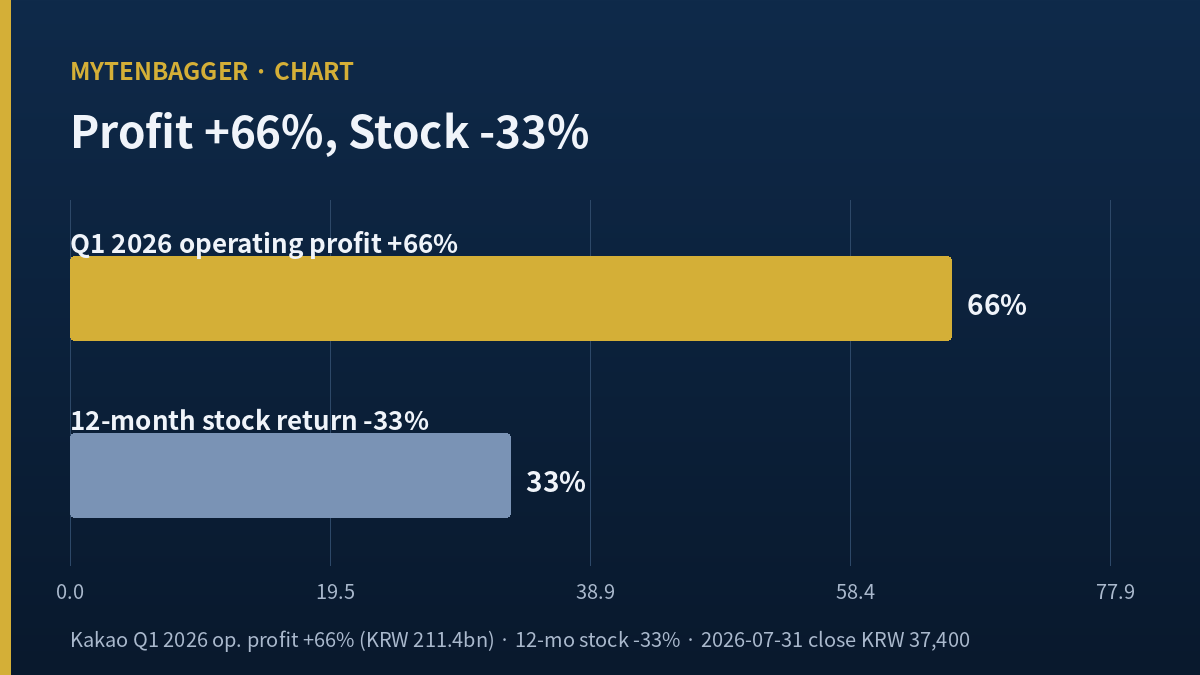
Kakao runs KakaoTalk, the messenger installed on essentially every smartphone in South Korea, plus adjacent ad, commerce, mobility, fintech and content businesses. Market cap about $11.3B (₩16.6T) as of July 31; my data terminal shows 33.7x earnings, 1.47x book, 4.6% ROE. The stock is down 33% over twelve months and 46% from its 52-week high of ₩69,700 — while company-reported Q1 2026 operating profit rose 66% year over year and 2025 operating profit was a record. That divergence is the whole story here. My stance: not a holder, watching — with conditions I’ll spell out.
Contents
Kakao Stock’s July Paradox: Targets Down, Price Up
Start with what just happened. Korea Investment & Securities cut its price objective from ₩70,000 to ₩60,000 (about $41) on July 9 while keeping a buy rating; the analyst wrote that the market wants proof of new AI-driven growth and Kakao hasn’t yet supplied it, and that the mainstream view of Korean internet has slipped to “low-growth domestic play.” A July 18 press tally counted nine of ten covering brokerages cutting, with Samsung Securities at the low end at ₩44,000 (about $30). Yet the shares bottomed intraday at ₩32,250 on June 26 and have ground higher since. On July 28 — a day the KOSPI fell 10.84% and tripped a market-wide circuit breaker — Kakao fell just 3.6%. A seven-point relative defense from a stock this beaten up told me the marginal seller may finally be exhausted.
For readers new to the market plumbing: the KOSPI is Korea’s main board, home to the large caps (there’s also the KOSDAQ, the growth-and-smallcap venue — Kakao sits on the KOSPI). Ten brokerages publishing on one name is normal coverage density for a former national champion like this one. Which makes the unanimity of the cuts, and the tape’s refusal to care, more interesting rather than less.
Record Earnings the Kakao Stock Price Refused to Pay For
Now the part that looks like a contradiction. Per the company’s own release, Q1 2026 revenue came in at ₩1.94T (about $1.32B), up 11% year over year, and operating profit at ₩211.4B (about $144M), up 66% — both all-time firsts for a first quarter, with operating margin reaching 11%. That followed a record 2025: revenue ₩8.1T (about $5.5B), operating profit ₩732B (about $498M), up 59.1%, and a swing back to a ₩525.7B net profit after a loss-making patch. The platform segment grew 16% in Q1, led by ads inside KakaoTalk (+16%), business messaging (+27%), and a mobility-and-fintech line up 30%. Content was the laggard at +5%, which is exactly where the company has been pruning.
The segment detail sharpens the picture. Inside the platform division (₩1.18T of Q1 revenue, up 16%), the fastest line was the mobility-and-fintech bundle at ₩507B, up 30% — the part of Kakao that looks least like a messenger and most like an infrastructure company. Content, at ₩759B and just 5% growth, splits into music (₩485B, +11%) and media (₩92B, +23%) doing fine while the story business — webtoons and web novels, once the group’s global ambition — sat at ₩182B. The company is visibly rotating weight toward what compounds and away from what doesn’t, and the income statement is the receipt.
So earnings up strongly, margins widening, and the stock down by a third over a year — and down roughly 80% from its June 2021 peak of ₩173,000, a figure the Seoul Economic Daily’s English edition ran in early July. When fundamentals improve and the price falls anyway, either the market doubts the earnings can last, or the price never rested on earnings in the first place. My read is the second. Most of what investors were paying for at ₩69,700 was never this year’s profit.
What 33.7x Really Buys: The Option Premium Inside Kakao Stock
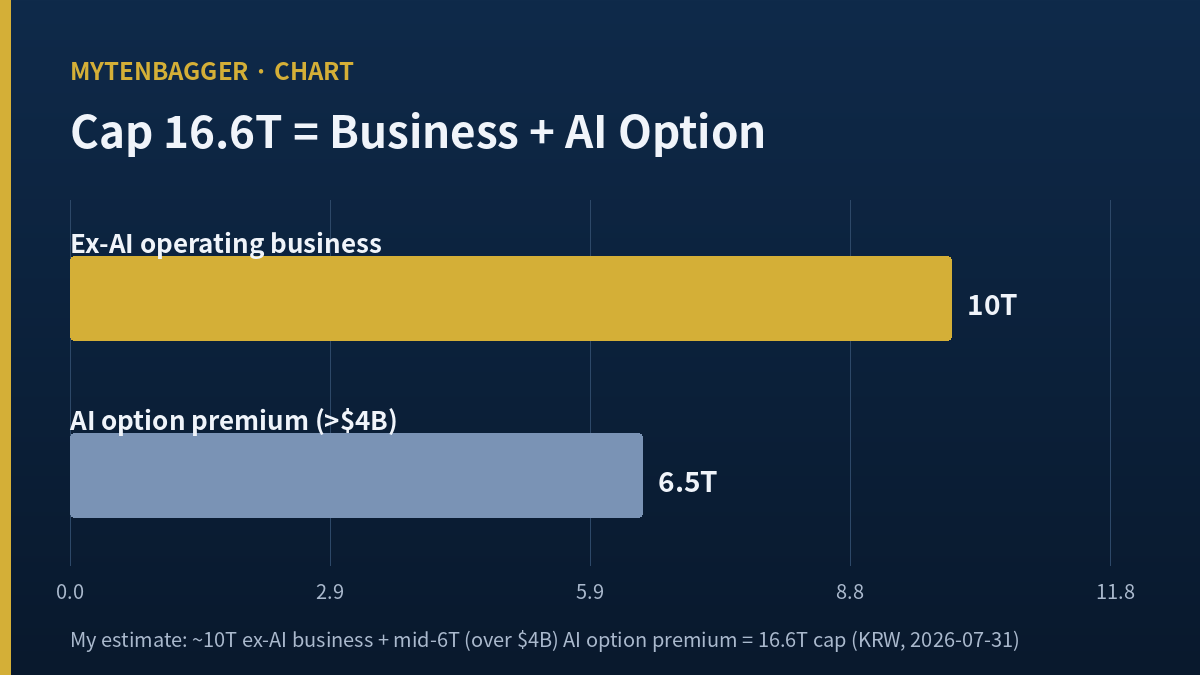
A 33.7x multiple on a 4.6% ROE business is not a valuation of the business. Korean bank holding companies earn double-digit returns on equity and trade at single-digit multiples on the same exchange. What the multiple is pricing is optionality: KakaoTalk is the one piece of digital real estate in Korea that every consumer, every merchant and every advertiser must pass through, and if a monetizable AI layer lands on top of it, the earnings power changes category. That is an option, and options have premiums.
Let me size the premium, with every assumption on the table — this is my back-of-envelope, nobody else’s. Annualize the run-rate (Q1 actual of ₩211.4B plus the consensus ₩223.9B for Q2) and you get roughly ₩870B in operating profit power. Put a generous 15x after-tax multiple on that — the kind of rating a high-single-digit-growth domestic platform earns — and the ex-AI business is worth around ₩10T, call it $6.8B. Against a ₩16.6T market cap, that leaves ₩6T-plus, over $4B, as the AI option premium investors are still paying today. At the ₩69,700 high, the same arithmetic makes the premium well over half the company. So the past year did not kill the option; it marked it down to roughly a third of its former size. That reframing matters, because it tells you what August is: not a product launch, but a mark-to-market event for a $4B line item.
One more sobering entry for the ledger: the dividend won’t catch this knife. The 2025 payout was ₩75 a share — a 0.2% yield per the disclosed dividend history. There is no income floor here the way there is under Korean banks. The floor is the business value, full stop, which is why the earnings exam below carries the weight it does.
The AI Scorecard — Proven, and Not Yet
What’s on the board already: Kakao signed a strategic collaboration with OpenAI in February 2025 — announced by the company and covered by CNBC — the first of its kind in Korea. The flagship product, ChatGPT for Kakao, launched in Q4 2025 and reached 11 million cumulative sign-ups by the Q1 earnings call in May, per CEO Chung Shin-a’s remarks reported in the Korean press. The company has also split the stack deliberately: OpenAI for consumer AI services, Google for on-device AI — a “full-stack” division of labor laid out in February and reported by The Korea Herald and The Investor. Forbes framed the alliance as Kakao’s growth restart; OpenAI itself documents the KakaoTalk integration in its help pages. This is not vaporware. The distribution deal of the Korean consumer internet is signed and shipping.
What’s not on the board: money. Eleven million sign-ups have not yet shown up as disclosed traffic, engagement or revenue. A DB Securities analyst, cutting to ₩57,000 in early July, noted that traffic metrics and external partner integrations “have not yet been fully realized” — sell-side language for we can’t find the usage. Samsung Securities was blunter in the July 18 tally: Kanana, Kakao’s in-house assistant, “lacks competitiveness,” and ChatGPT for Kakao isn’t differentiated enough to pull meaningful new users. I can’t refute either claim with data, because the company hasn’t published the data. That silence is itself information.
Which is why the next event matters more than any earnings print this company has delivered in years: per Korean press reports, in early August Kakao is expected to unveil an AI agent inside KakaoTalk that carries search, product discovery and — the important word — payment. If an agent can complete a purchase inside the messenger, Kakao finally has a tollbooth between its AI layer and its ad-and-commerce machine. If August brings another beta and another “later this year,” the option gets marked down again.
Why the Street Still Rates Kakao Stock a Buy — the Case Against My Caution
I keep the opposing brief with equal care, because it’s strong. Every named cut I listed above kept a buy rating. The published objectives — Korea Investment ₩60,000, Hanwha ₩62,000, DB ₩57,000, Daol ₩60,000, Mirae Asset ₩58,000 — sit 52% to 66% above the July 31 close, and even Samsung’s low-ball ₩44,000 is 18% above it. After the most bearish repricing cycle this stock has seen in years, nobody covering it thinks it’s worth less than the screen price.
The earnings case also has an underrated wrinkle. Consensus for Q2, per the late-July press tally, is revenue of ₩2.04T (about $1.39B), up just 0.8%, with operating profit of ₩223.9B up around 10% — and the flat top line is largely an accounting illusion. Kakao has been shedding affiliates on purpose: the group’s count fell by 22 entities under Korea’s Fair Trade Commission conglomerate designation, and Mirae Asset’s May cut explicitly reflected Kakao Games dropping out of consolidation rather than any operating deterioration. A company whose profit power rose because it sold what it shouldn’t own is a different animal from one squeezing costs. If the 11% operating margin is a starting point rather than a ceiling, today’s ₩10T business-value estimate is too low, and the margin of safety is wider than my arithmetic implies.
Foreign investors, for what it’s worth, still hold 28.8% of the float — reduced from the glory years, but not an abandonment. The flow picture matches the thesis: the option was discounted, not written off.
And here is the asymmetry my back-of-envelope exposes, which is the honest core of the bull case. If the market ever pushes the stock down toward my ₩10T ex-AI business value — the low ₩20,000s per share, around $15 — a buyer at that level gets the entire AI option for free, with the operating business covering the ticket. We came within sight of that in late June. Above it, every won of price is a claim on the August proof. The trade-off I’m accepting by waiting is explicit: I give up the gap between ₩37,400 and wherever confirmation prints, in exchange for not funding a promise. People who bought the June low made the opposite trade, and if the agent works, they’ll have been right to. I want it on record that I understand exactly what my caution costs.
What WeChat and LINE Teach Me About Kakao Stock
Since most of my readers can’t check Kakao against a domestic comparable — nothing else in Korea does what it does — I check it against the two nearest foreign relatives. Tencent’s WeChat is the proof of concept for the entire thesis: a messenger that layered payments, mini-programs and commerce into the chat window and turned national distribution into an earnings machine. That’s the end state the AI-agent plan is reaching for, and it’s why I don’t dismiss the ₩6T premium as fantasy — the category precedent exists, at scale, one country over. LY Corp’s LINE in Japan is the cautionary relative: similar messenger dominance, years of super-app and AI-assistant initiatives, and a monetization curve that arrived far more slowly than the keynote slides promised. Kakao’s August question, translated into this family portrait, is simply: which relative does it take after?
Two structural differences keep me from leaning on either analogy too hard. Korea is a single, saturated, heavily regulated market — Kakao has already been through antitrust hearings, a data-center fire that triggered national dependency debates, and a political cycle that treated its expansion as a policy problem; WeChat-style unbounded bundling is not on the menu. And unlike Tencent, Kakao doesn’t own a world-class game and media portfolio to subsidize the experiment — which is precisely why it outsourced the frontier-model layer to OpenAI and Google instead of burning capital to build one. Capital-light optionality cuts both ways: cheaper to hold, easier for the market to doubt.
Moat Check: The Network Held, the Growth Left
I name moats by type, and Kakao’s is a network-effect moat — the purest one on the Korean exchange. Every merchant that runs KakaoTalk business messaging (+27% in Q1), every advertiser buying talk-tab inventory (₩338B of Q1 ad revenue, +16%), every consumer whose commerce gift transactions ran through ₩2.9T of quarterly volume, deepens a graph no competitor can replicate domestically. The nearest global analogues — Tencent’s WeChat in China, LY Corp’s LINE in Japan — show both what a messenger-super-app can monetize into, and how long the AI layer takes to pay; I use them as a map here, not as a valuation crutch.
And I write down the cracks with the same pen. First, growth on top of the network has gone single-digit; that’s the “low-growth domestic play” tag in one phrase. Second, the moat has labor unrest inside the walls: union mediation broke down on May 27, the headquarters union secured a legal strike mandate, and four affiliates — Kakao Enterprise, Kakao Pay, DK Techin and XL Games — passed strike votes, raising the possibility of a coordinated walkout, per the Seoul Economic Daily’s English edition. Restructuring created the profit story; it also created this friction, and a strike that slips the August agent timeline would hit the exact catalyst I’m watching. Third, founder risk is back in a courtroom: Kim Beom-su was acquitted at first instance on SM Entertainment stock-manipulation charges, prosecutors appealed, the appellate trial opened June 24, and his side denied collusion outright at the July 22 hearing — all per Korean court reporting. An overturned acquittal would reopen the governance file this market only recently closed.
My Two August Exams for Kakao Stock
I refuse to lump August into one “catalyst.” There are two exams, graded on different rubrics, and I score them separately.
Exam one — the agent: proof the option exists
Launching is not passing. My bar has three parts: payment actually opens inside the agent, not just search and discovery; external partners connect commercially rather than as demos; and the first earnings call after launch discloses traffic and monetization numbers instead of adjectives. Clear all three and I stop watching and start sizing a position — knowingly paying more than the June low, because in this name the risk was never the bottom tick, it’s whether the option is real. Confirmation is worth its cost here.
Exam two — Q2 results: proof the business holds
The print itself is nearly pre-graded — the named estimates (Korea Investment ₩223.4B, Hanwha ₩223.7B, DB ₩218.4B of operating profit) sit within a whisker of each other, and mid-July reporting had operating costs actually declining year over year. So I’m not grading the headline; I’m grading composition: does talk-tab advertising hold its mid-teens growth, and does the 11% operating margin survive now that the easy restructuring is done? Both yes, and the downside gets solid regardless of what the agent does. Advertising decelerating into the low single digits, and 33.7x becomes a number neither the business nor the option can carry. I’d also grade the disclosure itself: if management uses this call to publish the first hard AI metrics — daily users of the assistant, query volumes, anything with a unit attached — that alone would tell me the company believes its own numbers, which is a signal I weight almost as heavily as the numbers themselves.
Outside the exam room, two deductions run on their own clocks: a realized general strike that delays the agent, and any appellate signal that the first-instance acquittal is in danger. Either one extends my wait automatically — the first postpones the test, the second adds a subject I can’t study for.