LigaChem Biosciences Q2 Results: Sales Fell 83%, Loss Up 3x
LigaChem Biosciences Q2 results showed revenue of KRW 5.5bn (about $4.1m) for April to June 2026, down 83% from the same three months of 2025, while the operating loss widened to KRW 72.0bn (about $53.3m). That is a loss thirteen times the size of the sales line. After rebuilding the quarterly table, I am watching until the July to December numbers show whether the full-year forecasts were realistic.
Contents
How I came back to LigaChem Biosciences Q2 results
I was not looking for this company at all. I was going through a list of Korean biotech names whose share prices sat far below their 52-week highs, mostly to see which ones had a reason I could name. LigaChem caught my eye because the drop had no single headline attached to it. When I opened the six-month report, the reason turned out to be ordinary. The money that usually arrives from partners simply did not arrive in the second quarter, and spending kept climbing.
Some context for readers outside Korea. LigaChem Biosciences (KOSDAQ: 141080) trades on KOSDAQ, Korea’s growth-company board, roughly the Nasdaq to the KOSPI main market. The company designs antibody-drug conjugates, or ADCs: an antibody that finds a tumor cell, a chemical linker, and a toxic payload that is released once the drug is inside. LigaChem licenses its linker technology and individual ADC candidates to larger drug makers and collects upfront fees, milestones and, later, royalties. Its partners have included Janssen, Amgen and Japan’s Ono Pharmaceutical. That business model is the whole story of the Q2 print.
It helps to know how that money shows up in the accounts. An upfront fee is usually recognized when a license is signed. A development milestone is recognized when the partner reaches a defined event, such as dosing the first patient in a trial or filing for approval. Royalties only start once a drug is sold. None of these arrive on a steady monthly rhythm. For a company at LigaChem’s stage, almost all revenue is upfront fees and milestones, so a quarter’s revenue tells you mainly whether a partner happened to hit an event in that window. That is why I never read a single three-month period on its own here, and why the six-quarter table below matters more to me than the headline percentage.
At the October 2, 2026 close of KRW 82,800 (about $61.31), the 37.0 million common shares give a market value of roughly KRW 3.07tn, or about $2.27bn. The stock has lost close to two-thirds of its value from its 52-week top.
LigaChem Biosciences Q2 results in six quarters
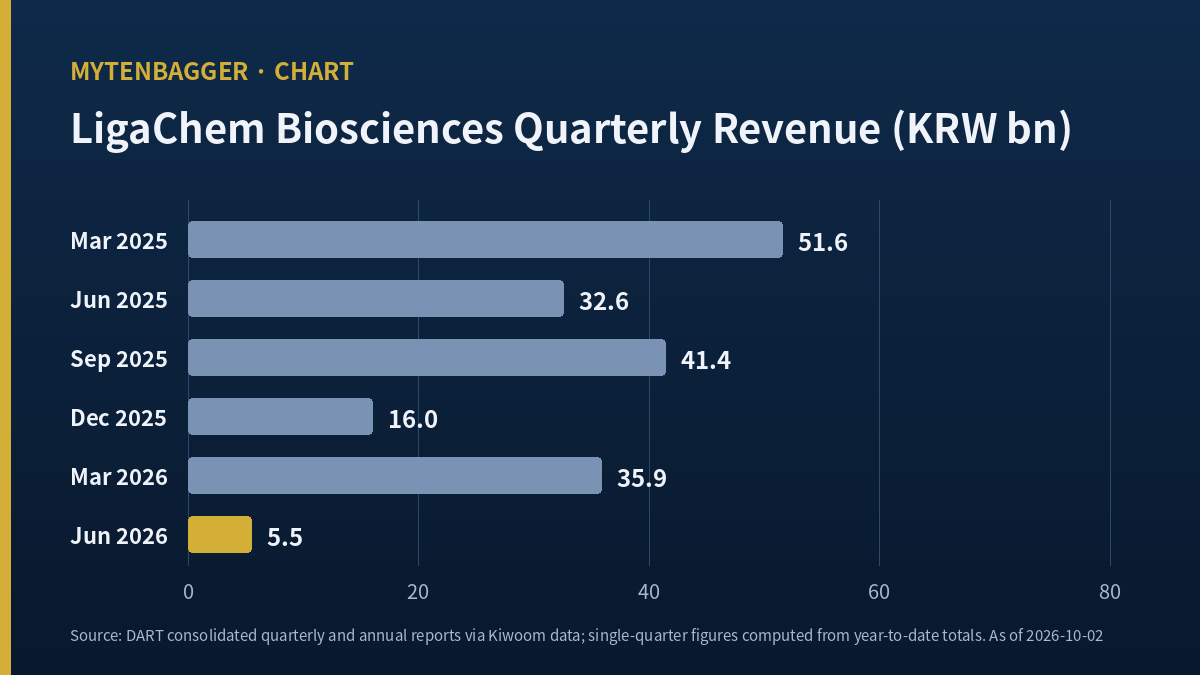
I built this table from the company’s consolidated quarterly reports filed with Korea’s disclosure system (DART), pulled through a Kiwoom data feed. Korean reports give year-to-date totals, so April to June is the six-month figure minus the January to March figure, and the October to December 2025 line is the full year minus nine months.
| Three months to | Revenue (KRW bn) | Operating result (KRW bn) |
|---|---|---|
| March 2025 | 51.6 | +11.4 |
| June 2025 | 32.6 | -21.5 |
| September 2025 | 41.4 | -23.2 |
| December 2025 | 16.0 | -73.1 |
| March 2026 | 35.9 | -37.4 |
| June 2026 | 5.5 | -72.0 |
Source: DART consolidated quarterly and annual reports via Kiwoom data, single-quarter figures computed by me from year-to-date totals. The four 2025 quarters add to revenue of KRW 141.6bn and an operating loss of KRW 106.5bn, matching the annual report. Dollar figures are approximate, at roughly KRW 1,350.6 per dollar, the Seoul close on October 2, 2026, the session the won figures come from.
Three points stand out to me. First, revenue moves in steps, and the steps are deal payments. The best quarter in the table, January to March 2025 at KRW 51.6bn, was also the only profitable one. Second, the loss line does not track revenue at all. It got worse in four of the five moves, regardless of what revenue did. Third, the April to June 2026 quarter is the first in the table where revenue fell into single digits, and the loss was the second largest.
Why the LigaChem Biosciences Q2 results looked this way
License income fell by 50.1%
The cleanest explanation comes from the company’s standalone (parent-only) financials for January to June, reported by the Korean trade outlet Medipana on September 22. On that basis, six-month revenue was KRW 43.0bn, down 49.0% from KRW 84.2bn a year earlier, and technology transfer revenue was KRW 36.8bn against KRW 73.7bn, down 50.1% (Medipana, September 22, 2026). The standalone and consolidated revenue lines differ slightly, KRW 43.0bn against KRW 41.4bn, so I keep them in separate sentences and do not mix them in one ratio.
In plain terms, last year’s first six months contained large milestone payments and this year’s did not. None of the reports I read point to a partner canceling a program. What I see is a gap between payments.
Research spending roughly doubled
The same Medipana report puts standalone research and development spending for January to June at KRW 149.3bn (about $110.5m), against KRW 72.6bn a year earlier, a 2.06 times increase by my calculation. The company said it is moving from licensing early-stage assets toward running more of its own clinical work before partnering, aiming for five new clinical trial applications this year, two of them run in-house (as Edaily reported in July).
That is a deliberate choice, and it explains why the loss line is no longer tied to the sales line. Revenue now depends on partners. Costs now depend on LigaChem’s own trial plan. The two have come apart.
One milestone is already on its way
On July 9 the company disclosed that Ono Pharmaceutical had dosed the first patient in a global Phase 1 study of LCB97, an ADC aimed at the L1CAM protein, triggering a milestone payment. LigaChem did not disclose the amount, only that it equals at least 10% of the prior year’s consolidated revenue, payable within 45 days of invoice (Medipana, July 13, 2026). Ten percent of KRW 141.6bn is KRW 14.2bn, or about $10.5m, so that is the floor I use. According to an Edaily report carried by Daum in early July, the full Ono deal is worth about $700m before royalties.
I have looked at this pattern before on the English side of my journal. Lunit spent years burning more operating cash than it recorded as revenue, and the turn only came once sales grew faster than costs. Pharmicell taught me to check how many independent forecasts a story rests on; there, it was one. Here, as the forecast section below shows, it is two, and both predate the quarter that matters.
What LigaChem Biosciences Q2 results leave for July to December
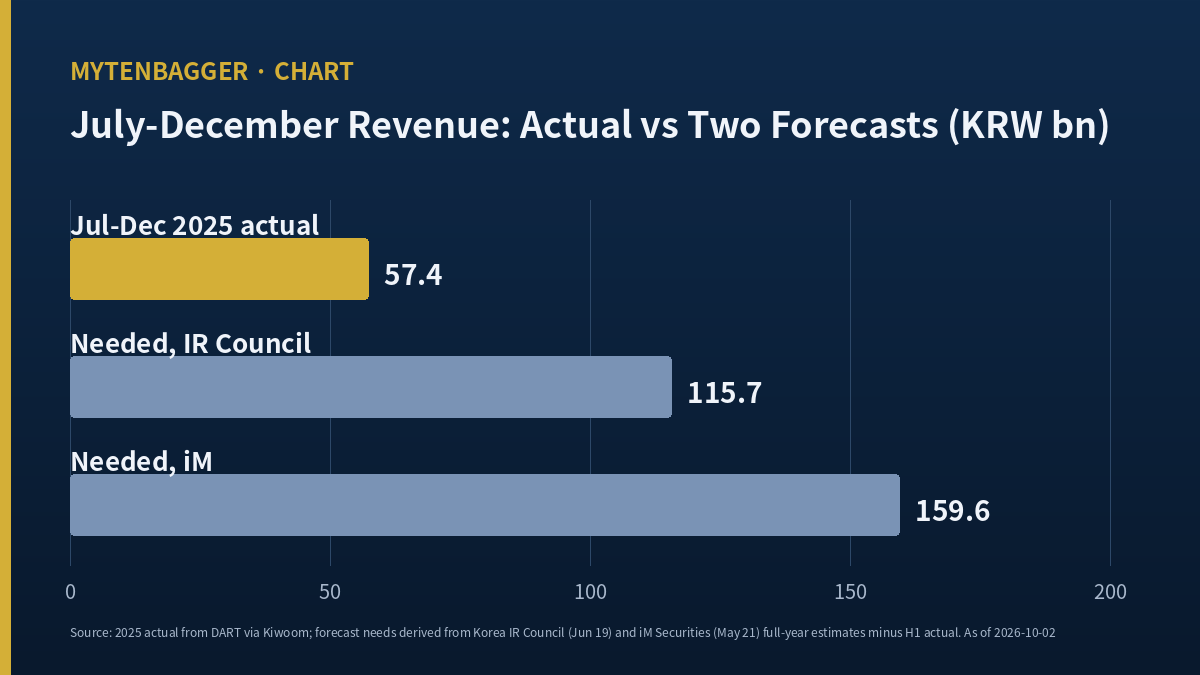
This is the part that made me stop and redo my numbers. I found two named 2026 forecasts, and both came out before the Q2 report.
- iM Securities (analyst Jung Jae-won, May 21, 2026): revenue KRW 201bn, operating loss KRW 108bn (iM Securities note).
- Korea IR Council research center (Kim Seung-jun, June 19, 2026): revenue KRW 157.1bn, operating loss KRW 108.0bn (Korea IR Council report).
Consolidated revenue for January to June was KRW 41.4bn and the operating loss was KRW 109.4bn. Subtract, and the iM figure needs KRW 159.6bn of revenue in the second six months, while the IR Council figure needs KRW 115.7bn. For comparison, July to December 2025 produced KRW 57.4bn. So the lower forecast needs about twice last year’s July to December revenue and the higher one nearly three times.
The loss line is where it gets uncomfortable. Both forecasts put the full-year loss at about KRW 108bn. The first six months already lost KRW 109.4bn. If either forecast is right, July to December has to end with an operating result of roughly zero, a small profit of about KRW 1.4bn by my arithmetic, while the research budget is running at twice last year’s speed. That can only happen with one or two large licensing payments arriving before December.
I am not saying the forecasts are wrong. They were written before the Q2 numbers existed, and I could not find a named update published after August 14. What I am saying is that anyone reading those numbers today is reading a bet on a new deal, written as a revenue line.
Three ways LigaChem Biosciences Q2 results could carry into the full year
I sketched three paths for July to December. I am not putting odds on them. Each one is defined by what has to happen, so I can tell from the Q3 and full-year reports which one I am on.
Path one: last year repeats. If July to December brings the same KRW 57.4bn of revenue as 2025 did, full-year revenue comes to about KRW 98.8bn, which is 49.1% of the iM figure and 62.9% of the IR Council figure. Costs are the harder part. In January to June, revenue plus the operating loss implies roughly KRW 150.8bn of operating costs, about KRW 73.3bn in the first three months and KRW 77.5bn in the next three. If costs simply hold that pace, the second six months would lose about KRW 93.5bn and the year would end near a KRW 203bn operating loss, almost twice what both forecasts expect. These are my own calculations from the reported figures.
Path two: the Ono payment plus one mid-sized milestone. The KRW 14.2bn floor from Ono and one more event of similar size would lift July to December revenue somewhere toward the IR Council path without reaching it. The loss would narrow but stay well above KRW 108bn for the year. In this path the forecasts get revised down after the Q3 report, and the share price reaction depends on how much of that is already expected.
Path three: a new large license. A deal with a sizeable upfront fee, signed and recognized before December 31, is the only path where the forecasts hold. Platform licensors have done this before in the final weeks of a year. If it happens, my Q2 worry turns out to have been about timing only, and I will have watched the recovery from the sidelines.
A US peer whose revenue fell just as hard
The closest comparison I could verify is Sutro Biopharma (Nasdaq: STRO), a US ADC developer that also lives on partner payments. I picked it for one reason: in the same April to June 2026 quarter its revenue collapsed by almost exactly the same proportion. I compare only two items, the revenue drop and the direction of research spending, and I do not compare valuations, profitability or growth.
Sutro reported Q2 2026 revenue of $9.8m against $63.7m a year earlier, down 84.6%, and research and development expense of $31.7m against $38.3m, down 17.2%. It ended June with $164.3m in cash and securities and guided that this supports operations into at least the second quarter of 2028 (Sutro Q2 2026 release, August 12).
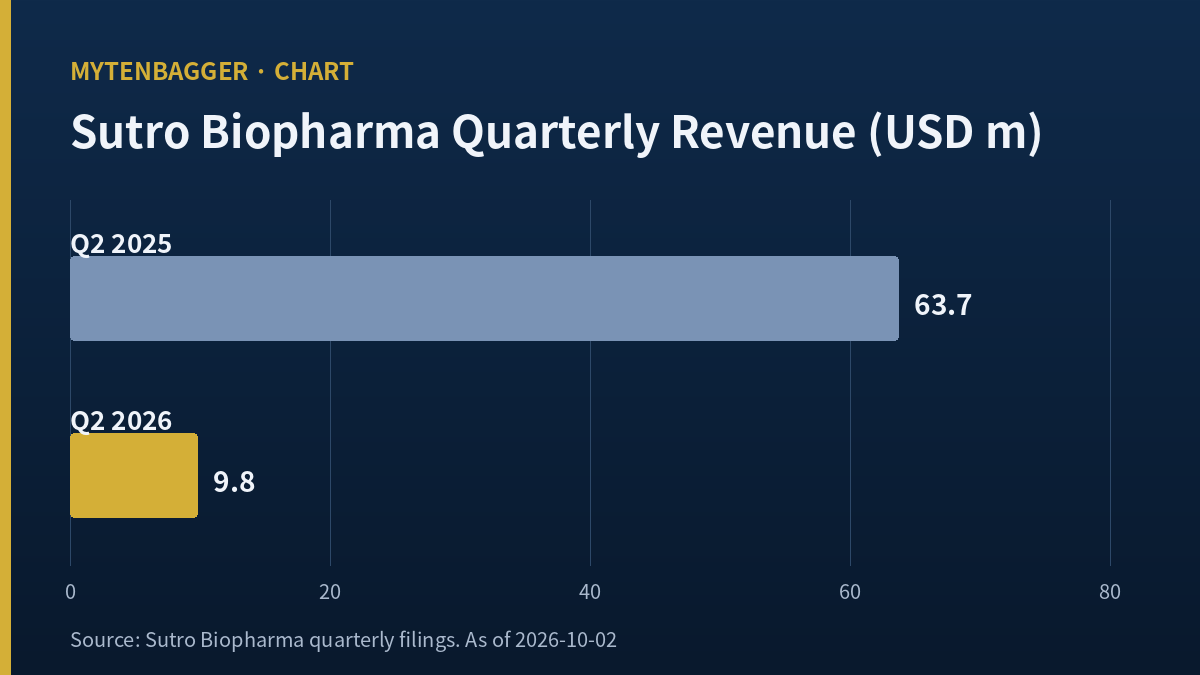
One more number lines up almost exactly. Sutro’s Q2 net loss rose from $11.5m to $38.5m, a 3.3 times increase, and LigaChem’s Q2 operating loss rose from KRW 21.5bn to KRW 72.0bn, also about 3.3 times. The measures differ (net loss for Sutro, operating loss for LigaChem), so I treat the match as a coincidence of size and no more. Still, it reminded me that this is what a revenue gap looks like at a licensing company on either side of the Pacific.
So the two companies had the same revenue shock and responded in opposite directions. Sutro trimmed research; LigaChem doubled it (its figure is for six months on a standalone basis, so the periods differ, and I treat this only as a direction). Sutro’s choice protects its cash runway. LigaChem’s choice raises the stakes on the next deal. Neither is obviously wrong, but they are different bets, and the market is pricing LigaChem’s bet at about $2.27bn.
What I first got wrong about these numbers
My first read of the Q2 loss was that a part of the business had broken: a failed trial, a returned license, a write-off. I spent a while hunting for it before admitting the explanation was dull. Revenue from partners comes in lumps, and LigaChem chose this year to spend more of its own money before those lumps arrive. The loss is a choice plus a gap in timing, and I had to stop treating it as a shock.
That does not make me more comfortable. A choice to spend more is only good if the next deal arrives at a decent price, and the company now has less leverage in a negotiation if partners know it needs revenue to meet expectations. On August 6 it also took full control of LNCB74, a B7-H4 ADC, after its US partner NextCure exited cancer research. LigaChem now pays the future development costs alone and owes NextCure milestones and royalties if the drug succeeds (Kormedi, August 2026). That adds cost now and potential upside later.
The details matter for the revenue question. LNCB74 pairs NextCure’s B7-H4 antibody with LigaChem’s linker and an MMAE payload, and it is aimed mainly at breast cancer and gynecologic tumors such as ovarian and endometrial cancer. The US Phase 1 study continues without interruption, and the FDA cleared a higher-dose expansion cohort in November 2025, according to the same Kormedi report. NextCure is merging with an autoimmune-disease developer and will rename itself, which is why it walked away from oncology. For LigaChem, this is one more asset where any future license income stays in-house, but also one more trial whose costs now sit entirely on its own income statement. In revenue terms it is a future option. In cost terms it starts now.
The independent research report from the Korea IR Council made a related point in June. In my own translation and paraphrase, it said the company is proving its ADC platform model through partnerships and milestone receipts, but that tougher competition calls for clinical differentiation, and that the earnings swings built into a licensing-centered structure need continued monitoring. I agree with the closing part of that sentence more than the opening. The platform has been proven by the deals already signed. What is not yet proven is that the next deal arrives on the timetable the 2026 forecasts imply.
Where my LigaChem Biosciences Q2 results read could be wrong
- One large licensing deal before December would make the iM revenue figure look reasonable in a single day. Platform companies often sign deals in the fourth quarter.
- The Ono milestone could be well above the 10% floor I used. The disclosure only gives a minimum.
- Higher research spending now can mean better data later, and better data usually means better deal terms. Sutro’s cuts could prove the weaker choice.
- iM Securities held a buy rating with a KRW 200,000 valuation in May, arguing the company could fund two or more years of research from its own cash. The sell-side view is far more positive than mine.
- My comparison uses standalone research spending for six months against Sutro’s three-month consolidated figure. A cleaner match could narrow the gap.
The two events that would change my LigaChem Biosciences Q2 results view
- July to September consolidated revenue, due in the Q3 report by November 16, 2026, shows at least the KRW 14.2bn Ono floor plus a new payment, putting the company on the IR Council path of KRW 115.7bn for the second six months.
- A new global licensing deal is announced with an upfront payment large enough to cover a full quarter of the current loss, which in Q2 was KRW 72.0bn.
The first answers itself on a fixed date. The second could come any day, or not at all this year. If the first arrives without the second, I will read it as the lumps simply arriving late, and I will still wait.
How I will check this story in November
I wrote down the order in which I will open the Q3 report, so that a strong or weak headline does not steer my reading.
- Revenue for July to September alone, by subtracting the six-month figure from the nine-month figure, and whether it includes the Ono payment.
- Any note that names technology transfer revenue separately, so I can tell license income from other sales.
- Research and development expense for the quarter, to see whether the doubling pace continued or eased.
- The operating result for July to September, set against the near-zero July to December result the forecasts need.
If step one shows less than KRW 14.2bn, the Ono payment either slipped into the next quarter or was recorded in a way I have not understood, and I will look for a company explanation before drawing any line. If step four shows a loss close to the April to June level, path one is the live one.
My position on LigaChem for now
I rebuilt the six-quarter table, and the conclusion I reached was simple. The April to June numbers are not a failure of science. They are a reminder of who controls this company’s revenue: its partners. Until the July to December numbers show that the partners are paying on the timeline the forecasts assume, I read the stock as a bet on a deal I cannot see.
I will reopen this file in mid-November, put the Q3 line under the six I already have, and check whether the KRW 14.2bn floor turned into a larger payment.