Taihan Cable Rights Issues: How Paid-In Capital Funded Its Growth
Contents
Taihan Cable Stock and a Peer Reported on the Same Day
On July 30, 2026, two cable manufacturers published results within hours of each other. Prysmian, the Italian company that is the largest in the industry by revenue, raised its full-year free cash flow outlook to a range of EUR 1,650 million to 1,750 million, up from EUR 1,300 million to 1,400 million. Taihan Cable, listed in Seoul, announced the best operating quarter in its history and an order book above KRW 4 trillion for the first time.
I read both releases the same evening. The Korean one is the reason I spent the next two hours in a spreadsheet instead of going to bed, because the record quarter sat on top of a cash flow statement that has been running the other way for four straight years.
Here is what I found, using the August 12, 2026 close of KRW 29,450 (about USD 20.80) as my reference price. Almost everything that made this company bigger over the past four years came from shareholders and lenders, and very little of it came from the business. That gap has not closed yet, and until it does I am only watching.
Taihan Cable Stock Against Its Own Peer, First Half 2026
Same industry, same six months, opposite cash signs
| Item | Taihan Cable | Prysmian |
|---|---|---|
| Revenue | KRW 2,282.0 billion (USD 1.61 billion) | EUR 11,239 million |
| Profit measure disclosed | Operating profit KRW 121.3 billion (USD 85.7 million) | Adjusted EBITDA EUR 1,331 million; net profit EUR 584 million |
| Cash from operations | Q1 alone: KRW −215.5 billion (USD −152.3 million) | Trailing twelve-month free cash flow: EUR 978 million |
| Full-year cash guidance | None published | Raised to EUR 1,650 to 1,750 million |
The two companies differ in size, accounting regime and business mix, so the levels are not comparable. What I am reading across the row is the sign and the direction of the cash items. Taihan’s half-year net profit has not been published; only revenue and operating profit were released on July 30, 2026.
Prysmian is not the better company by default here. It is roughly ten times the size and decades further into its own capital cycle. I picked it because it is already doing the thing I am waiting for Taihan Cable to do.
What Taihan Cable Stock Is and Where It Trades
Taihan Cable Corporation (KRX: 001440) makes power cable: low and medium voltage distribution cable, extra-high-voltage transmission cable, and submarine cable for offshore grid connections. It is listed on KOSPI, the senior board of the Korea Exchange, which is the Korean rough equivalent of the NYSE main list; the junior board, KOSDAQ, is closer to a domestic Nasdaq. The controlling shareholder is Hoban Industrial, a Korean construction group that took over in 2021.
At the August 12, 2026 close of KRW 29,450 the company is worth about KRW 5,772.0 billion, or roughly USD 4.08 billion, on 195,993,080 shares outstanding. That works out to a price-to-book multiple of 3.42 times against book value per share of KRW 8,613 (about USD 6.08), and a trailing earnings multiple in the mid-sixties. Return on equity is 5.5 percent and the 2025 operating margin was 3.54 percent. The company pays no dividend.
I want to be plain about one thing before going further: the operating business is improving, and quickly. Revenue rose from KRW 2,450.5 billion in 2022 to KRW 3,636.0 billion in 2025, a gain of 48.38 percent. Operating profit went from KRW 48.2 billion to KRW 128.6 billion over the same four years, up 166.98 percent. The second quarter of 2026 was the best in the company’s history on both lines. None of what follows disputes any of that.
The Three Amounts I Put Side by Side
| 2022 through Q1 2026 | KRW billion | USD million | Source |
|---|---|---|---|
| Paid in by shareholders (two rights issues) | 952.5 | 672.8 | IB Tomato, April 21, 2026 |
| Earned by the business (cumulative net profit) | 250.9 | 177.2 | DART consolidated, summed by me |
| Consumed (cumulative free cash flow) | −882.8 | −623.6 | DART consolidated, summed by me |
DART is Korea’s electronic disclosure system, run by the Financial Supervisory Service, and it is the primary source for Korean consolidated statements. The two summed rows are my own arithmetic across five reporting periods; the paid-in figure is a Korean trade-press aggregate that I checked against the underlying issue terms for the more recent of the two events.
Paid-in equity is 3.7959 times cumulative net profit (952.5 divided by 250.92, my calculation). Cumulative free cash burn equals 92.68 percent of paid-in equity (882.8 divided by 952.5, my calculation). Roughly speaking, the money shareholders handed over and the money the company consumed above its operating cash generation are the same size.
The Two Rights Issues Behind Taihan Cable Stock
Korean trade publication IB Tomato aggregated the funding in an April 21, 2026 piece: KRW 490.0 billion raised in 2022, and KRW 462.5 billion raised in 2024. Together, KRW 952.5 billion, or about USD 672.8 million.
The 2024 event has enough public terms attached that I could rebuild it. Korean business daily etoday reported in March 2024 that the company issued 62,000,000 new shares at KRW 7,460 each in a pre-emptive offering to existing holders, and that subscriptions came in at 105.39 percent of the offering. Hoban Industrial subscribed to the maximum allowed, 120 percent of its allocation, roughly 30.02 million shares. The new shares listed on April 2, 2024.
62,000,000 multiplied by 7,460 gives KRW 462,520,000,000. That agrees with the aggregate to the won. Two independent sources describing the same event at the same size is enough for me to build on it.
On the share count: 195,993,080 shares are outstanding today. Subtract the 62,000,000 new shares and the pre-issue count works out to 133,993,080, which makes the issue equal to 46.2711 percent of the prior base (my calculation). Because it was pre-emptive and fully subscribed, holders who took up their entitlement kept their percentage intact. Only holders who sat it out were diluted. I should flag that the pre-issue count is my own back-calculation from the current figure, and I did not open the completion filing to confirm it.
Paid-in capital of KRW 196.0 billion divided by 195,993,080 shares gives KRW 1,000.04 per share, which closes cleanly against a KRW 1,000 par value. There was a ten-for-one reverse split in the spring of 2023, taking the count from about 1.24 billion shares down by a factor of ten, and no par-value event since. The vendor data field for split detection reads false.
Where the Equity Underneath Taihan Cable Stock Came From
2024 on its own shows the structure most clearly.
| 2024 movement in total equity | KRW billion | Share |
|---|---|---|
| Total increase | 542.8 | 100.00% |
| From the rights issue | 462.5 | 85.20% |
| From that year’s net profit | 74.2 | 13.67% |
| Everything else (OCI, minority interests and so on) | 6.1 | 1.13% |
Total equity was KRW 953.3 billion at the end of 2023 and KRW 1,496.1 billion at the end of 2024, both DART consolidated. The increase and the net profit are reported figures; the percentage split is my own division. The residual of KRW 6.1 billion is what remains after the first two items, and I did not confirm what sits inside it.
More than four fifths of one year’s equity growth was money that came in from outside. When a company is visibly improving and its equity base expands, my reflex is to read that as retained profit accumulating. Here the reflex would have been wrong by a wide margin, and I ran the division a second time before I believed it.
That matters for how I read the current multiple. At KRW 29,450 the shares trade at 3.42 times book. I am being asked to pay more than three times over for net assets, and a large portion of those net assets is money that holders of this same security wired in. The vendor’s published multiple of 3.36 times is calculated off the August 10, 2026 close of KRW 28,900, which is why the two numbers differ; either way the conclusion is the same.
Five Periods of Cash, in One Table
| Period | Revenue | Operating profit | Net profit | Operating cash flow | Free cash flow |
|---|---|---|---|---|---|
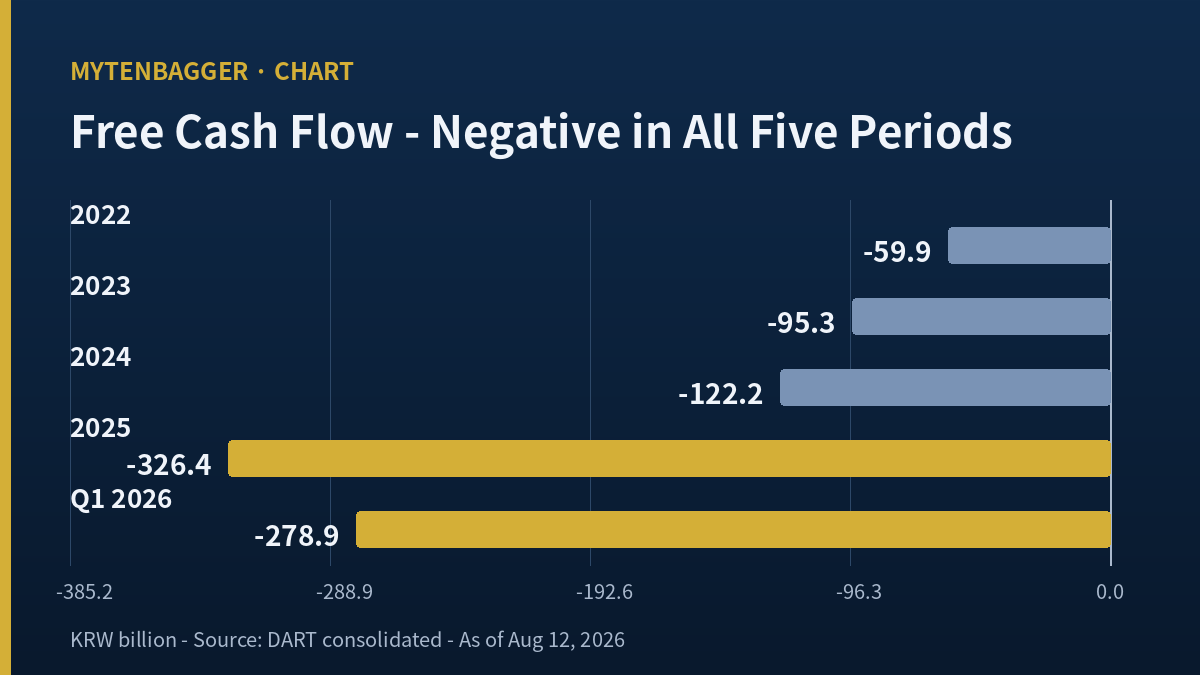
| FY2022 | 2,450.5 | 48.2 | 21.8 | −46.6 | −59.9 |
| FY2023 | 2,844.0 | 79.8 | 71.9 | 30.7 | −95.3 |
| FY2024 | 3,291.3 | 115.2 | 74.2 | 6.8 | −122.2 |
| FY2025 | 3,636.0 | 128.6 | 89.9 | −171.3 | −326.4 |
| Q1 2026 | 1,083.4 | 60.4 | −6.8 | −215.5 | −278.9 |
| Cumulative | — | 432.2 | 250.9 | −396.0 | −882.8 |
KRW billion, DART consolidated. Q1 2026 covers January through March and the cumulative and discrete figures are identical for a first quarter. The bottom row is my own sum of the five periods, computed on the unrounded figures, so adding the displayed values can differ by a rounding tick. For orientation, KRW 100 billion is roughly USD 70.6 million at the rate used in this piece.
Operating cash flow was negative in three of the five periods. Free cash flow was negative in all five. And the deterioration is recent, not historic: 2025 swung from a small positive to KRW −171.3 billion, and the first quarter of 2026 alone consumed KRW −215.5 billion, more than the whole of the prior year.
I have written about a similar-looking pattern before. When I went through Dongwon Industries and its capital spending, the company generated operating cash and then spent essentially all of it on vessels and plant, so free cash flow sat near zero year after year. That is an allocation question. Here the cash is already gone at the operating stage and capital spending sits on top of it. That is a funding question, and it is a different animal.
Working capital and where the borrowing went
Cash leaving at the operating stage in a project business usually means working capital. Inventory went from KRW 596.6 billion at the end of 2024 to KRW 856.3 billion at the end of 2025, an increase of KRW 259.7 billion, or 43.53 percent. Korean outlet Newsquest, writing in April 2026, also pointed to growth in trade receivables. In cable and construction contracting, revenue that ramps quickly pulls raw material and unbilled work onto the balance sheet before the cash arrives. This is what growth looks like in the sector. It is not by itself a sign of something broken.
The question is what filled the hole. Total liabilities went from KRW 1,146.6 billion at the end of 2024 to KRW 1,860.9 billion at the end of 2025, an increase of KRW 714.3 billion, or 62.30 percent. IB Tomato counted short-term borrowings rising from KRW 142.2 billion to KRW 459.5 billion, a factor of 3.2314, with a further KRW 210.0 billion of long-term debt falling due within a year, so roughly KRW 670.0 billion matures inside twelve months. The company issued KRW 155.0 billion of corporate bonds in September 2025. The same article put 2025 cash from financing activities at positive KRW 439.5 billion.
The debt-to-equity ratio moved from 76.64 percent at the end of 2024 to 114.00 percent at the end of 2025 and 117.15 percent at the end of the first quarter of 2026. That is not a distressed level. It is, however, a one-way move across three consecutive reporting dates.
Why interest expense stays out of my case
There is an obvious argument sitting right here about the cost of all that borrowing, and I am deliberately leaving it alone for two reasons.
The first is that my two sources disagree by a factor of five. IB Tomato put 2025 interest expense at KRW 42.5 billion, up 38.4 percent from KRW 30.7 billion, and noted it equalled about 33 percent of operating profit. Internally that checks out: 42.5 divided by 128.61 is 33.04 percent. But the DART-sourced financial series I work from carries an interest expense line of KRW 212.4 billion for the same year, which is 4.9976 times larger. One of those is narrow interest cost and the other is probably total finance cost including foreign exchange items, and I could not establish which is which. I do not build an argument on a figure I cannot pin down.
The second reason is about my own output. In the LS Electric piece and again in my most recent write-up, I already built a whole article around what happens between operating profit and net profit. Having the raw material a third time is not a reason to write the same angle three times running. So the KRW 42.5 billion sits in this article as an attributed fact and nothing more.
What the Money Is Building
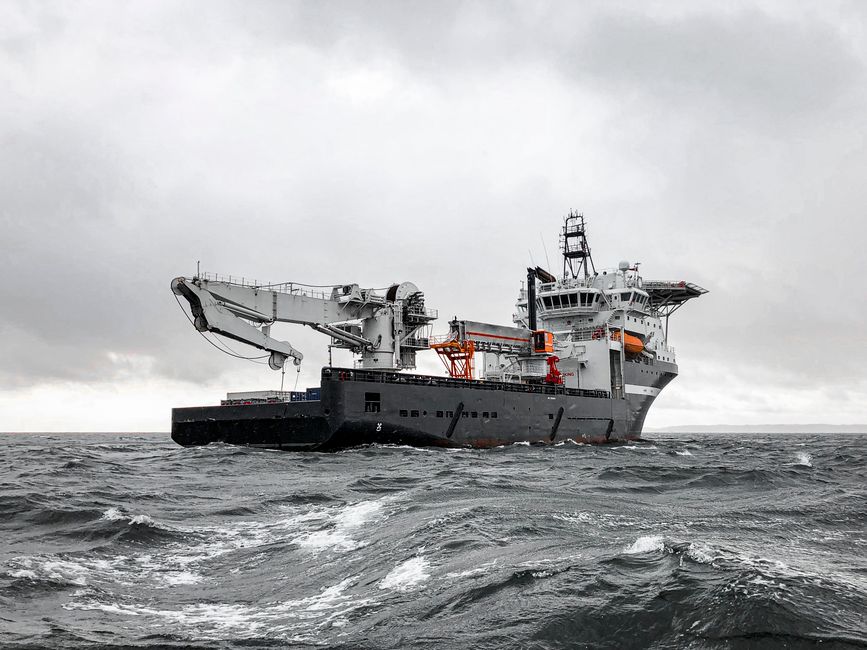
IB Tomato itemized the submarine cable program in three parts: KRW 46.9 billion for a cable-laying vessel, KRW 220.0 billion for the first submarine plant, and KRW 497.2 billion for phase one of the second plant, approved by the board in July 2025. That totals KRW 764.1 billion, about USD 539.7 million, with a further KRW 720.0 billion of capital expenditure still to come on the second plant. Completion is targeted for December 2027.
The industrial logic is real, and the sell-side leans on it. Mirae Asset Securities analyst Kim Tae-hyung, initiating coverage on July 15, 2026, cited the high share of extra-high-voltage and submarine cable in the mix, the in-house laying vessel that lets the company bid turnkey instead of supplying components, the Dangjin second plant lifting HVDC submarine capacity, and the acquisition of the vessel Scandi Connector strengthening the full-scope offering. Demand-side drivers are US transmission replacement and European interconnection build-out.
What I wrote next to all of that was the timing. The plant completes in December 2027, and the company’s own stated payback year is 2034. From August 13, 2026 that is roughly sixteen months to completion and more than seven years to the recovery the company itself points at. Asked about it, management told IB Tomato that “a 2034 recovery target after 2027 completion is on the fast side.” That may well be accurate for heavy infrastructure. It is simply a different clock from the one I use.
Taihan Cable Stock Fell While the Business Improved
The second quarter of 2026, reported July 30, 2026: revenue of KRW 1,198.7 billion (about USD 846.7 million), up 30.8 percent year over year, and operating profit of KRW 60.8 billion (about USD 42.9 million), up 113 percent. First-half revenue reached KRW 2,282.0 billion, up 28.8 percent, with operating profit of KRW 121.3 billion, up 117.8 percent. Six months of 2026 delivered 94.31 percent of all of 2025’s operating profit. The order book crossed KRW 4 trillion for the first time, closing the quarter at KRW 4,062.9 billion, equal to 1.1174 years of 2025 revenue (my calculation).
One small reconciliation note. My Q1 operating profit of KRW 60.41 billion plus the company’s Q2 figure of KRW 60.8 billion gives KRW 121.21 billion, against the KRW 121.3 billion the company published for the half. The 0.09 billion gap looks like rounding in the company release. I kept the two attributions separate instead of blending them.
The share price went the other way over the same stretch.
| Measure | Value | Note |
|---|---|---|
| Reference close, August 12, 2026 (Wednesday) | KRW 29,450 | About USD 20.80 |
| Closing-basis high | KRW 72,300 | May 8, 2026 (Friday) |
| Closing-basis low | KRW 20,800 | July 30, 2026 (Thursday) |
| Below the closing high | −59.27% | 29,450 over 72,300, my calculation |
| Above the closing low | +41.59% | 29,450 over 20,800, my calculation |
| 250-day intraday high and low | KRW 75,900 / 14,740 | 38.80% of the high; 1.998 times the low |
| Three-month and twelve-month change | −56.18% / +88.66% | Kiwoom Securities data |
Closing-basis high and low are measured inside a one-year window from August 12, 2025 to August 11, 2026; the 250-day figures are intraday and belong to a separate series, so I have not mixed them. The percentages against the high and low are recomputed at my KRW 29,450 reference instead of taken from the screen, where they appear as −60.86 percent and +36.06 percent against the August 11, 2026 close of KRW 28,300.
Reading that decline as a company-specific event would be a mistake. Over the same window KOSPI fell from 9,114.55 on June 22, 2026 to 5,593.56 on July 30, 2026, a peak-to-trough drop of 38.63 percent. The index bottomed on exactly the same day this stock did. With a one-year beta of 1.033 and a correlation of 0.632 against the market, the honest description is that a market-wide drawdown hit a moderately high-beta name harder, and I cannot separate out how much was specific to this company.
Where the Sell-Side Splits on Taihan Cable Stock
Three Korean houses, all of which I reached through secondary coverage; I did not read any of the original notes.
- Hana Securities, analyst Yoo Jae-sun, May 4, 2026: buy, set its number at KRW 60,000 (about USD 42.38), up 62.16 percent from the KRW 37,000 the same house carried on February 9, 2026. Cited first-quarter new orders of KRW 733.9 billion, up 108.7 percent, and an order book at KRW 3.8 trillion. Multiples carried in the note for 2026 were 133.3 times earnings and 6.0 times book, with the valuation applied at 67 times 2028 estimated earnings per share.
- Mirae Asset Securities, analyst Kim Tae-hyung, July 15, 2026, initiating: buy, set its number at KRW 35,000 (about USD 24.72). Estimates 2026 revenue of KRW 4,051.5 billion, up 11.4 percent, and operating profit of KRW 215.7 billion, up 68.1 percent, for a 5.3 percent margin. The same coverage notes the shares trade at 49.1 times earnings, a premium of more than 80 percent to the global peer average.
- Yuanta Securities, January 6, 2026: raised to KRW 33,000 (about USD 23.31). I could not confirm the analyst’s name.
The two most recent figures sit 1.7143 times apart (60,000 over 35,000, my calculation). They were published ten weeks apart across a period when the shares halved, so a straight comparison is unfair to both. What survives the caveat is that one house used the valuation premium as part of its case and the other flagged the same premium as the risk.
Running Mirae Asset’s own estimate back through my table: of the KRW 215.7 billion of 2026 operating profit, KRW 121.3 billion already arrived in the first half, which is 56.24 percent, leaving KRW 94.4 billion for the second half. The first half was the strongest six months this company has ever had, and the implied second half is smaller. That could be conservatism, or a view on copper input costs, or a view on project mix. Without the note itself I cannot say which.
Thirteen Things That Cut Against My Taihan Cable Stock Case
- The most fundamental objection: funding source and funding outcome are separate questions. Whether the plant was paid for with shareholder money or bank money, if it throws off cash above the cost of that capital, holders win. My comparison measures whether the return has arrived, and it cannot measure whether it will.
- Management called the 2034 payback fast for the sector. If that is right against industry norms, the mismatch is in my patience and not in their plan.
- Submarine cable is a pre-investment industry by construction. Before a plant exists there is no revenue from it and only cash going out. Judging the sector on this measure may be the wrong test entirely.
- My cumulative figure is sensitive to the start date. Beginning in 2022 pulls the whole 2022 issue into the window. Start in 2023 and paid-in equity drops to KRW 462.5 billion and the ratio changes completely.
- Cumulative net profit of KRW 250.9 billion contains loss-making quarters, notably KRW −6.8 billion in the first quarter of 2026 and KRW −23.0 billion in the second quarter of 2025. How those are treated changes what “earned by the business” even means.
- A debt-to-equity ratio of 117.15 percent is not a distress reading. It is above 2022’s 83.66 percent but close to 2023’s 97.06 percent.
- The first quarter of 2026 carried the best operating margin of the five periods above, at 5.58 percent, rising steadily from 1.97 percent in 2022. The table prints revenue and operating profit but not the ratio, so I divided one column by the other: 1.97, 2.81, 3.50, 3.54, 5.58.
- Hana Securities set its number at KRW 60,000, more than double my reference price.
- Most of the operating cash outflow is inventory and receivables. Those are assets rather than write-offs, and they reverse as projects convert to revenue.
- Anyone who took up the 2024 issue has done well. KRW 29,450 against the KRW 7,460 subscription price is 3.9477 times (my calculation). “Shareholders paid for the growth” has not been a bad outcome for shareholders.
- The 2024 issue was pre-emptive and 105.39 percent subscribed, with the controlling holder taking its maximum allocation. Existing owners chose to fund it; this was not capital extracted from an unwilling market.
- An order book of KRW 4,062.9 billion is 1.1174 years of 2025 revenue. The next year of sales is largely under contract already.
- The second quarter of 2026 was the best in company history, with a 5.07 percent operating margin against 3.54 percent for full-year 2025 (60.8 over 1,198.7, my calculation).
Figures I Checked and Did Not Use
- Interest coverage of 0.78. Excluded with the rest of the interest series for the reasons above. For the record it is Q1 2026 operating profit of KRW 60.41 billion over the same quarter’s interest expense field of KRW 77.84 billion.
- A payout ratio field reading 59.7. The dividend per share and dividend yield fields are both zero for this company, so the payout field has nothing coherent underneath it.
- The vendor equity figure of KRW 1,257.6 billion. It differs from the DART consolidated Q1 2026 equity of KRW 1,615.3 billion by KRW 357.7 billion. Since the published debt ratio of 117.15 percent reproduces exactly from 1,892.2 divided by 1,615.3, I treated the screen ratio as consolidated and used the DART equity figure throughout.
- An EBITDA field of KRW 60.4 billion, identical to the first quarter of 2026 operating profit down to the last unit. That is a copied value with no independent calculation behind it.
- A three-year revenue growth rate of 14.06 percent. I could not establish the exact window it covers.
- Relative performance. Over the year to August 11, 2026 the shares returned 69.77 percent, KOSPI 98.93 percent, and the equally weighted electrical equipment sector excluding this name 61.73 percent. That is 29.16 points behind the market and 8.03 points ahead of the sector, ranking tenth of thirty names. Weight the sector by market capitalization and it returns 104.73 percent, which flips the verdict.
- Other screen readings. Foreign ownership 12.24 percent, margin loan balance 1.31 percent, price versus 20-day, 60-day and 120-day moving averages of +10.05 percent, −16.38 percent and −20.11 percent, and inventory days of 74.7 in Q1 2026 against 77.2 in Q4 2025.
My Position on Taihan Cable Stock
I am not standing aside because the results are weak. The results are getting better on almost every line I track. I am standing aside because the primary supplier of capital to this company is still its shareholders, and I want to watch that hand over to the business before I change my read. That handover sits much further away at HLB, where first-quarter 2026 interest expense of KRW 21.109 billion came in above revenue of KRW 18.689 billion.
The specific document I am waiting for is the 2026 semi-annual report, due under Korean law on August 14, 2026. One line in it decides this for me: cash from operating activities on the consolidated statement for the six months. The first quarter reading was KRW −215.5 billion. The same filing also carries the second-quarter net profit figure, which has not been published anywhere yet.
My case breaks in two directions, and I would rather name them now. If half-year operating cash flow has turned positive, then “cash leaves at the operating stage” shrinks from a pattern to a single bad year, and what I revise is the argument itself and not the objection list. If it is still deeply negative but the driver turns out to be something other than inventory and receivables, then the paragraph where I called the working capital build a normal feature of sector growth is the paragraph I delete.
What I need from this company fits in one line of one statement: cash from operations, positive, four quarters running, with capital expenditure no lower than it is now. Not a better order book, not a higher margin, not a bigger valuation from anyone. That line, four times in a row, and I would open this file again as a buyer instead of a reader.
Prices and multiples reflect the August 12, 2026 close as checked at the time of writing; this piece publishes afterwards, so the figures can drift from live quotes by however long that gap turns out to be. Korean won is the reference currency throughout and USD amounts are approximate, converted at about KRW 1,415.7 per dollar, the Seoul market close on that same date. Euro figures are quoted in the currency of the original source and not converted. Financial statement figures are DART consolidated.
Sources: Money Today, Q2 2026 results, July 30 2026 · IB Tomato, submarine cable investment and funding burden, April 21 2026 · Newsquest, operating cash flow turns negative, April 2026 · etoday, 2024 rights issue subscription results · Newspim, Hana Securities report brief, May 4 2026 · Prysmian H1 2026 results release, July 30 2026 · DART, Financial Supervisory Service electronic disclosure · Taihan Cable corporate site
Related reading: LS Electric after its best quarter ever · LS Eco Energy, a price for a business that earns nothing yet · Dongwon Industries, where capital spending goes · Samsung E&A and the target nobody revised