Why HLB Shares Hit Their Low on the Day of the FDA Rejection
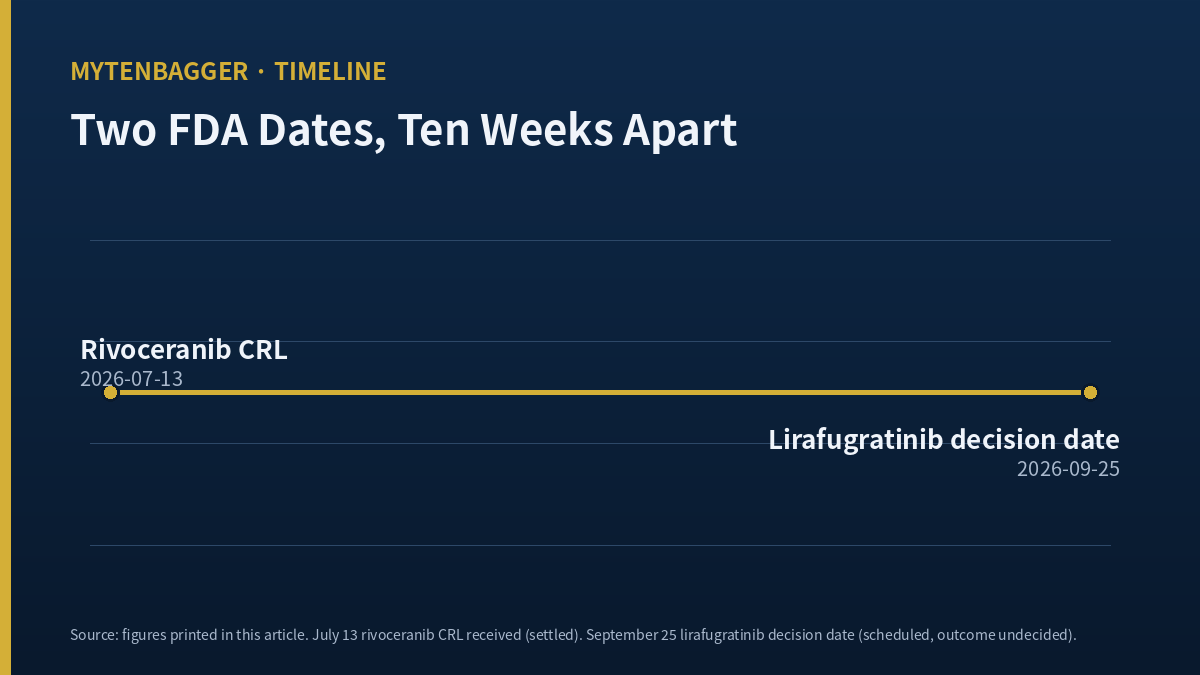
One drug at this company was turned down by the US Food and Drug Administration on July 13, 2026. A second drug at the same company carries a decision date of September 25, 2026. I opened both files on the same afternoon, and what held my attention was not the science in either one. It was that the two dates sit ten weeks apart and pull in opposite directions, and that HLB stock printed its 52-week closing low on the first of them.
Two FDA files at one company, side by side
| Drug | Date | Where it stands |
|---|---|---|
| Rivoceranib, liver cancer | July 13, 2026 | Third complete response letter. No refiling date disclosed. |
| Lirafugratinib, bile duct cancer | September 25, 2026 | Late-cycle meeting completed with no new review issues raised. |
| The stock | July 13, 2026 | 244-session closing low of KRW 25,650 (about USD 18.08). |
Contents
HLB stock and the two dates I built this piece on
HLB Inc. trades on KOSDAQ under the code 028300. KOSDAQ is the smaller of South Korea’s two main exchanges, the venue where growth companies and most listed biotechs sit, while the larger and more industrial KOSPI carries the household names. Being on KOSDAQ does not mean small: at KRW 5.7475 trillion (about USD 4.05 billion) this is the sixth largest company on that exchange by market value, according to a Korean market wrap published by Joongang Economy News on August 15, 2026.
On August 14, 2026, a Friday, the shares closed at KRW 43,150, which is about USD 30.42 at the rate footnoted at the end of this piece. Multiply that close by the 133,198,146 shares outstanding and you get KRW 5,747,499,999,900, which matches the market value my data source displays down to the won. That reconciliation is how I confirm the price and the share count are standing on the same date.
The first of my two dates is July 13, 2026, a Monday. Korean trade press outlet BioTimes reported that the FDA issued a third complete response letter on the combination of rivoceranib and camrelizumab in first-line liver cancer. What matters in that report is the stated reason. It was not the clinical data. It was findings from a current good manufacturing practice inspection at the Chinese partner Hengrui Medicine, documented on a Form 483. The company said it received the response and the corrective action plan from Hengrui, asked the FDA for background on the letter, and would negotiate the scope of a resubmission through a Type A meeting. In the same report the company said it could not offer a refiling date.
The second date is September 25, 2026, a Friday. Lirafugratinib is an FGFR2-targeted therapy that the company’s subsidiary Elevar filed for second-line bile duct cancer. Herald Business reported on July 24, 2026 that a late-cycle meeting had been completed in the United States the day before, that post-marketing requirements and commitments were discussed, and that no new review issue bearing on approval was raised. The same report said the drug substance and drug product manufacturing sites cleared a general cGMP inspection in 2025. Medical Daily and Herald Business both print September 25 as the decision date.
So one file is stuck on a manufacturing inspection with no date attached, and the other cleared a manufacturing inspection and has a date attached. The thing that broke one file and cleared the other was the same category of finding. I have not seen the FDA documents in either case; both accounts come from the company through Korean press.
HLB stock set its low on the rejection date
Over the 244 trading sessions from August 14, 2025 to August 14, 2026, the closing low was KRW 25,650 on July 13, 2026. The closing high was KRW 68,200 on April 15, 2026, a Wednesday. From that high the stock is down 36.73%; from that low it is up 68.23%. Maximum drawdown across the window was 62.39%.
I want to be careful about what I am claiming. I know the low close and the letter fall on the same date. I could not establish the order within that session, meaning whether the low print came before or after the letter became public. So I am recording an alignment of dates and nothing about causation.
What followed is easier to measure. Over the five sessions ending August 14 the stock rose 15.68% while its sector rose 2.89% and KOSDAQ rose 8.24%. Over twenty sessions it rose 22.24% against 7.66% and 9.20%. My data source flags both windows as idiosyncratic, meaning the move is not explained by the sector or the index. Two windows pointing the same way is worth more to me than one.
And that 15.68% cross-checks against the press. Joongang Economy News listed the daily closes for the second week of August as KRW 40,700 on Monday August 10, KRW 41,950 on Tuesday, KRW 41,600 on Wednesday, KRW 42,750 on Thursday and KRW 43,150 on Friday. A separate outlet, Bloter, printed KRW 37,300 as the close on Friday August 7. Dividing 43,150 by 37,300 gives 1.15684. Two unrelated sources land on the same figure my analytics tool produced.
What HLB stock costs to keep waiting
Here is the part of the story the two dates do not tell. A company that waits for a regulator is paying for the wait, and I wanted to know how much.
In the first quarter of 2026 this company reported revenue of KRW 18.689 billion (about USD 13.17 million) and interest expense of KRW 21.109 billion (about USD 14.88 million). Interest came to 112.95% of revenue. The operating loss for the quarter was KRW 23.193 billion and the net loss was KRW 40.897 billion, so interest alone accounts for 51.62% of the bottom line. All four figures come from the consolidated first-quarter filing lodged with Korea’s Financial Supervisory Service under receipt number 20260515001567. For the same test run on a company that is profitable, see Emart stock: the best quarter in that window covered 0.78 times its interest.
| Period | Revenue (KRW bn) | Interest (KRW bn) | Interest over revenue |
|---|---|---|---|
| FY2022 | 179.71 | 21.54 | 11.99% |
| FY2023 | 42.90 | 20.02 | 46.67% |
| FY2024 | 68.13 | 13.96 | 20.50% |
| FY2025 | 84.17 | 49.54 | 58.85% |
| 1Q 2026 | 18.69 | 21.11 | 112.95% |
The four annual rows are full years and the last row is a single quarter, so the levels are not comparable across the table. The ratios are computed inside each row, which is what makes the direction readable. Interest went from a fifth of revenue in FY2024 to nearly three fifths in FY2025 and then past parity in the opening quarter of 2026.
Where the interest comes from
Bloter reported on August 9, 2026 that the company had approved a 44th series of privately placed convertible bonds worth KRW 30.0 billion, bringing total outstanding convertible bonds and bonds with warrants to roughly KRW 315.6 billion (about USD 222.47 million). The article itemized the prior balances: series 38 at KRW 10.0 billion, series 39 at KRW 0.77 billion, series 40 at KRW 30.0 billion, series 41 at KRW 20.0 billion, series 42 warrants at KRW 199.836 billion and series 43 at KRW 25.0 billion. Those sum to KRW 285.606 billion; adding the new KRW 30.0 billion gives KRW 315.606 billion. I added them myself and the total holds.
Series 44 carries a 1% coupon, a 4% yield to maturity, an August 19, 2029 maturity and a conversion price of KRW 33,361 per share. It would create 899,253 new shares, which the article puts at 0.68% of shares outstanding. KRW 30.0 billion divided by KRW 33,361 gives 899,253.6 shares, and 899,253 divided by 133,198,146 gives 0.6752%. Both reproduce.
The same article gave the cash position: roughly KRW 40.9 billion at the end of 2025, falling to KRW 26.1 billion by the first quarter of 2026. Operating cash flow in that quarter was negative KRW 17.747 billion. Dividing 26.1 by 17.747 gives 1.47, so the cash on hand covers about a quarter and a half at that burn. That is my own division, and it assumes the burn holds steady, which I did not verify.
If the whole KRW 315.6 billion converted at the series 44 price, it would create 9,460,148 shares, or 7.10% of the current count. I am stating that as an approximation and nothing firmer. Conversion prices differ across series, warrants are structured differently from convertibles, and I did not check every series. Korean outlet CBC News separately reported a conversion price being reset down to KRW 35,866 on one series without my being able to identify which. A lower conversion price turns the same principal into more shares.
Operating cash flow has been negative in every one of the seventeen quarters from the first quarter of 2022 through the first quarter of 2026, without exception. So the money that has kept this company running came from capital markets, and a large share of it arrived in a form that charges interest. A single warrant series at KRW 199.836 billion is most of the reason the interest line looks the way it does. When I looked at Nexen Tire and found its profit being decided below the operating line, the items below that line were adding to earnings. Here they are subtracting, and there is no operating profit above them to absorb the hit.
HLB stock beat its sector and tied its index
Across the same 244-session window the stock returned 4.48%. KOSDAQ returned 6.06% and the healthcare equipment and supplies sector index returned negative 14.18%. That puts the stock 1.58 percentage points behind the index, which my tool classifies as a tie, and 18.66 points ahead of the sector, which it classifies as a win.
The sector index here is equal-weighted with the stock itself excluded. That construction matters: this company alone is 21.55% of its sector by market value, and my data source printed an explicit warning that a market-cap-weighted comparison would amount to measuring the company against itself. I read that warning before I used the number.
My tool splits that gap into negative 20.23 points of sector effect and positive 18.66 points of stock effect, and the two sum to the negative 1.58 against the index. The sector is the larger driver at 52.0% of the gap.
Rank within the sector is 13th of 83 names, or the top 15.7%. But the median return in that group is negative 30.31%. Finishing 13th in a group whose middle member lost 30% tells me more about the group than about this company. I could not decompose how much of the positive 18.66 points came from the business as opposed to positioning around the two review dates.
No sell-side firm publishes a forecast on HLB stock
I tried to assemble forward estimates from at least two named brokerages and failed. The forward earnings, forward multiple and peer multiple fields in my indicator database are all empty. The brokerage opinion table on the Korean corporate information service that aggregates local sell-side research renders as an empty frame. A Korean financial portal displays an opinion and a figure on its quote page without stating how many estimates it aggregates or when it was last refreshed, so I declined to quote it; an average whose sample size and vintage I cannot see is not something I can check. One research write-up exists from a non-brokerage service dated April 7, 2026, which predates the third complete response letter by roughly three months.
A company worth USD 4.05 billion with no named sell-side numbers on it is unusual, and I treated the absence as information in its own right; papering over it was never an option. Analysts stop publishing continuous forecasts when results stop being continuous. Approval rewrites the revenue line; rejection leaves the current table in place. There is no smooth path between those two outcomes to model.
This is the mirror image of what I ran into at HK inno.N, where prescriptions rose 15% while reported product sales rose 0.3%. There the problem was too many numbers pointing different directions and having to decide which one was the company’s. Here there are no numbers to sort.
Global peer, the company that already cleared this gate
I picked Incyte Corporation (NASDAQ: INCY). The selection test was not size and not valuation. It was whether a listed company had already walked through the exact regulatory gate this company reaches on September 25, in the same tumor type and against the same molecular target. Incyte’s Pemazyre (pemigatinib) won FDA approval in April 2020 as the first targeted treatment for adults with previously treated, unresectable locally advanced or metastatic cholangiocarcinoma carrying an FGFR2 fusion or other rearrangement. That is the indication and the target lirafugratinib is filed against.
From StockAnalysis, checked at 2:01 PM EDT on Friday August 14, 2026, which is the same trading date as my Korean close: share price USD 119.97, market value USD 24.32 billion, trailing price to earnings 15.35, forward 50.33, trailing twelve-month earnings per share USD 7.85, trailing twelve-month revenue USD 5.82 billion, 202.70 million shares outstanding, 52-week range USD 81.09 to USD 132.60, no dividend. Price times share count gives USD 24,317.9 million, which matches the displayed market value.
I did not build a table of multiples and margins. Incyte sells several approved medicines and this company sells none. Putting two businesses at different commercial stages into the same margin column produces numbers without meaning, and I have not read either company’s financial statement notes. I compared three things instead.
- Revenue. Incyte’s trailing twelve-month revenue of USD 5.82 billion converts to roughly KRW 8,256.3 billion at the rate in my footnote. This company’s FY2025 revenue of KRW 84.17 billion is 1.02% of it.
- Market value. Incyte at USD 24.32 billion converts to roughly KRW 34,500.4 billion. This company at KRW 5,747.5 billion is 16.66% of it. Revenue is 1.02% and market value is 16.66%, a gap of more than sixteen times between the two ratios.
- Coverage. StockAnalysis shows 27 analysts covering Incyte with a twelve-month average of USD 124.96. This company has zero named brokerage estimates, as set out above.
The third comparison is the one I keep returning to. Two companies chasing the same indication with the same target in front of the same regulator, and one has 27 people publishing numbers while the other has none. The difference tracks approval far more closely than it tracks size. If September 25 goes one way, some of those 27 will have a Korean counterpart within a year. If it goes the other way, the coverage void stays exactly where it is.
My position on HLB stock and the marks I am watching
At KRW 5.7475 trillion the company sits sixth on KOSDAQ but outside the top hundred Korean listings overall, which puts it in observation by my default rule. I added one condition on top of that rule for this name.
When interest expense exceeds revenue, I do not move off watching until I have mapped the maturity structure of the debt that produced it, series by series. I know series 44 matures on August 19, 2029. I do not know the maturities or the put dates on the other six outstanding series. If early redemption rights cluster somewhere, KRW 26.1 billion of cash means something different from what it means today.
Two marks I am watching. The first is September 25, 2026 itself. Approval gives this company its first medicine sold in the United States and opens a path by which revenue could eventually pass interest; rejection leaves the interest table intact for at least another quarter. The second is the 2026 half-year filing, statutorily due August 15, 2026, a Saturday that fell on Korea’s Liberation Day holiday and so most likely slips to Monday August 17. I wrote this before that filing existed. If first-half interest lands near twice the first-quarter figure, my read holds; if it runs well above that, the burden is still climbing.
What would make me throw this out
The premise of this piece hangs on one date. I am writing the discard condition as a date instead of as a clause: if these sentences are still standing unchanged after September 25, 2026, that is not my view holding up. That is me failing to revise. Approval or rejection, the company on the far side of that Friday is a different company from the one described here, and I intend to reopen this file that day.
Figures I checked against HLB stock and left out
Two vendors, two book values per share
For the identical August 14, 2026 date, one Korean data vendor shows book value per share of KRW 3,213 and a price-to-book of 13.43, while another shows KRW 3,159 and 13.66. Dividing 43,150 by each gives 13.4298 and 13.6594, so both are internally consistent with their own inputs. The book values differ by KRW 54, or 1.71%. I could not establish which figure is on a controlling-interest basis, so I used neither in the argument.
Book value times share count misses total equity
KRW 3,213 times 133,198,146 shares gives KRW 427.97 billion. Consolidated equity at the end of the first quarter of 2026 was KRW 493.87 billion. The difference is KRW 65.90 billion, or 13.34%. Non-controlling interests are the likely explanation but I did not open the notes to confirm it.
Two drawdowns from two window lengths
My indicator screen uses 250 adjusted closes and reports a high of KRW 69,200, a low of KRW 24,150 and a drawdown of negative 37.6%. The benchmark tool uses 244 sessions and reports KRW 68,200, KRW 25,650 and negative 36.73%. The gap is 0.87 percentage points. I used the 244-session numbers throughout so the drawdown sits on the same window as the close in my tables, and I am parking the 250-session set here.
Short interest that is two months stale
Money Today reported short balance of 9,108,564 shares as of June 10, 2026, worth about KRW 441.8 billion (roughly USD 311.43 million), third largest on KOSDAQ and first among pharmaceutical names, at an average entry of KRW 53,769. That is 6.84% of shares outstanding. Dividing the KRW 441.8 billion valuation by the share balance gives KRW 48,504, which describes the price around June 10 and is a different number from the KRW 53,769 average entry; the two should not be read together. Against the August 14 close the short side would be ahead by 19.75%. I have no reading on that balance after June 10, so I left it out of the argument about the August advance.
A screening checklist that scored zero
The seven-metric quality checklist in my tool passed zero of seven for this company: revenue scale, operating margin, earnings per share, return on equity, price to earnings, price to book and positive operating profit. Applying a profitability screen to a clinical-stage developer is outside what that screen was designed for, so it stayed out.
Twenty-one lines that argue against me
- The sector classification is assigned by my data source. Grouping a clinical-stage drug developer with medical device makers is arguable on its own terms.
- This company is 21.55% of that sector by value. Even with itself excluded from the equal-weighted index, the comparison group is not fully independent of it.
- The 250-session and 244-session windows disagree by 0.87 percentage points on drawdown, which is a reminder that the window is a choice I made.
- The seventeen-quarter operating cash flow streak I counted comes from quarterly filings and derived single-quarter figures; the fourth-quarter values are computed as full year minus nine months, and were never filed directly.
- Annualizing first-quarter interest by multiplying by four is arithmetic I performed. The company issued no such guidance, and the exercise assumes even quarterly incidence.
- My 7.10% dilution estimate applies one conversion price to every series. The real figure will differ.
- Interest expense is not all cash. Under the effective interest method, convertibles and warrants routinely record accounting interest well above the coupon. I did not open the notes to separate the two.
- So reading KRW 21.109 billion as cash leaving the building overstates it. The comparison against revenue still holds; the cash pressure implied by it does not follow automatically.
- KRW 315.6 billion is an outstanding balance and not an amount due soon. Series 44 alone runs to 2029.
- Conversion turns debt into equity. To the extent holders convert, both the debt ratio and the interest line fall.
- The KRW 26.1 billion cash figure is as of the first quarter of 2026. If the KRW 30.0 billion from series 44 has landed since, the current balance is higher.
- Equity fell KRW 157.70 billion during 2025 while the net loss was KRW 235.42 billion, implying roughly KRW 77.72 billion of capital coming in. I could not identify its composition.
- Revenue is growing. First-quarter 2026 revenue of KRW 18.689 billion is 5.80% above the same quarter of 2025, and FY2025 was 23.56% above FY2024.
- The operating loss is shrinking, from KRW 28.758 billion in the first quarter of 2025 to KRW 23.193 billion in the first quarter of 2026, a 19.35% improvement.
- BlackRock raised its disclosed stake from 5.01% to 6.05% between March and June 2026, which runs against my cautious framing.
- The lirafugratinib file genuinely looks clean: priority review, a late-cycle meeting with no new issues, manufacturing sites already inspected.
- That said, the account of the late-cycle meeting comes from the company. I have not seen an FDA document.
- Orphan drug designation in 2022 and breakthrough therapy designation in 2023 also weigh toward approval.
- The third complete response letter cited a partner’s manufacturing site, which supports a reading in which the molecule itself is not the problem.
- Sources disagree on when the first complete response letter arrived, with one outlet placing it in 2024 and another in March 2025, so I referred to the letters by ordinal and left the first two dates out entirely.
- The loosest seam in this piece is the link I drew between rising interest expense and the growing bond balance. The two moved together across the years in my table, but I never broke the interest line out by series, and other borrowings may sit inside it.
Paradise Co and asked what its casino win percentage was actually dividing, Handsome Corp taught me that a balance sheet item can be worth less than its stated value
Basis, sources and one thing I got wrong
Before the sources, the correction. I lined up July 13 as the closing low and July 13 as the rejection date and felt, for about twenty minutes, that I had found the spine of the piece. Then I went to establish whether the low print came before or after the letter reached the market, and I could not do it from closing data. The alignment survived into the piece; the causal sentence I had already drafted did not. What remains is two events on one date, which is smaller than what I thought I had and is the part I can defend.
Prices and metrics reflect the close on Friday, August 14, 2026, checked at the time of writing. August 15 fell on a Saturday and on Korea’s Liberation Day, making August 14 the most recent business day.
Financial figures come from consolidated statements filed with Korea’s Financial Supervisory Service, annual data through the FY2025 report (receipt number 20260323001673) and quarterly data through the first quarter of 2026 (receipt number 20260515001567). The 2026 half-year report had not been filed when this was written. Indicator data is from a Kiwoom-sourced feed refreshed at 20:03 on August 14, 2026; the benchmark window runs 244 sessions from August 14, 2025 to August 14, 2026.
USD conversions use KRW 1,418.6 per dollar, which is the close of Thursday, August 13, 2026 as published in KB Kookmin Bank’s daily FX bulletin dated August 14, 2026. The bulletin’s publication date and the date of the rate it reports are one day apart, and the rate is a day behind my price date; both are stated here so the figures can be rebuilt. Conversions are approximate.
Other sources, all Korean press unless noted, and translated by me from the Korean: BioTimes on the third complete response letter, Herald Business on the late-cycle meeting, Medical Daily on the September 25 decision date, Bloter on the bond balance and cash position, Money Today on short interest and the BlackRock filings, Joongang Economy News on daily closes, and in English StockAnalysis for Incyte figures and Incyte’s own release on the Pemazyre approval.
Here is the whole of what I am willing to claim about this company today: two dates, one of which has already moved the price, and an interest line that is now larger than the revenue line. Everything past that is somebody’s opinion about a molecule, and I do not have one.