Netmarble Earnings: Debt Fell While Financing Costs Doubled
Two mobile game publishers on two continents both closed a reporting period where the bottom of the income statement pointed away from the top of it. Netmarble stock trades on a company whose net margin for the first half of 2026 ran 20.10 points above its operating margin. Playtika, listed on Nasdaq, ran 26.345 points the other way over its trailing twelve months. Same industry, opposite sign, and in both cases the operating line explains almost none of what lands at the bottom.
What reconstructed on this screen and what did not, at the August 19, 2026 close of 37,350 won ($26.72)
Reconstructed. Market capitalization of 3.06 trillion won ($2.1895 billion) equals 37,350 won multiplied by 81,935,743 shares to the last digit. The 35.79 percent debt-to-equity figure is 2.16 trillion won of liabilities over 6.02 trillion won of equity. The 3.80 percent free cash flow yield is 116.35 billion won ($83.24 million) over that market capitalization, or 3.8018 percent. Payout of 33.5 percent is 876 won of dividend over 2,617.38 won of earnings per share, or 33.4686 percent. Interest coverage of 0.73 reconstructs as well.
Did not reconstruct. Book value per share of 67,887 won matches no filed equity figure divided by the share count. The raw payout field of 36.0 comes out of no combination I tried. And the 183.26 billion won ($131.12 million) used to build that 0.73 turns out, inside the very calculation that reconstructs, to be something other than interest.
I have read game companies from the top of the income statement down. When revenue and operating profit move, the lines beneath them usually follow. Netmarble broke that reading order for me, and it broke in a place I was not checking.
Contents
What Netmarble stock costs against a peer with the same disconnect
Netmarble Corporation trades on the KOSPI under 251270. The KOSPI is the senior board of the Korea Exchange, where the country’s larger listings sit, while the KOSDAQ carries smaller and earlier-stage issuers. Netmarble publishes mobile games and also consolidates Coway, a Korean household appliance rental business in which it holds the largest stake.
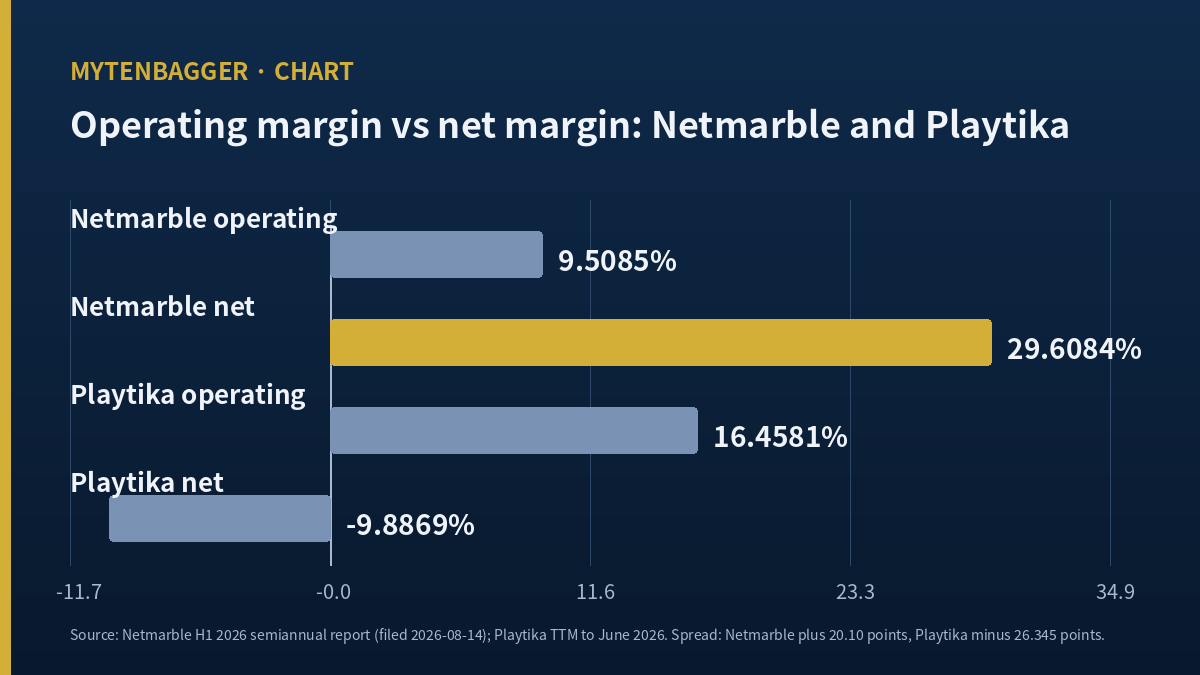
I picked Playtika as the comparison because both companies fail the same test in opposite directions. Playtika is a Nasdaq-listed mobile game publisher and its trailing twelve months to June 2026 show revenue of $2.829 billion, operating income of $465.6 million and net income of negative $279.7 million. The operating margin is 16.4581 percent and the net margin is negative 9.8869 percent, a fall of 26.345 points between the two lines.
| Line | Netmarble, H1 2026 | Playtika, TTM to June 2026 |
|---|---|---|
| Revenue | $1.0023 billion (1.40 trillion won) | $2.829 billion |
| Operating profit | $95.31 million (133.21 billion won) | $465.6 million |
| Net profit | $296.77 million (414.80 billion won) | negative $279.7 million |
| Operating margin | 9.5085 percent | 16.4581 percent |
| Net margin | 29.6084 percent | negative 9.8869 percent |
| Gap between the two margins | plus 20.10 points | minus 26.345 points |
Netmarble figures come from the half-year report filed on August 14, 2026. Playtika figures are the trailing twelve months shown on stockanalysis.com as of the August 18, 2026 close. Won amounts are converted at 1,397.7 won per dollar, the August 19, 2026 Seoul daytime close. The four margin percentages and the two gap figures are my own arithmetic on the two revenue lines.
The four periods do not overlap exactly and the businesses differ, so I have kept the comparison to five lines that both companies report the same way. I am also aware that this peer cuts my own case. If two publishers on two exchanges both show a bottom line detached from operations, the detachment is not a Netmarble finding. It may be what leveraged publishers look like. I return to that in the section on the other side.
One more number, for scale. Playtika carries a market capitalization of $850.56 million against $2.829 billion of revenue. Netmarble carries $2.1895 billion against 2025 revenue of $2.0284 billion. That is 1.0794 times sales for the Korean company and 0.3007 times for the American one, both of which I calculated from the figures above.
The financing cost line that doubled while Netmarble stock debt fell
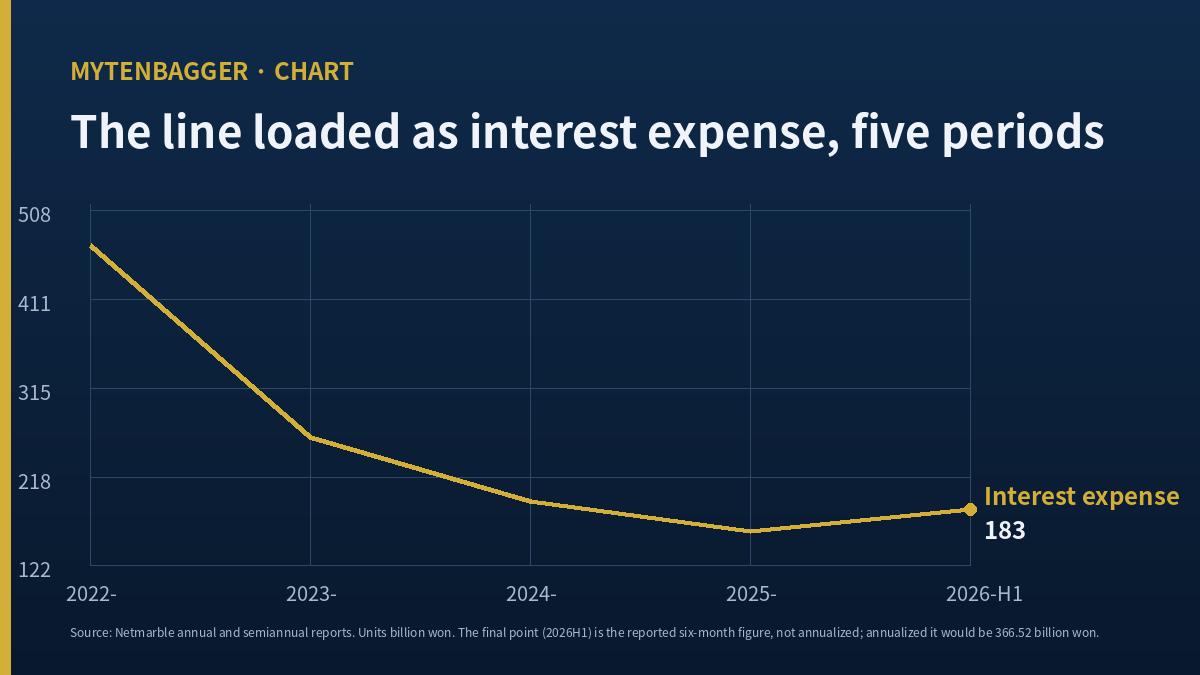
Here is the number that made me stop. The half-year filing carries 183.26 billion won ($131.12 million) on the line loaded as interest expense for the six months to June 2026. The comparable figure for the six months to June 2025 was 76.03 billion won ($54.39 million). That is 2.4105 times as much, an increase of 141.05 percent, and it is 115.20 percent of the 159.08 billion won booked on the same line for the whole of 2025.
Liabilities went the other way over the same twelve months. Total liabilities stood at 2.37 trillion won ($1.6922 billion) on June 30, 2025 and 2.16 trillion won ($1.5420 billion) on June 30, 2026, a fall of 209.92 billion won, or 8.88 percent against the 2.37 trillion won starting balance. The debt-to-equity figure fell from 47.36 percent at the end of 2025 to 35.79 percent at the end of June 2026, a move of 11.57 points.
A borrowing balance that shrinks 8.88 percent does not produce interest that grows 141.05 percent. So I divided the line by the balance it is supposed to attach to.
| Fiscal period | Loaded as interest expense | Total liabilities | One over the other |
|---|---|---|---|
| 2022 | 470.57 billion won | 3.31 trillion won | 14.20 percent |
| 2023 | 261.96 billion won | 2.84 trillion won | 9.23 percent |
| 2024 | 192.31 billion won | 2.70 trillion won | 7.11 percent |
| 2025 | 159.08 billion won | 2.60 trillion won | 6.12 percent |
| H1 2026, annualized | 366.52 billion won | 2.16 trillion won | 17.01 percent |
Liability balances are period-end figures, and the 2026 row uses June 30. The annualization in the last row and all five percentages are my own calculation.
Between 6.12 percent and 17.01 percent, with 14.20 percent in 2022. I know of no Korean listed issuer of this size borrowing at those rates, and I do not believe a real cost of funds swings across that range in four years. So the line holds something wider than interest. Foreign exchange losses and derivative valuation losses are the usual candidates for a Korean publisher with dollar obligations, and I could not open the note that would settle it.
A coverage ratio that reconstructs and still cannot be used
Operating profit of 133.21 billion won divided by that 183.26 billion won gives 0.7269, which rounds to the 0.73 shown as interest coverage. Both inputs sit in the filing. The division is correct. Written as a sentence it reads that the company earned only 73 percent of what it owed in interest over the half, and that sentence would have been the strongest argument for staying out that I could have made this session.
I have been separating usable screen figures from unusable ones by asking whether they reconstruct. If market capitalization comes back as price multiplied by shares, I use it. If book value per share matches no filed equity, I drop it. That test has caught real errors for me across many pieces.
The coverage ratio passes it. What the test cannot see is the label on the line I divided by. Reconstruction only proves that two figures stand in an arithmetic relationship. It says nothing about whether either figure is the item its label claims.
So I added a step. Before using any ratio, I now divide the lower input by a third balance and check that the result lands in a sane range. Interest against debt. Depreciation against fixed assets. In this piece that single extra division reversed my conclusion, and I would have published the wrong sentence without it. The same instinct sent me back through what I wrote about NCSoft’s trailing multiple, where the problem was which profit the multiple divided, a different question from what the line was called.
The other side of the Netmarble stock case
My conclusion is to watch. The material pointing the other way is heavier than the material supporting me, and I list it before anything else.
Six of seven screening checks pass
The seven-item screen scores 86 with six passes and one miss. Revenue scale of 2.835 trillion won, operating margin of 12.43 percent, earnings per share of 2,618 won, a price to earnings multiple of 14.27, a price to book multiple of 0.55, and positive operating profit all clear. Return on equity of 4.2 percent against a 10.0 percent threshold is the only miss, short by 5.8 points. The dividend also came back. Filed history shows 767 won for 2020 and 528 won for 2021, then a gap, then 417 won for 2024 and 876 won ($0.63) for 2025. That last figure over the August 19, 2026 close is a yield of 2.3454 percent.
Both covering brokers still say buy
Lim Hee-seok at Mirae Asset Securities kept a buy on May 8, 2026 while cutting his valuation from 85,000 won to 65,000 won ($46.50). Ahn Jae-min at NH Investment and Securities kept a buy on May 11, 2026 while cutting from 73,000 won to 60,000 won ($42.93). Both sit well above the August 19, 2026 close, by 74.03 percent and 60.64 percent. Two people who read the statements I said I could not read came away buyers.
Overseas revenue is 78 percent of the total
The company reported on August 5, 2026 that second-quarter overseas revenue reached 580.8 billion won, or 78 percent of the total, up 22.6 percent from a year earlier. The regional split was North America 39 percent, Korea 22 percent, Europe 13 percent, Southeast Asia 10 percent and Japan 9 percent. The first quarter ran 512.2 billion won and 79 percent, with North America at 41 percent.
The peer argument works against me too
If Playtika shows the same disconnect with the sign flipped, then a bottom line that ignores operations is a feature of this industry and this capital structure. In that reading my objection is not about Netmarble at all, and a reader who accepts it should also refuse to price Playtika, most leveraged publishers, and a good part of the sector. I do not have a clean answer to that.
Six quarters of Netmarble stock ranked by operating profit
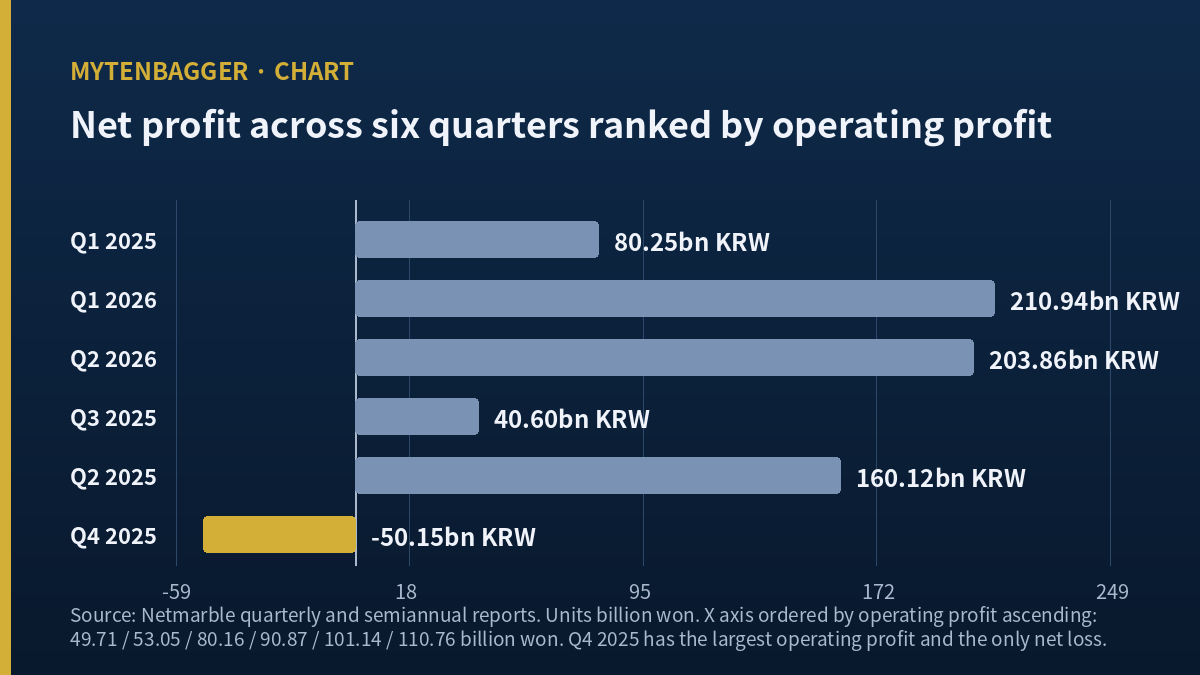
Having removed the coverage ratio, I needed something else. I lined up the six most recent discrete quarters in order of operating profit, smallest first.
| Discrete quarter | Revenue | Operating profit | Operating margin | Net profit |
|---|---|---|---|---|
| Q1 2025 | 623.88 billion won | 49.71 billion won | 7.97 percent | 80.25 billion won |
| Q1 2026 | 651.73 billion won | 53.05 billion won | 8.14 percent | 210.94 billion won |
| Q2 2026 | 749.22 billion won | 80.16 billion won | 10.70 percent | 203.86 billion won |
| Q3 2025 | 695.96 billion won | 90.87 billion won | 13.06 percent | 40.60 billion won |
| Q2 2025 | 717.64 billion won | 101.14 billion won | 14.09 percent | 160.12 billion won |
| Q4 2025 | 797.60 billion won | 110.76 billion won | 13.89 percent | negative 50.15 billion won |
Korean quarterly filings report flow items cumulatively, so these are discrete single-quarter figures. Q4 2025 is the full year less the nine-month cumulative. The six operating margins are my own arithmetic on each row.
The bottom row holds the largest operating profit of the six. It is also the only quarter of the six with a net loss. The second row from the top, Q1 2026, has the second smallest operating profit and the largest net profit. Pairing the two rankings gives a rank correlation of negative 0.5429, worked from a sum of squared rank differences of 54 across six observations. Over these six quarters, bigger operating profit went with smaller net profit.
A report by The Public dated May 9, 2026 put the first-quarter swing down to gains on disposal of assets held. I have not read the company’s own release, and quarterly detail on which assets and at what price is not broken out. Without that, I cannot judge whether this profit repeats.
Two Korean brokers left numbers in May that Netmarble stock has not met
The May 8, 2026 note from Mirae Asset Securities carried 2026 full-year estimates of 2.66 trillion won of revenue and 243.0 billion won of operating profit. Against 2025 actuals of 2.835 trillion won and 352.48 billion won, those are declines of 6.1 percent and 31.2 percent. Subtracting the reported first half tells me what the second half has to do.
| Line | H1 2026 actual | H2 implied by the estimate | H2 2025 actual | Change required |
|---|---|---|---|---|
| Revenue | 1,400.94 billion won | 1,262.06 billion won | 1,493.56 billion won | minus 15.50 percent |
| Operating profit | 133.21 billion won | 109.79 billion won | 201.63 billion won | minus 45.55 percent |
| Revenue, actual H1 move | 1,400.94 billion won | H1 2025 was 1,341.52 billion won | difference 59.42 billion won | plus 4.43 percent |
| Operating profit, actual H1 move | 133.21 billion won | H1 2025 was 150.85 billion won | difference 17.64 billion won | minus 11.70 percent |
The two implied second-half figures and the four percentage changes are my own arithmetic, taking the full-year estimate less the reported first half. The 2025 second half is likewise the full year less the reported first half.
For the estimate to land, second-half operating profit has to fall 45.55 percent against the same period a year earlier. The first half fell 11.70 percent. Meanwhile on August 5, 2026 the company said it would ship three new titles in the second half and that marketing spending, elevated in the first half, would return to its historical quarterly average. Chief executive Kim Byung-gyu also said the company would apply stricter launch standards and work on extending the life of existing titles, citing Seven Deadly Sins: Grand Cross as a title still generating more than 100 billion won a year seven years after release. The company guidance and the May estimate point opposite ways.
That gap is itself the material. I should note that both notes predate the August 5, 2026 second-quarter release by nearly three months, so they may have been revised since. I did not find revised versions, and I therefore read the table above only as what the May estimates required.
The buyback of 1,816,017 shares and what cancellation does not do
Between March 26 and June 25, 2026, Netmarble bought 1,816,017 common shares for 82.80 billion won ($59.24 million) through a KB Securities trust, at an average of 45,594 won ($32.62) per share. That is 2.22 percent of shares outstanding, and the company said it intends to cancel them within the year. As of August 19, 2026 I had not found a cancellation resolution.
If cancellation happens, shares outstanding drop from 81,935,743 to 80,119,726 and market capitalization computed at the same price drops from 3.06 trillion won to 2.99 trillion won. There is a trap in that sentence.
Cancellation lowers the market capitalization figure I quote by 2.22 percent. It does not raise the claim attached to an existing share by 2.22 percent. Treasury shares leave the weighted average count on the day the company buys them, so per-share measures already moved at purchase. Cancellation tidies the registered share total. What I found at Krafton was one piece of good news that enlarged a cost at the same time. Here one piece of good news barely moves the figures I use.
A March 19, 2026 report by Bloter noted that Korean game companies have been widening the charter language covering disposal of treasury shares while publicly emphasizing shareholder returns, and named Netmarble among the examples. Announcing cancellation and preserving room to dispose are not strictly contradictory, but until a resolution is filed this stays on my list as an intention.
What I could not verify about Netmarble stock
- The account composition of the 183.26 billion won loaded as interest expense. How much is interest, how much is foreign exchange, how much is derivative valuation, I do not know.
- Which assets produced the Q1 2026 net profit of 210.94 billion won, and at what price. Quarterly detail is not disclosed.
- The full text of the Mirae Asset and NH notes. I worked from secondary coverage of both.
- Whether either estimate was revised after the August 5, 2026 release.
- The treasury share cancellation resolution.
- The basis of the 67,887 won book value per share. Dividing the owners’ share of equity at the end of 2025, 5.43 trillion won, by that figure implies 79,981,440 shares, which is 1,954,303 fewer than the 81,935,743 outstanding. That gap runs 138,286 shares beyond what the treasury purchases alone would explain.
- Which share count is correct. The June 25, 2026 press report gives 81,934,571 and the data screen gives 81,935,743, a difference of 1,172 shares, or 0.0014 percent. Both round to the same market capitalization on screen.
- The Q3 2026 earnings date. The statutory filing deadline for the quarterly report is November 15, 2026.
- Whether the Playtika earnings per share of negative $0.75 reconciles. Net income of negative $279.7 million over 381.42 million shares gives negative $0.7333, a difference of 2.28 percent that I take to be weighted average share count but did not confirm.
My position on Netmarble stock and what would break it
Market capitalization is 3.06 trillion won ($2.1895 billion). I did not count where that ranks on the KOSPI, and at this size my default is to watch. Nothing this session changed that default.
The reason is unusual for me, though. It is not that the shares look expensive and not that earnings have broken down. A 14.27 multiple on earnings and 0.55 on book are cheap by any screen. The trouble is that the earnings the first multiple divides moved against operating profit for six straight quarters, and I could not see the line that made them move. The book multiple has a separate problem, since the 67,887 won it stands on is a figure I failed to reproduce. When I wrote up Coway I knew exactly what was holding the price up and the date it stopped. Here I do not know what is producing the profit.
I am writing down two thresholds, both judged on discrete Q3 2026 operating profit.
- At or above 90.87 billion won the sharp second-half decline the May estimates required has failed to appear. In that case the estimates I quoted are stale, and I move toward the company guidance. That figure is the discrete Q3 2025 operating profit.
- Below 54.90 billion won the three second-half titles have not covered even the normalization of marketing spending. In that case I drop the name from the watch list. That figure is the 109.79 billion won implied second half from the May estimate, split across two quarters.
Between the two I wait for the fourth quarter. And whichever way it falls, I will open the financing cost note in that filing before I read the operating line. The sentence that changed my mind this time sat underneath the statements, down in the notes.
Sources
- Hankyung, August 5, 2026, Netmarble second-quarter results report
- Inven, August 5, 2026, Netmarble second-quarter conference call coverage
- The Public, May 9, 2026, Netmarble first-quarter results and the swing to net profit report
- Newstomato, June 25, 2026, completion of the Netmarble treasury share purchase report
- Bloter, March 19, 2026, Korean game company charters and shareholder returns report
- Edaily, May 11, 2026, NH Investment and Securities valuation change by Ahn Jae-min report
- Mirae Asset Securities, May 8, 2026, first-quarter review by Lim Hee-seok note
- stockanalysis.com, quote as of the August 18, 2026 close, Playtika page
- Money Today, August 19, 2026, Seoul daytime closing exchange rate report
Netmarble financial figures come from filed statements as loaded from the half-year report of August 14, 2026. Price and multiple figures come from a Kiwoom data feed at the August 19, 2026 close.