Korean Skincare Maker Manyo Factory: Buyback Leaves a 40% Float
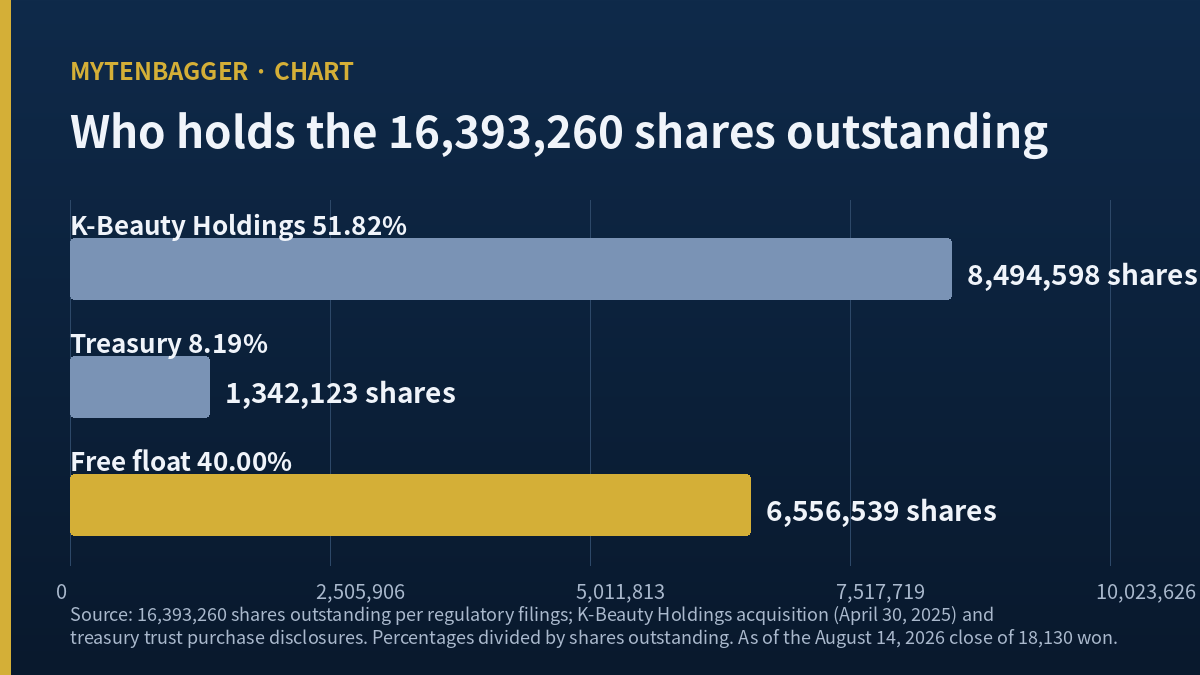
I went looking at Manyo Factory stock and closed the chart to open the share register instead. The company has 16,393,260 shares outstanding. A private equity sponsor holds 8,494,598 of them. The company’s own treasury account holds 1,342,123 more. Subtract both and 6,556,539 shares are left, which is 40.00% of the register. The 18,130 won ($12.78) close on Friday, August 14, 2026 was set by those 6,556,539 shares and by nothing else, because the other two holders have never quoted a price to me and are under no obligation to start.
Locked and floating, as of the August 14, 2026 close
| Holder | Shares | Register | Last price it attached |
|---|---|---|---|
| K-Beauty Holdings (KL&Partners) | 8,494,598 | 51.82% | 22,367 won on April 30, 2025 |
| Company treasury account | 1,342,123 | 8.19% | undisclosed trust purchases, mid-2026 |
| Everyone else | 6,556,539 | 40.00% | 18,130 won on August 14, 2026 |
Percentages are my own division against 16,393,260 shares. Korean press reported the sponsor’s stake as 51.87%, which appears to use the share count in force in April 2025; against today’s count the same block works out to 51.82%.
Contents
Two owners of Manyo Factory stock have never quoted me a price
Manyo Factory is a Korean skincare brand listed on KOSDAQ under the ticker 439090. KOSDAQ is Korea’s junior board, operated by the same exchange group as the main KOSPI market but populated by smaller and generally younger companies, so a name like this one sits well outside anything a US index fund would hold. The company designs and sells its own products and outsources manufacture, which puts it on the brand side of an industry where Korea’s better-known listed names are contract manufacturers.
That description is where most write-ups start and stop. I want to start somewhere else, because the single largest and most recent act of pricing in this company did not happen on the exchange.
On March 20, 2025 a Korean private equity firm, KL&Partners, signed to buy 8,494,598 shares from L&P Cosmetic through a special purpose vehicle named K-Beauty Holdings. Korean press reported the transaction closed on April 30, 2025 at 22,367 won ($15.77) a share for roughly 190 billion won ($134.0 million). A Korean outlet covering the signing put the premium at 17% over the prior month’s average close, and another Korean business daily headlined the implied company value at 370 billion won.
I checked the multiplication myself, because a headline number that rounds is a number I cannot use. 8,494,598 times 22,367 comes to 189.999 billion won, which agrees with the reported 190 billion. Applying the same 22,367 to today’s 16,393,260 shares gives 366.67 billion won ($258.5 million), which lands 3.33 billion won short of the 370 billion the daily printed. That gap is either rounding or a share count that has moved since April 2025, and I could not establish which.
The subtraction I ran before anything else
On August 12, 2026 the company filed the early termination of a 10 billion won ($7.05 million) buyback trust it had signed with NH Investment & Securities on June 24, 2026 with a stated end date of December 23. The stated reason for ending it five months early was that the buying was finished. 656,972 common shares return to the company’s corporate account, and Korean coverage of the filing put total treasury holdings at 1,342,123 shares, or 8.19% of the 16,393,260 outstanding. My own division gives 8.187%.
So the sponsor’s 8,494,598 and the treasury’s 1,342,123 add to 9,836,721 shares. Against the register that is 60.00%. What is left over is 6,556,539 shares, or 39.995%. The two figures settle on 60 and 40 to two decimal places by accident. I did not arrange that and I would not have believed it if the subtraction had not produced it twice.
Three figures that meet in the same place
At 18,130 won the whole company is worth 297.21 billion won ($209.6 million). At the sponsor’s 22,367 it would be worth 366.67 billion won. The market is 18.94% below the control price. Per share, 18,130 divided by 22,367 is 0.81056, which is the same 18.94% from a different direction. And the sponsor’s own block, bought for 190 billion won, is worth 154.01 billion won ($108.6 million) at Friday’s close, a difference of 35.99 billion won. Three routes, one answer.
What a sponsor paid, and what the market pays now
Two things are true about that 18.94% at once, and a US reader is more likely to trip on the first one than a Korean reader would be.
The first is that a control price and a screen price are not built from the same materials. 22,367 won bought 51.82% of a company and the right to appoint its board. 18,130 won buys one share and the right to watch. If I accept the 17% premium the Korean coverage reported, the unpremiumed control price would sit near 19,117 won and the gap narrows to 5.16%. I could not verify the 17% independently, because the article specifies only that it is measured against a one-month average close and I did not reconstruct that average.
The second is that the gap is still real in the way that matters to a sponsor. Private equity money has to come back out. Whether the route is a block trade, a secondary sale to another fund, or a tender, the price on that day is made by the market on that day. What the sponsor paid in 2025 does not stand in for it. And the market on that day will be made by the same 40.00% making it now.
This is the part US investors have a ready mental model for and should be careful with anyway. In the US, a sponsor sitting on a control block of a small listed company with the shares below its entry price has a well-worn option: take it private. In Korea that route exists but is heavier, and the more common paths for a sponsor already holding a majority of a KOSDAQ name are a staged block sale into the market or a negotiated handoff to a strategic buyer. Both of those press on the float instead of removing it. I am not predicting which happens. I am saying the float is small enough that it matters which one does.
Nobody on the sell side is writing about this
I looked for forward estimates in two places. WiseReport’s company screen shows zero contributing houses and no published view inside the prior three months as of August 14, 2026. The Korea Economic Daily’s consensus page shows an empty aggregate and no participating brokers. On April 20, 2026 a Korean-language piece by The Guru reporter Jin Yu-jin, carried on Investing.com’s Korean edition, wrote that single-name broker reports on this company had effectively vanished over the prior six months.
That same piece attributed the 2025 earnings decline to higher marketing spend and to one-off costs incurred during the change of control, and said the sponsor’s arrival had raised caution in the market. I use both halves of that sentence later, once as support and once against myself.
Manyo Factory stock and the 8.19% the company bought from itself
Those 1,342,123 treasury shares have not been retired. They sit in a corporate account, and the difference matters twice over.
Because they were not retired, the share count is unchanged and no per-share figure needs recalculating. Market capitalization still runs off all 16,393,260 shares, treasury included.
Also because they were not retired, they can come back. If the company sells them, the float goes from 40.00% to 48.19% on the day of the sale. When I say 60% of this register is locked, I mean it is not offering today. I do not mean it is gone.
The word this filing does not use
Ten billion won across 656,972 shares works out to about 15,221 won a share, by my calculation. That division assumes the full 10 billion was spent, and the filing coverage does not state the amount actually executed, so I have kept the figure out of my argument and print it only as a marker. What the filing also does not say anywhere is that any of these shares will be retired. A Korean company can hold treasury stock indefinitely, and holding it is not the same commitment as retiring it.
Why Manyo Factory stock carries 32.54 times a finished year
The screen shows a price to earnings ratio of 32.54. I wanted to know which earnings. The precise earnings per share on the same screen is 557.16 won; multiplied by the share count that implies net profit of 9.13 billion won. Consolidated net profit for fiscal 2025 in the regulatory filings is 9.13 billion won. The 32.54 is Friday’s close measured against the full year 2025.
| Fiscal year | Revenue | Operating profit | Operating margin | Net profit |
|---|---|---|---|---|
| 2023 | 105.00 | 15.86 | 15.11% | 11.63 |
| 2024 | 127.92 | 18.56 | 14.51% | 16.37 |
| 2025 | 113.02 | 10.46 | 9.25% | 9.13 |
| Q1 2026 | 26.91 | 6.05 | 22.49% | 6.10 |
Billions of Korean won, consolidated, from Korean regulatory filings. Fiscal 2025 revenue of 113.02 billion won is about $79.7 million and fiscal 2024’s 127.92 billion won about $90.2 million. Operating margins are my own division and may differ from figures the company presents.
Revenue fell 11.65% in 2025 and operating profit fell 43.66%. Those two declines reproduce the growth fields on the data screen exactly, which confirms the screen is measuring full years and not quarters. The 32.54 multiple therefore runs off the year in which both lines came down, and which was also the year the change of control was executed. A US reader who takes 32.54 as a statement about the current business is reading a finished year.
Where the second multiple went
Summing net profit over the four quarters through March 2026 gives 12.45 billion won, which against Friday’s close is 23.88 times. I have left that comparison out. My immediately preceding piece on a Korean display driver designer was built on exactly this, two multiples standing on one close, and running the same structure again one article later would make it a template. Here I use 32.54 alone and state which year sits underneath it.
The quarter revenue stood still and profit did not
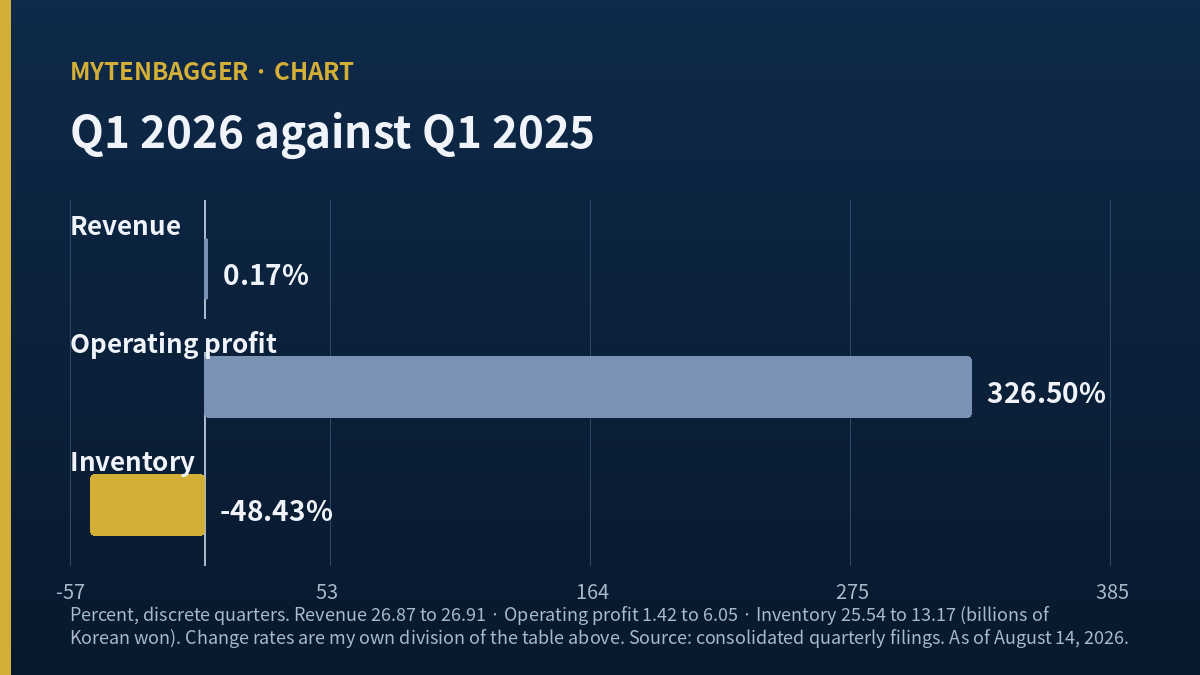
Operating margin in the first quarter of 2026 was 22.49%, the highest of the nine discrete quarters I can compute. Revenue in that quarter was 26.91 billion won ($19.0 million) against 26.87 billion won a year earlier, a difference of 0.17%. Operating profit over the same pair went from 1.42 billion won to 6.05 billion won ($4.27 million), which is 4.2650 times, or 326.50% higher.
Something else moved between those two dates, and it was on the balance sheet.
| Quarter | Revenue | Operating profit | Operating margin | Inventory | Inventory days |
|---|---|---|---|---|---|
| Q1 2025 | 26.87 | 1.42 | 5.28% | 25.54 | 86.5 |
| Q2 2025 | 31.69 | 2.98 | 9.41% | 20.36 | 58.4 |
| Q3 2025 | 28.70 | 4.02 | 14.01% | 17.39 | 55.1 |
| Q4 2025 | 25.75 | 2.03 | 7.89% | 15.51 | 54.8 |
| Q1 2026 | 26.91 | 6.05 | 22.49% | 13.17 | 44.5 |
Billions of Korean won. Revenue and operating profit are discrete quarters; year-to-date figures are converted. Inventory days is the data tool’s own field, computed as inventory over single-quarter revenue times 91. The fourth-quarter row is derived by subtracting nine-month cumulative figures from the full year.
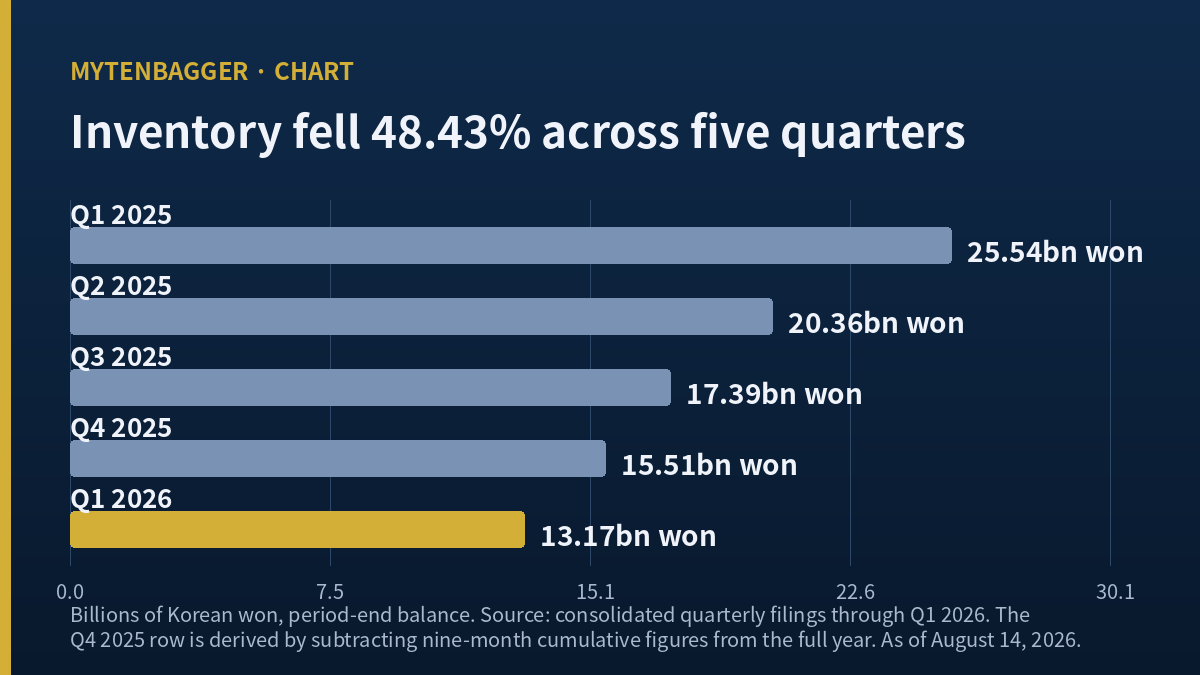
Inventory fell from 25.54 billion won ($18.0 million) to 13.17 billion won ($9.29 million), a decline of 48.43%. Inventory days went from 86.5 to 44.5, which is 42.0 days shorter. Operating cash flow moved the same way, from negative 5.60 billion won in the first quarter of 2025 to positive 8.79 billion won in the first quarter of 2026.
I do not read this profit as the result of selling more. Revenue moved 0.17%. I read it as the result of stocking less and discounting less, and both of those show up immediately in the same lines. Inventory that stops piling up stops carrying write-downs, and product that does not need to be pushed out stops carrying markdowns.
Inventory days is the test, and the next quarter runs it
44.5 days is the shortest reading in the nine quarters I have. There is not much room left below it. So from the next quarter the question stops being whether revenue grows and becomes whether a 22% margin survives without further emptying. If it survives, I have read this wrong. If inventory days climbs back up and the margin comes down with it, I have read it about right.
Manyo Factory stock next to a US brand that grew into a smaller profit
I wanted one listed comparison, and I picked e.l.f. Beauty (NYSE: ELF) for a specific reason. It is the closest US analogue in business model, an asset-light cosmetics brand that outsources manufacture, and its two headline lines currently point in the opposite directions from this company’s. That opposition is the comparison. It is not a claim that the two businesses are otherwise alike.
e.l.f. traded at $93.10 with a market value of $5.49 billion across 59.01 million shares, on revenue of $1.76 billion over the trailing twelve months and net income of $59.61 million. Trailing price to earnings was 93.50 and the forward figure 30.05. Revenue grew 31.2% while net income fell 39.1%. Those readings are from a US market data page timestamped 11:16 AM EDT on August 17, 2026, which is an intraday quote three sessions after the Korean close I am using for everything else. The two dates do not match and I have not adjusted for it.
Revenue of $1.76 billion against this company’s $79.7 million makes e.l.f. 22.09 times larger by sales. e.l.f. grew revenue and lost profit; Manyo shrank revenue in 2025 and then produced its best quarterly margin. The market pays 93.50 times for the first pattern and 32.54 times for the second.
What I left out of that table
I compared four things and no more: revenue direction, profit direction, the trailing multiple, and whether a forward multiple exists at all. I did not put margins, segment mix, or balance sheet ratios side by side, and the reason is that they would not mean the same thing in the two columns. e.l.f. reports on a March fiscal year and this company on a December one, so any margin pair would be measuring different twelve-month stretches. The size gap of 22.09 times means overhead sits differently in each cost base. And one of the two has a published forward figure while the other has none at all, so a forward comparison has nothing on one side to stand on. A four-row comparison I can defend beats a twelve-row one I cannot.
Four arguments against my reading of Manyo Factory stock
I have put these in the reverse of the order I would defend them, hardest first.
- A small float did nothing to the price when it had the chance. Over the twenty sessions to August 14, the Korean cosmetics sector index rose 16.91% and KOSDAQ rose 9.20%. This stock rose 4.86%, lagging its own sector by 12.05 points. If a 40% float made this name quick to move, the twenty sessions where its sector ran should have shown it. My premise that float size drives price formation is not supported in the one window where it was directly testable.
- The margin may be an absent cost and not an emptied warehouse. The Guru piece named one-off change-of-control costs among the causes of the 2025 decline. If those costs sat in 2025, then the 22.49% first quarter of 2026 is an ordinary quarter with the noise removed, and the margin simply continues. I cannot rule this out, because I could not find any disclosure quantifying those costs.
- 22,367 and 18,130 are not the same kind of price and I put them next to each other anyway. Accepting the reported 17% premium collapses the gap from 18.94% to 5.16%, and a 5% gap is not a sponsor in trouble. I make the comparison because it is the only recent transaction of size in this name, which is a reason and does not excuse it.
- Treasury shares are stepped aside, and stepping aside reverses easily. No retirement has been resolved and none is mentioned in the filing. A single disposal takes the float to 48.19%. My sentence about 60% of the register not quoting a price describes today and does not describe a structure.
My position on Manyo Factory stock, and what would break it
A market value of 297 billion won puts it well outside Korea’s hundred largest companies, and my default with names that size is to watch. I want to separate that from what I am doing here, though. I am not watching because it is small. I am watching because what I would be buying is 40% of a register and not a company, and in this name those are not the same purchase.
On the seven-point checklist I run, five pass for a score of 71. Revenue scale, operating margin, earnings per share, price to book at 2.42 against a cosmetics-sector threshold of 3.0, and a positive operating result all clear. Return on equity at 7.7% and the 32.54 multiple do not. Two of those thresholds move with the industry, so I do not read the score as an absolute.
One thing would tell me I am wrong. If any part of K-Beauty Holdings’ 8,494,598 shares changes hands at 22,367 won or better before the end of 2026, then the price in this name was set by the buyer of control and not by the 6,556,539 shares I have been writing about, and the subtraction this piece opens with has to be redone from the beginning.
Two other Korean names I have written up sit either side of this one on the same question. A clothing company whose markdowns took its margin is the same mechanism running the other way: there inventory pressed profit down, here inventory coming down let profit up. A Korean cosmetics manufacturer whose sector rank changed with the measurement window shares this company’s industry and not its model, since it makes other people’s brands.
Prices and multiples here reflect the Friday, August 14, 2026 close, checked at the time of writing. Korean markets were shut on August 15 for Liberation Day, on August 16, and on August 17 for the substitute holiday, so that Friday was the last session. Dollar figures are approximate, converted at roughly 1,418.3 won per dollar as of that same Friday, and the Korean won is the reference currency for everything except the e.l.f. Beauty figures, which are left in dollars as reported. Financial data is consolidated and drawn from Korean regulatory filings; margins and change rates are my own division and may differ in the decimals from figures the company or the press present. Ownership percentages are calculated against 16,393,260 shares.
- Amorepacific ROE vs Global Beauty Peers: A 23-Point Gap
- Asia Holdings Valuation: Minority Owners Hold 41% of the Equity
- Why Hanwha Systems Shares Fell 66% as Operating Profit Tripled