Sang-A Frontec Stock: The Revenue Line Does Not Say Hydrogen
I keep a note file for Korean small caps I have not opened yet, and beside this one I had written two words: hydrogen play. That is where the name sits in most Korean screeners, and it is not a wild label. The company does make electrolyzer membranes. Then I opened the segment forecast and found that industrial components carry almost half the revenue, and membranes do not.
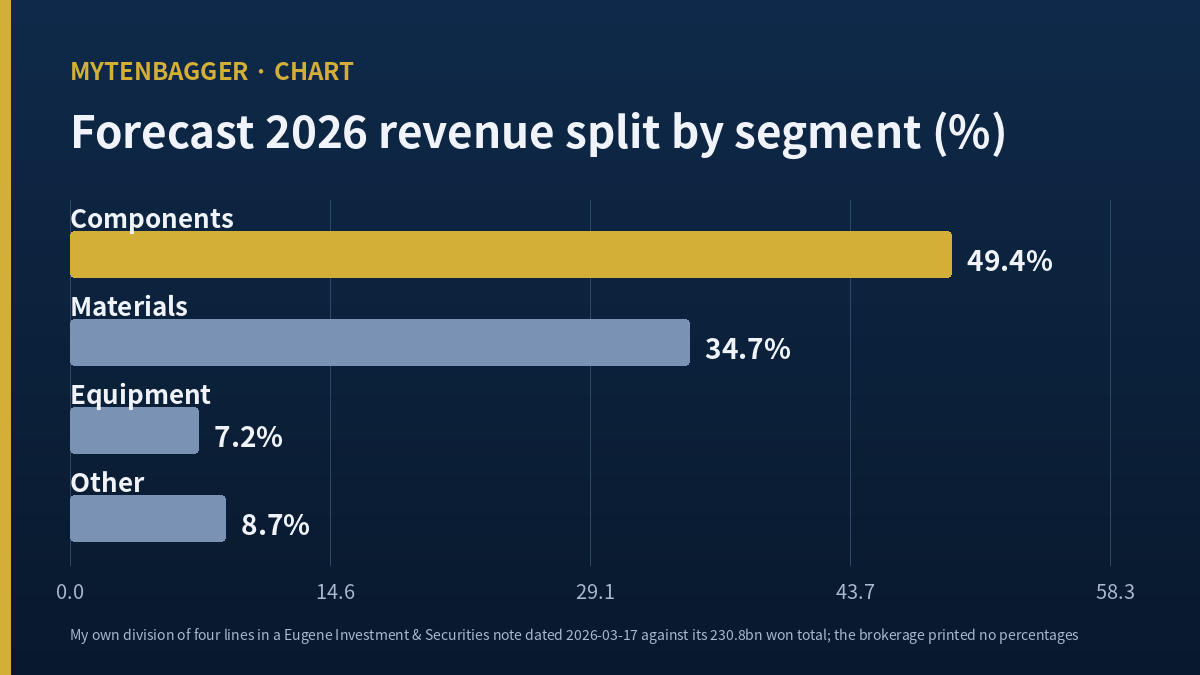
Forecast 2026 revenue by segment, from the one brokerage note that covers this company: components 114.0bn won, materials 80.1bn won, equipment 16.7bn won, other 20.0bn won. Total 230.8bn won. The word hydrogen does not appear as a segment.
Sang-A Frontec trades on the KOSDAQ, which is the smaller of South Korea’s two main equity markets and the one where most Korean industrial suppliers and technology small caps list. The KOSPI is the larger board, home to Samsung Electronics and the big Korean industrials. Under ticker 089980, this company closed at 15,050 won on Tuesday, September 8, 2026, for a market value of roughly 240.6bn won, or about US$180 million at the exchange rate I note at the end.
Contents
What Sang-A Frontec stock actually sells
The segment split above comes from Eugene Investment & Securities, in a note dated Tuesday, March 17, 2026, which I read in full as a PDF. Turning those four lines into percentages of the 230.8bn won total gives components 49.4%, materials 34.7%, equipment 7.2% and other 8.7%. Every one of those percentages is my own division. The brokerage printed no such percentage.
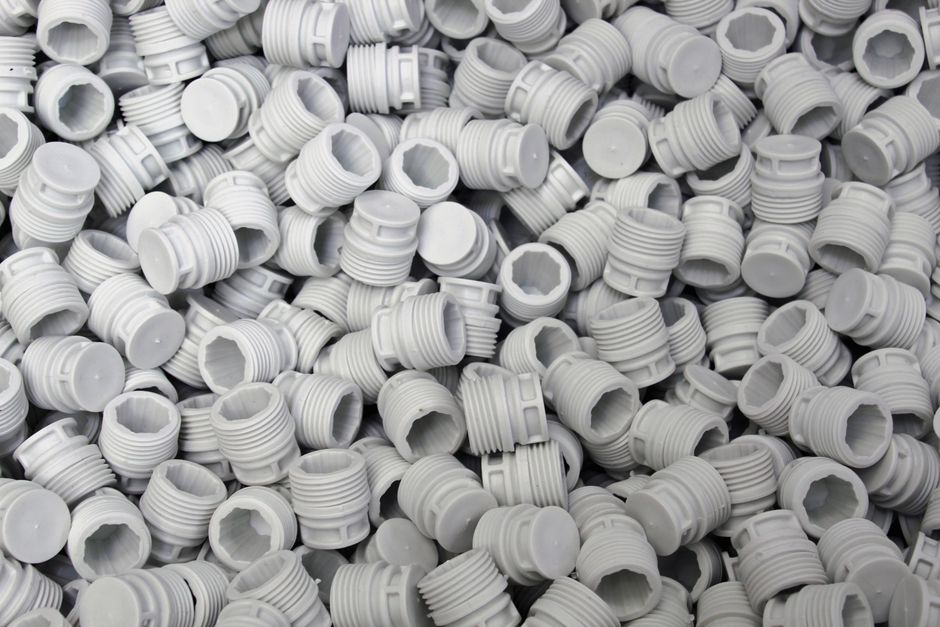
What sits inside those buckets matters more than the buckets. The components line is precision fluoropolymer and engineered-plastic parts, the kind that go into semiconductor wet benches and battery cell assemblies. The materials line is film and membrane. Inside materials, the note flags satellite receiver ETFE film as the driver of the recent profit improvement, and it flags a capacitor seal component for US battery energy storage systems as the growth item, with four production lines targeted by the second half of 2027. Water electrolysis membrane appears in that same note, but it appears as a yield-improvement story. It has no revenue line of its own.
So the hydrogen exposure is real and it is small. I am comfortable saying that, and I am also comfortable saying that a company can be worth owning for a reason other than the one that got it into a screener. What I am not comfortable with is buying a label and then discovering the revenue is somewhere else.
Sang-A Frontec stock and four years of operating margin
Here is the series I actually lean on. Revenue and operating profit are from the company financial screen at Korea’s WISEreport company monitor, read on Tuesday, September 8, 2026, in units of 100 million won which I have converted to billions for readability. The margin column is mine.
| Fiscal year | Revenue | Operating profit | Operating margin (my division) |
|---|---|---|---|
| 2022 | 181.2bn won | 12.9bn won | 7.12% |
| 2023 | 183.6bn won | 9.0bn won | 4.90% |
| 2024 | 171.8bn won | 5.8bn won | 3.38% |
| 2025 | 196.0bn won | 6.7bn won | 3.42% |
Revenue in 2025 is 8.2% above 2022 by my arithmetic. Operating profit in 2025 is 48.1% below 2022 by the same arithmetic. The margin lost 3.70 percentage points across those four years, and it lost most of that in a single step between 2022 and 2023. I want to be precise about what this does and does not show. It does not show a company in distress: the operating line stayed positive in every one of those years. It shows a company whose top line recovered and whose profitability did not follow it back up.
I have written before about a Korean supplier whose mature-product margins were quietly financing a new business line, and the pattern there was visible because the segments reported separately. Here the segments are forecast by an analyst and are never broken out with their own profit lines, so I cannot do that decomposition. I can only say the aggregate margin fell.
Three companies whose catalogs overlap with Sang-A Frontec stock
I picked these three because a buyer of engineered polymer film, precision fluoropolymer parts or semiconductor-grade fluid handling could plausibly get a quote from any of them. Rows are in alphabetical order of ticker. The ordering carries no argument. I have not converted any currency, and I have put each company’s fiscal year end in the first column because one of the four does not close its books in December.
| Fiscal year end | Company | Revenue | Operating profit | Margin (my division) |
|---|---|---|---|---|
| Dec 31, 2025 | Entegris (NASDAQ: ENTG) | US$3,196.6m | US$455.9m | 14.26% |
| Mar 31, 2026 | Nitto Denko (TYO: 6988) | JPY 1,028,171m | JPY 183,615m | 17.86% |
| Dec 31, 2025 | Rogers Corporation (NYSE: ROG) | US$810.8m | US$(45.0)m | -5.55% |
| Dec 31, 2025 | Sang-A Frontec (KOSDAQ: 089980) | 196.0bn won | 6.7bn won | 3.42% |
Two things in that table cost me real time. First, the operating profit figures disagree between data aggregators and company filings for all three foreign names, so I took every one of them from the company’s own release: Nitto Denko’s fiscal 2026 tanshin, Rogers Corporation’s full-year 2025 results release, and Entegris’s fourth-quarter 2025 release. In Rogers’s case the aggregator I checked showed a positive operating result where the company reported a loss, because restructuring and impairment charges had been added back. I used the company number.
Second, Rogers is negative and I left it in. A peer list that only contains companies doing well is a list I assembled to feel good about something. The honest reading of this table is that a US$810.8m specialty materials company posted a GAAP operating loss in the same calendar year that this Korean company posted a thin but positive margin, and that neither of those facts tells me what either business will earn next year.
What the table does tell me is scale. Entegris reports US$3,196.6m of revenue and this company reports 196.0bn won; I have not converted either figure, so I am not printing a ratio between them, and none is needed to see that Nitto Denko is larger again. Being small is not a flaw. It does mean that a single customer program, like the battery energy storage seal component the analyst note describes, can move the whole margin line in a way it could not move at any of the other three.
Why I did not put a fuel cell company in that table
A fuel cell peer is what I went looking for first, and I spent about three quarters of an hour on it. The candidates were obvious enough: the US and European electrolyzer and fuel cell names that a hydrogen screener would pair this company with. I pulled two of them up, started reading their income statements, and then stopped.
The reason I stopped is that putting them in the table would have meant accepting the premise I had just spent a section taking apart. If 49.4% of forecast revenue is industrial components and the membrane work is a yield story inside a materials segment, then a table of hydrogen pure plays measures this company against a business it mostly is not in. It would also have flattered it: the hydrogen names I opened carry deeply negative operating lines, and any comparison would have made a 3.42% margin look like discipline instead of what it is, which is a thin margin.
I do not usually record the searches that go nowhere. I am recording this one because the decision to abandon it is the same decision as the article’s argument, made a second time, and if I had made it the other way this entry would have reached a different conclusion on the same facts.
The two quarters that moved the margin on Sang-A Frontec stock
The most recent two reported quarters are the reason I am still watching this and have not dismissed it. In the quarter ended March 2026 the company posted revenue of 48.5bn won and operating profit of 1.2bn won, a margin the screen prints as 2.40%. In the quarter ended June 2026 it posted 55.8bn won and 3.6bn won, printed as 6.41%. Dividing the rounded billions myself gives 2.47% and 6.45%, and the small gaps are rounding in the source, which reports in units of 100 million won.
A 6.41% quarter is the best quarterly margin this company has printed in the window I can see, and it is nearly double the full-year 2025 figure. One quarter is one quarter. I have watched enough Korean small caps post a good June and then give it back in December to know that the third reported quarter is where this either becomes a trend or becomes a blip.
Debt moved the other way over the same stretch. The balance sheet ratio the screen labels debt-to-equity stood at 86.93% at the end of June 2025 and 92.51% at the end of June 2026. Both are comfortable levels for an industrial manufacturer. The direction is still up, and the next section is part of why.
A convertible that reprices Sang-A Frontec stock’s share count from 2027
In April 2026 the company approved a privately placed unsecured convertible bond, its eighth such issue, carrying a zero coupon and a zero yield to maturity. The conversion price is set well above where the shares trade today. If the whole issue converts, it creates 1,558,387 new shares, which the filing puts at 9.06% of shares outstanding. Conversion requests can be made from May 7, 2027 until April 7, 2031.
At 15,050 won nobody converts today, so the dilution is not a live problem. It becomes one if the share price roughly doubles, which is the awkward part of this financing: the outcome that would make holders happiest is also the outcome that hands 9.06% more shares to somebody else. I would rather own that problem than the alternative, but I want it written down before it arrives, while it is still hypothetical.
There is a related arithmetic exercise I have run on another Korean name, where dividing the declared dividend by the per-share rate revealed a treasury holding the company never disclosed directly. I ran the same division here. It produced a plausible number, and I could not confirm it against a filing, so it stays out of this entry’s reasoning and appears only in the list of things I checked and set aside.
One house covers Sang-A Frontec stock
The forward view on this company is thin in a specific, measurable way. The consensus screen at the company monitor, read on Tuesday, September 8, 2026, lists one contributing institution. Its 2026 estimates are earnings per share of 688 won and book value per share of 13,147 won.
I am carrying one of those two vintages into this entry and leaving the other where it is. The screen’s 2026 earnings estimate and the March brokerage note’s own 2026 earnings estimate are not the same number, and I could not establish which revision the screen reflects or when it was made. Printing two forecasts for one year would invite a reader to treat them as a range, so I have taken the screen figure, said where it came from, and stopped there.
Coverage of one is not a scandal for a company this size. It does mean that the phrase market expectations, applied to this name, describes one analyst’s spreadsheet. My P4 research gate asks for forward estimates from two independent houses before I write, and this piece does not clear that bar. I am publishing it anyway with that shortfall stated, which is the rule I set for myself when the alternative is silence about a company that exists.
What the company says its plan is, and one thing I could not name
In March 2026 the company filed a voluntary corporate value enhancement plan, part of a Korean regulatory push to get listed companies to publish shareholder-return roadmaps. The operative commitment is procedural: fix the dividend amount first, then set the record date, so that shareholders know the figure before the entitlement date. The strategy section lists expanding super engineering plastics applications, entering eco-friendly energy parts and materials including fuel cells, secondary batteries and solar, and upgrading its environmental and governance practices.
I read that document twice looking for a number attached to a future year and did not find one. Predictability of process is a real improvement over nothing, and I would not call it a return commitment.
The satellite film customer
The March note credits the materials segment’s profit turn to receiver film for a global satellite communications operator, and describes that operator only as a top-tier global company. I would have liked to name the customer and size the program, and I could not. An unnamed customer driving a segment turn is a fact about the note. It is not yet a fact about the business, so I have left the description at the level the source supports.
Where Sang-A Frontec stock could prove me wrong
- The segment split is a brokerage forecast for a year that is not finished. The company’s own audited segment disclosure could divide the business differently.
- Calling the hydrogen exposure small is a judgment about revenue today. Membrane programs are multi-year, and a business that is 3% of revenue can be 30% of the reason someone owns the shares.
- Percentages of the segment total are my divisions. If the analyst’s four lines do not sum to exactly the total he printed, my shares are slightly off.
- The four-year margin walk uses figures rounded to units of 100 million won. At this company’s size, rounding can move a margin by several hundredths of a point.
- I have not seen a cost breakdown explaining why the margin fell between 2022 and 2023. Without it, I am describing the fall without accounting for it.
- The June 2026 quarter’s 6.41% could be timing: a delivery schedule, a one-off recovery, a mix effect. I have not verified which.
- Net profit in that quarter behaved very differently from operating profit, and I did not establish why. If the difference is non-operating, the quarter is weaker than the headline.
- The peer set is my construction. Someone who defines the business as semiconductor consumables, or as automotive components, would build a different table and reach a different conclusion.
- Nitto Denko’s fiscal year ends in March, so its figures cover a different twelve months from the other three rows. I marked the year end in the column and did not adjust the figures, and a stricter approach would drop the row.
- Leaving a loss-making peer in the table is a choice about honesty, but it also drags the visible range wide enough that a thin positive margin looks better by contrast.
- Debt-to-equity rising from 86.93% to 92.51% is one year of one ratio, taken from a screen; I did not open the balance sheet notes.
- The convertible’s conversion price could be subject to downward adjustment clauses common in Korean private placements. I could not confirm whether such clauses exist here, and if they do, the 9.06% figure would understate the dilution.
- Zero coupon on a five-year bond means the buyers priced the option, and they may be better informed about the customer programs than I am.
- A single covering analyst means the forward figures in this entry rest on one person’s model.
- That analyst’s published estimates for this company have missed materially before, in a year I looked at while researching. Treating a past miss as evidence about a current model is a bias I am naming here so that I do not act on it.
- I could not open a single primary filing for this company. Korean regulatory filing portals block automated access from my environment, so every disclosure fact here reached me through a secondary report or a data screen.
- Founder-aligned holders control a large minority of the shares, which I read from a screen; I did not open a shareholder register. Governance conclusions from that number would be unsupported.
- The market value in this entry is roughly US$180 million on one exchange rate on one date. At this size, a few days of volume can move the price enough to change every multiple in the piece.
My reference point and when it stops being checkable
My working rule on this one is narrow. When a company’s revenue returns to a prior peak and its operating margin does not, I stop reading the growth narrative and wait for a third consecutive quarter of margin. Two good quarters after four bad years is a pattern I have been wrong about before.
Two checkpoints, then. The first is the operating margin in the quarter ending September 2026, whose report is due in Korea in mid-November. Above the 2025 full-year figure makes it three in a row and my caution looks excessive. Below 2.40% makes the June quarter the outlier. The second is whether the company’s next annual report gives a cost or mix explanation for the 2022 to 2023 margin step, which is the single fact this whole entry is built around not knowing.
Both of these can stop being checkable, and I want that written down too. The first checkpoint dissolves if the company restates or reclassifies segment revenue between now and then, because the margin I would be comparing would no longer be measured on the same base. The second dissolves in a quieter way: annual reports are not obliged to explain a four-year-old margin step, and if the next one simply does not discuss it, I will have a checkpoint that can never resolve either way. I have spent enough time treating unresolved as unfavorable to know it is a reflex worth naming. A test I cannot run is not a test I failed.
Currency, dates and where each figure came from
Prices and ratios reflect the Tuesday, September 8, 2026 close as I checked them that day, so live quotes can differ. The Korean won is the reference currency throughout. The single US dollar figure uses roughly 1,340.5 won per dollar, an approximate rate I last confirmed on Monday, September 7, 2026, and it is there for scale only; no calculation in this entry runs through it. Peer figures are printed in each company’s own reporting currency and are not converted.
Company financials, the closing price, the share count and the consensus contributor count come from the WISEreport company monitor screen. The segment forecast and the materials-segment narrative come from the Eugene Investment note of March 17, 2026, which I read in full. Convertible bond terms come from a Korean summary of the filing; I could not open the filing itself. Peer revenue and operating profit come from the three company releases linked in that section.
Where a figure is my own arithmetic and no source printed it, I have written that beside it. I hold no position in this company and have no order working.