SeAH Besteel Holdings Cash Flow: Ten Quarters of Spending
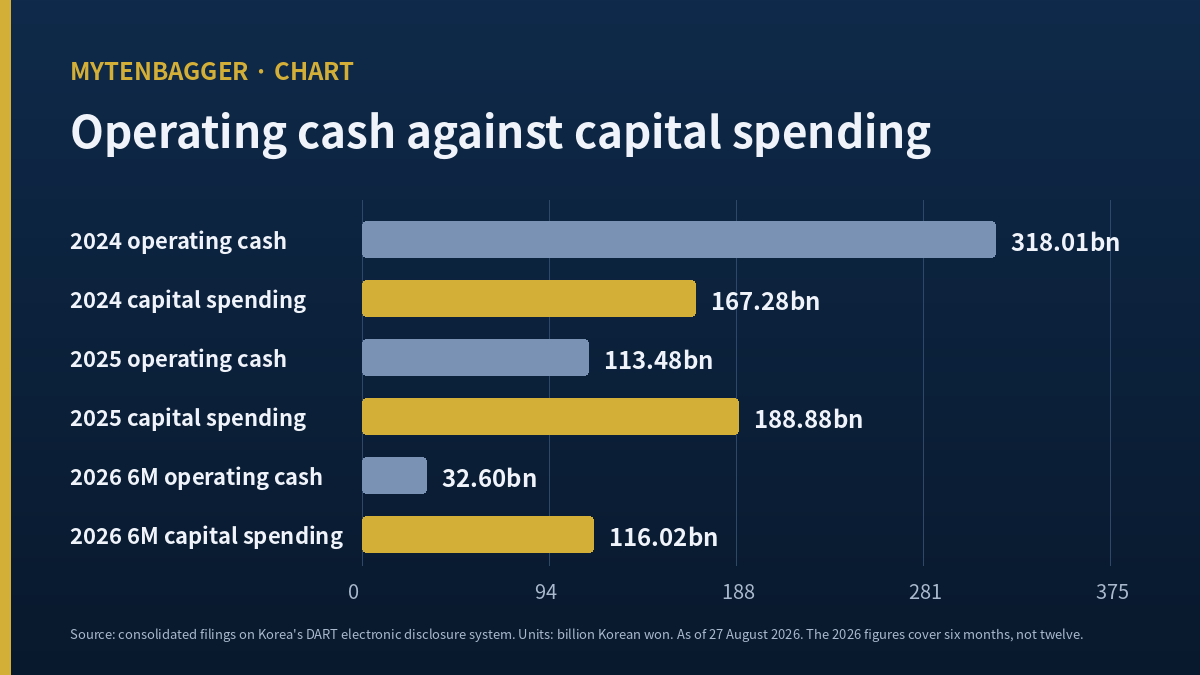
I opened SeAH Besteel Holdings stock at the cash flow statement this time, and I stayed there longer than I meant to. Across the ten quarters from January 2024 through June 2026, this Korean specialty steel group produced 464.08 billion won of operating cash. Across the same ten quarters it spent 472.18 billion won on capital projects. The two figures are 8.10 billion won apart. Ten quarters of cash generation went into the ground, and the small shortfall was covered by borrowing.
That is not a scandal. It is what a company does when it decides to build something. The question I care about is narrower. If a company spends everything it earns for two and a half years, the interest on what it borrowed becomes the first claim on the next upturn. So I wanted to know whether the recovery visible in the 2026 first half income statement had reached that claim yet. It has not.
Contents
SeAH Besteel Holdings stock sits on ten quarters of spent cash
Here is the ledger I built from the consolidated filings on the Korean regulator’s electronic disclosure system. All figures are in billions of Korean won. The 2026 column covers six months, not twelve, and I have kept it labeled that way so nobody reads it as a full year.
| Period | Operating cash | Capital spending | Difference |
|---|---|---|---|
| 2024 full year | 318.01 | 167.28 | plus 150.72 |
| 2025 full year | 113.48 | 188.88 | minus 75.41 |
| 2026 first half | 32.60 | 116.02 | minus 83.42 |
| Ten quarters combined | 464.08 | 472.18 | minus 8.10 |
Combined operating profit over those same ten quarters was 241.67 billion won. Capital spending of 472.18 billion won is 1.95 times that figure. A company can carry that ratio for a while if the projects turn into revenue on schedule. The projects here are a stainless capacity program in Korea and a nickel based superalloy plant in Texas, and neither has produced a revenue line I can point to yet.
The balance sheet shows where the shortfall went
Total liabilities rose from 1,626.12 billion won at the end of 2023 to 2,293.87 billion won at the end of June 2026, an increase of 667.75 billion won. Total equity moved the other way, from 2,039.05 billion won to 1,990.68 billion won, a decrease of 48.37 billion won. The debt to equity ratio went from 79.75 percent to 115.23 percent. Part of the equity decline is a drop in non controlling interests from 83.66 billion won to 11.26 billion won, and I was not able to open the footnote that explains that movement. I am recording that gap instead of guessing at it.
SeAH Besteel Holdings stock carries an interest bill that has not fallen
This is the number that made me stop. Interest expense in the 2026 first half was 43.37 billion won. Annualized at the same pace that is 86.74 billion won, which is 3.78 percent larger than the 83.58 billion won this company paid in the full year 2024. Two and a half years of building, and the annual interest bill is slightly bigger than it was at the start.
Set that against the coverage ratio, which is operating profit divided by interest expense for the same period.
| Period | Operating profit | Interest expense | Coverage |
|---|---|---|---|
| 2023 | 196.69 | 73.94 | 2.66 times |
| 2024 | 52.33 | 83.58 | 0.63 times |
| 2025 | 98.41 | 75.45 | 1.30 times |
| 2026 first half | 90.93 | 43.37 | 2.10 times |
In 2024 this company earned 52.33 billion won of operating profit against an 83.58 billion won interest bill. Coverage of 0.626 times means the year’s operating profit did not pay the year’s interest, and the 31.25 billion won difference came from somewhere else on the balance sheet. Eighteen months later coverage is 2.097 times, which is 3.349 times what it was. Every part of that improvement came from the profit side. I have written the same sentence three different ways in my working notes because I kept expecting to find that debt had been repaid, and it had not been.
SeAH Besteel Holdings stock earned its second quarter somewhere specific
The company reported second quarter consolidated revenue of 1,136.3 billion won, operating profit of 60.5 billion won and net profit of 35.2 billion won on July 30, 2026. The same release broke out three operating subsidiaries, and that breakout is where the quarter becomes legible.
| Subsidiary | Q2 revenue | Q2 operating profit | Operating margin |
|---|---|---|---|
| SeAH Besteel | 598.9 | 24.6 | 4.11 percent |
| SeAH Changwon Integrated Special Steel | 430.5 | 34.4 | 7.99 percent |
| SeAH Aerospace and Defense Materials | 35.5 | 6.3 | 17.75 percent |
| Three combined | 1,064.9 | 65.3 | 6.13 percent |
The margin column is mine, computed by dividing the reported figures. The unit that gave the holding company its name is the largest by revenue and the second largest by profit. Measured against consolidated operating profit of 60.5 billion won, the Changwon stainless business accounts for 56.86 percent, SeAH Besteel for 40.66 percent and the aerospace materials unit for 10.41 percent. The three add to 65.3 billion won, which is 4.8 billion won more than the consolidated figure, because consolidation adjustments and the holding company’s own costs take that back out. I did not get the detail of that adjustment.
The aerospace materials unit is a 35.5 billion won business with a 17.75 percent margin, which is 4.32 times the 4.11 percent margin of the unit that is 16.87 times its size by revenue. Its second quarter operating profit was 4.5 percent lower than a year earlier, so this is not a growth story yet. It is a mix story. And it is the part of the group that the Texas project is meant to enlarge.
A listed peer already sells what the Texas plant is being built to make
SeAH Superalloy Technologies, the group’s plant in Temple, Texas, has taken about 110 million US dollars of investment and is reported to have annual capacity of 6,000 tonnes of nickel based superalloy. Korean trade press reported in June 2026 that the company planned to start production within the year, and the same reporting stated plainly that the customers, contract terms and supply volumes had not been officially confirmed.
Nickel based superalloy for aerospace and defense is a business with listed comparables, so I looked at one. Carpenter Technology (NYSE ticker CRS) closed at 490.58 US dollars on August 27, 2026, the same session I used to price the Korean name. Its market value was 24.31 billion US dollars on 49.56 million shares, and I checked that multiplication myself before using it. Trailing twelve month revenue was 3.12 billion US dollars, trailing net income 529.60 million US dollars and trailing earnings per share 10.52 US dollars, giving a trailing price to earnings ratio of 46.63 and a forward ratio of 36.67. My own division of net income by share count gives 10.686 US dollars, which is 1.58 percent above the published per share figure, a difference consistent with basic against diluted counts; I used the published figure.
My reason for choosing this comparison is narrow and I want it stated out loud instead of assumed. I did not pick a company of similar size, similar geography or similar product mix. I picked a listed company whose primary product is the material the Texas plant is being built to produce, so that the multiple the market pays for that material is visible somewhere. Carpenter trades at 46.63 times trailing earnings. SeAH Besteel Holdings, recomputed below, trades at 17.57 times. Those two numbers describe two different businesses at two different points in their build cycles, and I am not translating one into the other.

What the screen shows and what the filings show are two different multiples
The vendor screen I use puts this company at 27.73 times earnings on the August 27, 2026 close of 43,450 won. I could reproduce that figure exactly, and reproducing it is how I found the problem. It divides the current price by earnings per share built from the full year 2025 net profit attributable to owners of 56.20 billion won across 35,861,910 shares.
Adding the four most recent quarters instead gives net profit attributable to owners of 88.67 billion won, earnings per share of 2,472.5 won and a trailing multiple of 17.57 times. The screen value is 1.58 times the figure the filings support. The same screen reports book value per share of 54,192 won; multiplying that by the share count returns 1,943.43 billion won, which is exactly the owners’ equity at the end of 2025, not at the end of June 2026. Using the June 2026 owners’ equity of 1,979.42 billion won gives book value per share of 55,195.5 won and a price to book ratio of 0.787 where the screen says 0.80.
Neither correction changes my stance. Both change what I would say if someone asked me what this company trades at, and I would rather say the number I can rebuild.
The other side of SeAH Besteel Holdings stock, in six parts
Without this section the paragraphs above are a position with no test attached.
One. Coverage of 2.10 times is still below the three times region that credit practice tends to treat as a floor, and I have not verified that convention against a primary source. Worse, I cannot confirm whether the 43.37 billion won line is pure interest or a broader finance cost that includes derivative and foreign exchange losses. For a company this size the figure looks large for pure interest. If it is the broader measure, the true coverage is better than what I have written.
Two. Second quarter operating cash flow was negative. Half year cumulative operating cash of 32.60 billion won minus first quarter operating cash of 50.59 billion won leaves negative 17.98 billion won for the quarter with the highest profit. This is not the first time; the third quarter of 2025 was negative 21.54 billion won. Working against that reading, inventory turnover improved, with inventory days falling from 106.4 at the end of 2024 to 92.2 at the end of June 2026. This does not look like unsold stock piling up.
Three. The anti-dumping case has no rate attached to it. Korea’s Trade Commission opened a dumping investigation into Chinese steel bar on May 21, 2026, with SeAH Besteel and SeAH Changwon as the petitioners. A preliminary ruling is scheduled for September 2026, a public hearing for December and a final ruling for February 2027. Kim Yoon-sang of iM Securities wrote that a meaningful improvement at SeAH Besteel would be expected if anti-dumping duties are actually imposed. That sentence has a conditional clause in it, and the clause is still open.
Four. The Texas plant contributes nothing to the income statement so far, and its customers are unconfirmed in the reporting I could reach. I have not converted that expectation into a number anywhere in this piece.
Five. Park Sung-bong of Hana Securities wrote on July 11, 2026 that average selling prices would rise by about 50,000 won per tonne on non automotive price increases, but that scrap prices would rise by more, narrowing the spread slightly. Profit that comes from volume and price is not the same asset as profit that comes from a widening gap over input cost, and the two behave differently in the next cycle.
Six. Four Korean brokerages cut the figures they attach to this name between April and July 2026. Kiwoom Securities moved to Outperform on April 10 at 77,000 won. Lee Jung-woo of Daol Investment and Securities went from 87,000 won on April 22 to 64,000 won on July 31, a reduction of 26.4 percent, in the same note that described revenue and operating profit as beating consensus. Kim Yoon-sang of iM Securities went from 72,000 won on April 30 to 50,000 won on July 31, a reduction of 30.6 percent. BNK Investment Securities published 54,000 won on June 26. All four sit above the August 27 close of 43,450 won, which is its own kind of warning.
Two numbers for the same quarter depending on the filing
A small item worth recording. The company’s July 30 release put second quarter consolidated operating profit at 60.5 billion won. The half year report filed on August 14 gives cumulative operating profit of 90.93 billion won, and subtracting first quarter operating profit of 31.09 billion won leaves 59.84 billion won. The difference is 0.66 billion won, or 1.10 percent. On revenue the release said 1,136.3 billion won against a computed 1,135.71 billion won, a difference of 0.59 billion won or 0.05 percent. This is an ordinary revision between a preliminary release and a statutory filing, but the two sets are not interchangeable, so the subsidiary table above uses release figures and the consolidated series uses filing figures.
Where the price has been
On the August 27, 2026 close of 43,450 won, the 250 session high is 92,500 won and the low is 23,050 won, a range of 4.01 times. The current price is 46.97 percent of the high and 88.50 percent above the low, and I rebuilt all three from the close before using them. I left the one, three, six and twelve month change figures out of this piece because the vendor calculated them against an intraday price of 42,250 won from the following session, which is not the base I chose. What I can verify directly is that the close moved from 33,300 won on July 31 to 43,450 won on August 27, a rise of 30.48 percent, with 45,000 won on August 14 as the top of that window. Korean reporting in February 2026 described the shares as having quadrupled while noting overheating concerns in the same article.
My stance on SeAH Besteel Holdings stock and what would change it
I am watching. The recovery in the income statement is real: full year operating margin went from 1.44 percent in 2024 to 4.32 percent for the 2026 first half, and the second quarter standalone margin of 5.27 percent is the highest since the 6.56 percent of the second quarter of 2024. The dividend has been 1,200 won per share for four consecutive years, a 2.76 percent yield on the August 27 close.
What holds me back is that the improvement rests on one input. Any one of the following would make me reopen the file.
| Number | Condition that breaks my reading | Where it would show up |
|---|---|---|
| 1 | Nine month interest expense comes in below 1.5 times the half year 43.37 billion won | Third quarter report |
| 2 | The preliminary anti-dumping ruling attaches an actual duty rate | Korea Trade Commission |
| 3 | The Texas plant confirms production start and a first named customer | Company disclosure |
| 4 | Nine month operating profit exceeds 80 percent of the 144.6 billion won full year estimate published by Hana Securities | Third quarter report |
On that last line, Hana Securities estimated 2026 revenue of 4,054.0 billion won and operating profit of 144.6 billion won on July 11, 2026. Against 2025 revenue of 3,651.59 billion won and operating profit of 98.41 billion won those are increases of 11.02 percent and 46.93 percent, which match the 11.0 percent and 47 percent figures in the reporting. The first half filled 51.88 percent of the revenue estimate and 62.88 percent of the profit estimate, against a 63.61 percent first half share of operating profit in 2025. The pace is close to normal for this company.
Three assumptions this piece stands on
Instead of repeating the conclusion I will write down what would have to be true for the paragraphs above to hold, so that whoever grades this later knows which sentence to attack first.
Assumption one. That the 43.37 billion won half year figure is pure interest expense. If derivative or foreign exchange losses are folded into it, then the coverage ratio is understated and I have read this company’s financial burden as heavier than it is. This is checkable in the annual report footnotes, which I did not open.
Assumption two. That second half interest runs at the same pace as the first half. The annualized 86.74 billion won exists only on that footing. A change in borrowing structure or rates would collapse it, and with it the central sentence of this piece. Of the three, this is the one most likely to break.
Assumption three. That the second quarter margin of 5.27 percent is not a single quarter event. My only support is that the first half filled 62.88 percent of the Hana estimate against 63.61 percent in 2025, which is a statement about how past years distributed themselves and not about this one. This company posted a 57.02 billion won operating loss in the fourth quarter of 2024 and operating profit of only 8.86 billion won in the fourth quarter of 2025.
The second and third assumptions both resolve in the third quarter report, due after the statutory filing deadline of November 15, 2026. Until then this is the end of what I can write about the name.
Hyundai Steel earned its second quarter in one division and is expected to earn its third , SeAH Steel, a separate listed company in the same family of names, posted positive operati, the Asia Cement piece
Basis and sources
Prices and multiples use the August 27, 2026 close of 43,450 won, the previous session at the time of writing on the morning of August 28, 2026. Market value of 1.5582 trillion won is the close multiplied by 35,861,910 shares. One exchange rate is used throughout this piece and the Korean companion piece, 1,380.9 won per US dollar at the Seoul foreign exchange close of August 27, 2026, taken from Korean market wrap coverage of that session. Financial figures come from consolidated statements on Korea’s electronic disclosure system cross checked against a Korean market data vendor, with financial data as loaded on August 20, 2026. Figures originally reported in Korean press have been paraphrased into English instead of set inside quotation marks, and the attribution is given where it belongs.
- Second quarter subsidiary breakout and company commentary: Newspim, July 30, 2026
- Second quarter consolidated summary and anti-dumping response: Bloter, July 30, 2026
- Hana Securities estimates and spread outlook: Steel and Metal News, July 11, 2026
- Daol Investment and Securities note briefing: Newspim, July 31, 2026
- iM Securities note briefing: Newspim, July 31, 2026
- Anti-dumping investigation schedule: Ferro Times, May 21, 2026
- Texas superalloy plant investment and start up plan: Global Economic, June 1, 2026
- February 2026 share price surge and overheating concern: News1, February 12, 2026
- Carpenter Technology price and trailing figures: stockanalysis.com, August 27, 2026 close
- Binggrae Earnings Seasonality: Two Summer Quarters Carry the Year
- Hyosung Advanced Materials Capex: Five Years Compared With Hexcel