Korea Asset In Trust Stock: A Guarantee With No Premium
There is no clean English word for chaekim jungong. Korean real estate trust companies sign it, and what it means is that if a building does not reach completion by an agreed date, the trust company makes the project lenders whole. Korea Asset In Trust stock, listed in Seoul under the code 123890 and closing at KRW 2,555 on September 8, 2026, sits on top of a business that has been signing that promise for years. I do not own the shares and I have no order in the market. I opened the file because I wanted to see where the promise shows up in the accounts.
It shows up in two places, and neither of them is revenue. The first is a line called the trust account receivable, which is the company’s own cash advanced into a project site when the developer runs short. The second is the allowance the company holds against that cash. Both sit on the balance sheet. Neither has a premium attached to it, because nobody paid a separate price for the guarantee.
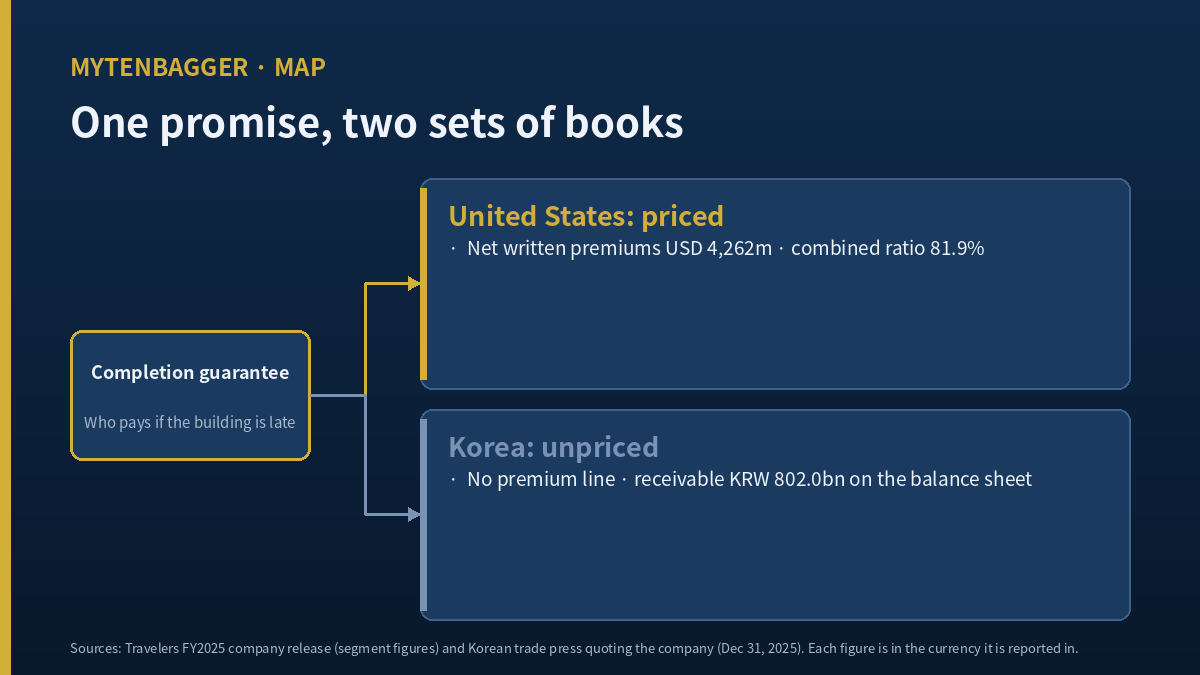
That last sentence is the whole reason I kept reading. In the United States, this same promise is a product. It has a premium line, a loss ratio and an expense ratio, and it is written by insurers who reserve against it. I wanted to hold the two versions up next to each other.
Three numbers, each with the route it reached me by
Company filing, quoted by Korean trade press, as of Dec 31, 2025. Trust account receivable of KRW 802.0 billion.
Financial data screen, consolidated, read on September 9, 2026. Debt to equity of 55.61 percent at June 30, 2026, down from 65.04 percent at December 31, 2024.
Company press release, fiscal year ended Dec 31, 2025. Travelers wrote USD 4,262 million of net premiums in the segment that sells the American version of this promise.
Contents
Where Korea Asset In Trust Stock Sits On September 8, 2026
The shares closed at KRW 2,555. Multiplying that by the 122,373,926 shares outstanding gives KRW 312,665,380,930, which is roughly USD 232.6 million at the exchange rate described in the note at the bottom of this piece. That is a small company by any measure a reader outside Korea would apply, and I will come back to what that means for access.
The consensus on the screen I use is built by two estimating houses. I put that count ahead of the value on purpose. Those two houses carry a 2026 estimated EPS of KRW 449 and a 2026 estimated dividend of KRW 160, and the valuation they publish sits above the current quote by a margin I have chosen not to carry into this note. I am not adopting any of those figures as my own view. I am recording that they exist and that two people made them.
What a KOSPI Listing and a Trust Mandate Actually Are
Two pieces of context for readers who do not follow Seoul. The KOSPI is Korea’s main board, the exchange where the large industrial and financial names trade; the KOSDAQ beside it is the smaller, more venture weighted board. This company is a KOSPI name, which puts it in the senior venue even though its market value is small by the standards of that board.
The second piece is what a Korean real estate trust company does. A developer transfers legal title of a site into trust, and the trust company administers the project for a fee. In the lightest form of mandate the trust company is an administrator and nothing more. In heavier forms it advances its own money when the project runs short, and in the heaviest it also signs the completion guarantee described above. The company also runs asset management for real estate investment vehicles. Fee income comes from the mandates; the balance sheet exposure comes from the two heavier forms, and the composition of the mandate book is therefore the whole question in a downturn.
The Balance Sheet Under Korea Asset In Trust Stock
Here is the part of the accounts I am willing to lean on, taken from the consolidated financial screen on September 9, 2026. Amounts are in hundred millions of Korean won, which is the unit Korean statements are printed in.
| As of | Total assets | Total liabilities | Total equity | Debt to equity |
|---|---|---|---|---|
| Mar 31, 2026 | 17,402 | 6,630 | 10,772 | 61.55% |
| Jun 30, 2026 | 17,125 | 6,120 | 11,005 | 55.61% |
Liabilities fell by more than assets did
Between those two dates total assets fell by 277 and total liabilities fell by 510, so equity rose by 233. That is the arithmetic behind the drop in the ratio, and it is a cleaner story than the ratio alone tells. A company can improve a leverage ratio by shrinking, and this one did shrink, but the liability side shrank faster than the asset side. I did that arithmetic by hand because ratios that move six points in one quarter usually have one line doing all the work.
Across four year ends the same ratio reads 46.26, 42.99, 65.04 and 60.45 percent. The step between the second and third of those, an increase of 18.78 points during 2024, marks the year this business turned. Return on equity over the same four year ends reads 12.15, 13.18, 3.60 and 4.64 percent.
Two quarters I will use and one I will not
The quarterly screen gave me three columns. Two of them, dated March 2026 and June 2026, carry balance sheet totals that appear nowhere else in the file, so I trust their period headers. The third column’s balance sheet totals matched the December 2025 year end exactly while its header said something different, which means the header and the contents disagreed. I left that column out instead of guessing which of the two was right. Revenue of 688 and then 788, with operating profit of 108 and then 310, are the two columns I kept.
Operating margin on those two columns runs 15.70 percent and then 39.34 percent, both by my own division. A margin that more than doubles in one quarter in a business whose costs are dominated by loss provisioning tells me about provisioning, and not much about fees.
A Peer Table Where Every Row Arrived by a Different Route
I could not build the peer table I wanted, so I built one that shows why. Korea’s trust industry has fourteen firms and only a few of them are separately listed. The rest are wholly owned subsidiaries of financial groups, and their numbers reach the public through trade press articles, not through filings I can pull myself. That difference is not a footnote. It is the second column.
| Company | How the figure reached me | As of | Trust account receivable |
|---|---|---|---|
| Korea Asset In Trust (KOSPI: 123890) | Listed. Figure via Korean trade press quoting the company | Dec 31, 2025 | KRW 802.0bn |
| Hana Asset Trust | Not listed. Subsidiary of a financial group, figure via Korean trade press | Jun 30, 2026 | KRW 861.2bn |
| Woori Asset Trust | Not listed. Figure via Korean trade press | Sep 30, 2025 | KRW 289.7bn |
| All fourteen Korean trust companies | Regulatory aggregate, via Korean trade press | Jun 30, 2026 | KRW 9,516.5bn |
Three different dates in a four row table. I am not going to pretend that is a ranking. Korea Asset In Trust’s figure is six months older than the two June figures beside it, and Woori’s is older still. What the table does show, and this survives the date mismatch, is that a company whose market value is KRW 312.7 billion is carrying an advance into project sites of KRW 802.0 billion, or 2.57 times its market value by my own division of two figures in the same currency. That relationship does not need the rows to line up in time.
The industry total I could not put on one line
I found three separate figures for the industry’s total trust account receivable, published within eight weeks of each other by three outlets. One said about KRW 6.7 trillion at the end of the first quarter. Another said KRW 9,516.5 billion at the end of June. A third said about KRW 10 trillion in mid August. I could not tell whether the three were measuring the same set of firms or the same underlying exposure, so I put one of them in the table with its date and left the other two out of any trend. Three points that may not be on the same axis do not make a line.
A Guarantee Is Only as Good as the Balance Sheet Behind It
One more sector figure, from a Korean outlet reviewing the first quarter of 2026 in July. Across the fourteen firms, first quarter net profit came to KRW 75.9 billion and adjusted credit costs to KRW 78.4 billion in the same three months. Alongside those, the sector’s trust account receivable stood at 160.7 percent of the sector’s own equity.
That last ratio is the one I kept. A group of companies that has advanced more than one and a half times its combined equity into project sites is a group whose promises are backed by capital already committed somewhere else. The guarantee and the advance are the same balance sheet, used twice.
The same article named this company as one of three whose credit ratings were lowered. I did not confirm the notch, the assessor or the effective date, and I am not going to infer any of them from a single sentence in a sector review. But I want to mark why a rating matters more here than it does for an ordinary borrower. For a company whose product is a promise to pay if a building is late, the rating is not only an input to funding cost. It is part of what the counterparty is buying.
Korea Asset In Trust Stock Against a Premium Line in America
Here is the comparison I came for. Travelers reports a segment called Bond and Specialty Insurance, which is where surety sits. Surety is the American contract that answers the same question chaekim jungong answers: who pays the lender if the building does not get finished. For the fiscal year ended December 31, 2025, Travelers reported total revenues of USD 48,828 million and net income of USD 6,288 million, and inside that, the Bond and Specialty segment produced net written premiums of USD 4,262 million, segment income of USD 950 million and a combined ratio of 81.9 percent.
Read those three segment numbers slowly. The premium is a separate line of business. The combined ratio says what fraction of every premium dollar went out as losses and expenses, and at 81.9 percent it says the pricing held that year. Segment income divided by net written premiums comes to 22.29 percent by my own division, which I ran only to see the scale.
Now put the Korean version beside it. There is no premium line to divide by. The guarantee was attached to a trust mandate that earns a fee for administering a project, and the fee is not separately priced for the risk of the building not getting finished. When that risk arrives, it does not arrive as a claim against a reserve. It arrives as cash going out of the company and into the site, and later as an allowance held against that cash. That is why the earlier table has a receivable column and no premium column. I did not omit the premium column. It does not exist.
I want to be careful about how far this carries. Travelers and this company are not comparable as investments and I am not putting them in one table. The comparison I am making is narrower: the same economic promise is a priced product in one market and an unpriced attachment in the other, and that difference explains why one shows up in an underwriting result and the other shows up in a balance sheet.
Korea Asset In Trust Stock and a Share Count That Fell
The annual screen prints shares outstanding for each year end. For 2022, 2023 and 2024 the figure is 123,977,752. For 2025 it is 122,373,926. The difference is 1,603,826 shares, or 1.294 percent of the earlier count, and it happened at some point during 2025.
I could not confirm from a filing what caused it. A retirement of treasury stock is the ordinary explanation for a share count that falls and never comes back, but I did not read the disclosure that would settle it, and I am not going to name a mechanism I have not seen. So I am recording the fact and marking the cause as unverified. What the fact does mean, regardless of cause, is that every per share figure computed on the newer count sits on a base 1.294 percent smaller than the older one, and any comparison across that boundary carries that much distortion before anything else happens.
What a foreign account can and cannot do here
This company has no American depositary receipt. Neither of the two Korea country funds most American readers hold is likely to carry a name worth about USD 232.6 million at any weight that matters, and I did not confirm whether either holds it at all, so I am not going to assert an index route that I have not checked. The practical position for most readers outside Korea is that this is a direct market access name or nothing.

What Korea Asset In Trust Stock Would Have to Show Me
I hold none of this and I have placed no order. Watching only. Twenty one things I either cannot resolve or think cut against my reading, in no order of weight:
- The cause of the 1,603,826 share reduction is unconfirmed.
- The loss allowance balance at June 30, 2026 is not in my hands. I read the year end figure only.
- The corporate value up plan filed September 2, 2026 is a title to me and nothing more.
- An investor relations meeting was announced the same day. I do not know what was presented.
- Four litigation filings were disclosed on June 4, June 15, July 30 and July 31 of 2026, with amounts and counterparties I did not obtain.
- The reported credit downgrade is a single sentence in a sector review. The notch, the assessor and the date are all unconfirmed.
- The 55.61 percent ratio rests on an allowance judgment, per the first question above.
- Total liabilities falling 510 in one quarter is a large move I did not decompose.
- My operating margins of 15.70 and 39.34 percent are computed from rounded printed figures.
- The three column quarterly screen had a header that disagreed with its contents, which means the screen itself has at least one defect I found.
- Woori’s receivable in my table is nine months older than the Hana figure beside it.
- The industry aggregate I used is one of three published figures that I could not reconcile.
- Travelers writes surety across a whole American construction market and this company guarantees a set of named Korean sites. Concentration is not comparable.
- A combined ratio and a balance sheet allowance are not the same measurement, and I am using their difference as an argument and not their levels.
- Court outcomes in these disputes move several Korean trust companies at once, which limits how much single company analysis can explain.
- First instance rulings in this area have generally awarded full damages, which is the direction that hurts.
- If the projects behind the receivable reach completion, cash returns and my reading weakens.
- If they slip, more cash goes out instead.
- The consensus is two houses. That is thin enough that one revision moves it.
- Foreign ownership of 5.38 percent and a free float of 45.42 percent mean prices here are set by a small pool.
- I did not open the semiannual report itself. Everything above came from screens and from Korean trade press quoting filings.
Two related pieces of mine sit near this one. The way a receivable can grow while profit grows is the subject of my Korea Gas note on a receivable four times the market value, and the way a share count changes what a multiple means is the subject of my Daishin Securities note on why a quoted multiple can rest on a different share base.
My two conditions. First, whether the loss allowance balance disclosed for December 31, 2026 comes in below the December 31, 2025 level. If it does, the provisioning cycle is genuinely turning and the balance sheet improvement is not just a quarter. Second, whether the next annual report still shows 122,373,926 shares and whether it states why the count fell during 2025. If the count falls again with a stated policy behind it, that is a different company from the one I am describing.
And one more thing I have not put in a closing section before. Both conditions have dates on them, and after those dates they stop being conditions. They become facts that somebody already knows, and the person reading this note then is in a better position than the person writing it now. I am not going to pretend otherwise by phrasing them as though I will be the one to check. I am writing them down so that whoever arrives here after the December 2026 filings has the two questions in front of them without having to reconstruct why they were the questions.
Prices and multiples reflect the September 8, 2026 close in Seoul as checked at the time of writing on September 9, 2026. Korean won is the reference currency throughout. The one dollar figure in this piece uses KRW 1,344.45 per dollar, the September 8, 2026 close, and is approximate. Financial statement figures come from a consolidated financial data screen; industry aggregates and company level items not on that screen come from Korean trade press quoting company filings, named in each case. Divisions I performed myself are marked as such.
Sources: EBN, Sep 1 2026, Hana Asset Trust receivable · EBN, Aug 24 2026, industry first half review · Dealsite, Feb 19 2026, Korea Asset In Trust risk clean up · Newspim, Jul 12 2026, first quarter trust sector · Travelers, full year 2025 results · Company data screen, code 123890 · Filing history index