SK Innovation Stock Rose 37% in a Month: Why I Didn’t Chase It
SK Innovation stock is up 37% in a month, and on the day the KOSPI fell 4.5% it barely flinched. I’m still not buying at ₩130,000 (about $85). Roughly ₩780 billion of the first quarter’s refining profit was inventory valuation gains the company itself calls temporary, and the domestic half of the business now sells fuel under a government price cap whose compensation formula is still being argued over. The one layer I’d actually want to own — lubricant base oil — is real, but I don’t get to buy it separately. My checkpoints are the Q2 print, the first cap settlement, and the battery loss line.
On July 20 the Korean market had one of those days: the KOSPI — Korea’s benchmark stock index, the rough equivalent of the S&P 500 for the Seoul market — dropped 4.5% while Brent sat near $89, because tanker traffic through the Strait of Hormuz had been cut roughly in half. My watchlist was a wall of red with one green column in it: the refiners. So the obvious question — who wins a war-margin market? — answers itself. Refiners, obviously. And that’s exactly what made me suspicious enough to spend a weekend on SK Innovation stock instead of just admiring the chart. When an answer is that obvious, the market has usually already paid for it, and the interesting question becomes what the market is choosing not to look at. In this case I think it’s a piece of paper: a price cap the Korean government slid between the country’s refiners and the best refining margins in a generation. I didn’t ride this move up — I watched the whole first leg from the sidelines, and I’ll own that — so what follows is not a victory lap. It’s me deciding, with the stock at ₩130,000, whether the second act is worth paying for. My answer, for now, is no. Here’s the work behind that answer.
Contents
Why SK Innovation Stock Held When the KOSPI Cracked
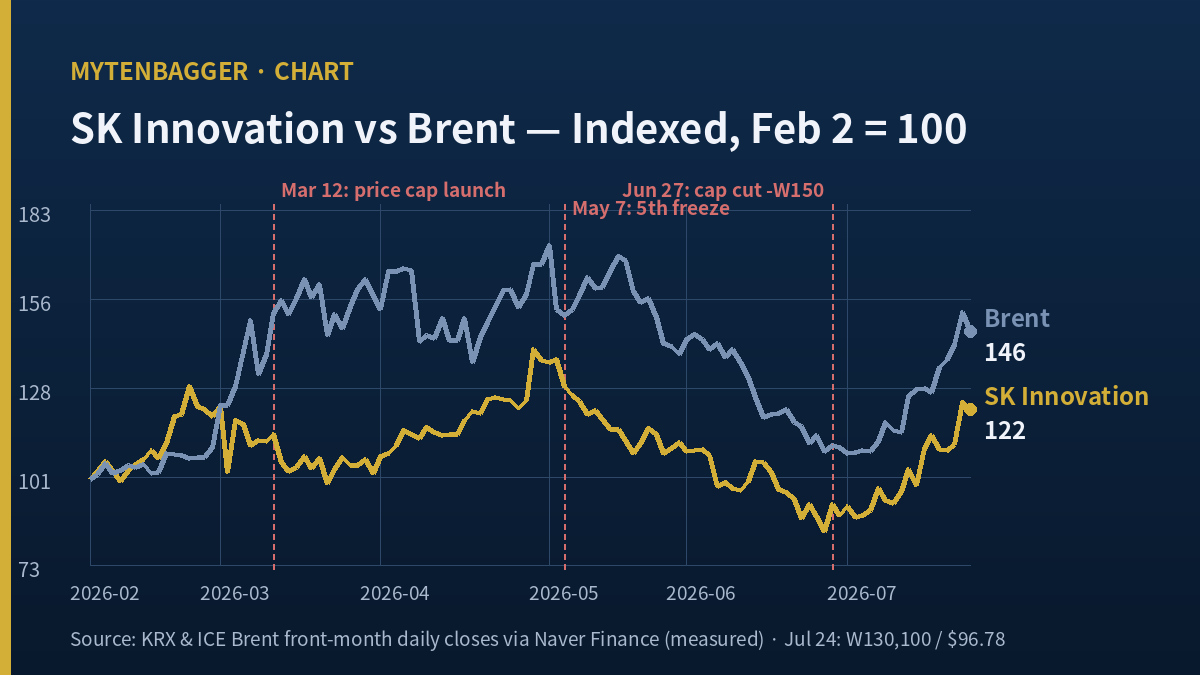
First, the tape, because the tape is what pulls people into this name. Through July 24, SK Innovation stock was up 37.09% for the month, and it was the laggard of the group — S-Oil ran 42.11% and GS 43.74% over the same stretch, per Bloomingbit’s July 25 wrap. The driver is not subtle. The US–Iran confrontation around Hormuz and Houthi attacks on Saudi tankers pushed September Brent through $100 on July 23, and benchmark refining margins — the spread between crude in and products out — averaged about $40 a barrel this month with a $48 print on July 17. The long-term average is about $10. Airlines fell hard the same day for the mirror-image reason. S-Oil carries a different overhang of its own: 9.26 trillion won committed to a single petrochemical complex that is built but not running, in the one segment that lost money last quarter.
Meanwhile the broader market was breaking. The AP’s July 20 market report has the KOSPI down 4.5% with Brent at $89.22 and Hormuz transits at 127 vessels, half the prior week’s count. Three days later Brent was through triple digits. That whiplash — $89 to $100-plus inside a week — matters later in this journal, so hold onto it.
Where does that leave the stock? My daily data has the July 24 close at ₩130,100, about $86 at the ₩1,520/$ rate I’ll use throughout. That’s up from roughly the ₩95,000 area a month ago, against a 52-week range of ₩87,700 to ₩155,400. Shares outstanding put the market cap around ₩21.99 trillion, call it $14.5 billion (my back-calculation from the share count, so treat it as derived, not disclosed). That friction is part of why Korean refiners often move after their story is already visible in English.
What’s Actually Inside the SK Innovation Stock Rally
I first filed this whole move under “war beta” and almost stopped there. Splitting the profit into layers changed my read — not to a friendlier one, exactly, but to a more specific one. There are three layers, and they deserve opposite treatment.
Layer one: inventory gains — the part the company itself calls temporary
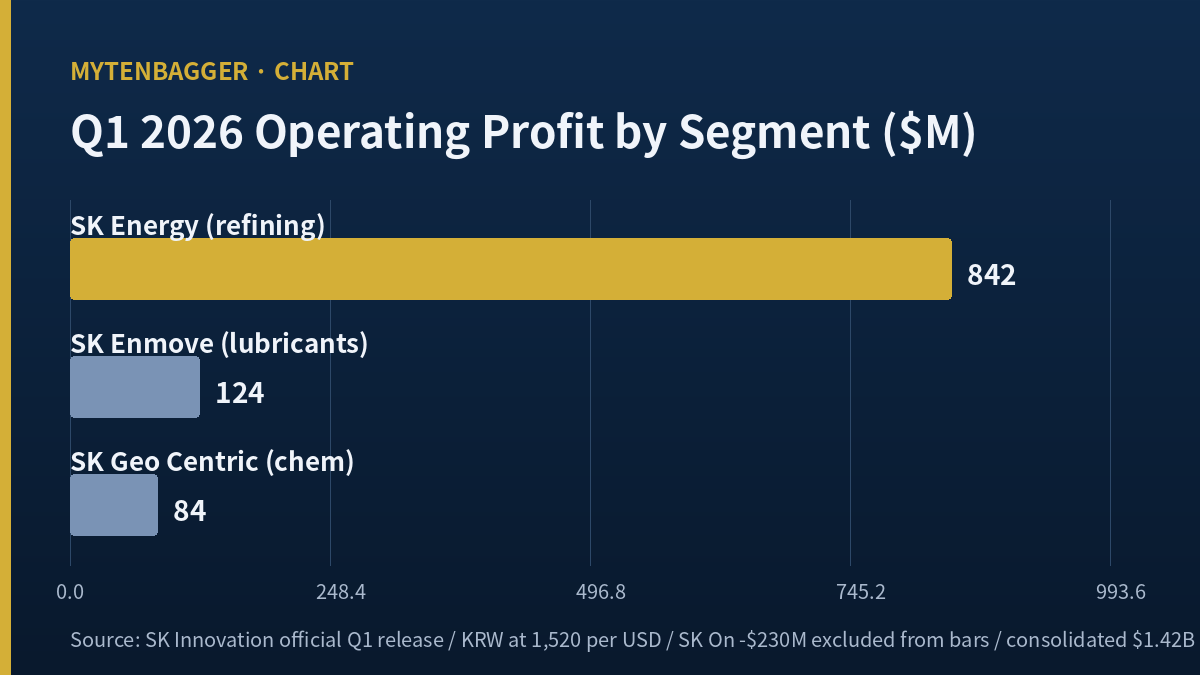
In SK Innovation’s official Q1 2026 release, the company posted revenue of $15.9 billion (₩24.21 trillion) and operating profit of $1.42 billion (₩2.16 trillion). The refining arm, SK Energy, earned $842 million (₩1.28 trillion) of that. And then the company did something I respect: it flagged, in its own materials, that roughly $513 million (₩780 billion) — about 60% of SK Energy’s operating profit — came from inventory valuation gains, the accounting windfall you get when crude you bought at $63.9 a barrel is suddenly marked against a market that touched $128.5 in March. The company’s own caveat was that this piece “may decline or disappear if oil prices fall.” That is not a bear making that argument. That is the CFO’s office.
Here is the Q1 anatomy in one table, dollars first, company figures throughout:
| Q1 2026 segment | Operating profit | KRW |
|---|---|---|
| SK Energy (refining) | $842M | ₩1,280.0B |
| — of which inventory valuation gains (company estimate) | ~$513M | ~₩780B |
| SK Enmove (lubricants) | $124M | ₩188.5B |
| SK Geo Centric (petrochemicals) | $84M | ₩127.5B |
| SK On (batteries) | -$230M | -₩349.2B |
| Consolidated operating profit | $1.42B | ₩2,160.0B |
Source: SK Innovation Q1 2026 official results release | USD at ₩1,520/$ (my conversion) | Segments shown are the main four; smaller units omitted
Read the first two rows together and the uncomfortable arithmetic falls out: strip the self-declared inventory effect and the mighty refining quarter earned about ₩500 billion on an operating basis. Good, not historic. The sell side knows this too — the Street’s Q2 consensus sits at $980 million (₩1.49 trillion), a drop of roughly 31% from Q1 (my back-calculation from the two prints), precisely because nobody expects the crude-mark windfall to repeat at the same size.
Layer two: lubricant base oil — the layer I take most seriously
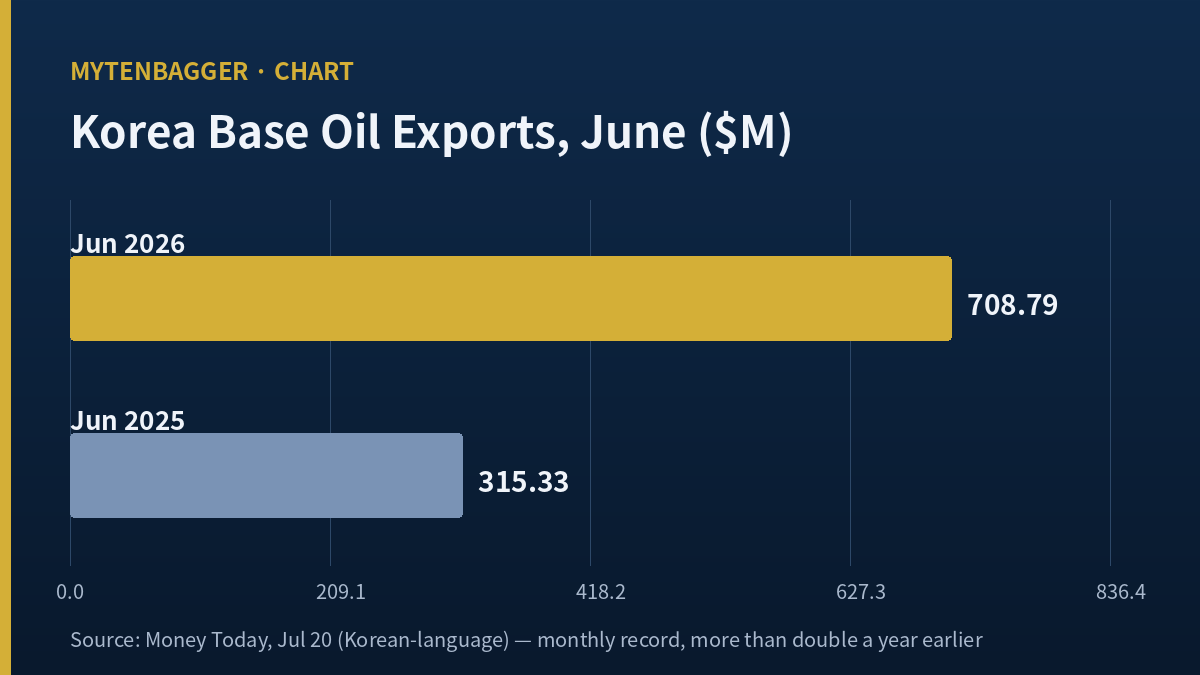
The quiet story inside the loud one. Middle East disruptions knocked out supply from Qatar’s Pearl GTL and Saudi Arabia’s Satorp — two pillars of premium base oil — and Korea happens to be the other pillar. Per Korean daily Money Today’s July 20 report (Korean-language source), SK Innovation’s lubricants unit SK Enmove and S-Oil together handle roughly 40% of global Group III base oil production, international Group III prices have run to nearly $4,000 a ton from the $1,000-plus range early this year, and Korea’s June base oil exports hit a monthly record of $708.79 million — more than double June last year’s $315.33 million. The paper adds an important structural point: restoring the lost supply needs crude procurement, refinery restarts, inventory rebuilds and shipping lanes all normalized at once, which is why the shortage is expected to outlast the headlines.
The named sell side is leaning hard on this layer. In a July 16 note reported by Edaily (Korean-language source), Hana Securities’ Yun Jae-sung modeled Q2 operating profit of $1.19 billion (₩1.809 trillion) — 21% above that ₩1.49 trillion consensus — with the lubricants segment alone contributing an estimated $626 million (₩950.9 billion) at a 40.7% operating margin, and raised his full-year 2026 estimate to a record $4.29 billion (₩6.52 trillion). His objective went from ₩170,000 to ₩200,000 (about $132). An English-language summary of the same note carries his supply argument: damage to Qatar’s GTL facilities leaves at least 10% of global Group III capacity struggling to run normally until the first half of 2027. KB Securities’ Jeon Woo-je, same day, set ₩180,000 (about $118) with a Q2 estimate of $1.58 billion (₩2.4 trillion) — 57% above consensus — arguing product inventories are thin, a second round of strait disruption has been underway since July 8, and jet fuel demand starts climbing from July as airlines fly longer routes around closed airspace, per Newspim’s report brief (Korean-language source; the same brief puts the six-month brokerage average objective at ₩163,154). To be clear on attribution: those are their estimates and their objectives, not mine, and the two houses disagree with the consensus by 21% and 57% respectively — a spread that itself tells you how unmodelable this quarter is.
I’ll admit the $4,000-a-ton print made me sit back for a minute. If I could buy SK Enmove by itself, this journal would probably read differently. I can’t. It comes bundled with everything else on this page.
Layer three: SK On — the loss that shrank but didn’t leave
The battery subsidiary lost ₩349.2 billion ($230M) at the operating line in Q1 — an improvement of ₩91.6 billion from the prior quarter, per the company’s release. Hana’s note attributes the narrowing to volume recovery and US tax credits. My own framing, and I want to be careful that this is mine: the question for the second half is whether that loss line keeps walking toward zero, because a refiner-plus-lubricants story with a battery unit bleeding $200-plus million a quarter is a different equity from one where the bleed stops. Every won the war margin earns upstairs, the chasm-era battery buildout has been spending downstairs. The rally has decided the upstairs matters more. Fair enough — but that’s a bet on both floors, whether the buyer knows it or not.
The Price Cap Nobody Prices: SK Innovation Stock’s Other Ledger
Now the part that kept me from buying, and the part I see discussed least in English. On March 12, Korea introduced its first fuel price cap since 1997 — capping what refiners can charge distributors and gas stations, initially at ₩1,724 a liter for gasoline (about $1.13), reset every two weeks, explicitly to stop the Middle East spike from passing through to pumps, as Malay Mail reported at launch. By May the caps had been raised once and then frozen at ₩1,934 for eight straight weeks across five extensions, with crude swinging between $100 and $110; the trade ministry’s own counterfactual, per Seoul Economic Daily’s English edition, was that gasoline would otherwise cost ₩2,200. From June 27 the government began normalizing, cutting caps by ₩150 to ₩1,784, per Money Today (Korean-language source).
So who eats the difference between the world price and the capped price? On paper, nobody — the government promised compensation. In practice, the arithmetic is a live fight. Per Korea Economic Daily’s June 18 report (Korean-language source), the ministry’s draft rule compensates on a “production cost plus reasonable margin” basis — each refiner’s audited crude, depreciation and labor costs, reviewed by a settlement committee — while the industry wants losses measured against international product prices (the Singapore MOPS benchmark), a basis on which refiners put their combined loss at ₩3–4 trillion including forgone profit. Per the same Money Today report linked above, the government has budgeted a $2.8 billion (₩4.2 trillion) reserve, the settlements run quarterly, and the first one covers March 13 through June 30. A senior ministry official quoted in that report was blunt in a way that translates cleanly — as he framed it, emergency-period taxpayer money is not going to underwrite refiners’ peacetime-level profits. Money Today adds the hard technical problem underneath: one distillation run produces gasoline, diesel and naphtha simultaneously, so even honest people can’t easily agree what the “loss” on one capped product is.
One company, two prices at the border: every export ton floats on the best margins in a generation, while every domestic liter is sold against a number set in a ministry meeting room.
That sentence is the core of my hesitation, so let me unpack it once. The rally math treats SK Innovation as a pure taker of that $40 refining margin. But a meaningful slice of its barrels never touches that margin — they’re sold at home under the cap, and what shareholders hold instead is a receivable from the state, of contested size, on a contested formula, paid on a committee’s schedule. I have no idea how to put a multiple on that receivable, and I notice the market has decided not to try — it’s simply paying for the visible margin and ignoring the ledger behind it. Sometimes that works. It’s still not an analysis, and there’s something nagging me about owning a claim whose counterparty also writes the rules.
SK Innovation Stock Next to Marathon and Valero
The cleanest way I know to see the cap’s shadow is to look at refiners that don’t have one. Per Forbes’ July 23 piece, the US 3-2-1 crack spread has broken above even its 2022 crisis peak; Marathon Petroleum and Valero have nearly doubled this year, Phillips 66 is up 66%, and the refiner ETF CRAK gained more than 21% in July alone. US gasoline prices are up 98% this year against 44% for WTI — the product, not the crude, is where the war shows up — on top of a structural base: US refining capacity down about 1.2 million barrels a day since 2019, and global refining output down an estimated 4.5 million barrels a day in Q2.
An American refiner keeps that spread. A Korean refiner banks the export share of it and swaps the domestic share for the government IOU I just described. I read the performance gap — SK Innovation stock’s +37% month against US peers’ doubling year — as partly that cap discount and partly the conglomerate wrapper, with the battery unit’s losses riding along. I’d normally anchor this section with peer multiples, but I couldn’t verify current P/E figures for the US names to my own standard while writing, so I’m deliberately leaving them out rather than quoting numbers I haven’t checked. The structural contrast stands without them. Worth saying out loud: the Korean names are cheaper for reasons, and the reasons have names — cap, committee, chasm.
Three Paths I’m Sketching From Here
Probabilities here are my personal markers, not math — they exist so a future me can grade this entry honestly.
The path I’d weight most (~40%): the margin outlasts the summer
Hormuz stays restricted into the autumn, margins hold well above the $10 long-run average even off the $48 extreme, and Q2 lands closer to Hana’s ₩1.8 trillion — or KB’s ₩2.4 trillion — than to the ₩1.49 trillion consensus. The lubricants shortage runs its course slowly, exactly as the supply-chain argument suggests. The first cap settlement pays out enough to make the receivable credible, and the stock grinds toward the sell side’s clustered objectives in the ₩160,000–200,000 band. In this path my caution costs me the last leg, and I’ll write that entry when it happens.
Where the rally unwinds (~35%): the premium leaves faster than it came
Brent went from $89 to $100-plus in three days in July; it can make the return trip just as fast if the strait reopens. The company already told everyone what happens next — the inventory gains “may decline or disappear,” this time with the sign flipped, since crude bought at wartime prices would be marked against a falling market. The Money Today report above already projects refiners’ Q2 operating profit down 24–35% from Q1 on the crude reversal that happened mid-quarter. Meanwhile normalization cuts the caps toward market prices, which removes the political drama but also means the settlement — computed on “actual cost,” not the industry’s MOPS math — comes in far below the ₩3–4 trillion the refiners claim. A stock that rose 37% in a month on margin euphoria can retrace most of it on margin normalization. I’ve watched Korean refiners do exactly this across cycles; the down leg never sends a calendar invite.
The tails (~25%): escalation, or a sudden peace
Escalation tail: brokerages quoted in the Bloomingbit wrap float $160 crude if the conflict deepens. Perversely, I don’t think that’s clean upside for this equity — at $160 the political pressure that produced the cap intensifies, the caps ratchet, and the share of profit routed through the committee grows. Windfalls that visible invite windfall politics. Peace tail: an abrupt reopening compresses margins and the lubricants premium together, and layer one reverses while layer two deflates. Either tail, note, argues against paying a full price today for this quarter’s earnings power.
Where I’d Change My Mind — Three Checkpoints in Order
Staged, because they answer in sequence, and each one hands its answer to the next.
First, the Q2 print — the composition, not the headline. Due within weeks. I’ll read three lines before anything else: how much inventory-gain residue is still in refining; whether SK Enmove’s segment profit lands anywhere near Hana’s modeled ₩950.9 billion; and the slope of SK On’s loss. A headline beat built on another crude-mark windfall changes nothing for me. A lubricants number near the model changes a lot.
Second, the first cap settlement. The window closed June 30; the committee’s decision tells me what fraction of the industry’s claimed ₩3–4 trillion actually converts to cash. That ratio is my price on the government receivable, and by extension on every future quarter the cap regime lasts. A stingy first settlement on the “actual cost” formula would confirm my discount; a generous one would force me to redo every line of this work, and I’d do it without complaint.
Third, the second half: SK On’s walk to break-even, and the blockade itself. If the loss line keeps shrinking while Brent holds triple digits, the two floors of this company stop fighting each other for the first time in years. If Brent heads back toward its March starting line — the company’s own materials used $63.9 as the pre-spike mark — then layer one runs in reverse and I want to be nowhere near the unwind. My thesis for even watching this name breaks if the settlement is stingy and the strait reopens in the same quarter; at that point the 37% month becomes a museum piece.
So: I’m passing at ₩130,000, on paper and in my account. Not because the businesses are bad — the base oil franchise is the real thing — but because the price now assumes the margin belongs to shareholders, and I count at least one hand between them and it. I’d rather pay up later for a confirmed lubricants engine and a priced receivable than pay today for a war premium with a committee attached. The night the sidecar halts were tripping I caught myself refreshing a tanker-tracking map at midnight instead of sleeping, which told me the market was trading on the same three ships everyone else was watching — that’s usually my cue to step back and read filings instead. The Q2 print and the settlement decision land within weeks of each other. I’ll re-run every number on this page then, in public, including the ones that end up embarrassing me.
Related journals — the same policy-holds-the-price lens: KEPCO Stock at 2.5x Earnings: The Market Prices Only Tariffs · the blockade’s other beneficiary: HMM Stock Trades 20% Below Its Own ₩26,200 Buyback Price · a different commodity-cycle scale: POSCO Holdings Stock Fell 42% Just as Lithium Started Paying