POSCO Holdings Stock Fell 42% Just as Lithium Started Paying
POSCO Holdings stock has fallen about 42% from its early-May peak — while the company’s Argentine lithium unit posted its first monthly operating profit since starting commercial production. I opened a small scout position near ₩311,000 (about $210 for the Seoul shares; the NYSE ADR is PKX). Whether the scouts get reinforcements depends on what the July 30 second-quarter call says about lithium losses and that monthly-profit streak.
POSCO Holdings stock closed at ₩311,500 on July 17 — call it $210 and change at recent exchange rates. On May 7 it traded as high as ₩542,000, roughly $370. That is a 42% drawdown in about ten weeks, computed straight off Korea Exchange prices. Here is what makes the chart interesting rather than merely painful: over those same ten weeks, the operating news ran the other way. The company’s lithium subsidiary in Argentina booked its first monthly operating profit in March and pushed utilization past 70%, and four Korean brokerages still have their published calls parked between ₩533,000 and ₩650,000 (about $365 to $445). When a price halves its spring gains while the underlying business inflects upward, either the market knows something I don’t, or it is handing out a discount before the proof arrives. I spent two weeks trying to figure out which. My answer landed in the middle, and so did my position size.
One housekeeping note for readers outside Korea. POSCO Holdings trades on the KOSPI — the main board of the Korea Exchange in Seoul, home to the country’s large caps — under ticker 005490, and it is one of the few Korean industrials you can buy directly in New York: the ADR trades on the NYSE as PKX. Everything below uses Seoul prices, with rough dollar figures alongside.
Contents
How POSCO Holdings Stock Lost 42% in Two Months
The run-up came first. On April 30 the company reported first-quarter results — consolidated revenue of ₩17.87 trillion (about $12 billion) and operating profit of ₩707 billion (about $480 million), per the company’s own release — and paired them with a three-year shareholder-return framework: 35–40% of adjusted controlling-interest net income for 2026–2028, split between a steady dividend and newly announced buybacks with cancellation. The stock ran from the ₩360,000s in mid-April to that ₩542,000 intraday print on May 7. The same day, Kiwoom Securities analyst Lee Jong-hyung lifted his call 39% to ₩650,000, arguing the Argentine lithium business was making a structural swing into profit, and noting Chinese lithium carbonate spot had climbed into the $25,000-per-ton range in early May — that attribution and those numbers come from his note as covered by the Korean financial press.
Then the tide went out. On May 12 the stock dropped almost 7% on one of its heaviest volume days of the year. Chinese lithium futures — which had topped 200,000 yuan per ton on May 13 — slipped back below 190,000 by late May, per Trading Economics data. The stock stair-stepped down through June, touched ₩292,000 intraday on July 9, and now sits about 21% below its own 60-day moving average. Market cap is roughly ₩24.7 trillion, or about $17 billion — you can see the long arc of this valuation on Macrotrends’ PKX history. The final leg down got its narrative on July 7, when KB Securities analyst Choi Yong-hyun penciled in second-quarter operating profit of ₩692 billion (about $470 million), slightly below consensus, and blamed near-term steel weakness — his view, as carried by The Asia Business Daily’s English edition. So the rally was a lithium story, and the give-back was a steel story. That asymmetry is the whole setup here.
The Lithium Turn: March Was the First Month in the Black
I have watched this company promise that lithium would eventually pay for years, and I will admit the promises had started to wash over me. What changed this spring is that the evidence moved from guidance decks to income statements. Three data points, all from the first quarter, all reported by Korean trade press in early May from the company’s disclosures.
First, POSCO Argentina — the brine operation at Salar del Hombre Muerto — posted first-quarter revenue of about $19 million (₩28 billion) against an operating loss of about $12 million (₩18 billion). A loss, yes. But a year earlier the same quarter showed less than half the revenue and an operating loss three times as deep (₩54 billion). Utilization crossed 70% in March, and March itself was the unit’s first month of positive operating profit since commercial start-up. Second, the Gwangyang lithium-hydroxide plant run with Australia’s Pilbara Minerals cut its quarterly loss to near break-even — about $2 million — from a ₩49 billion loss a year before. Third, the battery-recycling unit swung to a small operating profit. Three units, one direction. You can argue the lithium price rebound did the work — Korean coverage noted global lithium prices roughly 2.7x off their mid-2025 lows by late April — but price alone doesn’t lift utilization. Both moved together, and that is what a real ramp looks like.
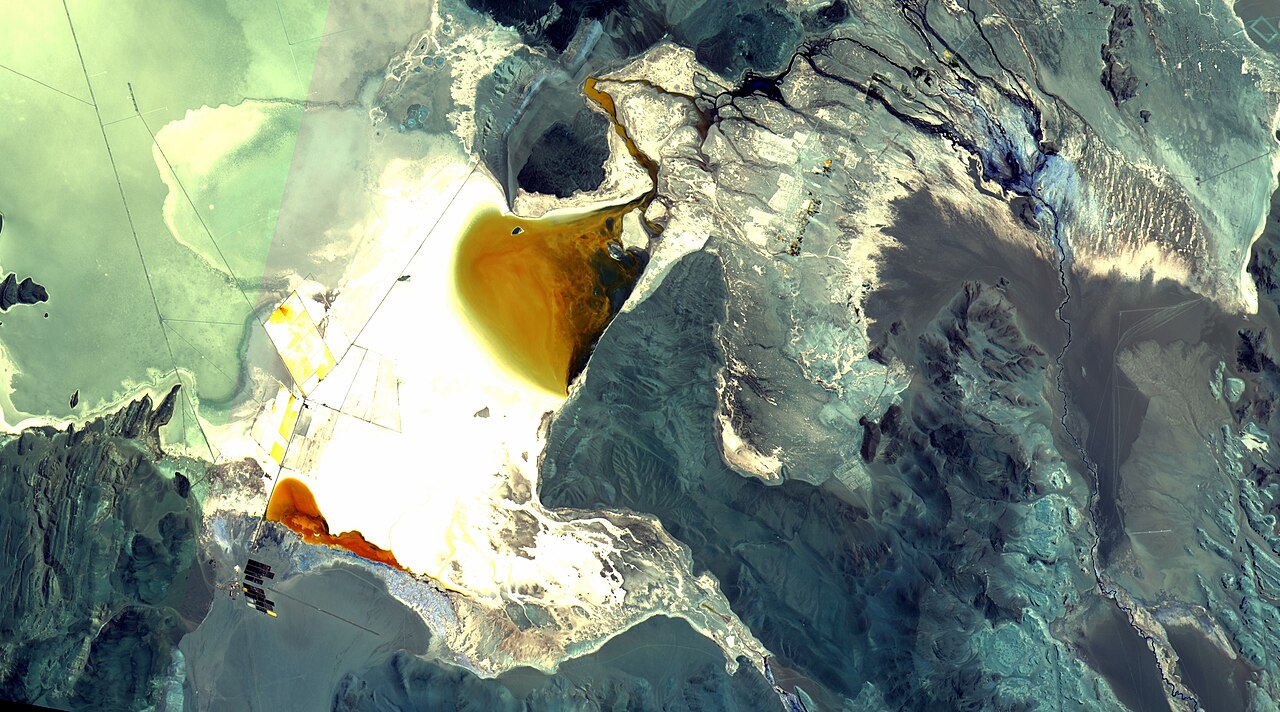
The resource base keeps widening, too. On April 9 the company said it had completed the roughly $65 million acquisition of Lithium South’s Argentine subsidiary, adding the Hombre Muerto North brine block — about 1.58 million tons of resource — and bringing its Argentine total to some 15 million tons by the company’s count. That followed the late-2025 deal for a 30% stake in a Mineral Resources holding entity in Australia, worth $765 million, which secures about 270,000 tons of lithium concentrate a year, as reported at the time by Korean media. And the stated ambition is bigger still: 173,000 tons of annual lithium capacity by 2033, a top-five global position, and lithium operating profit of $1.2 billion by 2035, within a group investment plan of ₩16.7 trillion (about $11 billion) through 2028 — laid out in The Korea Times’ July 2 rundown of chairman Chang In-hwa’s portfolio reset. There is also a pending wild card: Argentina’s RIGI large-investment incentive regime, which the company says would cut taxes and ease currency rules if its projects are approved. I treat the 2033 numbers and RIGI as free options, not as the thesis. The thesis is the March monthly profit.
It also matters where the demand is coming from. The bull note I found most specific on this was Hanwha Investment & Securities’ early-May call — analyst Kwon Ji-woo raised his number to ₩550,000 arguing that energy-storage demand, not electric vehicles, has become the core engine of the lithium fundamentals (Korean press coverage of the note). That reframing is worth pausing on. The 2023–2024 lithium bust was an EV-demand story; the 2026 recovery is increasingly a grid-storage story, which runs on utility procurement cycles rather than consumer sentiment. It is why lithium futures, even after their May pullback, were still up roughly 190% year-on-year in late May per Trading Economics — a rebound of that size against a backdrop of cautious EV headlines only makes sense if a second demand pillar is doing the lifting. For a producer ramping brine capacity into that market, the demand mix matters as much as the price level: storage buyers contract in volume, and volume is exactly what a 70%-utilization plant needs to keep climbing.
The Bear Case on POSCO Holdings Stock: Steel Is Still on the Floor
Now the other side of the ledger, because it is heavy. This is still, by earnings weight, a steel company — and steel is the reason last year was ugly. Full-year 2025 consolidated operating profit came in around ₩1.83 trillion (about $1.25 billion), per the annual report — weak enough that Korean papers spent January asking whether the company would hold the ₩2 trillion line it had defended for two decades. The 2025 number carried the fallout from the Shin-Ansan construction collapse at its POSCO E&C unit, which Mirae Asset’s June note treats as a base-effect item for this year. On trade, the US 50% steel tariff has hardened into a fixture rather than a negotiation — the read of Korean industry press since last fall. The scale of that wall is easiest to see through a peer’s checkbook: Nippon Steel paid roughly $14 billion to acquire U.S. Steel and produce inside the tariff line, while Korean mills largely remain exporters standing outside it. American producers get the pricing umbrella; Korean producers get the margin squeeze. That, more than anything company-specific, is why Korean steel assets trade at a fraction of book while US steel equities have re-rated — and it is a discount POSCO cannot fix with execution alone. And KB’s second-quarter segment math still has the battery-materials division at a ₩11 billion loss: monthly profits in Argentina notwithstanding, the segment as a whole hasn’t crossed zero on a quarterly basis yet.
| Item | FY2025 | Q1 2026 | Q2 2026 (KB est.) |
|---|---|---|---|
| Operating profit | ₩1.83T (~$1.25B) | ₩707B (~$480M) | ₩692B (~$470M) |
| Battery materials segment | loss-making all year | Argentina -₩18B | -₩11B |
| POSCO Argentina | Q1’25 loss ₩54B | -₩18B, March in the black | streak is the question |
| Quarter’s defining event | accident costs, tariffs | 3-yr return policy | earnings call July 30 |
Sources: company release (Q1 2026), FY2025 annual report, KB Securities July 7 estimates via Korean press, Dealsite May 5 reporting (Argentina) | As of July 17, 2026
Put valuation on top of that table and you get the contradiction that defines this stock. On last year’s depressed earnings, the shares trade near 38x (back-calculated from FY2025 EPS of ₩8,085) — not cheap. On book value they trade at 0.44x. My reading is that the 38x is evidence the denominator is at a cyclical floor, not evidence the stock is expensive; the 0.44x tells you what the market will pay for steel assets in a tariff world. The honest caveat: if the steel downcycle runs longer than anyone models, “floor” becomes “basement,” and I would be early. Analysts as a group have been shaving their numbers, not raising them — an aggregation note at Simply Wall St flagged fair-value estimates being trimmed even as the lithium view improved. I hold both facts at once.
One more layer a US reader should have: part of that 0.44x is a Korea story rather than a POSCO story. Seoul’s Corporate Value-Up program — the government-led push, modeled loosely on Japan’s exchange reforms, to shame and incentivize listed companies out of chronic book-value discounts — is the policy backdrop against which POSCO announced its April return framework. Holding companies and old-economy industrials have been the deepest-discount corner of the KOSPI for years, and the Value-Up era is slowly repricing the names that actually return capital. That is the second-order bet inside my position: a company that pairs a real earnings recovery with a stated 35–40% payout ratio is exactly the profile the policy wind favors. If the earnings recovery doesn’t come, though, no policy program rescues the multiple — Value-Up rewards delivered numbers, not frameworks. So I log it as tailwind, not thesis, same shelf as RIGI.
Where Korean Analysts Put POSCO Holdings Stock — and What I Actually Take From It
Four named sell-side calls frame the forward view, all from Korean-language reports; I cite them, I don’t adopt them. Kiwoom’s Lee Jong-hyung went to ₩650,000 on May 7 on the structural lithium turn, keeping the name his sector top pick. Hanwha’s Kwon Ji-woo raised to ₩550,000 in early May, calling energy-storage demand the core engine of the fundamentals — Korean outlets reported both. Mirae Asset’s Kim Ki-ryong set ₩620,000 on June 8, modeling 2026 operating profit of ₩3.05 trillion, up 67% — a number that assumes steel price hikes stick in the second half. KB’s Choi Yong-hyun, the most conservative of the four, sits at ₩533,000 as of July 7 — and even that is roughly 70% above the last close (my arithmetic, not his). I don’t lean on that gap: sell-side numbers descend slowly after a 40% drawdown, and some of these marks probably haven’t caught up with the tape. What I do take seriously is the shared architecture — all four put the lithium turn at the front of the argument, with Mirae Asset pairing it with second-half steel price hikes rather than replacing it. KB’s specifics give the skeleton: an all-in Argentine brine cost around $11,000 a ton by 2028, and roughly ₩500 billion (about $340 million) a year in operating profit at full run-rate. If the cost line lands anywhere near there, the business survives lithium prices far below today’s.
One quarter just earned 39% of last year’s full-year operating profit — ₩707 billion in Q1 against ₩1.83 trillion for all of 2025 (my back-calculation). The income statement turned before the stock did.
That ratio is the quiet number I keep coming back to. And there is a structural point US investors will recognize faster than a Seoul-only reader might: pure-play lithium names — think Albemarle or SQM — live and die with the commodity, and a ramp caught in a downcycle usually means dilution or delay. POSCO is running its lithium ramp off a steel-and-infrastructure engine that generates on the order of ₩700 billion in quarterly operating profit (KB’s segment math for Q2). I wrote it down as “steel pays lithium’s tuition.” The same coupling works in reverse — steel weakness is exactly why the whole thing trades at 0.44x book — but it means the ramp is funded without passing the hat, which is not something the pure plays can say.
A Dividend Cushion Under POSCO Holdings Stock While I Wait
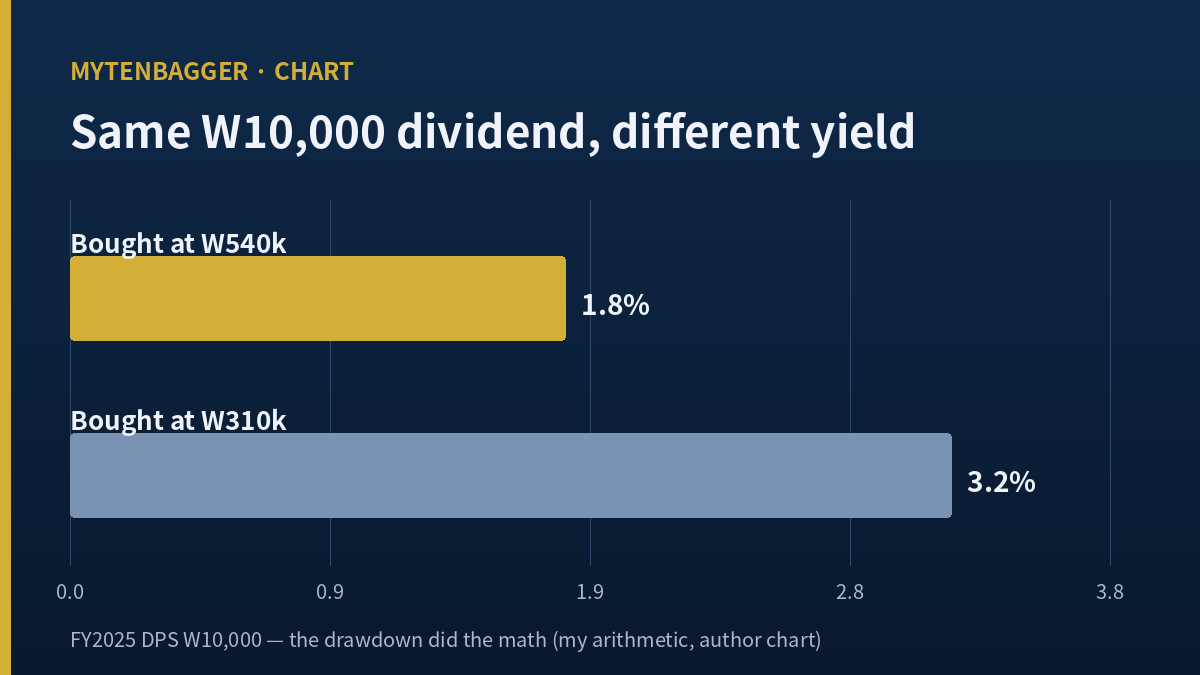
The waiting itself pays something. Korean regulatory filings show the dividend held at ₩10,000 a share (about $6.80) for fiscal 2023 through 2025, down from ₩12,000 in 2022 — flat through the worst earnings stretch in two decades, which I read as management drawing a line under it. At ₩311,500 that is a yield of about 3.2% (my arithmetic). Anyone who bought at the May peak locked in 1.8%; the drawdown did the yield work for late arrivals. Layer on the April framework — 35–40% of adjusted controlling-interest net income returned through 2028, dividends plus new buybacks-and-cancellation, per the company — and the return stream is performance-linked: if earnings recover, the payout pool grows with them. That cuts both ways, and it is why the dividend is a cushion here, not a thesis. For ADR holders, PKX passes these distributions through with the usual Korean withholding mechanics — worth checking with your broker rather than assuming.
Three Paths I Can See From Here
Probabilities are mine alone; the market will grade them.
Base path — my 50%. Q2 lands near KB’s ₩692 billion, slightly under consensus, with battery materials still modestly negative. But the call confirms the Argentine monthly-profit streak held and second-half steel price hikes are progressing (the auto and shipbuilding negotiations Mirae Asset flagged). The stock builds a floor in the low ₩300,000s, and my scouts get reinforcements on a schedule, not on a whim. One thing I will listen for beyond the segment lines: whether management puts a size on the new buyback. The April framework promised fresh repurchases with cancellation but attached no number in the release — and a sized tranche executed at 0.44x book would be the loudest possible statement that the people with the best information agree the discount is wrong. Silence on sizing, by contrast, would tell me the framework is still a brochure.
The path where I’m wrong — 30%. Lithium prices roll back over, March turns out to have been a one-month cameo, and tariff-era steel keeps grinding. In that world 0.44x book isn’t a bargain, it’s a structural discount that stays. I take the small loss on the scouts and stand down. No averaging into a broken thesis.
The tails — 20%. Upside tail (15%): lithium strength resumes on storage demand and the battery segment crosses zero a quarter early, at which point the two-month drawdown unwinds fast. Downside tail (5%): a group-level surprise — last year’s accident costs are a reminder that unbudgeted charges are not exotic events at this conglomerate.
My Scouting Position in POSCO Holdings Stock — and the July 30 Gate
What I actually did: a small scout position this week, near ₩311,000. I’ll own the sloppy part of the record too — when the stock broke ₩500,000 in early May I wrote a note to myself to look again “if it ever comes back down,” and then didn’t look for a month. The July 9 low is a receipt for what that inattention cost. So this time the checkpoint has a date attached.
The company has set its Q2 provisional earnings call for July 30 — it’s in an SEC 6-K, since PKX reports to Washington as well as Seoul. Three questions go in with me. Did the battery-materials loss hold near KB’s -₩11 billion, or blow out? Did Argentina’s monthly profits continue through the quarter? And are the second-half steel price increases showing up as actual negotiations, not slideware? If the three answers point the same direction, I scale in on a schedule. If they split, the scouts hold the ground alone until the next quarter. And if lithium slides toward that $11,000 all-in cost line while the monthly profits die — the hypothesis itself gets retired, in writing, in this journal. Retiring a thesis is also a result.
So that is my ledger on POSCO Holdings stock: a 42% markdown taken as a discount offered before the proof, answered with scout-sized money because my conviction is currently scout-sized. July 30 writes the next line. My journal just shows the work. The ADR route is the simplest of the three, with the usual caveats — the ADR tracks the won-denominated Seoul price, so currency moves ride along with the equity story whether you invited them or not.
Primary sources and coverage: POSCO newsroom — Q1 2026 results and 3-year shareholder-return policy (Korean), Kiwoom note coverage (Korean, May 7), Mirae Asset note coverage (Korean, June 8), lithium subsidiaries’ Q1 figures (Korean, May 5).
Related reading
- Samyang Foods Stock: I Bet on Capacity, Not Buldak Hype
- SK Innovation Stock Rose 37% in a Month
- POSCO M-Tech Stock Paid Out 1.47 Times Its 2024 Profit