HMM Stock Trades 20% Below Its Own ₩26,200 Buyback Price
- I don’t own HMM, Korea’s flagship container carrier, and I didn’t chase this freight rally. What pulled me back to the chart is a stranger fact: HMM stock trades around ₩21,000 (~$13.80), roughly 20% below the ₩26,200 (~$17.20) the company itself paid last September to buy back and burn 8% of its shares (my arithmetic).
- Sell-side full-year operating profit talk has moved from ₩858 billion (~$560M, a January Hana Securities estimate) to roughly ₩2 trillion (~$1.3B, the range Korean trade press now reports) in five months. The added trillion comes from Red Sea detours and tariff-deadline front-loading — earnings with an expiry date nobody can read.
- My timetable has three pages: mid-August Q2 results, the September–October freight tape, and — the only one that isn’t about freight — the structure of the state’s 70% stake sale. I’m writing, not buying, until they turn over in that order.
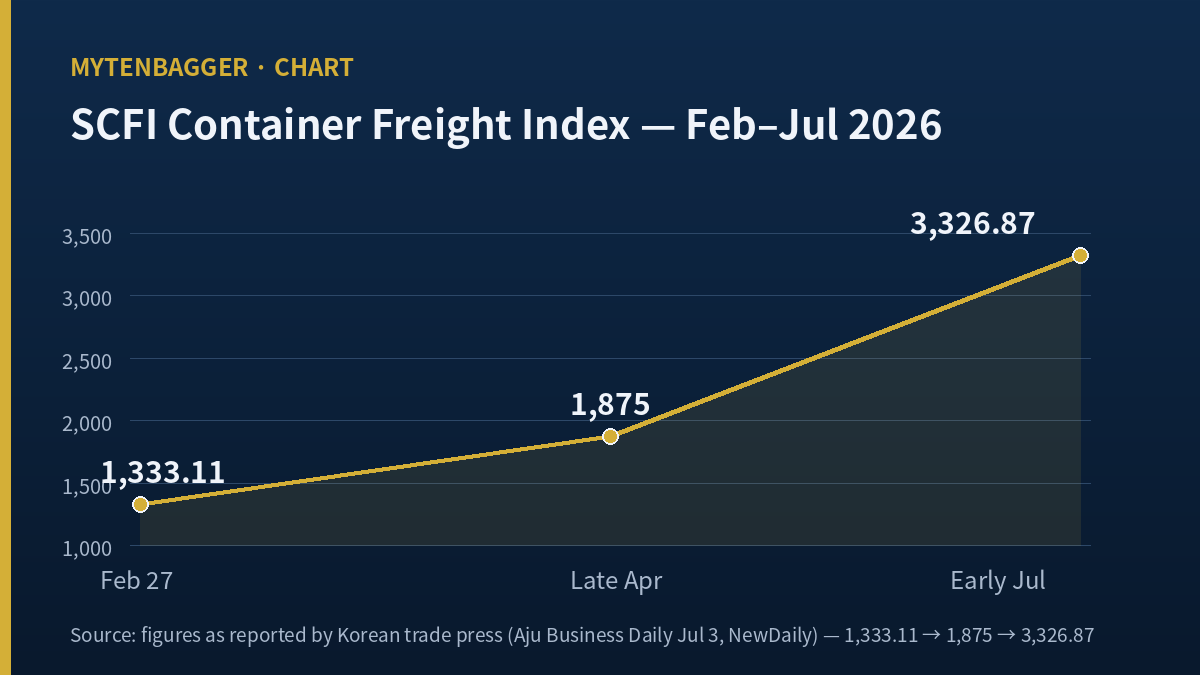
Every conversation about HMM stock right now starts with freight. Fair enough: the Shanghai Containerized Freight Index sat at 1,333 on February 27 and printed 3,326.87 in the first week of July — two and a half times higher in four months, as reported by Aju Business Daily, a Korean economic daily. I read that number twice before dawn and honestly assumed a typo. It sent me back to a stock I hadn’t opened in months. But the line that held my eye wasn’t the freight chart. It was a price from last September: ₩26,200 per share — about $17.20 at the roughly ₩1,520-per-dollar rate I use in this journal — which is what HMM paid to tender for 81.8 million of its own shares and retire them. The market today asks ₩21,000, call it $13.80. The company paid more for this stock than you have to. Somewhere between the excitement of a 2.5x freight index and the oddity of a share trading below its own tender price sits the real question, and that’s the one I want to write down. So this entry starts with freight and ends with an auction.
Contents
HMM Stock and the Freight Rally That Doubled Estimates
Quick scaffolding for readers who don’t trade Seoul: HMM (011200) lists on the KOSPI, the main board of the Korea Exchange — think of it as Korea’s NYSE. At ₩21,000 the company is worth about ₩19.8 trillion, or $13 billion — my multiplication of 943 million shares by the price, so treat it as arithmetic, not a filing.
The year began badly. First-quarter revenue was ₩2.72 trillion (~$1.8B) with operating profit of ₩269.1 billion (~$177M), down 56% from a year earlier per the company’s filing, in a quarter when average spot rates fell 14% and fuel ran 9% hotter, as Korean financial press summarized it. In late January, Hana Securities analyst Ahn Do-hyun penciled in full-year 2026 operating profit of ₩858 billion (~$560M), down 38% year over year, with a neutral rating and a ₩21,000 objective — the note was covered by ShippingNewsNet, a Korean maritime outlet. His premise, as he framed it then: absent a reopened Red Sea, spot rates would drift gently lower through 2026. I nodded along at the time. I had no better model.
That premise didn’t survive six months. U.S. reciprocal-tariff deadlines pulled cargo forward as shippers front-loaded, peak season arrived, and Red Sea detours kept swallowing capacity — the three-part explanation Aju Business Daily gave for a spot index that went vertical. From 1,875 in late April to 3,327 in early July by the Korean trade tally, and HMM stock followed with a 10% move over the past month (exchange data). The sell side chased. The FnGuide consensus — Korea’s equivalent of a Street estimate aggregate — now looks for Q2 revenue of ₩3.04 trillion (~$2.0B) and operating profit of ₩299 billion (~$197M), up 28% year over year, while the more aggressive desks call for ₩340 billion (~$224M), per NewDaily. The same report carries a third-quarter figure of ₩932.1 billion (~$613M) and full-year talk of roughly ₩2 trillion (~$1.3B). Shinhan Securities separately argued the rate effect lands hardest in Q3, per Korean business press.
Split the segments and the picture sharpens. The Q2 numbers Korean press relays put container revenue at ₩2.85 trillion, up 31%, doing nearly all the pulling, with bulk at ₩514 billion, up 29%. But the bulk gauge has already turned: the Baltic Dry Index slid from 3,114 in early June to 2,551 in early July per the same NewDaily tally. A rising index and a falling index living inside one income statement — easy to miss if you only watch the container tape, so I’m writing it down.
| Period | Operating profit | Whose number (source) |
|---|---|---|
| FY2025 | ₩1.46T (~$960M) | Company filing; down from ₩3.5T-level in 2024 (derived from the filed YoY change) |
| Q1 2026 | ₩269.1B (~$177M) | Company filing; -56% YoY |
| Q2 2026 consensus | ₩299B (~$197M) | FnGuide aggregate, via Aju Business Daily (July 3) |
| Q3 2026 forecast | ₩932.1B (~$613M) | Korean sell-side figure via NewDaily (July 10) |
| FY2026 forecast | ~₩2T (~$1.3B) | Korean sell-side range via NewDaily (July 10); Hana’s January estimate was ₩858B |
Sources: HMM filings, FnGuide aggregate via Aju Business Daily, NewDaily | As of July 2026. USD at ~₩1,520/$.
I built that table and stared at it for a while. The same company’s same-year profit outlook widened from ₩858 billion to ₩2 trillion in five months. What that gap tells me isn’t that the business got better at anything. It tells me the controlling variables of this income statement live outside the company — the length of a detour around Africa, a tariff date in Washington. The one thing the company does control is cost, and there the record is genuinely good: LS Securities analyst Lee Jae-hyuk raised his objective 13% to ₩26,000 (~$17.10) on May 27, keeping a buy call, and his core argument was relative muscle — while Maersk, Hapag-Lloyd, and Japan’s ONE sat in losses or thin profits, HMM held a 9.9% operating margin even in the ugly first quarter, per Money Today, a Korean financial daily. Same storm, only dry deck in the fleet. I give them that without argument.
Freight-made earnings never print their own expiry date. That’s the price of admission in this industry.
HMM Stock at $13.80 vs. the $17.20 the Company Paid
Now the protagonist of this entry. On August 14, 2025, HMM committed ₩2.14 trillion (~$1.4B) to a tender offer for 81,801,526 of its own shares — 7.98% of the count — at ₩26,200 apiece, and burned the lot on September 24, per Aju Business Daily’s contemporaneous report. It was the delivery on a shareholder-return framework the company had announced in January 2025: more than ₩2.5 trillion (~$1.6B) of buybacks, cancellations, and dividends within a year. The dividend leg kept walking too. The fiscal-2025 year-end dividend came to ₩700 a share (~$0.46), and the last four annual payouts run ₩1,200 → ₩700 → ₩600 → ₩700 by regulatory-filing history — a shade over 3% on today’s price, my division. Korean media tallied the last two year-end dividends at ₩1.19 trillion (~$780M) combined, per NewsQuest. For the state institutions holding 70%, the dividend itself is how public bailout money walks back out the door — worth remembering when you wonder why a cyclical pays this steadily.
If you invest mostly in U.S. names, pause on the mechanics here, because they are not the mechanics you know. An American buyback is a quiet daily drip at market prices; you never learn what management thought the shares were worth. A Korean tender offer of this kind names its price in public, in a filing, with a premium attached — and when the seller on the other side is mostly the government, the tender doubles as a piece of the state’s exit plan. That’s the lens I’d offer readers used to Apple-style repurchases: this wasn’t opportunistic value-buying, it was infrastructure for a privatization, priced generously enough to move two state institutions to the table. Which cuts both ways when you try to trade off it.
Here’s the number that hooked me. The company valued its own equity at ₩26,200 with real money; the market currently asks 20% less (my arithmetic). My first instinct was to read that as a floor. Half a day later I had talked myself halfway out of it. A tender price is a policy price — spot plus a premium designed to get the deal done — not somebody’s estimate of value. And there’s a sharper objection on record: Korea Investment & Securities analyst Choi Go-woon kept a neutral stance last September, noting that roughly 85% of the tendered shares came out of the government institutions’ hands, so the benefit to ordinary holders was thinner than the headline, as ShippingNewsNet reported. Most of that ₩2.14 trillion, in other words, bought and burned the majority owner’s paper. It’s a fair hit and I couldn’t argue back.
I ran the same division from the buying side on another name. At Coway the purchaser was the largest shareholder rather than the company, and the amount was fixed before the price moved: 49,999,750,000 won divided by the share increment in the filing implies a reference price of 85,000 won, and once the stock closed at 92,800 won that same money bought 538,790 shares instead of 588,235, landing the stake at 27.53% against the 27.60% disclosed. HMM’s own tender price still sits 20% above the market; Coway’s market price has climbed 9.18% above the price its filing assumed. Both leave the same question behind: whose valuation was that number?
And yet some things survive the objection. Eight percent of the share count is genuinely gone. The return framework is still alive this year. The stock trades at 0.75x book value — my division of the price by the ₩28,168 book value per share in exchange trading data as of July 23. Cash and equivalents were reported at ₩14.5 trillion (~$9.5B) as of mid-2025 in the analyst notes Korean maritime press covered; subtract the ₩2.14 trillion tender and the dividends since, and by my rough math the company still holds cash somewhere near half its own market value. I like this balance sheet a great deal. Liking a balance sheet and buying a stock are, inconveniently, different things.
One more trace that cash leaves, because it matters for the bear case. In fiscal 2025 the company filed ₩1.46 trillion of operating profit but ₩1.88 trillion (~$1.24B) of net income — the bottom line beat the operating line by more than ₩400 billion (exchange-compiled figures). Finance income earned outside the fairway is holding up the floor. That’s why the dividend doesn’t have to die at the same speed freight does, and it’s why HMM stays on my list even in the scenario where the rally ends badly.
A word on the multiple, since screeners will flash it at you. On exchange-compiled trailing figures the stock shows a P/E around 11 and, as noted, 0.75x book. My caution: trailing earnings multiples are exactly the wrong tool for a company whose profit swung from ₩3.5 trillion-level to ₩1.46 trillion in one year and may double back within another. Shipping looks statistically cheapest near earnings peaks and most expensive at the trough, which is the opposite of what the screener implies you should do. I anchor on the 0.75x book and the cash instead, and treat the earnings line as weather.
HMM Stock’s Real Variable: A 70% Government Stake
Trading this name on freight alone is half an analysis, in my view. The other half is the register of owners. Korea Development Bank — the state policy bank — holds 35.42% and Korea Ocean Business Corporation, a state maritime fund, holds 35.08%: 70.5% of HMM sits with the government, per Invest Chosun, a Korean M&A-focused outlet. In January, Korean media reported the sale process reigniting at a ₩6–7 trillion ($3.9–4.6B) scale; by February and March the reporting had KDB studying a solo sale of its own block, separate from the maritime fund, per TheBell; and in May, Invest Chosun described banks and brokerages staffing up for a restart, with Dongwon, POSCO, Harim, LX, and SM Group circulating as candidate names. The same piece listed the drag factors honestly: KDB’s other restructuring burdens, an undecided structure between the two state holders, and audible caution inside the biggest candidate. Korea also remembers the last auction — a Harim-led consortium won preferred-bidder status and the deal collapsed anyway.
The ownership table explains one more oddity a U.S. reader would notice on the quote screen: foreign investors hold just about 8% of HMM by exchange data, versus far heavier foreign ownership in Korea’s big exporters. With 70.5% locked in state hands, the tradable float is thin, which is part of why this stock moves the way it does — fast in both directions on freight headlines. Thin float plus a pending auction is a volatility recipe, not a defect, but I size for it.
I checked the price tag against the tape. KDB’s 35.42% of a ₩19.8 trillion market cap is about ₩7 trillion ($4.6B) — my multiplication — which squares with the ₩6–7 trillion the January reports carried. And last year’s 8% burn shrank exactly the thing an acquirer must pay for; Korean coverage of the tender made that point at the time. Cancellation and privatization aren’t two stories. They’re one story told in two filings, and that — more than any freight print — is why I file HMM under structural change rather than under shipping cycle. I worked through a similar stake-versus-market-cap puzzle in my HD KSOE holdco discount journal.
There’s a third filing in the same drawer: at a May extraordinary shareholder meeting, HMM confirmed relocating its headquarters to Busan, the port city in Korea’s southeast, per Busan Ilbo, the city’s daily. A company hunting for a new owner and moving house in the same year. I’ll admit I flipped once while writing this section. My first draft called the sale restart a clean positive. On the reread I struck that: until the structure is fixed, 70.5% is also the largest overhang in the Korean market. A control-premium whole-block sale wears a bull’s face; anything that leaks stock into the market in tranches wears the other one. Betting before you know which face shows up isn’t my kind of trade.
A personal memory, for the record. In 2021, when Korean retail nicknamed this stock “Heumseulla” — HMM-Tesla, if you translate the joke — I watched from the pier as it ran to roughly two and a half times today’s price. I was honestly jealous on the way up, and then honestly not, watching what happened to the people who boarded at the top. The sentence that episode carved into me still governs: profits the freight market gives, the freight market takes back. It’s why I’m permanently one beat late on this name, and why I’ve never been badly hurt by it.
Two Paths From Here
Path one — the rally’s inertia carries Q3 (my odds: 60%)
Tariff-deadline front-loading, peak season, and Red Sea detours keep overlapping into the third quarter. If the Korean sell-side’s ₩900-billion-level Q3 lands anywhere close, a full year between the mid-₩1-trillions and ₩2 trillion becomes the base, and the dividend funding question answers itself. On this path the stock keeps arguing about peak rates all the way up: from the 52-week low of ₩17,910 (~$11.80, exchange data) it has already climbed about 17%, and if this path is the right one, today’s level reads less like late and more like still discounted against a company that valued itself at ₩26,200.
Path two — the expiry date arrives first (my odds: 40%)
Front-loaded cargo is, by definition, borrowed from future quarters. Once the tariff deadline passes and the Red Sea takes even one visible step toward normal, the fourth-quarter tape could skip Hana’s January drawing of a gentle drift and go straight to a steep giveback. The industry’s rough breakeven on the spot index — the 1,000 line, as Korean trade press puts it — is far below here, but this index has repeatedly laughed at the word far. On this path 2026 ends as a half-year boom with a cold second act, and the stock walks back toward the high-₩10,000s it knows well. I do not consider that probability small enough to ignore.
What makes the second path heavier is supply. A September 2025 note by Sangsangin Securities analyst Lee Seo-yeon, as relayed by ShippingNewsNet, described HMM’s own 2030 fleet plan as +63% container capacity and +15% bulk. And it isn’t just HMM: the whole industry ordered ships into the Red Sea boom, and those hulls arrive on schedule regardless of where rates sit. Falling rates plus growing fleets is a combination this industry has staged many times, and it never improves on rewatch. Even if path one wins this year, the supply variable doesn’t disappear — it just rolls its delivery date to 2027. I keep a separate journal on one of the yards building those hulls: HD Hyundai Heavy Industries.
My Timetable for Ending the HMM Stock Watch
Three checkpoints, in the order the answers arrive.
First, mid-August: confirmed Q2 results. Less whether the ₩299 billion consensus gets beaten than the texture of the container margin — how much of the rate spike actually reached operating profit. This one is a settlement of freight already sailed, so I intend not to get excited even by a beat. Second, September and October: the freight tape after the tariff event is digested. If the spot index holds above the 2,000 line — the level LS Securities leaned on for its upgrade — the earnings have a longer shelf life than I fear; if 2,000 cracks and the slide is fast, I’ll read it as path two opening. Third, sometime this year: the privatization structure going official. Solo sale or joint, whole block or tranches — the day that method and calendar hit paper is the day this company’s next decade gets decided, and honestly it’s the only checkpoint of the three that has nothing to do with freight. Even if the first two pages come back clean, I’m not putting more than watch-list attention on this name before the third page turns. That’s the rule of this particular watch.
A closing confession. The working title of this entry was about a freight rally. Somewhere in the writing, freight became the backdrop and ₩26,200 became the lead. With HMM stock sitting 20% below the price the company itself paid, I’m writing instead of buying — and I’ll reopen this journal in the order the answer sheets turn: August results, autumn rates, auction structure.
Related reading
- BNK Financial Stock Trades 57% Below Book, and 6% Has a Cause
- Pan Ocean Stock Buys Tankers Into a 2028 Delivery Wave