Korea AI Infrastructure Stocks After the $950 Billion Summit
The $950 billion announced in San Francisco on July 24 is not money coming into Korea. Korea’s own presidential policy chief described the semiconductor portion as “a five-year long-term purchase contract.” So when I look at Korea AI infrastructure stocks, I read that figure as a revenue pipeline for two chipmakers, not as a capex wave washing over the whole peninsula. Across the four axes I use — software, hardware, infrastructure, government will — the one place I raised my watch weight is power equipment, and inside power equipment it is distribution gear rather than extra-high-voltage transformers. I own nothing new off this news, and I explain below exactly what would prove me wrong.
I spent the weekend on one story. In San Francisco, at a venue called The Midway, Korean industrial groups and American technology companies announced cooperation totaling roughly $950 billion. Jensen Huang, Sam Altman, Dario Amodei and Hock Tan sat on one side. Jay Y. Lee of Samsung, Chey Tae-won of SK, Euisun Chung of Hyundai and Naver’s Lee Hae-jin sat on the other. When a number is that large the question gets simple. Where does the money actually land?
What bothered me was how fast the answer arrived. Semiconductors, power, data centers. By Saturday morning the ticker lists were already circulating. I have learned to distrust events where the beneficiary list assembles itself that quickly, because a list that easy is usually a list everyone already owns. So instead of building a list I spent the weekend on something duller: what kind of money this actually is. That one question reordered everything downstream.
Contents
What the $950 billion actually is, and why it changes the Korea AI infrastructure stocks list
Kim Yong-beom, policy chief at Korea’s presidential office, briefed reporters in San Francisco on July 24 local time. His stated figure: SK will pursue “roughly $750 billion in long-term advanced memory supply cooperation over the next five years” with Nvidia and other global technology firms. Add Samsung Electronics’ $200 billion arrangement with Broadcom and you get $950 billion.
The sentence that mattered more to me came the next day. As reported by Korean outlet Financial News on July 25, the same official explained that the semiconductor cooperation means “signing a five-year long-term purchase contract,” and — this is the part I would underline twice — “it is not that they made an investment, but a contract to definitively buy that scale of memory.” Aju Business Daily, reporting on July 26, cited the presidential office directly in stating that the $950 billion does not represent capital being disbursed now or revenue that is locked in.
This is not inbound investment into Korea. It is the expected value of memory that Korean companies will sell to American buyers. Those two things have completely different beneficiary paths.
The legal form varies by deal, and the Korean press was careful about it even when the headlines were not. Per the Korea Economic Daily on July 25, the Samsung–Broadcom arrangement is a memorandum of understanding. The SK–Nvidia piece, reported at $500 billion of the $750 billion total, is a letter of intent. Naver’s $10 billion AI factory breaks down into a $1 billion direct investment from Nvidia and up to $9 billion from Brookfield that Edaily described on July 25 as a non-binding LOI. The remaining roughly $250 billion of SK’s total has not been decomposed by counterparty in any outlet I could find.
I am not dismissing any of this. Even read strictly as a five-year revenue pipeline, it is larger than anything Korean manufacturing has been handed. But the distinction is operationally enormous. If this were inbound investment, fabs and grid connections get built in Korea and construction and equipment suppliers eat first. Because it is a purchase commitment, the money lands in Samsung’s and SK hynix’s income statements first, and only a secondary slice returns as domestic equipment orders. Get that backwards and your ordering of Korea AI infrastructure stocks is wrong from the first line.
The four axes I used to sort Korea AI infrastructure stocks
I sorted every announcement from that day into four buckets: software (models), hardware (chips), infrastructure (power, data centers, networks), and government will (policy, budget, permitting). Infrastructure earns a separate government axis because no single company can build it — transmission rights, interconnection queues and siting all sit with the state.
Filling the buckets broke a belief I had been carrying. The received wisdom is that Korea is weak in software and strong in hardware. I believed that too. The data says it is half right.
| Axis | Where Korea actually sits | My read |
|---|---|---|
| Government will | 5th worldwide in the Oxford Insights Government AI Readiness Index 2025. 2026 national AI budget approved by the National Assembly at ₩9.9 trillion (about $6.8bn), roughly triple the ₩3.2 trillion 2025 base budget, per Korea’s National AI Strategy Committee | Strongest axis |
| Hardware — memory | Q1 2026 HBM share: SK hynix 58%, Samsung 21%, Micron 21% (Counterpoint). Q1 2026 DRAM: Samsung retook first place at 38.5% (TrendForce) | Strong, but no longer a monopoly |
| Hardware — logic | Q1 2026 foundry share: TSMC 72% vs Samsung 6.5% (TrendForce). Korea’s system-semiconductor share 2.3% in 2023, projected to 1.6% by 2027 (Omdia and Korea’s next-generation intelligent semiconductor program office) | Weak and getting weaker |
| Software | 3rd globally in notable AI models (5) and 1st in AI patents per capita, both per Stanford HAI AI Index 2026. Yet zero Korean models in the LMArena text top 20 when I checked the board on July 21, 2026 | Quantity without quality |
| Infrastructure | Of 736 grid-impact assessment applications between Aug 2024 and Mar 2026, the final approval rate in the Seoul capital region was 1.9%, with a single approval inside Seoul itself (Money Today exclusive). Against a headline national program of 260,000 Blackwell-class GPUs, verified deployments total roughly 5,000 (Air Street compute index, July 1, 2026) | Weakest axis |
Sources cited in each cell. Won-to-dollar conversions in this article use roughly ₩1,455 per dollar and are my own arithmetic.
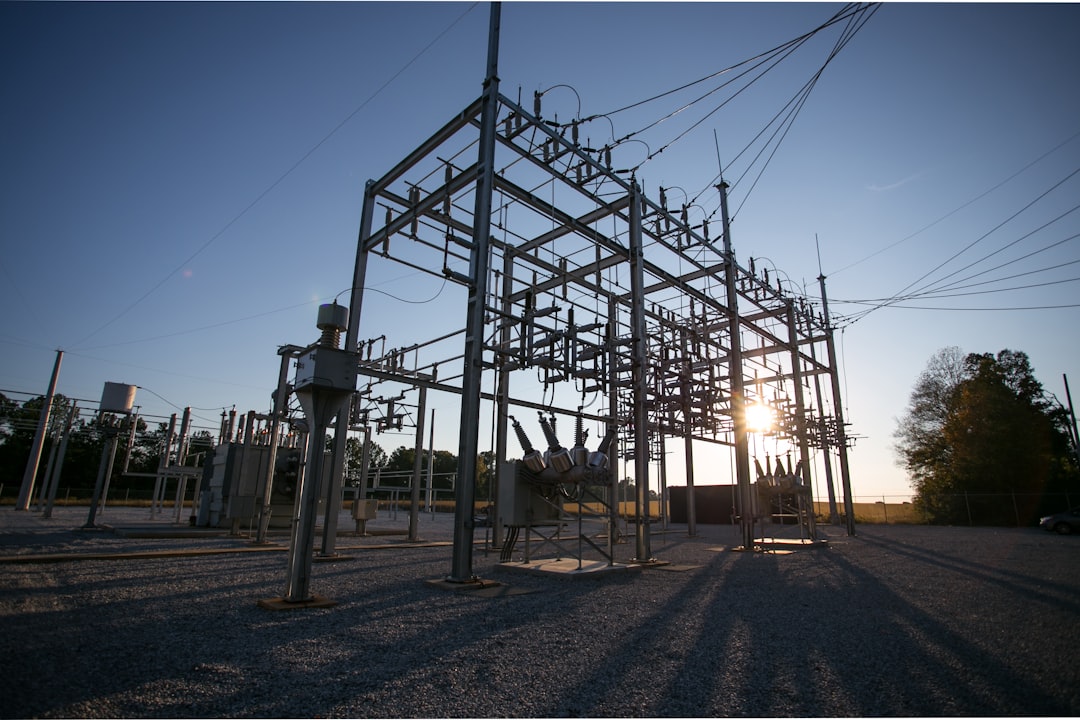
The cell where my hand stopped was infrastructure. A country ranked fifth in the world for government AI readiness is approving 1.9% of capital-region grid applications. That is not a failure of intent. That is a failure of copper and steel. The bottleneck is physical, and physical bottlenecks do not respond to summits.
The GPU line says the same thing in a different currency. Roughly 5,000 units verifiably racked against a 260,000-unit national program is a ratio investors should sit with before extrapolating the summit’s headline numbers. And those headline numbers — about two million GPUs on a B200-equivalent basis, roughly 5GW of associated power capacity — came from Kim Yong-beom’s briefing. Nvidia’s own summit blog post disclosed no GPU counts, no gigawatts and no dollar figures. Those are Korean government numbers, not vendor numbers, and I treat them accordingly.
Reordering the Korea AI infrastructure stocks tree
Once I had the money’s character and the four axes, I re-ranked. One filter did all the work: is there a signed contract, or only a summit press release?
First — power equipment, and specifically distribution
This axis ranks first precisely because it does not depend on the summit. HD Hyundai Electric disclosed a framework agreement with a global technology company on July 2 worth up to ₩1.1212 trillion, about $770 million on my conversion. Four days later, on July 6, it raised its full-year order target from $4.222 billion to $5.185 billion, a 22.8% increase. LS Electric posted Q2 2026 revenue of ₩1.577 trillion (about $1.08 billion), up 32.2% year on year, with operating profit of ₩178.5 billion (about $123 million), up 64.4% — a record quarter. Its first-half cumulative North American big-tech orders run to roughly ₩1.2 trillion.
Here is where I changed my mind over the weekend, and I want it on the record because I had it wrong for several quarters. When this axis comes up, the conversation goes straight to extra-high-voltage transformers. Mine did too. But market structure cited by Edaily on July 13 puts the distribution market at two to three times the size of transmission, and the North American distribution market at roughly six times the extra-high-voltage transformer market.
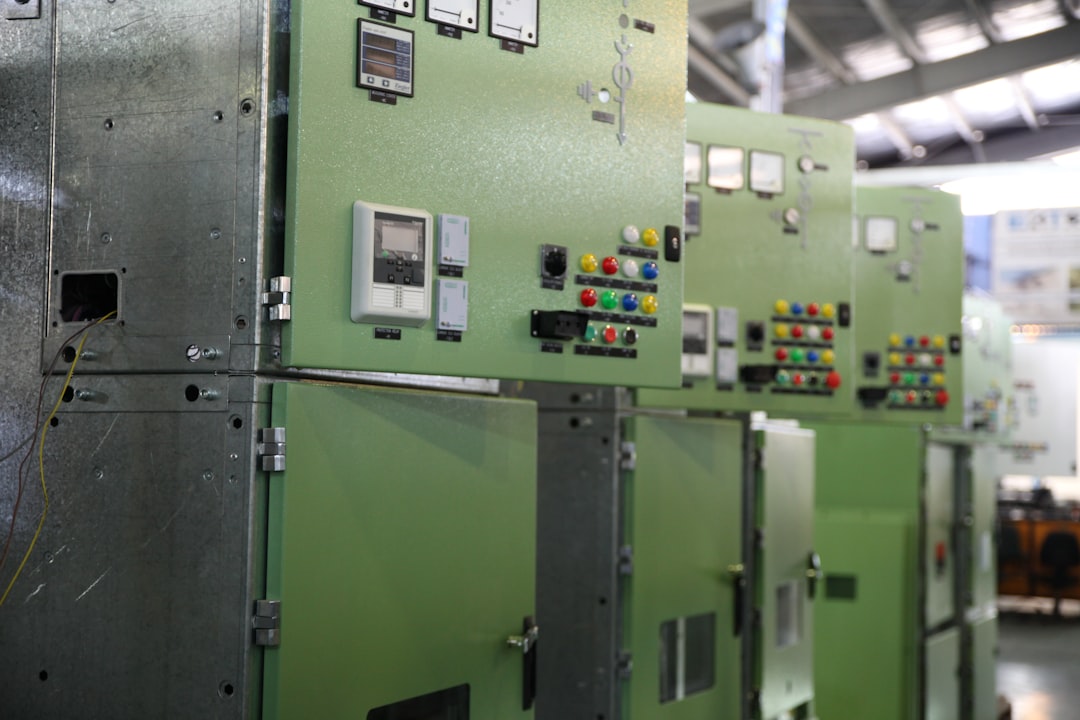
Then look at the composition of that HD Hyundai Electric contract: ₩553.9 billion distribution, ₩567.3 billion power. Essentially a 50-50 split. If you were watching only the transformer story you were watching half the deal. Lead times differ too — extra-high-voltage transformers carry long delivery schedules while switchgear and distribution systems turn faster, which means distribution converts to recognized revenue sooner. That single structural fact moved my ordering inside this axis.
For US readers there is an access wrinkle worth stating plainly. American investors reach for Vertiv, Eaton or Schneider Electric when they want the electrical layer of the AI build-out. The Korean names sit further upstream, in transformers, switchgear and distribution systems, and none of them carry US-listed ADRs. That is the memory axis, which is the one I did not raise my weight on.
Second — data center operators and builders
SK Telecom’s board approved the establishment of SK Hypher, a dedicated AI data center subsidiary, on July 23, with ₩750 billion (about $515 million) of cash contributions committed through 2030 and ₩330 billion of that this year. What separates this company from most of the summit’s headlines is that the revenue already exists on a statement. Q1 2026 AI data center revenue was ₩131.4 billion, about $90 million, up 89.3% year on year. Among announcements that are still plans, that is a number. At the summit itself SK Telecom and Nvidia announced a build of up to 2GW targeting operation from 2027.
On the construction side, GS E&C is the only case where I found a published unit-cost formula rather than a vibe. A July 10 note from Han Hwa Investment analyst Song Yoo-rim models the Donghae project as 1.2GW in 2028 plus 1.2GW in 2029 at roughly ₩8 billion per megawatt. Shinhan Investment analyst Kim Sun-mi, also on July 10, used ₩6–8 billion per megawatt. The spread between those two assumptions is, functionally, the uncertainty of the entire axis.
Third — semiconductor equipment
I am leaving the megacaps out of this piece and looking only where contracts are visible. Hanmi Semiconductor disclosed a ₩44.2 billion (about $30 million) order on June 8 for HBM4-generation TC bonders destined for SK hynix, then printed Q2 2026 revenue of ₩251.1 billion (about $173 million), up 39.5%, and operating profit of ₩130.3 billion (about $90 million), up 51.0% — its best quarter ever. This is a company whose Q1 operating profit had collapsed to ₩8.46 billion. I read Q1 as the air pocket between HBM3E and HBM4 tooling and Q2 as the snap-back.
One honest gap belongs here. I could not find a single outlet that named the Korean equipment suppliers who benefit from the Samsung–Broadcom 2nm foundry arrangement. That list does not exist yet. Constructing it myself would be authorship, not analysis, so I am not constructing it. Micron, incidentally, is the peer US readers can actually price directly — and at 21% of Q1 HBM share it sits level with Samsung, which is a useful reminder that Korean memory leadership is one company deep, not two.
Fourth — physical AI
Hyundai Motor Group’s own July 25 release announced a jointly built Robot Reference Platform with Nvidia and a self-driving foundry partnership with Waymo, with modified IONIQ 5 vehicles produced at its Metaplant America facility in Georgia. Euisun Chung is quoted in that release saying the group is “evolving beyond traditional automotive manufacturing into a Physical AI solution company.”
The affiliate where cash moves first is Hyundai Autoever, which disclosed a ₩138.06 billion (about $95 million) integrated GPU server procurement order for Kia on July 24 — the day before the summit. But this axis has a problem I cannot argue away: the sell-side valuations are moving opposite to the narrative. On Hyundai Motor, KB Securities analyst Kang Sung-jin published ₩1.2 million on June 15; Yuanta analyst Kim Yong-min cut to ₩570,000 on July 24. That is a 2.1x spread across forty days. I do not put weight into a gap that wide, because a gap that wide means there is no consensus to be early to.
What I distrust most about the Korea AI infrastructure stocks story
Everything above only works if press releases convert into purchase orders. I do not yet believe the conversion speed. Three reasons.
First, the last big package has produced nothing in eight months. Korea signed a $350 billion US investment framework in November 2025. On July 20, 2026, the government’s own policy briefing stated that “nothing has been decided regarding the specific content or announcement timing of the first US investment project.” The Korea–US Strategic Investment Corporation launched on June 18 and a committee convened on July 2, and the answer was still nothing. I cannot find a reason why a larger, looser package would move faster.
Second, the official announcing it said he had not verified it. In that same Financial News report of July 25, Kim Yong-beom said he “could not confirm whether it is a simple MOU, or how much is being put in as advance payment.” I think that was the most honest sentence anyone said all week. It was also the most alarming.
Third, the market did not believe it. On July 24, the last Korean trading session before the news landed, the KOSPI fell 5.72% to 6,690.62 and sell-side sidecar circuit breakers triggered. Samsung Electronics closed at ₩249,500, down 7.59%. SK hynix closed at ₩1,759,000, down 8.34%. To be precise about the clock: the summit ran on the afternoon of July 24 in San Francisco, which is the morning of July 25 in Seoul, so that session predates the announcement and the selloff was not a reaction to it. What remains true anyway is that a country flying to announce a near-trillion-dollar package watched its index drop 5.7% on the way there. The genuine reaction arrives Monday, July 27.
One more data point belongs in this section. TrendForce projects third-quarter conventional DRAM contract prices rising 13–18% quarter on quarter, describing that as “a noticeably slower pace than in previous quarters” and citing softening consumer demand, a high base, and contract prices already at record levels reaching the limit of what customers will accept. Prices are still rising, but the slope is flattening. However large a five-year memory purchase commitment is, a commitment does not by itself defend a multiple through a flattening cycle.
My position in Korea AI infrastructure stocks right now
I bought nothing off this summit. The next trading session has not even opened. What I moved was attention, not capital.
For several quarters I had been tracking this sector through one number: extra-high-voltage transformer exports. When Korea Economic Daily reported on July 23 that first-half 2026 exports hit $701.52 million, up 6.7% year on year and past ₩1 trillion for the first half for the first time on record, I treated that as the whole story. Learning that the distribution market is roughly six times larger took me until this weekend. I ended up with a spreadsheet splitting the HD Hyundai Electric contract into distribution and power columns and stared at it longer than I want to admit. That split is the actual output of my weekend.
So my position reads like this. Power equipment: watch weight raised, with names carrying heavier distribution mix moved up inside the axis. Memory megacaps: not added. I am poor at buying names that fall on record earnings days, and I know that about myself. Data center operators: I look only where revenue has started printing. Physical AI: untouched while the sell-side disagrees by a factor of two.
On valuation I will be blunt rather than flattering. At the July 24 close, HD Hyundai Electric traded at a trailing 39.85x earnings and 14.28x book; Hyosung Heavy Industries at 48.09x and 10.63x (Kiwoom data, trailing basis). Trailing multiples overstate the case when profits are compounding this fast, and I discount for that. Even discounted, none of this is cheap — and all three of the major power names, including LS Electric, are already down between 22% and 35% over the past three months.
What would break my Korea AI infrastructure stocks thesis
I list my checkpoints in the order they will answer, fastest first.
Answers Monday — the July 27 session. The first real market verdict. If power equipment outruns memory, my four-axis mapping matched how the market read the summit. If memory spikes and power sits still, I drew the axes wrong.
Answers this week — SK hynix Q2 results and the call on July 29. The question is whether the summit cooperation shows up in backlog or guidance language at all. If it does not appear, then for accounting purposes $950 billion is currently nothing.
Answers quarterly — Q3 new orders at the three power equipment makers. Whether the first-half North American order pace holds. Whether HD Hyundai Electric raises that $5.185 billion target again into year-end is the same signal in another form.
Answers slowest and matters most — the grid approval rate. If that 1.9% capital-region number does not improve, the domestic 5GW narrative is physically unavailable regardless of what anyone signed. Korea’s 12th Basic Plan for Electricity Supply and Demand has already slipped from September to December. How that plan absorbs data center demand sets the ceiling for this entire axis.
The first two will give me answers before the second two can overturn them, which is exactly the trap. So even if Monday and Wednesday both come in strong, I do not intend to scale up before Q3 orders and the 12th Basic Plan. Writing that down leaves me slightly uneasy, because flows like this have a habit of leaving the patient behind.
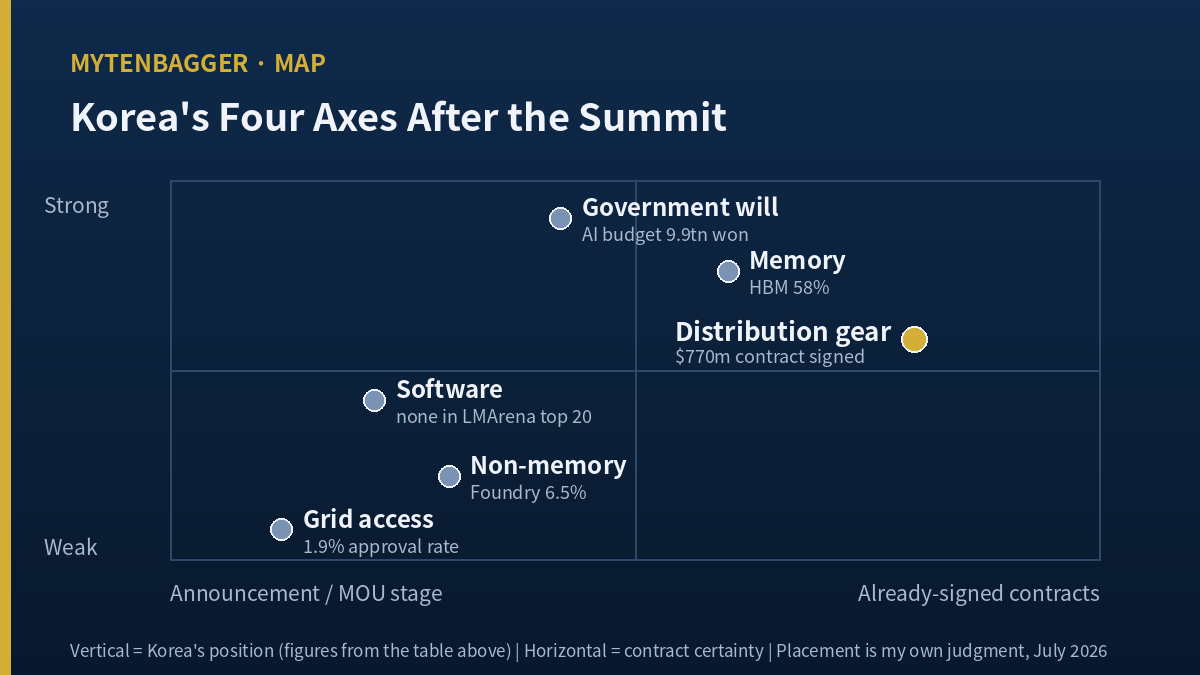
Where this goes next
This did not fit in one piece. I am keeping this as the hub and splitting the rest into two: one on the hardware and semiconductor axis, one on the power and network infrastructure axis. The distribution side in particular needs a name-by-name breakdown of North American backlog and lead times, and that is not a single table.
To close where I started: I do not read this summit as a trillion dollars arriving in Korea. I read it as five years of purchase commitments booked, with a secondary slice returning as domestic equipment orders — and I think the first place that slice lands is distribution gear, not transformers. Q3 order books will tell me whether that is right. Until then I am watching, not buying. The next entry gets written when those order books are out.
Primary material I worked from: Reuters on the $950 billion package, Nvidia’s own summit post, Hyundai Motor Group’s release on its physical AI announcements, the Korea Economic Institute of America’s read on the summit, The Korea Times on the partnership expansion, and Fortune on the Samsung–Broadcom arrangement. The Korean-language reporting I lean on above — Financial News, Korea Economic Daily, Edaily, Money Today, Aju Business Daily and Korea’s government policy briefing — is cited inline by outlet and date; those quotations are my translations from the Korean, not English-language originals.
Related journals — the distribution-gear name I just moved to the top: HD Hyundai Electric Stock: I Bought the 40% Correction · the other half of that axis: LS Electric Stock: A 100x Typo Cost It 15% — So I Started Buying · the benchmark for the component tier I ranked third: Hanmi Semiconductor: The 71% TC Bonder Monopoly Starts to Crack
Related reading