LG Innotek Stock Fell by Half: Why I’m Not Buying Yet
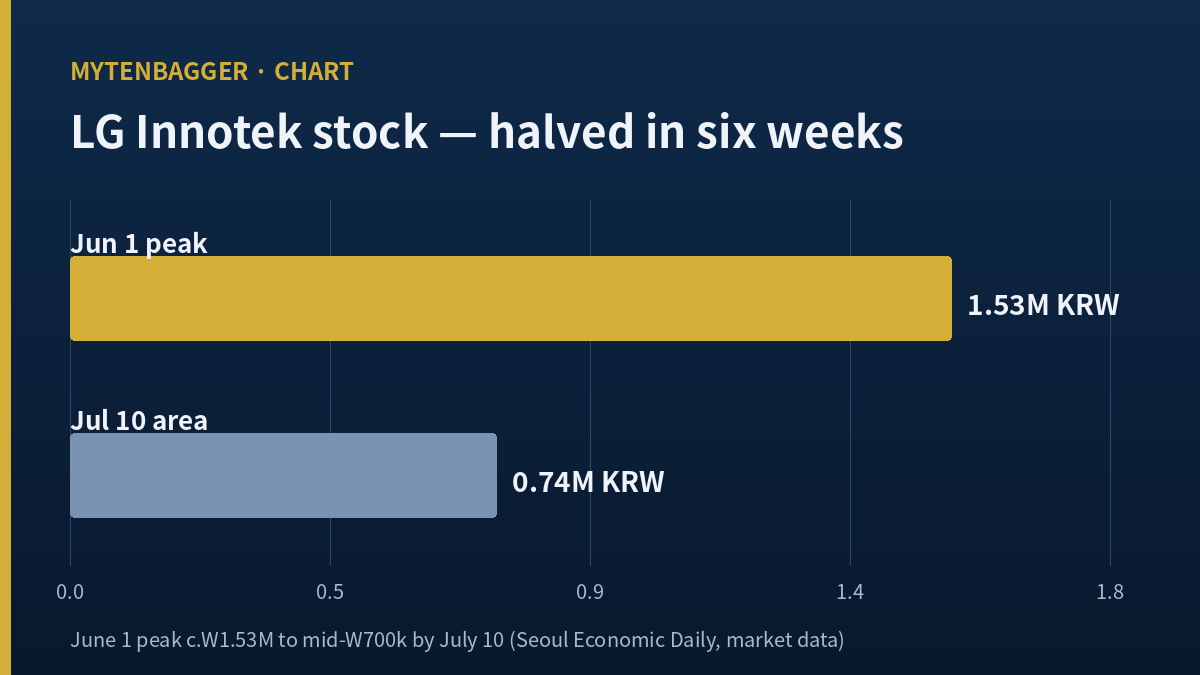
LG Innotek stock fell from about ₩1.53M ($1,110) in early June to the mid-₩700,000s ($540) by mid-July — roughly a halving. Q2 earnings are actually turning up, and I still own zero shares. What pulled profit higher was the Apple camera business swinging back to a profit, not the new FC-BGA substrate engine, so the trigger still sits at Apple. My conditions for starting to buy are at the end. (USD is approximate at ~₩1,380 per dollar.)
I had been watching this one from the sidelines for a long time. The market now files LG Innotek and Samsung Electro-Mechanics together as the “next AI-substrate plays” after the big memory names. I think that bundle is too coarse. Both make chip substrates, but the two companies are standing in very different places right now. So when I heard LG Innotek stock had halved, the first thing I checked was not “how cheap is it” but “what actually makes the profit.” Here is the picture I built. I’m just keeping my own journal in public.
Contents
Why LG Innotek Stock Halved While Earnings Improved
First, some context for readers outside Korea. LG Innotek trades on the KOSPI, Korea’s main board, under ticker 011070, and it is one of Apple’s most important component suppliers. One practical note before anyone acts on the numbers below: I quote won first and convert to dollars at roughly ₩1,380 per dollar, but the exchange rate moves, so a US investor’s realized return blends the stock move with the won. That currency layer is part of why I treat a Korean single name differently from a US-listed peer — the entry and exit both carry an FX decision I don’t fully control.
Now the facts. The shares topped near ₩1.53M ($1,110) in early June and closed at ₩957,000 ($694) on June 24, a drop of about 37% from the peak (Seoul Economic Daily), and slid further into the mid-₩700,000s by mid-July. Yet the plunge was not caused by broken earnings. If anything, it is the opposite.
The first thing I saw: the drop was flows, not fundamentals
Daishin Securities analyst Park Kang-ho estimates Q2 operating profit at ₩193.6bn ($140M), about 30.2% above the market consensus, on revenue of ₩5.01T ($3.6B), up 27.4% year on year (per the same Korean sell-side coverage). Shinsang Investment, another Korean broker, went further with a Q2 operating-profit estimate of ₩191.7bn ($139M) against a ₩170.9bn consensus and lifted its 12-month objective from ₩700,000 to ₩1.2M ($870), as reported by Korean press (Newspim). For a seasonally weak second quarter, that qualifies as an upside surprise.
So why did it fall? Through June, retail investors bought heavily while foreign and institutional money took profits — a classic unwind after a vertical run. The interesting tell is that foreigners flipped direction right into the low. They net-bought ₩60.9bn on June 22 and ₩77.2bn on June 23, ₩138.1bn ($100M) over two days, even as the price kept sliding (Seoul Economic Daily). That reads as a give-back of a short, sharp rally, not an earnings problem. I’ll be honest — this is the point where I wavered. I still didn’t buy. The reason is in the next section.
The second thing: the surprise came from optics, not FC-BGA
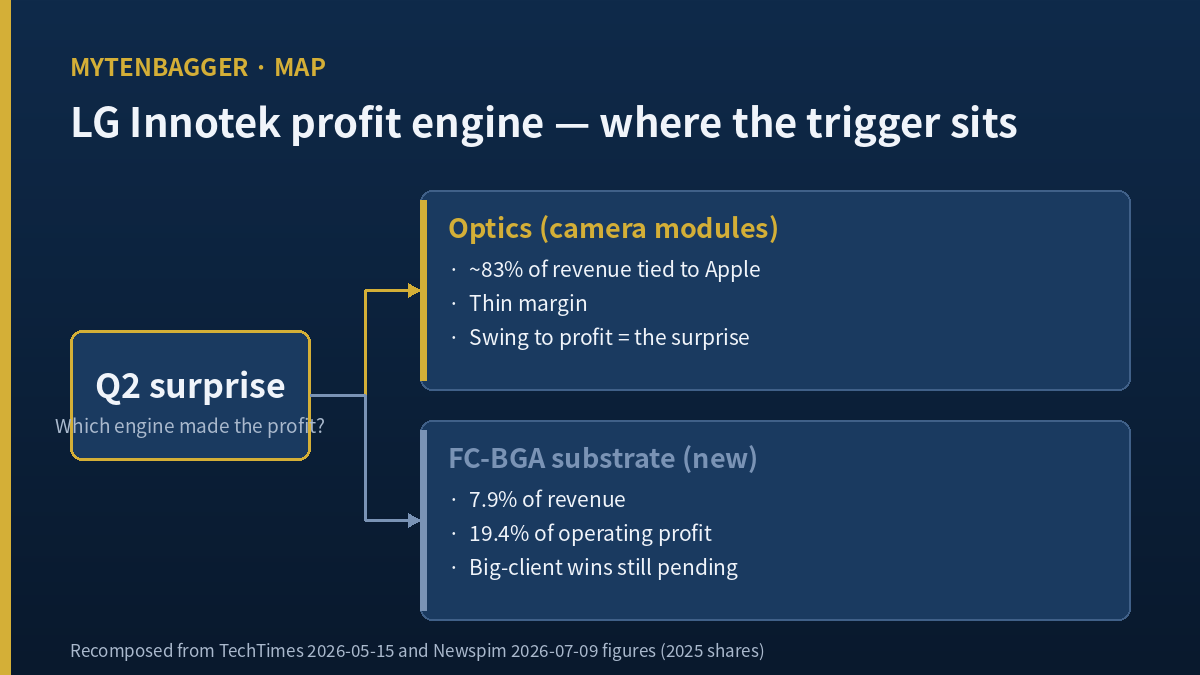
This is what kept me weighing the name for so long. In the Shinsang note, the driver of the Q2 improvement is the optical-solutions unit swinging “from a year-earlier loss to a profit.” Optical solutions is, in plain terms, the Apple iPhone camera-module business. In other words, the trigger for this rebound was pulled not by the new growth engine — chip substrates — but by the very Apple-dependent business the company has spent years saying it wants to shrink.
The concentration is stark: roughly 83% of LG Innotek’s revenue comes from Apple, mostly iPhone camera modules (TechTimes). Management has run a diversification push into substrates, automotive and robotics since 2024, but the center of gravity of profit has not moved yet — a tension English-language coverage has flagged directly (FinancialContent). Peel back “earnings improved” and you find that what improved is Apple, and what is risky is also Apple. I stopped adding once I saw that structure — or rather, I never started.
The third thing: FC-BGA is not a moat yet
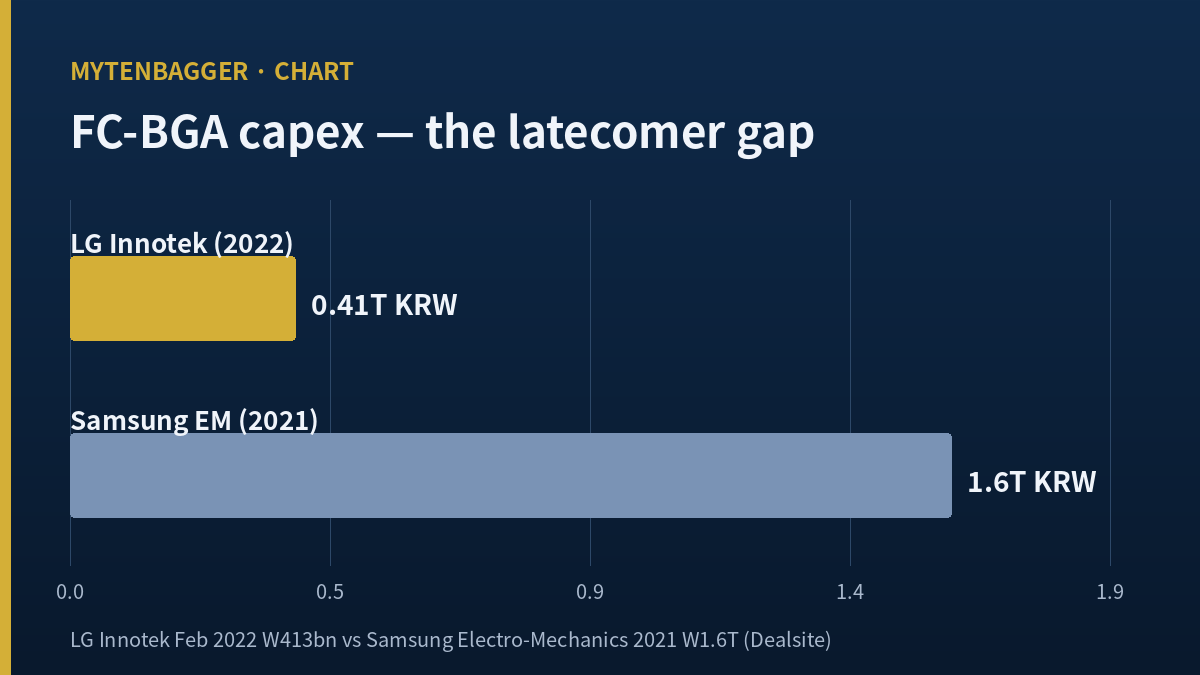
The market’s case for LG Innotek as an AI-substrate stock rests on FC-BGA (flip-chip ball grid array) packaging substrates. I grant the potential. But the company’s own challenge, by its own account, is not technology — it is landing large customers. LG Innotek entered FC-BGA mass production only in February 2024, and roughly five suppliers control about 74% of the global market (TechTimes). Samsung Electro-Mechanics has already moved ahead in hyperscale data-center substrates, while LG Innotek is still working to secure anchor clients among the Intel/AMD/Nvidia tier. That is the definition of a fast follower, not an incumbent.
The trajectory of the segment is a reminder to stay sober: LG Innotek’s board-and-substrate revenue has been lumpy rather than a straight line up in past years. The AI wave is now pushing that line higher again, but whether the recovery converts into the kind of anchor-customer moat that Ibiden and Shinko already hold is unproven. I’m reluctant to pay a premium multiple for the “before it’s proven” window.
Put simply: optics has a moat, but that moat is Apple concentration; substrates are still building one. I think those two sentences explain LG Innotek stock better than any single earnings line right now.
LG Innotek Stock and the Q2 Numbers I Actually Read
A table beats prose here. These are the two Korean brokers’ Q2 estimates, carried over as reported by Korean press. The objectives below are the brokers’ own figures quoted as fact — they are not mine.
| Item | Shinsang (Jul 9) | Daishin (Park Kang-ho) |
|---|---|---|
| Q2 revenue estimate | ₩4.99T / $3.6B | ₩5.01T / $3.6B (+27.4%) |
| Q2 operating profit estimate | ₩191.7bn / $139M | ₩193.6bn / $140M |
| Versus consensus | above ₩170.9bn consensus | +30.2% |
| Broker 12-month objective (quoted) | ₩1.2M / $870 (from ₩700k) | ₩1.3M / $940 |
Source: Shinsang Investment (via Newspim, 2026-07-09) and Daishin’s Park Kang-ho (via Seoul Economic Daily, 2026-06-24). The objectives are the brokers’ quoted figures, not my own view.
Valuation is the other half of what a “halving” means. On my screen LG Innotek trades around 50x trailing earnings and roughly 3x book (mid-July). Cut in half or not, that is not a value zone — it’s a high-multiple growth name giving back an over-extended move. If you’re already underwater it stings; but as someone deciding whether to start fresh, “down 50%” is not the same as “cheap enough for me.” A 50x multiple already embeds a big earnings recovery, so for the stock to work from here the recovery has to not only arrive but exceed what’s priced — and on my read the part that would exceed expectations is the unproven FC-BGA leg, not the Apple optics leg that just did the heavy lifting. That asymmetry is what keeps me patient.
Size the new engine honestly, too. First-quarter substrate revenue was about ₩437.1bn (~$300M), up 16% year on year (TechTimes), and management is investing $661M in Vietnam to expand RF-SiP and FC-CSP capacity, aiming to lift the division’s profit roughly eightfold by 2028 (KED Global). The direction is clearly up. But substrates are still a single-digit share of a company doing more than $15B in annual revenue, so it will take time for that growth rate to bend the whole earnings curve. I’d rather watch it bend than buy the theme ahead of it.
The diversification arc is real, and I don’t want to caricature it. Beyond FC-BGA, the Vietnam build-out expands RF-SiP and FC-CSP capacity, and management is layering in automotive components and robotics as longer-dated legs (KED Global). LG Innotek also used its debut at the ECTC 2026 packaging conference to showcase AI-chip substrates and slimmer 5G modules (TechTimes). None of that is empty; it’s a company genuinely trying to change its mix. My caution isn’t about intent — it’s about timing. Intent shows up in press releases years before it shows up in the operating-profit line, and I want to own the line, not the intent.
The Market Calls It the Next AI-Substrate Play — I Read It Differently
Here is where my reading diverges from the crowd. Three points.
One, the quality of the profit hides behind the headline. In 2025 the package-solutions (substrate) unit was only 7.9% of revenue but 19.4% of operating profit (TechTimes) — a high-margin business. Optics, which carries most of the revenue, runs thin. So a headline of “₩5T in sales, ~₩190bn in profit” misses something: this quarter’s surprise was made by the thin-margin optics unit climbing out of a loss, while the fat-margin substrate unit is still small. The number the market cheers and the engine that produced it are pointing in different directions.
What improved is Apple; what is risky is also Apple. That sentence is half of why I’m still on the sidelines.
Two, the global peers show where the real substrate moat sits. In AI-server substrates, the company actually holding the volume is Japan’s Ibiden, which supplies Nvidia and is pouring roughly $3.3bn into IC-substrate expansion (Nikkei Asia; DigiTimes). Add Shinko Electric and Austria’s AT&S, and roughly five firms hold ~74% of the FC-BGA market, with LG Innotek a 2024 entrant. It’s the same on the optics side, where Taiwan’s Largan Precision and China’s Sunny Optical are pushing into CPO and AI optics (DigiTimes). LG Innotek is strong, but “AI arrives, so it wins automatically” ignores how many strong players sit above and below it. When an incumbent like Ibiden is setting price and volume, a fast follower spends its first few years as a price-taker — which is exactly why I discount FC-BGA in the profit line even as I respect it in the story. The economics of ABF-based FC-BGA substrates reward exactly what LG Innotek doesn’t yet have: years of qualified, high-layer-count production for a small set of demanding compute customers, plus the yield curve that only comes from running those lines at scale. Ibiden’s roughly $3.3bn commitment isn’t just capacity — it’s a moat deepening while newer entrants are still qualifying. That’s the gap I keep coming back to. A halved share price closes the valuation gap; it does nothing to close the qualification-and-yield gap, and that second gap is the one that decides who earns the fat margins in AI substrates.
Three, this one is about my own book. I’m already heavily tilted toward semiconductors and AI — the same concentration I wrote about when I watched Samsung Electro-Mechanics. Adding the same AI-component bet, now with an iPhone-cycle risk stacked on top, isn’t something I’ve found a reason to do. “Good company” and “next thing I add to my portfolio” are two different questions, and I keep them separate.
I’ll admit a past miss here: years ago I dismissed this name as an “Apple camera-module subcontractor” and lowballed the valuation, and I missed the early innings of the substrate-and-automotive story. What I took from that is that this company’s next growth seeds tend to go on sale precisely when the Apple cycle presses the stock down. So this time I don’t ask “cheap or expensive” first — I ask whether the second engine has actually lit. The halved price tag is a second-order question.
LG Innotek Stock: Three Scenarios I’m Weighing
The path I think is most likely (about 50%)
Q2 lands as the brokers preview, and optics stays profitable into the second-half iPhone cycle. Daishin sees full-year 2026 operating profit near ₩1.08T ($780M), the first ₩1T year in four years (Seoul Economic Daily). The optics case has a concrete driver behind it, too: the same Korean sell-side note expects the number of premium iPhone models LG Innotek supplies to widen from four in 2026 toward six or seven in 2027, with foldable and anniversary editions in the mix (Seoul Economic Daily). If that model count is right, the camera-module business gets a volume-and-mix tailwind that could carry the profit that just turned positive — which is precisely the durability question I want answered before I commit. In that case the stock bases along with earnings, but with re-rating capped until there’s real FC-BGA anchor-customer news. It’s a “not cheap, not dear” range where the shares wait for a catalyst — which is exactly why I’m in no hurry. What sets direction here isn’t the absolute Q2 number but the combination of whether optics profit persists and when the substrate customer news arrives, and both are answered by time, not by today’s price.
Where I could be wrong (about 30%)
FC-BGA lands a large North American customer sooner than expected. KB Securities analyst Kim Dong-won sees substrate revenue from new North American clients growing roughly tenfold, from about ₩40bn ($29M) in 2025 to around ₩400bn ($290M) by 2028 (TechTimes). If that plays out, I’ll regret choosing to watch. And it isn’t a wild assumption: CEO Moon Hyuk-soo said at the March annual meeting that substrate lines were running at full utilization, with a decision on new expansion capacity due in the first half. The direction is already set.
The other paths (about 20%)
On the downside, iPhone unit demand rolls over and the optics profit turns out to be a one-off. With 83% of revenue tied to Apple, a single Apple build adjustment shakes the whole P&L. This is not hypothetical: LG Innotek has lived through quarters where a mid-cycle iPhone build cut turned a strong optics setup into an inventory problem within a single reporting period, because it has little pricing power against its largest customer and limited ability to redirect that capacity elsewhere. The very concentration that makes the camera business a quasi-monopoly on the supply side also makes it a hostage on the demand side. On the upside, robotics or automotive lands an unexpected order — but profit contribution there is still tiny, too early to underwrite a position today.
What Would Make Me Start Buying
I anchor my checkpoints to events, not prices, so the decision runs on data instead of emotion. The order I’ll read them in:
The first answer comes at the end of July, with confirmed Q2 results. What I’m reading there isn’t the operating-profit number itself but whether the optics swing to profit is a durable mix improvement or a low-season base effect. Park Kang-ho has flagged that optics profit gains in the second half of 2026 and into 2027 could exceed expectations; I want to see that print as an actual quarterly margin.
Next comes FC-BGA customer news. If any anchor customer in the Intel/AMD/Nvidia chain confirms real supply and revenue recognition, “building a moat” becomes “built a moat,” and a second leg appears to offset the Apple-concentration mark-down. If those two checkpoints point the same way, I’ll begin a first tranche in stages even with the valuation still full. If both stay unconfirmed, I won’t step in on a halved price alone — the discount by itself isn’t my reason.
To be concrete about how I’d act if that green light comes: I’d start small and let the fundamentals confirm before adding, rather than trying to catch the exact bottom of a name that just moved from ₩1.53M to the ₩700,000s. The reason is that a 50x-earnings stock re-rating on a genuine second engine tends to move in steps as each customer milestone prints, not in one clean leap, so scaling in against confirmed news costs me less regret than a single large entry against a still-unproven thesis. And because the won sits inside my return, I’d rather average my currency entry too. None of that is a call for anyone else to follow the same cadence — it’s just how I’d manage my own risk on a high-multiple, single-customer name trading through a violent drawdown.
Why I Haven’t Bought LG Innotek Stock Yet
To sum up: LG Innotek stock halved not because earnings broke but because a vertical rally unwound, and Q2 is actually set up for a beat. But what produced that beat was the Apple camera business turning profitable, not the new growth engine. I read the profit trigger as still sitting at Apple, while the real re-rating key — FC-BGA — hasn’t yet built the anchor-customer moat it needs. So I agree it’s a good company, and I still haven’t added it to my book. My next checkpoints are the durability of optics margin at the end-July print and whether FC-BGA customer news lands, in that order, because the first one answers within weeks and the second is the one that would actually change the multiple. If both turn my way I’ll stop watching and start scaling in; until then I’d rather miss the first leg of a proven move than pay up for an unproven one. That’s how I see it. Your math on this one may land somewhere else entirely.
For the same component-and-substrate tree, I’ve also written on why I watched Samsung Electro-Mechanics after its MLCC rally and drop and on buying HPSP’s cracked monopoly on the dip — reading them alongside this sharpens the context.
Related reading
- Daeduck Electronics Stock Has No Normal Year I Can Point To
- Simmtech Stock Went Up and That Is Why the Loss Got Bigger
- BH Co Stock: Operating Profit Now Barely Covers Interest