LS Electric Stock: A 100x Typo Cost It 15%, So I Started Buying
- I started buying LS Electric stock in stages in the ₩220,000 range (about $143 at ₩1,540 per dollar). The late-May crash was caused by a clerical error in the parent company’s filing, not by anything this company did.
- My case rests on order velocity: roughly $710 million of new orders in Q1 plus another ~$520 million confirmed since April, against full-year guidance of about $2.65 billion — a pace that runs ahead of the plan.
- If management doesn’t raise that order guidance at the August 18 earnings release, I stop buying and re-examine the thesis from scratch.
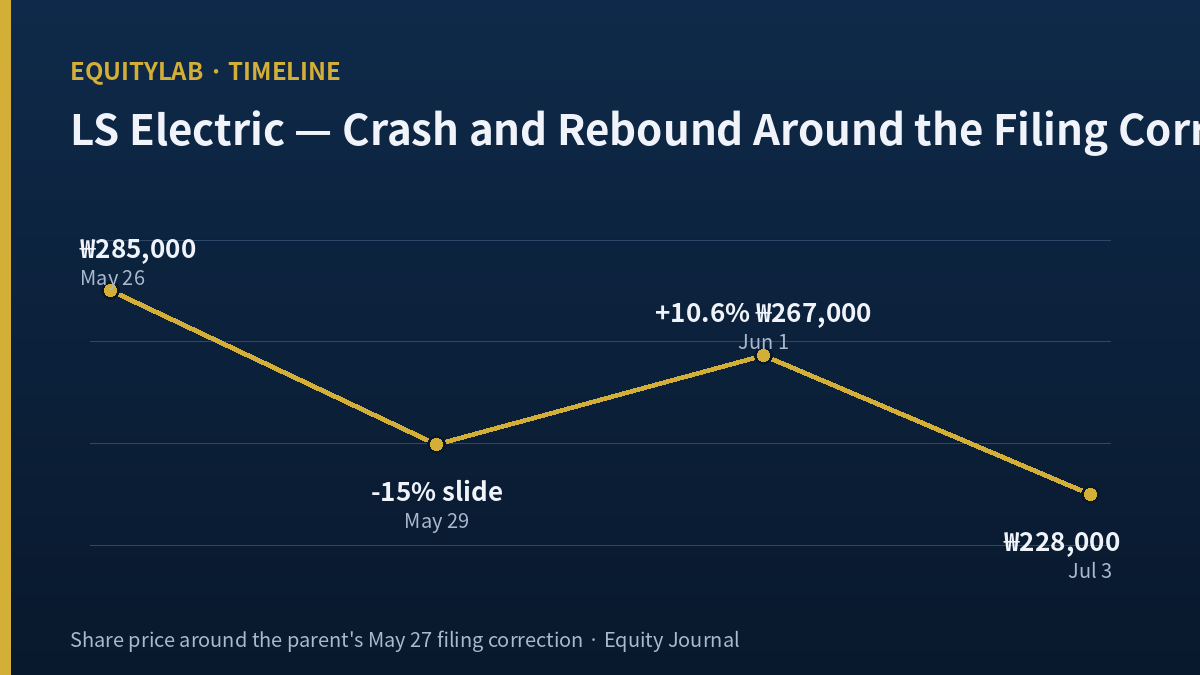
Two numbers: 2.38 trillion won and 23.8 billion won — roughly $1.55 billion versus $15 million. Same filing, same line item. On May 27, LS Corp, the Seoul-listed holding company of the LS Group, corrected its quarterly report and the first number became the second. Over the next three trading days, LS Electric stock lost more than 15%, and the combined market value wiped from the two companies came to roughly $2.3 billion. Korea’s Financial Supervisory Service opened a probe into how a subsidiary’s figures got overstated nearly 100-fold — the units of a small affiliate, LS Tirautec, had been entered in the wrong denomination.
Here is the part that mattered to me. The corrected line sat inside the holding company’s report, under an “other” category. LS Electric’s own first-quarter disclosure — its new orders, its backlog — was untouched. A company’s workload stayed exactly the same while its price tag dropped 15% in three sessions. That’s not news; that’s a markdown. I watched the drop, I watched the 10%-plus rebound on June 1, and once the bounce settled, I went back and counted everything from the beginning. This journal is that count.
Contents
Why I Bought LS Electric Stock: Three Reasons
Reason one: orders are outrunning the company’s own plan
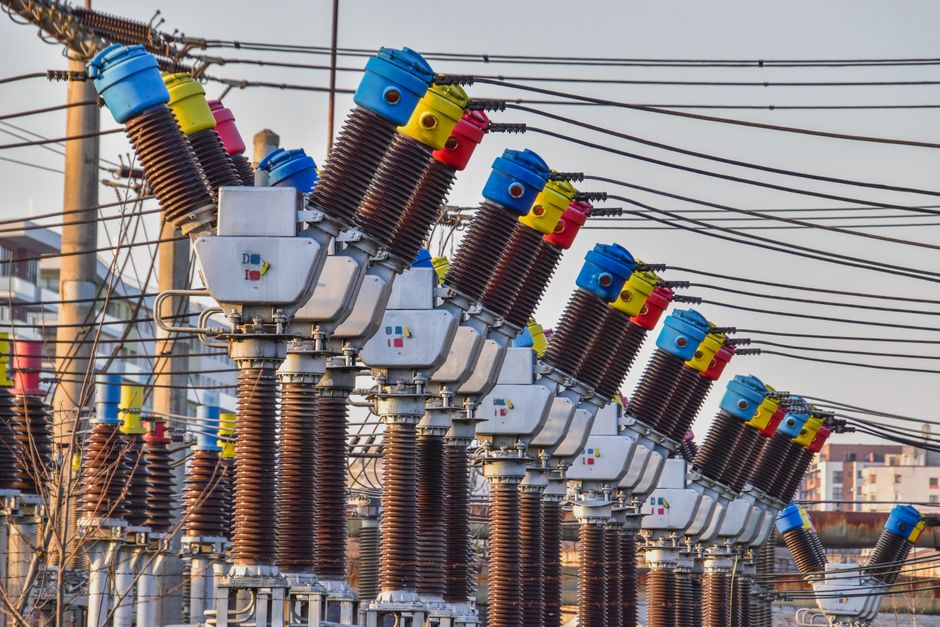
This is the reason I weigh most. For readers newer to the name: LS Electric (KRX ticker 010120, listed on Korea’s KOSPI exchange — the Korean equivalent of the NYSE) makes switchgear, transformers, and power-distribution systems, and it has become one of the main Korean suppliers wiring America’s data center buildout. Management guided for roughly ₩4.09 trillion (about $2.65 billion) of new orders this year. The first quarter alone delivered about ₩1.09 trillion ($710 million) — nearly 27% of the annual plan in a single quarter.
Then April and May kept piling on. A Korean brokerage, Yuanta Securities, tallied roughly ₩800 billion ($520 million) of additional confirmed contracts after the quarter closed. The largest single piece was a ₩319 billion (~$207 million) agreement with Bloom Energy to supply switchgear and transformers for a hyperscale data center project in New Mexico being built for a global big tech company. Bloom pairs its solid-oxide fuel-cell systems for on-site data center power with exactly the kind of distribution gear LS Electric makes — a neat illustration of where the order flow is coming from. On top of that came a $70 million ultra-high-voltage transformer contract, a $115 million data center power infrastructure deal, and smaller switchgear and microgrid orders.
The second quarter looks even heavier. Korea Investment & Securities counted two North American data center projects worth a combined ₩489.3 billion, or about $318 million, landed in Q2 alone — the same brokerage credits delivery speed roughly 30% faster than competitors as the wedge that keeps winning these big tech contracts — and the company itself has said that its revenue from North American big tech customers reached roughly ₩1.2 trillion ($780 million) through June — already past the ₩800 billion it booked from those customers in all of last year. What makes this more than a headline reel is the cash-conversion profile: unlike ultra-high-voltage transformers with multi-year lead times, switchgear ships in roughly six to twelve months. Orders signed this spring become revenue this year. Yuanta’s analyst framed LS Electric as the Korean power name where a guidance raise would show up fastest in the second half. My read is simple: I want to own a company’s stock before its own plan gets revised upward, not after.
Reason two: an 8.6% margin is a coiled spring, not a flaw
Among Korea’s three listed power-equipment majors, LS Electric ran the thinnest operating margin last year — 8.6%, versus 24.4% at HD Hyundai Electric and 12.5% at Hyosung Heavy Industries, per Korean industry-data outlet Datanews. On a screen, that looks like the weakest house on the block. I read it the other way: it’s the house with the most room to renovate.
The margin was thin because the product mix skewed toward lower-margin distribution solutions rather than premium ultra-high-voltage transformers. That mix is now shifting fast. Ultra-high-voltage units went from 41.7% to 55.0% of the power-division backlog in a year; Q1 transformer revenue grew 83% and switchgear revenue 79% year over year, per the same Datanews tally of company results. Korea Investment & Securities argued in a June report that the richer project mix starts showing up in profitability from the second quarter. Do the arithmetic on leverage: a 24% margin becoming 25% is a rounding error, but an 8.6% margin reaching 12% is a roughly 40% jump in operating profit on flat revenue. Half of why I picked this name over its two Korean peers lives in that gap. The growth isn’t single-engine either — company results showed energy-storage revenue tripling year over year, with Vietnam up 45% and its Indonesian unit up 75%, so the story doesn’t collapse if one region cools.
Reason three: analyst consensus is a lagging indicator
Honest admission first: my initial call was to stay out. The average analyst price objective compiled on financial data platforms sits near ₩233,700 (about $152), and the stock closed July 3 at ₩228,000 ($148) — you can track it on Yahoo Finance under 010120.KS. Buying a stock that has already kissed the Street’s average number violates one of my standing rules, and through most of June I told myself the disciplined move was to watch.
What changed my mind was thinking about what that average number actually is. An analyst’s price objective is a function of earnings estimates, and earnings estimates trail orders. The tape proves it: NH Investment & Securities lifted its number twice within a single month this spring — from ₩210,000 to ₩220,000, then to ₩275,000 — and Yuanta moved to ₩260,000 in April, each revision chasing a fresh order announcement. If the current order pace holds into the August earnings print, the same mechanical sequence likely repeats: orders beat, estimates rise, price objectives follow. A price sitting at the consensus average is uncomfortable when the average is standing still. It’s a different proposition when the average itself is a moving target. Buying the window before consensus catches up — that’s the actual bet I’m making, and I want it written down plainly so future-me can grade it.
LS Electric Stock by the Numbers — Q1 2026
Before putting money in, I re-checked the raw figures against the company’s April 21 preliminary results and cross-referenced them with Korean trade coverage. Here’s the quarter, dollarized at roughly ₩1,540 per dollar:
| Metric | Q1 2026 | Year over year |
|---|---|---|
| Revenue | $894M (₩1.38T) | +33.4% |
| Operating profit | $82M (₩126.6B) | +45% |
| North America revenue | ~$195M (₩300B) | +80% |
| New orders | $710M (₩1.09T) | 26.7% of annual guidance |
| Order backlog | $3.66B (₩5.64T) | +45.1% |
| — of which UHV transformers | $2.01B (₩3.10T) | +91% |
Source: LS Electric preliminary Q1 results (April 21, 2026); Datanews and Asia Today coverage of the earnings call. USD figures converted at ~₩1,540/$1.
A practical note for U.S.-based readers, since I get asked: LS Electric has no American depositary receipt. That friction is part of why a name this levered to American data center spending still trades on Korean retail flows and Korean sell-side estimates — which, for my purposes, is exactly where the inefficiency lives.
One housekeeping note for anyone pulling up a chart. The company completed a 5-for-1 stock split in April — trading resumed on April 13 with the share count going from 30 million to 150 million — so any price you see from before mid-April needs dividing by five to compare. The last pre-split close was ₩788,000; the adjusted reference price was ₩157,600. A split changes none of the valuation math, only the optics. For the record, the post-split run was violent in both directions: up 13.7% on the first day back, a record ₩278,000 by April 30, then the filing-error crash in late May. Three months, one full round trip of euphoria and panic.
Now the part I refuse to gloss over: this is not a cheap stock. At ₩228,000 with 150 million shares, the market cap works out to roughly ₩34 trillion, or about $22 billion (my own back-calculation from price times share count). Consensus compiled by Korean data provider FnGuide, as reported in local press, puts 2026 operating profit near ₩638 billion ($414 million); LS Securities’ analyst goes a bit higher at ₩673 billion. Net profit, for what it’s worth, grew even faster than operating profit in the quarter — up 77.6% per the preliminary release. Still, either way the market is paying more than 50 times this year’s operating profit (again, my back-calculation). I am not buying because it’s cheap. I’m buying because I think the estimates underneath that multiple are about to move, and I want that distinction on the record where I can’t retroactively blur it.
What the Crash Revealed: Backlog Is a Faith-Based Asset
The May episode handed me more than an entry window — it handed me a diagnosis of how this entire sector is priced. The market erased $2.3 billion of value over one wrong cell in a spreadsheet, then put most of it back within days. That tells you the valuation of Korean power-equipment stocks rests almost entirely on one line: the order backlog. A backlog is years of future revenue pulled into the present as a promise, and the price of any promise is trust. Which is why I don’t wave away the regulator’s ongoing review of the filing error. The correction didn’t stop at one line, either — the same “other” category’s backlog was cut from ₩1.54 trillion to ₩15.4 billion, and critics quoted in the Korean press argued the episode exposed real weaknesses in the group’s internal verification controls, not just one employee’s decimal slip. Until the review closes as the clerical mistake the company says it was, it stays on my list as a tail risk. A Korean brokerage, Daishin Securities, called the sell-off an overreaction to what was ultimately a typo, and directionally I agree — but it’s my capital on the line, so I label the tail a tail.
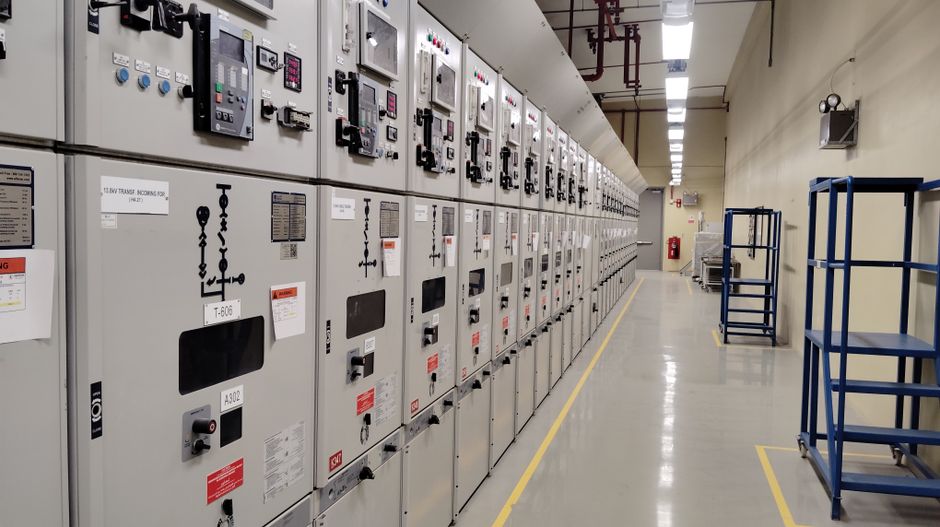
The episode also sharpened what exactly I’m buying. Not the size of the backlog — the speed at which backlog turns into cash. LS Electric’s incremental orders are concentrated in medium-voltage switchgear (about 80% of its data-center and on-site power orders, per Yuanta), gear that ships within a year. When I wrote up my HD Hyundai Electric buy during its 40% correction, the thesis leaned on the opposite trait: a three-year-lead-time ultra-high-voltage backlog that rate fears couldn’t touch. Same Korean grid-equipment wave, deliberately different horse. One bet is on duration; this one is on velocity.
Zoom out and the demand signal is not subtle. GE Vernova’s first-quarter release showed its Electrification segment — substations, switchgear, transformers — booking $7.1 billion of orders, up 86% organically, including $2.4 billion tied to data centers, more than that segment took from data centers in all of 2025 — on a book-to-bill near 2.5, with the company’s total backlog swelling to $163 billion. When the biggest Western grid-equipment maker is drowning in switchgear demand, a $22 billion Korean pure-play with a new U.S. factory is fishing in a stocked pond. And the pond keeps getting stocked: North America’s circuit-breaker market alone is projected to roughly double to $9.6 billion by 2034, per Global Market Insights figures cited in sector coverage of the Korean makers’ U.S. expansion race.
That expansion is the last piece. On June 25, the company broke ground on a roughly $163 million, sixfold expansion of LS Electric Utah in Cedar City — a switchgear plant it built out of MCM Engineering II, a local maker it acquired in 2022 — targeting operations from early 2027 and annual switchgear capacity of about $325 million. The site has a compounding history: the company bought MCM for just $6.3 million in 2022, tripled its capacity with a first expansion completed early last year, and this second phase adds local design and R&D so the plant becomes an all-in-one hub — planning, engineering, and manufacturing under one roof for American customers. A short-lead-time product, manufactured inside the tariff wall, next to the customers. That factory is the physical version of the velocity I’m buying. Small personal footnote: I screenshotted the correction filing the evening it dropped, out of an old habit that days like that eventually become entry points. I still didn’t buy that week. Conviction, for me, always arrives a few days late.
Three Paths for LS Electric Stock From Here
My base case (odds: 55%)
First-half orders confirm the overshoot, and management raises full-year order guidance at the August 18 release. Richer project mix pushes the operating margin into double digits, sell-side estimates ratchet up, and the price objective average — the one currently pinning the stock — climbs the same staircase it climbed in April. Longer out, the legs NH’s analyst laid out kick in: switchgear carries a three-to-five-year replacement cycle, the Utah plant starts contributing meaningfully from 2028, and capacity expansion by Korea’s chipmakers feeds domestic demand too. In this path, I complete the staged buying on schedule.
Where I’m wrong (odds: 30%)
Earnings deliver and the stock goes nowhere. A 50-plus multiple on operating profit isn’t an earnings problem, it’s an expectations problem — if AI infrastructure capex sentiment cools or the whole power-equipment complex de-rates, profits can grow while the multiple shrinks faster. Tariffs cut both ways here: the Utah plant sits inside the wall, but the ultra-high-voltage transformers still ship from Busan, Korea, and stay exposed. And all three Korean majors are adding capacity at once — today’s seller’s market has an expiration date somewhere. In this branch, the company is fine and my entry price is the mistake. If I’m honest about what keeps me up, it’s this one.
The tails (odds: 15%)
The good tail (10%): big tech orders keep chaining — the Bloom-style on-site power projects multiply, and the data center industry’s shift toward 800-volt DC architecture, which Yuanta’s analyst flags as a mid-term option for this company, arrives early. Then the guidance raise itself becomes the surprise. The bad tail (5%): the regulator’s review concludes it was more than a clerical error. If group-level disclosure credibility gets a permanent discount, every backlog-based valuation in the family gets marked down with it, and no earnings print shields you from a trust repricing.
Where I Get Off the LS Electric Stock Trade
Three tripwires, written before the fact. One: the August 18 second-quarter release comes and goes without a raise to the ₩4.09 trillion order guidance, or first-half order attainment visibly stalls — at the current pace, a raise is the natural outcome, so its absence would itself be the signal that velocity broke. Two: the Q2 operating margin slips back below the first quarter’s roughly 9.2% (my back-calculation of operating profit over revenue) — that would falsify the margin-leverage leg that Korea Investment & Securities and I are both leaning on. Three: the regulator’s conclusion lands anywhere beyond a simple filing mistake.
Sequencing matters more than the list. The first two tripwires resolve on a single day — August 18. The third runs on the regulator’s clock, not mine, so until then it’s a news-flow watch. If that day’s numbers support the thesis, I execute the remaining tranches. If they don’t, the question isn’t whether to add — it’s whether the entry logic survives at all, and the shares I already own get judged by that rewrite, not by my attachment to them.
The Bottom Line on LS Electric Stock
I took my first tranche in the ₩220,000s and I’m sitting on deliberately incomplete size. The rest of the buying belongs to the other side of August 18. Someone else’s typo opened a three-day window into a company whose own numbers never blinked — that’s the whole journal in one sentence. Whether that window was a gift or a trap is a question the second-quarter print will answer, and when it does, I’ll write the follow-up. These pages exist so I can’t lie to myself later.
Related reading