Hyundai Motor Stock: I Watch Tariffs and Margins, Not Robots
I reopened the Hyundai chart this week, and it told two stories at once. Six months ago Hyundai Motor stock traded below ₩300,000 (about $200 at roughly ₩1,500 per dollar, the basis I use throughout this note). By June 1 it had printed ₩783,000 (~$522), a fresh 52-week high. Then it slid back to the ₩423,000 range (~$282) where it sits now. Up 2.7x, then down nearly by half. One year, one ticker, two completely different narratives layered on top of each other. I wanted to understand the round trip before deciding whether it changes anything I do.
A quick orientation for readers outside Korea: Hyundai Motor (ticker 005380) trades on the KOSPI, the main board of the Korea Exchange (KRX) in Seoul, quoted in Korean won. Either way you are taking on won exchange-rate risk on top of the equity, and the won has been weak — around ₩1,500 to the dollar lately (Trading Economics).
Contents
What pushed Hyundai Motor stock up 2.7x was not cars
The facts first. Hyundai closed 2025 near ₩290,000 (~$193). In late January 2026, on days that turned over more than seven million shares, it jumped into the ₩500,000s, and by June 1 it touched ₩783,000. A 2.7x move in roughly six months is not something a large-cap automaker usually does. So what did the lifting?
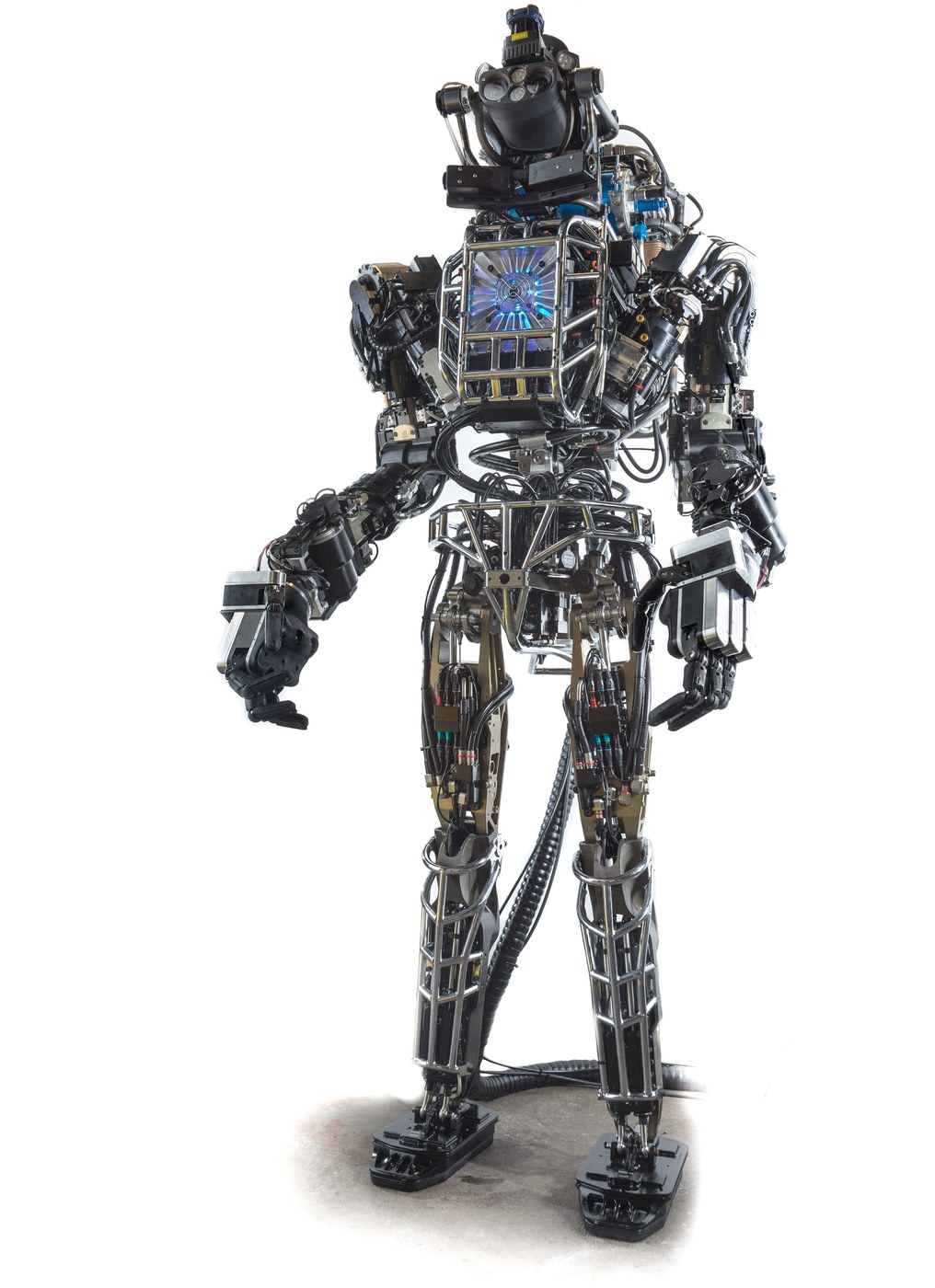
Three things stacked up, as I read it. The first was Korea’s “value-up” rotation — money moving into low price-to-book blue chips, and at a price-to-book near 0.9 Hyundai qualified. The second was the partial clearing of tariff uncertainty, which I treat separately below. The third, and the one that actually electrified the tape, was the robotics and “physical AI” story: Hyundai Motor Group owns Boston Dynamics, and the narrative of humanoid robots, accumulated industrial-site data, and a Google collaboration on AI training got bundled into a single frame — “Hyundai is no longer a carmaker, it is a robotics platform.” US readers will recognize the shape of this trade; it is the same physical-AI re-rating logic that has periodically lifted other manufacturers with humanoid ambitions. A robot story is a multiple story, not an earnings story, and multiples move fast.
I have watched that playbook run in US names before, which is precisely why I am cautious with it. The pattern is consistent: a manufacturer with a credible humanoid program gets re-rated from an industrial multiple toward a technology multiple on the promise of an addressable market that does not yet show up in the income statement. Sometimes the promise converts and the re-rating holds; more often the multiple round-trips while the market waits for orders that arrive slower than the narrative implied. The Boston Dynamics assets are genuinely differentiated — the electric Atlas program, years of locomotion and manipulation data, and the Google collaboration on training — but “differentiated asset” and “priced platform” are not the same claim. Until the data and the robots show up as booked revenue, I treat the platform as an option with real but unpriced value, not as a segment I can put a number on.
Here I have to check myself first. For years I looked at Hyundai as nothing more than an export carmaker caught in a US tariff vise. The robotics and software lines in the investor decks I filed under decoration. Watching the shares more than double in front of me forced me to admit I had priced the option value of this company far too low. But that admission was not a signal to chase at ₩783,000. When a narrative outruns the price, the price usually judges the narrative late — and harshly.
When the robot premium faded, Hyundai Motor stock’s core showed
The judgment came quickly. From the June peak the shares slid, and as Korean press framed it, the sense that “robot expectations were over-reflected” spread; over a single month Hyundai gave back more than 30% (Korean press, Etoday). On June 23 alone it fell from the ₩580,000s at the open to ₩510,000 at the close. The premium that had attached itself to one word — robot — came off just as fast as it went on.
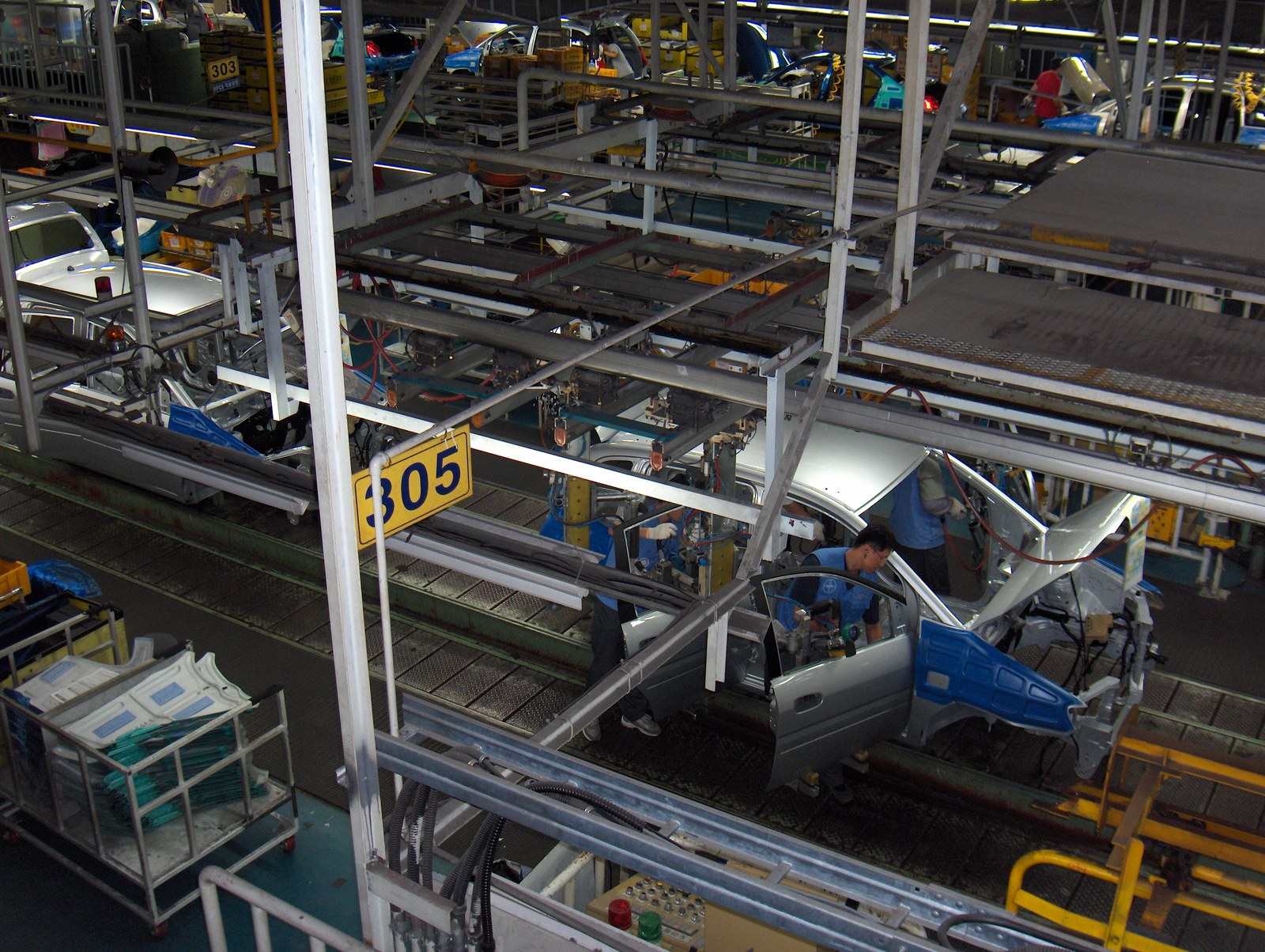
What remains once that premium is stripped is the thing I actually care about: the carmaker. And the carmaker’s picture is mixed. Korean sell-side estimates put Hyundai’s Q2 2026 revenue near ₩50 trillion (~$33 billion) — a milestone as the first non-chip Korean company to reach ₩50 trillion in a quarter (Korean press, Financial News). Yet operating profit for the same quarter is expected to fall by double digits year over year. NH Investment & Securities, in a June 30 note, modeled Q2 revenue of ₩48.1 trillion (down 0.3%) and operating profit of ₩3.12 trillion (~$2.1 billion, down 13.4%).
To size the scale for a US reader: Hyundai and Kia together are expected to post a combined Q2 revenue near ₩81.9 trillion (~$55 billion), a record for both, while their combined operating profit slips about 4.6% year over year to roughly ₩6.08 trillion (Korean press). That is a revenue base rivaling the largest industrials anywhere, attached to a KOSPI market value that still prices Hyundai below one times book on my domestic data. A company can be enormous and still cheap on paper — the question is never the size of the top line but whether profit compounds underneath it, and right now the profit line is going the other way.
Record revenue, shrinking profit. That gap compresses the whole situation, and I read it in three layers. One is the weak won: with the dollar near ₩1,495–1,500 during the quarter (Korean press), dollar sales translated into more won, so the revenue record carries a currency flatter inside it. Two is a March supplier fire that disrupted parts and, per NH, pressured output into June. Three is soft Middle East demand, a thin new-model pipeline, and currency-linked warranty-reserve revaluations that Kiwoom Securities flagged as a drag on profit. Notice the currency cuts both ways — a weak won lifts translated revenue while foreign-currency warranty provisions can bite profit. That is exactly why I do not take “₩50 trillion quarter” as a clean signal of operating health.
Tariffs from 25% to 15% — already inside Hyundai Motor stock
The largest external variable for the core business is still the US tariff. Let me clear one misconception: some commentary talks as if tariff relief is a catalyst still to come. It is not — the auto-tariff cut is a done, in-force fact. The Korea–US tariff agreement was finalized on October 29, 2025, and tariffs on cars and auto parts were lowered from 25% to 15%, applied since the July 30 framework (Korean government policy briefing). Of a total $200 billion in US investment pledges, the cash portion was capped at $20 billion per year.
So “25% to 15%” is a past-tense positive already inside Hyundai Motor stock, not a card still to be played. And 15% is not a small number. The tariff did not vanish to zero; the worst case of 25% was trimmed to 15%. Hyundai carried that rate and still got through the first half, but surviving a tariff and growing profit under it are different things. I hold the tariff as a constant that is already priced, and I count margin recovery separately, on top of it.
There was a second misread on my side, and I will own it. I had assumed that when a tariff cut was announced it would function as an upside trigger for the shares. But by the time 25%-to-15% was confirmed, the price had already discounted it, and what set direction afterward was the robot narrative and its unwind, not the tariff. The timing of good news and the timing of the price often diverge, and this ticker reminded me of that. So I have forbidden myself the easy link of “tariff relief equals reason to buy” this time.
₩700k vs ₩840k: an identity split under Hyundai Motor stock
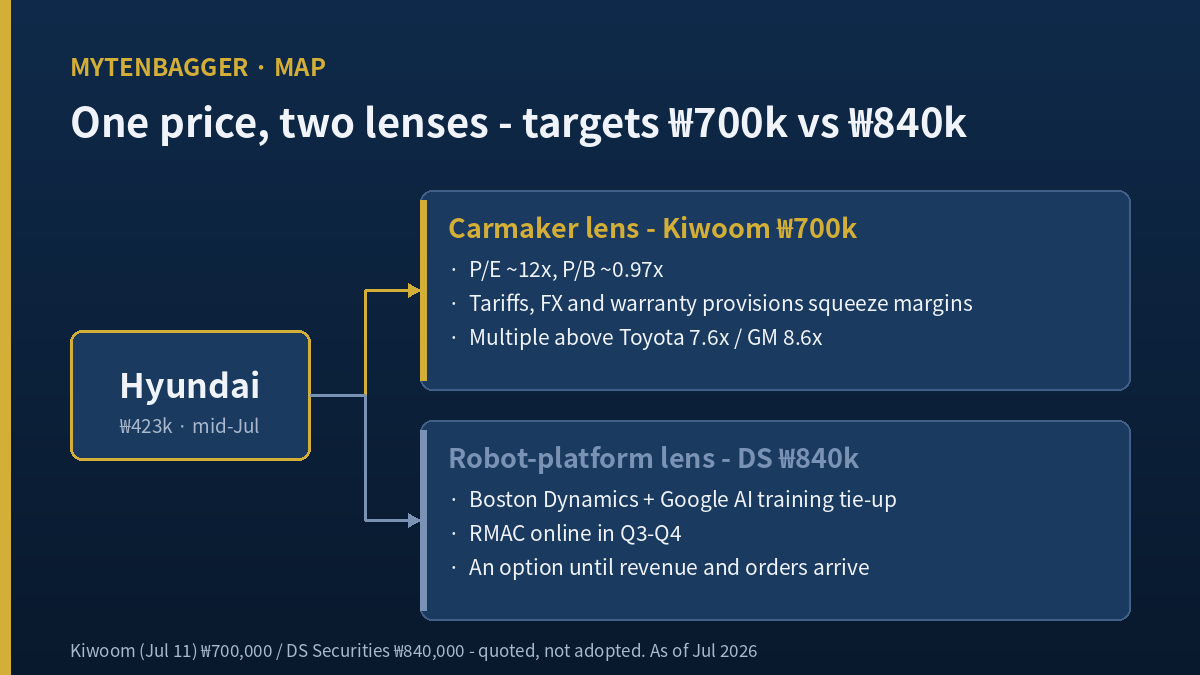
The market’s disagreement shows up most sharply in the price objectives. Kiwoom Securities analyst Shin Yoon-chul cut his 12-month price level to ₩700,000 (~$467) from ₩750,000 on July 11, citing accumulated first-half earnings shocks that make profit growth unlikely this year, a foreign-ownership slide from above 35% early in the year to below 25%, and currency-linked reserve pressure. On the other side, DS Investment & Securities analyst Choi Tae-yong raised his price level to ₩840,000 (~$560) from ₩740,000 — on a completely different axis: that Hyundai deserves a re-rating as a robotics-platform company, and that the value of industrial-site data and the Google AI-training collaboration should be recognized (Bloomingbit).
I do not read that ₩140,000 gap as simple optimism versus pessimism. The two numbers are not arguing about the fair value of Hyundai Motor stock; they are arguing about what the company fundamentally is. Kiwoom’s ₩700,000 values a carmaker squeezed by tariffs and margins. DS’s ₩840,000 values a robotics platform accumulating data. One applies an automaker’s yardstick, the other a growth-platform’s yardstick, to the same share. That makes it an identity disagreement, not a price disagreement.
Where does the whole street sit? The consensus still skews to buy-side views — one tally shows 27 buy, 4 hold, and 0 sell across 31 analysts (Investing.com). But separate from that optimism, the 46% slide from ₩783,000 to the ₩423,000 area is the market voting with its hands. I read that vote as: strip out the robot premium and re-price this as a carmaker for now. The platform identity is unproven, and until it is proven the market has retreated to the visible core-business numbers.
Foreign flows tell the same story. Foreign ownership has fallen from the mid-30s percent early this year to around 25%. A growth narrative fires the imagination of retail investors, but what pushes a foreign institution to hit the buy button again is the profit number printed each quarter. Several notes converge on the same point — narrative alone does not bring foreigners back. I watch the direction of foreign ownership as a secondary gauge of whether the robot expectation is being translated into results. If that share turns back up, it will be a sign the story is starting to cross into numbers.
Hyundai Motor stock next to the global automakers
So, on a pure-carmaker basis, is the price cheap now? There is a reflexive trap here: “price-to-earnings around 12, price-to-book near 0.9, so it must be cheap.” On domestic data Hyundai screens at roughly 12x earnings, 0.97x book, an 8.4% return on equity, a 6.2% operating margin, and a 2.2% dividend yield (FY2025 basis). In absolute terms those do look low.
But set it beside global peers through a pure-automaker lens and the picture changes. On companiesmarketcap’s trailing basis, Toyota trades near 7.6x, Honda 5.8x, Volkswagen 5.5x, GM 8.6x, and Ford 10.9x (companiesmarketcap). The measurement bases differ, so I would not push decimal-point comparisons, but the direction is clear: on a carmaker’s yardstick, Hyundai at ~12x is on the richer side of Toyota, Honda, and GM, not the cheaper side. This is not the place where the usual “Korea discount” lives.
I read the paradox this way. If a pure carmaker should already have been compressed toward Toyota-and-Honda multiples, and Hyundai is instead sitting at ~12x, that excess is the market still carrying a growth option — robotics, software-defined vehicles, electrification — on top of the shares. In other words, even measured as a carmaker, this is not an obvious bargain, and the leftover premium is the residue of the robot narrative. So I do not apply a plain “cheap, therefore accumulate” logic to this one.
Closer to home, the natural comparison is Hyundai’s sibling, Kia. On trading data Kia screens at roughly 7.3x earnings, 0.89x book, a 12.9% return on equity, and a 4.6% dividend yield — lower multiple, higher capital returns and yield than Hyundai. Korean press expects Kia’s Q2 operating profit to hold up relatively well, near ₩2.78 trillion (~$1.85 billion), helped by hybrid demand. Same group, same tariff, same currency, yet the market prices Kia cheaper and Hyundai richer. I take that intra-group gap itself as evidence that what the market layers onto Hyundai is not pure auto earnings but expectations around robots and holding-structure. If I wanted the cleaner read on pure-carmaker profitability, Kia is the more honest picture.
One more note on the dividend. Hyundai’s 2025 dividend was ₩10,000 per share (~$6.7), a 2.2% yield at the current price — but that is down from ₩12,000 the prior year (DART basis). In a value-up regime where shareholder returns were a re-rating axis, the dividend supports the downside, yet a payout that fell rather than grew is not something I wave past. A 2.2% yield is not a standout next to Kia’s 4%-plus or Korean financials either. I do not treat the dividend as a primary reason to buy; I count it only as a cushion that softens the downside during a watch.
The three checkpoints I wait for in Hyundai Motor stock
To sum up: I am watching Hyundai intently and have not bought. Not for lack of expectation. The tariff is fixed at 15%, cutting off the worst tail; the second half holds a new-model cycle — Grandeur hybrid, a new Elantra, a Santa Fe facelift, the Ioniq 3’s Europe debut (per NH); and the robot option, if it works, is the one card that could reset the automaker multiple entirely.
For a US-based reader the second-half cadence is worth making concrete, because a chunk of it aims straight at North America. Korean press previewing the quarter pointed to Elantra and Tucson updates for the US market and expanded hybrid output, with the group leaning on its US Georgia plant to build hybrids closer to the customer — a hedge that matters more now that the tariff sits at 15% rather than zero. Building more of the mix inside the US is how Hyundai blunts the tariff it cannot make disappear. I read the localization push as the quieter, more durable story under the louder robot headline: it does not re-rate the multiple, but it defends the margin that the multiple ultimately rests on. That is the kind of un-glamorous progress I weight more heavily than a demo video.
The currency deserves one more word from a dollar investor’s seat, because it is a second bet layered on the first. Buying Hyundai today means buying it with the won near multi-year weakness around ₩1,500 per dollar. If I am right on the business and the won also mean-reverts stronger over my horizon, that currency move amplifies my dollar return; if the business works but the won weakens further, the currency quietly eats part of the gain. I do not have an edge in forecasting the won, so I size any eventual position knowing the currency is a variable I am accepting, not one I am predicting. I honestly have large expectations for these three. But expectation and purchase are different actions, and I have set the order in which my expectation has to be confirmed in numbers.
First, Q2 results later this month. I watch whether the operating-profit decline lands inside the sell-side range (about ₩3.1 trillion, roughly −9% to −13%) and whether the March fire and Middle East softness prove one-off. If the decline blows well past consensus, the Kiwoom picture was right, and that is a reason to keep the watch longer.
Second, second-half utilization and the new-model “V.” As Korean press notes, the company is focused on recovering plant utilization in the second half (Korean press, Herald Business); I check whether new models actually show up as sales and margin from Q3. Only when the core recovery is visible in numbers does the valuation conversation even begin.
Third, the robot story turning concrete. I watch for signals that Boston Dynamics humanoid mass-production prep, the Robot Meta-plant Application Center (RMAC) coming online in Q3–Q4, and the Google collaboration are crossing over into revenue and orders. Until that shows, DS’s ₩840,000 is closer to a dream; once it shows, Kiwoom’s ₩700,000 becomes too bearish.
I watch whether those three switch on in order. The first two — the core numbers — come first. The robot is an option laid on top, not an alibi that covers a weak core. Today’s Hyundai Motor stock, with much of the robot premium already removed, has better downside support than it did at the peak, but I am not nailing ₩423,000 as the bottom. I want to see Q2 results and second-half utilization clear their two gates, and then, if the third card — the robot — reveals substance, that is when I fold the watch and start scaling in. Until the third card turns over, this stays a watch. I am only writing down the order of my own account.
One line to keep. In Hyundai I count the constant of tariffs and the reality of margins before the dream of robots, and I wait for the three to line up in order. My expectation is large, and I am not hiding it. But what turns expectation into a durable price is the earnings sheet in hand, not the story told about it.