
HPSP Stock: Why I’m Buying a Cracked Monopoly on the Dip
HPSP stock has fallen from a 52-week high near ₩92,000 (~$60) to about ₩48,500 (~$32) — roughly cut in half. And in 2026 the thing everyone called an unbreakable monopoly cracked: a challenger named YEST broke in. I’m still buying this name on the way down anyway, because the real moat was never the patent. My thesis breaks the day YEST turns a token second order into real repeat volume.
The first thing that pulled me toward HPSP stock wasn’t a growth story. It was a single line on the income statement: a piece of equipment maker running a 53% operating margin. That number felt impossible, so I dug in. According to Korean trade outlet THE ELEC, HPSP was the world’s first developer of high-pressure hydrogen annealing (HPA) equipment and held an effective monopoly, posting a 53% operating margin. When a hardware company earns software-like margins, it usually means one thing — nobody else can make the thing. So I put the stock on my “buy it when it finally dips” list and waited.
Now it has dipped, hard. But between then and now, the premise I was waiting on changed. This journal entry is my honest answer to a question that got harder in 2026: is HPSP stock still worth buying once the monopoly it was built on is no longer intact?
Contents
Let me be honest first — HPSP’s monopoly cracked in 2026
I won’t dress this up, because pretending otherwise would make my whole thesis dishonest. For years HPSP had the HPA market to itself. That ended. A KOSDAQ-listed challenger, YEST (Yes Tech), broke in. (KOSDAQ is Korea’s tech-heavy secondary exchange, the rough equivalent of the Nasdaq; the main board is the KOSPI.)
Here is what actually happened. In December 2025, YEST announced it would supply a 125-wafer HPA system to a global memory maker, with delivery in the second half of 2026, as THE ELEC reported. In March 2026 it installed a 75-wafer tool at a global foundry’s production fab. Then came the decisive moment: on June 18, 2026, Korea’s Patent Court ruled that YEST’s locking mechanism does not fall within the scope of HPSP’s core patent (the “027” chamber opening/closing patent), because HPSP’s design requires a rotating fastening ring while YEST rotates the outer door itself — a structurally different approach. Five other HPSP patents YEST had preemptively challenged were all found unrelated to YEST’s products, per THE ELEC’s account of the appellate ruling. Independent coverage from BigGo Finance had already framed this dispute as the pivot for the entire market structure.
The paper battle is one thing; the real-economy battle is louder. Between late May and early June 2026, YEST disclosed three equipment supply contracts with Samsung Electronics totaling about ₩43.5 billion (~$28 million) — close to half of YEST’s entire prior-year revenue, according to Korean regulatory filings. So when I say HPSP stock is no longer a pure monopoly play, I’m not speculating. The single most sophisticated buyer in the industry has already placed real orders with the challenger. Any honest analysis of this name has to start there.
Why I still hold HPSP stock — the real moat was never the patent
Here’s where my own judgment takes over. In semiconductor equipment, the durable moat is not a single patent. It’s qualification history, installed base, and switching cost. A fab does not casually swap out a mission-critical tool it has already qualified into a production line. Bringing in a new vendor means re-validating yield and reliability from scratch, and if the line wobbles during that transition, the loss dwarfs the price of a few tools. HPA sits directly on advanced-node yield, so the qualification cycle is long and the cost of failure is high. That is exactly why, in the real world, customers want the originator — the vendor with years of proven runtime. A newcomer usually can’t pry the door open without cutting price or offering special terms. The market is not naive.
HPSP made this case for me, in its own court briefs. As reported in the same coverage, HPSP argued that because it supplies equipment to leading manufacturers such as Samsung, SK Hynix, and TSMC, its technology has been validated at the highest level. That’s the whole point. A patent can be designed around. What can’t be copied overnight is a reference base embedded across the world’s three leading advanced-chip makers and the years of process data stacked on top of it. HPSP’s own product literature leans on this too — the company describes its system as the world’s first and only H2/D2 high-pressure anneal technology, processing at up to 25 atmospheres below 450°C. The underlying method is protected in filings like US Patent 8,481,123, but the point I keep coming back to is that the patents were always the smaller half of the moat.
So how do I read YEST’s Samsung win through this lens? Not as the originator being beaten. I read it as chipmakers deliberately cultivating a second source — treating single-vendor dependence as a structural risk and paying to reduce it. YEST’s pitch is productivity: its tool processes 125 wafers per cycle versus HPSP’s 75, roughly 60% more throughput. I don’t wave that away. But there’s a wide gap between a second vendor landing an initial order and a challenger actually dismantling the incumbent’s dominance. Repeat volume is a different animal from a first order. I’m betting HPSP keeps the “dominant” even though it lost the “only.”
There’s an economic subtlety here that I think the market misses when it panics. A challenger that enters on throughput and price is, almost by definition, entering on worse economics than the incumbent it’s undercutting. That’s how second sources usually get in — not by commanding a premium, but by conceding one. If YEST’s way into Samsung runs partly through price or special terms, then the very order that scares HPSP holders is also evidence that the originator still holds the pricing high ground. I’d worry far more about a competitor that entered at equal or higher prices, because that would mean the customer valued the newcomer’s tool as much as the incumbent’s. That’s not what I see yet. What I see is a classic second-source dynamic: real, but subordinate.
The demand pie under HPSP stock is still growing
Dominance only matters if the market itself grows, so this is the other leg of why I hold it. HPA demand is expanding structurally. TSMC, followed by Samsung, Intel, and Rapidus, is pushing 2nm-class logic, and interface-passivation demand rises as nodes shrink and thermal budgets tighten — HPSP’s own patent describes exactly this limited-thermal-budget problem that favors high-pressure, high-concentration hydrogen anneal. Memory is the same story: DRAM 1d process development and 300-plus-layer NAND with hybrid bonding both widen HPA’s addressable use. When the pie grows, the originator still takes the largest slice even in a multi-vendor world. I place the stock on that multi-year demand curve, not on any single quarter. And behind that curve sits the bigger engine — AI data-center capex, which keeps advanced-node and high-layer demand from cooling as long as it runs.
Capital allocation reinforces the case. HPSP has targeted roughly ₩500 billion (~$327 million) in HPA revenue and a 25%+ ROE by 2030, lifted its dividend payout ratio from single digits in 2023 to about 56% in 2024 and 2025, and retired shares earlier this year. A company that returns its monopoly cash to shareholders gives me a reason to be patient precisely while its dominance is being tested.
It’s worth being concrete about why this demand is different from past memory cycles. Old cycles were pulled by PCs and phones and broke on oversupply. This one is rooted in AI compute, and that compute is built as physical plant — data centers full of accelerators fed by HBM and high-density DRAM. Because the demand is tied to buildings and power rather than a software refresh, the investment cycle behind it tends to run longer and steadier, and every incremental advanced-node and high-layer wafer is a wafer that may pass through an HPA step. That is the multi-year curve I’m underwriting. It can still be wrong — AI capex could roll over — which is exactly why I keep a breakpoint, below.
HPSP stock by the numbers
Let me anchor this in figures rather than feel. HPSP stock trades around ₩48,500 (~$32) in early July, inside a wild 52-week range of ₩24,300 to ₩92,000 (about $16 to $60) — nearly a 4x swing in a year. That amplitude tells you everything about the debate: conviction in the moat and fear of the moat cracking take turns owning the tape. Market cap sits near ₩4.3 trillion (~$2.8 billion).
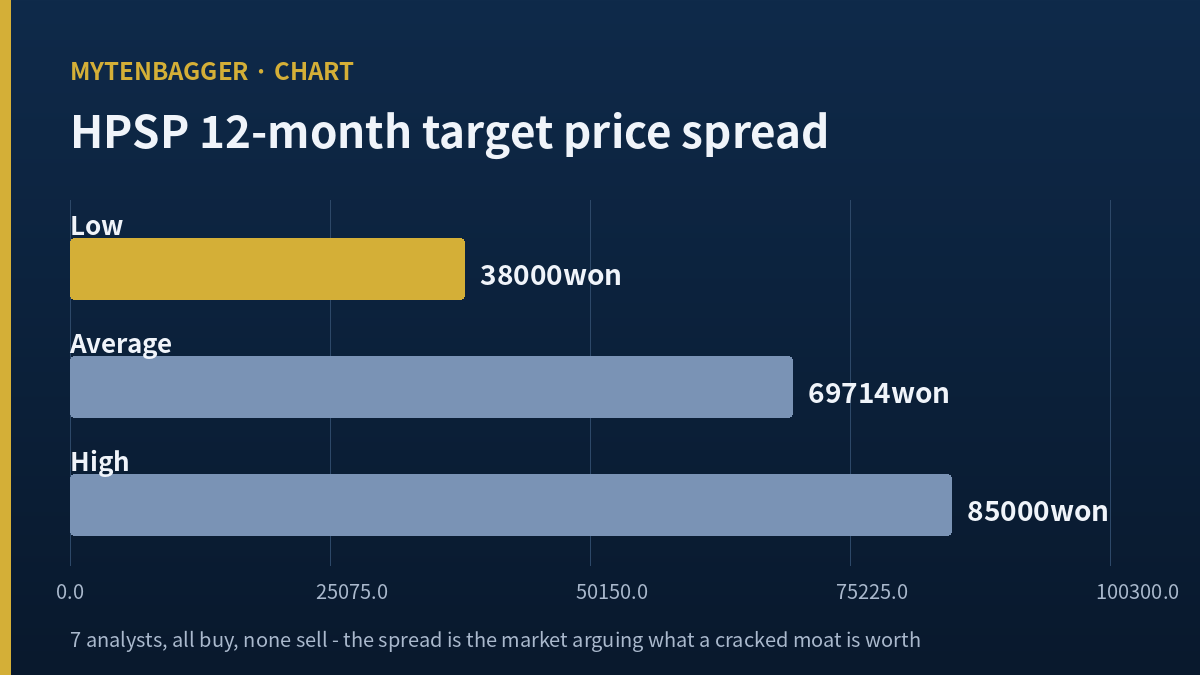
Estimates still point up. Sell-side house Hanwha Investment projects 2026 revenue of about ₩234 billion (~$153 million, +33%) and operating profit near ₩124.5 billion (+37%), keeping the operating margin above 50%. Seven analysts rate it buy and none sell, with a 12-month target averaging ₩69,714 (~$46) — a wide gap to today’s price. I don’t adopt those targets as my own; they’re the Street’s numbers, and what I actually track is how long the dominance lasts.
The counter-case has to sit right next to those numbers. YEST’s ₩43.5 billion (~$28 million) Samsung order equals roughly half its prior-year revenue, and its 125-wafer throughput edge is real. Chipmakers’ multi-vendor preference structurally favors the challenger. HPSP itself saw first-quarter 2026 standalone revenue fall about 13% year over year as memory and foundry customers throttled capex. A monopoly, it turns out, was never free from the cycle — and now it isn’t free from competition either.
It’s also fair to say part of this halving isn’t about HPSP at all. Korea’s market has been in a violent semiconductor-led drawdown, with the KOSPI and the KOSDAQ both selling off hard as global money rotates out of a crowded AI-and-chips trade. When that tide goes out, high-beta small-caps like HPSP get pulled down further than the index regardless of their own fundamentals. I actually like that: it means some of the price I’m paying reflects macro fear and forced de-risking, not a considered verdict on HPSP’s competitive position. The YEST story gave the market a fundamental reason to sell, and the broad rotation supplied the fuel. Untangling those two is most of the work here — and it’s why I treat the crack as real but the crash as partly indiscriminate.
That said, YEST is still roughly one-fifth of HPSP’s market cap, with 2025 revenue near ₩87 billion (~$57 million) and a 4.4% operating margin — a different league from HPSP’s 50%-plus. To be fair, YEST is recovering: it swung to a first-quarter 2026 profit with an 11.1% margin, and the Samsung orders back it up. So I neither dismiss YEST as trivial nor crown it the winner. What I’m confident of is narrow: YEST’s entry ended HPSP’s monopoly, but there is no evidence yet that it has ended HPSP’s dominance. An initial order and sustained volume are not the same thing.
There’s one more thing I keep in view that the excited coverage tends to skip: YEST is entering this fight while still carrying its own weight. It has to fund a new product ramp off a small, recovering base, and it has balance-sheet overhangs of its own to manage as its share price runs. None of that means YEST fails — it’s clearly a real competitor with a genuine throughput edge. It means the challenger has to execute flawlessly, for several quarters, against an incumbent that is larger, more profitable, and already inside every major customer. That asymmetry is exactly what I’m underwriting when I keep buying the leader instead of chasing the entrant.
What the HPSP stock target spread tells me — and a global-peer check
The most revealing thing about this stock is how far apart the analyst targets sit. One house calls ₩38,000, the average is ₩69,714, the high is ₩85,000. That’s a spread of more than 2x on the same company. I read that gap as the debate itself, priced: how much premium does a formerly-monopoly equipment maker still deserve once a credible second source exists?
The bears see multi-vendor commoditization erasing the premium. The bulls see the originator’s dominance and a growing pie overwhelming that risk. I stand with the bulls, for the reason I keep returning to — qualified switching cost is stickier than any patent. The patent got designed around; the reference base across Samsung, SK Hynix, and TSMC and the cost-and-yield know-how behind a 50% margin did not. So I read this halving of HPSP stock as a price that has already discounted a great deal of the “monopoly is over” news.
A global-peer check helps me sanity-test that. Truly hard-to-replace process-tool franchises are always argued over like this. ASML, which effectively owns advanced lithography, has been called expensive for years and kept its premium anyway; the same logic surrounds Tokyo Electron in coat/develop and ASM International in ALD. None of those are pure legal monopolies — they are dominant franchises whose real defense is qualification and installed base. HPSP is far smaller, but it belongs to that same category of asset, and it’s precisely that installed base — not a patent list — that is being stress-tested now. I’d rather own that stress test at half price than at the top.
Where my HPSP stock thesis breaks
So I draw the line clearly. In an earlier version of this journal I set my breakpoint at a November 2026 patent expiry — and that was wrong. The competition already moved from paper to the real economy, so my breakpoint has to move there too.
Here’s what makes me stop buying HPSP stock and re-underwrite it. If YEST converts its second-half 2026 first deliveries into repeat orders and additional customers at Samsung and SK Hynix, and that flow starts visibly eating HPSP’s share and margin, that’s no longer a second vendor’s toe in the door — it’s dominance cracking. The single cleanest signal is margin: if HPSP’s quarterly operating margin slips decisively out of the 50s, the originator is losing pricing power, and pricing power was the whole thesis. Concretely, each quarter I watch two things — whether YEST files fresh Samsung or SK Hynix orders, and whether HPSP holds its 50%-plus operating margin. The first rising while the second falls is the empirical proof of an eroding moat.
My buying reflects that line. I add in slices, starting from this halved zone, and I pace those slices to YEST’s mass-production results rather than to a calendar. While YEST is stuck at initial volume, I add on weakness; if repeat orders start spreading, I stop adding and switch to watching. I’m betting on the persistence of dominance while knowing exactly the point at which that dominance gets tested.
What I’m doing now
To put it plainly: I read the halving as a market that has already priced in “the monopoly is over,” and I’m betting on the part it may be underpricing — qualification, installed base, originator trust, and a 50% margin. I’m accumulating in slices against that view, with YEST’s real-world volume as the tripwire. My reasons to buy are dominance, a widening pie, and shareholder returns; my one reason to sell is a single event — the originator’s share and margin actually being eaten.
I owe myself an honest correction, too. I leaned on the “world’s only monopoly” story for too long and was slow to register how fast YEST was moving. Days ago I even had my breakpoint pinned to the wrong thing — a patent expiry. This entry is me fixing that. The value of a trading journal is writing down that you were wrong when you were wrong. This is my record and my judgment, not a nudge for anyone to act; plenty of people will look at the same halving and read risk, and that read deserves respect.
From here I stop watching patent headlines and start watching two things together — YEST’s order flow and HPSP’s quarterly margin. The day the originator’s dominance genuinely wobbles in the numbers, I’ll come back to this journal and write, just as honestly, that I changed my mind. This is also the first stop in a broader map I’m building of Korea’s semiconductor supply-chain moats, ranked by how hard each one is to replace; HPSP earns the front-end top slot not because its monopoly survived, but because its installed base is the kind of moat that outlives a patent. Until that base is proven to be cracking, a company that still makes something the world’s best fabs have trusted for years, trading at half its high, is a place I’d rather be buying than selling.
→ Next in the moat series: TCK Stock Up 4x: Watching the SiC Ring Leader, Not Buying
→ Also in the moat series: Leeno Industrial Stock: Why I’m Starting to Buy the Pullback
→ Also in the moat series: EO Technics Stock Fell 45% While Estimates Rose: Why I Buy
Related reading