Hyundai Glovis Stock: Robot Premium Gone, 8x Earnings Left
Hyundai Glovis stock built three rallies this year — on robots, on governance, on Boston Dynamics listing hopes — and gave every one of them back. What’s left near $123 (₩186,500) is a business earning at roughly 8x trailing earnings with an 18% ROE, plus a dividend floor the company put in writing. I started a first small position in the $120s. The heaviest weight in my thesis isn’t a robot; it’s whether that dividend promise gets kept.
It must have been the second week of January. The clip of Atlas walking at CES kept landing in my group chats, two or three times a day, and everyone wanted to talk about robots. What I typed into a search bar that night wasn’t a robot company. It was a shipping line — or more precisely, the company that hauls Hyundai and Kia cars across oceans while holding a stake in the robot maker everyone was watching. Hyundai Glovis stock printed an all-time high that week on upgraded earnings forecasts, as Korean market coverage noted on January 12. I didn’t chase it. At the mid-₩240,000s (about $160), I couldn’t tell how much robot was in the price. Half a year later the video clips are the same, but the price is back near $123. Now I can do the math — so I’m writing this entry.
Contents
Three Rallies, Three Round Trips — Where Hyundai Glovis Stock Landed
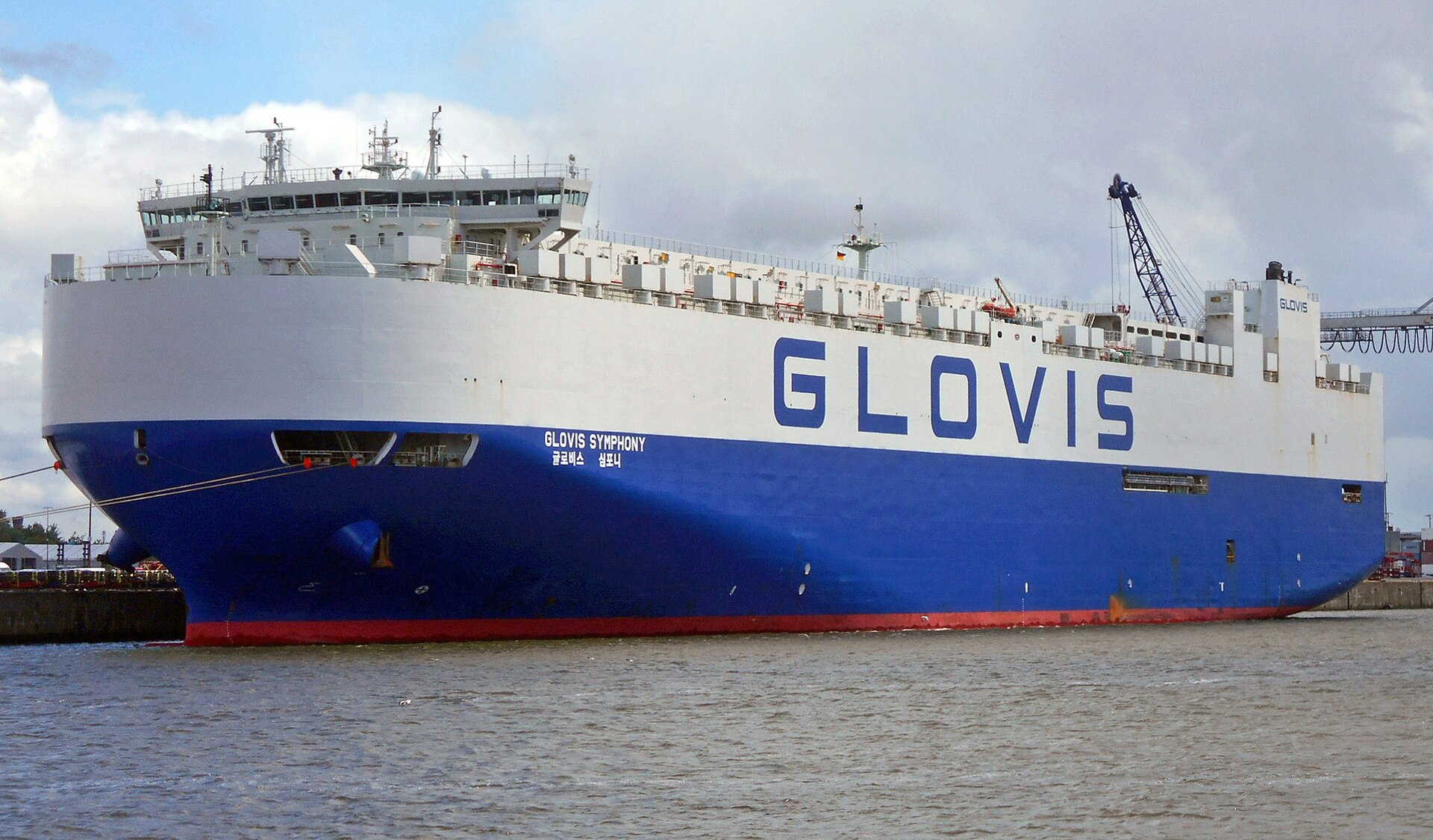
A quick frame for readers new to the name. Hyundai Glovis is the logistics, shipping, and distribution arm of Hyundai Motor Group, listed on the KOSPI — the main board of the Korea Exchange in Seoul, where it trades under ticker 086280. It moves finished cars on its own fleet of car carriers (the industry calls them PCTCs — pure car and truck carriers), runs inland and container logistics, and supplies knock-down auto parts kits to overseas assembly plants. Its market value works out to roughly $9.2 billion (about ₩14 trillion, my arithmetic from 75 million shares at the July 20 close; all conversions in this post use roughly ₩1,520 per dollar).
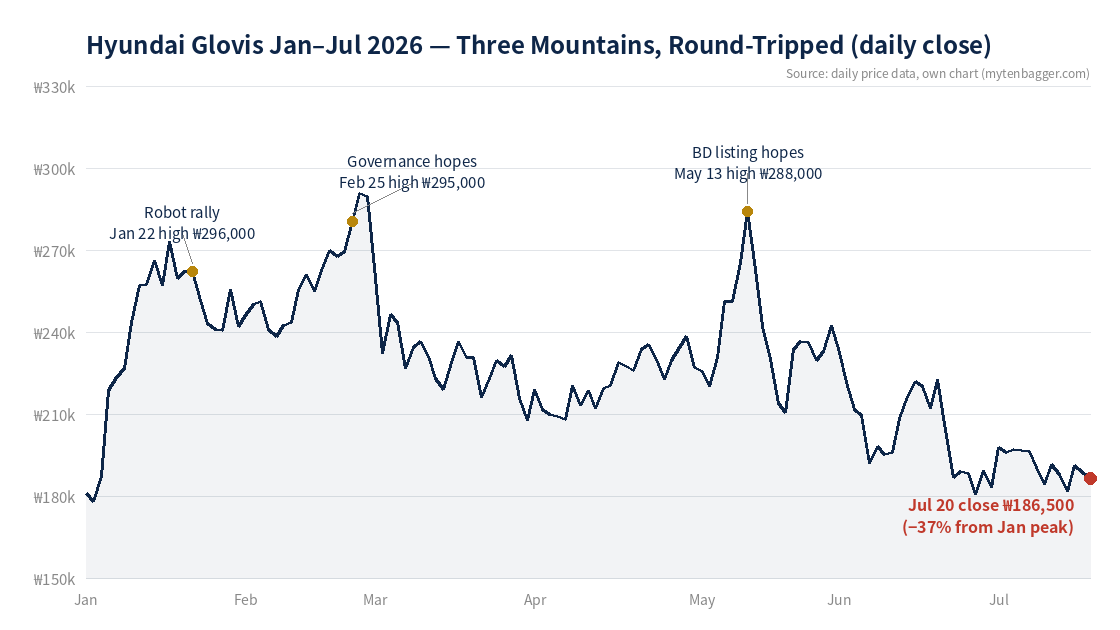
The daily chart this year shows three mountains. From around ₩180,000 in early January, the stock ran to an intraday ₩296,000 (about $195) on January 22 — fuel: robots, with Korean coverage of upgraded forecasts and an all-time high on January 12, and gains attributed to shipping improvement plus its robotics stake in the same stretch (per a Joseilbo movers piece, rendering from Korean). By late February it was back above ₩290,000 — fuel: governance, as Korean outlets highlighted that Chairman Chung Eui-sun personally owns 20% of Glovis, 29.36% including related parties, and that the group still runs Korea’s last remaining circular shareholding structure (Energy Economy News, February 19, my summary of the Korean report). On May 13 it touched ₩288,000 intraday — fuel: sell-side and press chatter about a possible Boston Dynamics listing. And on July 20 it closed at ₩186,500, roughly 37% below the January peak by my arithmetic. Twelve-month return: still +25%. Six-month return: −32% (both per Kiwoom-sourced data).
One observation I want on the record: all three mountains were built on fuel from outside the company — a trade-show video, governance articles, listing speculation. The day actual first-quarter results landed, April 23, the chart barely moved; the next session closed down about 2% (my read of the daily data). This stock has been moved by stories, not numbers. And right now the stories have all leaked out of the price. Oddly, that’s what makes me comfortable. I can’t measure the shelf life of a story, but the shelf life of a quarterly number is fixed at three months.
Why I Started Buying Hyundai Glovis Stock in the $120s
Weight one — earnings kept growing while the price round-tripped
While the chart climbed and fell, operations just did their job. Here’s the first quarter the company reported on April 23.
| Q1 2026 (consolidated) | Amount | YoY |
|---|---|---|
| Revenue | $5.1B (₩7.81T) | +8.2% |
| Operating profit | $343M (₩521.5B) | +3.9% |
| Net profit | $224M (₩341.0B) | −14.4% |
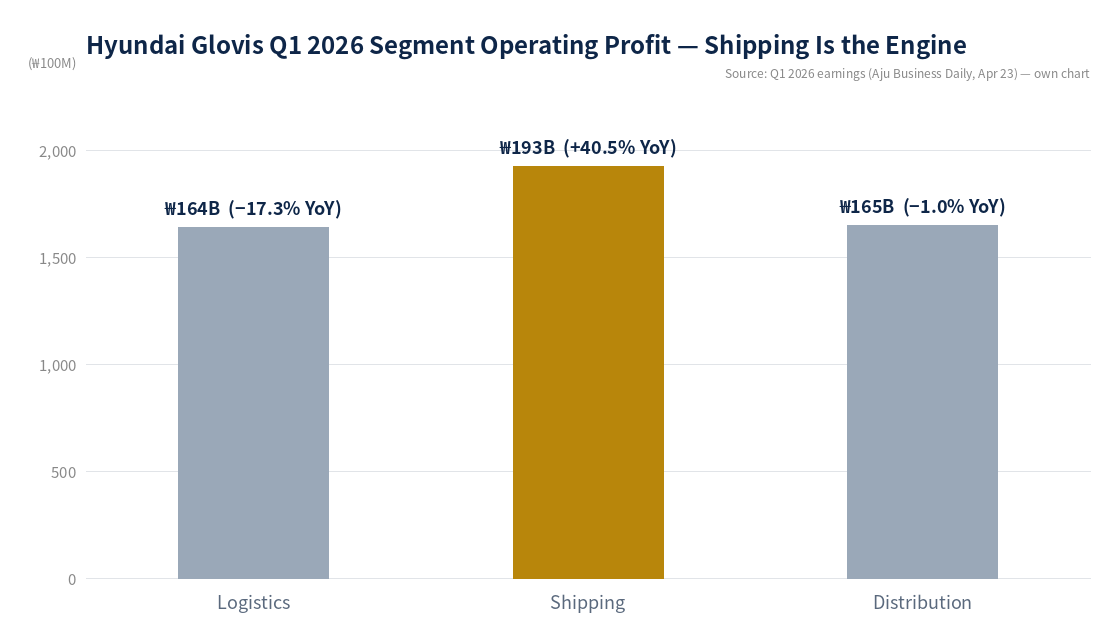
| Logistics operating profit | $108M (₩164.0B) | −17.3% |
| Shipping operating profit | $127M (₩192.6B) | +40.5% |
| Distribution operating profit | $108M (₩164.9B) | −1.0% |
Source: company Q1 release as reported by Aju Business Daily (Korean), April 23; USD converted at ~₩1,520/$
The cell my eye stopped on is shipping. Distribution has the biggest revenue line ($2.55B, ₩3.87T), but the biggest profit line is the fleet: $127M of operating profit, up 40.5% year over year, which the Korean coverage tied to expanded high-rate cargo volumes from Chinese carmakers and to tighter fleet utilization. For a company most people file under “Hyundai’s captive logistics arm,” the profit engine right now is ships carrying other people’s cars too. You don’t see that in consensus headlines; you see it when you pull apart the segment table.
Zoom out to a full year and the shape holds. On Kiwoom-sourced aggregates, the latest annual run: revenue about $19.5B (₩29.6T), operating profit about $1.4B (₩2.1T), net profit about $1.1B (₩1.7T). Per-share earnings of ₩23,117 (about $15.2) put the July 20 close at roughly 8x earnings, on an 18.1% return on equity. My bar for owning anything without a story attached is that the boring numbers alone justify a seat at the table. These do.
The other two segments deserve a line each. Distribution grew revenue 10.3% on knock-down kit supply to emerging-market assembly plants (per the Aju report) — low margin, but it spins as long as group cars sell. Logistics took the painful −17.3% on weak container rates; on the other side, Korea Investment & Securities analyst Choi Go-woon argued in a May 29 note that logistics value is re-rating, citing a 66% jump in the Shanghai container freight index since March and a 30% rise in April air cargo rates. How fast, and with what lag, that reaches this segment’s P&L is on my checklist for the Q2 print.
Weight two — the dividend is a disclosure, not a vibe
This company’s shareholder-return plan isn’t an IR talking point; it’s filed. The framework laid out at the June 2024 CEO Investor Day was hardened into a value-up disclosure on November 4, 2024: a payout ratio of at least 25% of profits — “plus alpha,” as Korean outlet Dealsite framed it — for 2025 through 2027, and a per-share dividend raised at least 5% every year (that floor per Sidae’s summary of the pledge, in Korean). The first report card is in: for fiscal 2025 the company paid out about $286M (₩435B) in total dividends, up 56.8%, or ₩5,800 (about $3.80) per share at a 25.1% payout — clearing the promised line (Sidae, March 27). The prior year’s total was ₩277.5B, so a company that promised at least 5% annual growth delivered 56.8% in year one. As opening moves go, I’ve seen worse ways to keep a promise.
The number I actually use is the floor. If the pledge holds, fiscal 2026’s dividend is at least ₩6,090 per share (₩5,800 × 1.05 — my arithmetic), which is about $4.00 and a 3.3% yield on the July 20 close (again my arithmetic). Nobody retires on 3.3%. The point is different: while I hold a de-storied stock and wait, the downside is cushioned by something the company filed, not something I hope. A pledge is only a pledge until it’s honored, though — which is exactly why it sits as the heaviest tripwire below.
Two more dials sit in the same disclosure: an average ROE goal of 15% plus alpha through 2030, and total shareholder return (TSR) added as a value-up metric (per Dealsite); the realized TSR figure was 56.1% as of late August 2025 (per Sidae). TSR flatters any year the stock ran, so I note it and move on. My trust rests on two numbers only: the payout ratio and the per-share floor.
Weight three — bigger ships, changing cost structure
Three newly built 10,800-CEU car carriers — each swallowing more than 10,000 small cars per sailing — were delivered to the fleet between April and late June this year (Global Economic, July 9, Korean-language report). On the Q1 conference call the company said these 10,000-plus-unit megaships enter service progressively from the second quarter (as reported from the call by Daehan Kyungje, in Korean). Owning bigger ships and cutting short-term charters is the same “cost improvement” thread Daol Investment & Securities analyst Oh Jung-ha flagged at the start of the year (via Shipping News Net, January 20). Korea Investment’s Choi, in that May 29 note, estimated more than ₩3 trillion (about $2B) of free cash flow over the next two years and floated the possibility of the payout ratio moving higher. Kiwoom-sourced aggregates point the same way: a free-cash-flow yield in the mid-5% range and interest coverage around 12x. Can they buy ships and keep the dividend promise at the same time? So far the ledger says yes.
The Case Against Hyundai Glovis Stock — My Other Ledger
A journal that only records the buy case is an advertisement. So, the other page. First, net profit fell 14.4% in Q1 even as operating profit rose — some quarters the bottom line walks backward on you. Second, the logistics segment is being squeezed by soft container rates, and in early July Korean movers coverage described foreign investors and the national pension funds taking profits amid worries about freight indexes rolling over (Jaekyung Ilbo, July 2). The flow is plainly against me right now — though foreign ownership still sits around 46% of the register (Kiwoom-sourced data), so whether July was a trend change or half-year rebalancing needs a few more weeks to read.
Third is the structural one. Per the Global Economic report, Chinese yards took 219 of the 276 PCTCs ordered worldwide for 2023–2028 delivery — 79.4% — including 18 of roughly 20 orders in the first half of this year, at prices it pegged 15–20% below Korean yards. The same report explains why the spigot sits where it does: Korean builders have largely ceded the PCTC niche because the economics favor other hulls — it cited an LNG carrier fetching 87% more than a PCTC at HD Hyundai — so the world’s car-carrier supply now rises or falls on Chinese slipways. Ships built cheap and in volume eventually come back as the enemy of freight rates. The +40.5% in shipping could be the shoulder of this cycle rather than the base of it; I’ve written that down as the single biggest threat to my base case. Fourth, governance. The 2018 attempt to merge a split-off Hyundai Mobis unit with Glovis died against market opposition (per the Energy Economy News retrospective), and I can price neither the timing nor the shape of whatever comes next. Cutting both ways, the chairman’s 20% personal stake at least aligns his interests with the share price over time — but “over time” is doing heavy lifting in that sentence, and a deal structured for succession math isn’t automatically a deal structured for minority holders. I hold the position as if no restructuring ever happens. Fifth, tariffs. U.S. auto tariffs bear directly on export volumes from the group’s Korean plants, and — this part is my own reasoning, not something I can source — the more production localizes in North America over the years, the less work there is for ships crossing the Pacific at all. Not a this-quarter risk; a direction that belongs on the calendar.
Now the sell-side numbers, quoted but not adopted. KB Securities’ Kang Sung-jin put the stock at ₩360,000 (May 11), Korea Investment’s Choi Go-woon at ₩330,000 (May 29), Daol’s Oh Jung-ha at ₩320,000 (January 20), Hana Securities at ₩310,000 (January 30) — that last report’s own title says it folds Boston Dynamics value into the number. Much of this complex, as I read it, is robot-scenario freight. Note even the size of the stake differs across sources — KB’s note says Glovis directly holds 11.3% of Boston Dynamics, while the Daol-sourced coverage says 10.9%, and I couldn’t establish which is current. Which is one more reason the stake carries zero weight in my math. For the record: one Korean outlet has cited estimates valuing Boston Dynamics at ₩128–146 trillion in a listing scenario — I treat that as scenario talk, not a fact I’d lean on. The mirror case sits one ticker over: at a ₩9.72 trillion market cap against ₩34.12 billion of fiscal 2025 revenue, the multiple stops working altogether and I had to run the arithmetic backwards instead.
I also went looking for a clean global comparable, because that’s the discipline for any Korean name I own. The nearest pure-play is Oslo-listed Wallenius Wilhelmsen, the global car-carrier operator. The structural contrast is the point: Wallenius is a rates business through and through, while Glovis stacks a captive volume base (Hyundai and Kia cargo), a third-party logistics arm, a parts-distribution annuity, and an unpriceable robot stake on top of its fleet. I couldn’t verify a current multiple for the peer that I’d stand behind, so I’m not quoting one — but the diversification gap is exactly why I’ll tolerate a shipping cycle here that I wouldn’t tolerate in a pure carrier.
Scenarios — Does the Business Carry the Stock Without a Story?
Base (my odds: 55%). Q2 shows shipping profit holding up and logistics finding a floor; the year-end dividend follows the pledged path (25%-plus payout). The company’s own comment on the Q1 call — that Middle East risk to car-carrier volumes looks limited (via the Aju report) — sits inside this picture. Here the downside is carried by earnings and the dividend, no events required. This is where my money is.
Bear (30%). The freight cycle cracks and China-built capacity floods in faster than expected. Shipping’s profit growth ends early, logistics keeps bleeding, and 8x earnings turns out to have been “a low multiple on peak profits” rather than cheap. I sized my first buy small precisely because I can see this page from here — and getting stuck underwater on it is a risk I accepted at entry.
Bull (15%). A Q2 beat plus the robot and governance stories reigniting. Honestly, during the May spike I wobbled for about two days — I had the order screen open in the ₩280,000s and closed it, and whether that was the right call still feels like a coin flip to me. The principle survived the wobble: events are a bonus, never the thesis.
My Tripwires — Four Weights on the Scale
Here are the conditions that would break or bend this thesis, in order of weight. The heaviest: the dividend pledge. If the fiscal 2026 per-share dividend misses the promised floor (prior year +5%, ₩6,090 by my arithmetic) or the payout ratio breaks below 25%, every other line in this entry gets re-underwritten — the hand cushioning my downside would be gone. Middle weight: the shipping segment’s direction. Slowing growth is already in my assumptions; an outright year-over-year decline in segment operating profit sends me back to re-examine the whole bigger-ships-lower-costs picture. Lightest: logistics. Two consecutive quarters of double-digit profit declines and I stop adding, full stop. And the zero-weight items — a robot listing, a group restructuring. They were never on the scale. If they arrive, they’re a tip, not a thesis.
Why the weights differ: the dividend is a promise the company itself filed, so breaking it is a trust event; freight rates are set by the market, so they can crack with nobody at fault. The first kills the thesis, the second only changes my speed. A journal that treats every piece of bad news at the same weight isn’t a journal, it’s a smoke alarm.
The calendar, not the weights, sets the checking order: the next test is Q2 results. Q1 landed on April 23, so I expect the print between late July and early August and I’ll sit on my hands until then. Three lines I’ll be reading that day: shipping segment profit against the $127M just posted, any commentary on how the three new megaships are being utilized, and whether the logistics margin shows the freight-rate rebound Choi’s note leaned on — in that order, because that’s the order my weights hang in. I ran the same drill — re-weighing a beaten-down name on delivered numbers instead of narrative — in my POSCO Holdings entry.
What Changed Between January and July for Hyundai Glovis Stock
One practical note for U.S. readers first: this name doesn’t trade on a U.S. exchange. That friction is part of why story premiums on KOSPI names inflate and deflate as violently as this one did. A second note on currency: every dollar figure here assumes roughly ₩1,520 to the dollar, a historically weak level for the won. If the won strengthens from here, dollar-based returns on Korean holdings pick up a tailwind that has nothing to do with the stock itself — and if it weakens further, the reverse. I treat that as noise I can’t time, but a U.S. holder should at least know the assumption is in the numbers.
In January I was watching robot videos in front of this company. In July I’m reading its dividend filings. The company didn’t change in six months — the price did, by about 37%, and that’s the entire difference between a stock I couldn’t underwrite and one I could. I put a first small position on in the $120s; Q2 results and the year-end dividend are the next pages of this entry. If you came here for the robot story, this price will bore you. I took the boring side on purpose. Some readers will see the boredom as the opportunity; either way, this journal is something I write for myself — what you do with it is entirely up to you.
Related reading
- LG Electronics Stock: A 56% Crash Into Record Earnings
- Hyundai Physical AI: Only One Contract Came With a Number