POSCO Future M Stock Sits Between a Thick 2026 and a Thin 2027
The furthest-out assumption I hold about POSCO Future M stock reaches the year 2035. The nearest year for which I found an outside shipment figure is 2027, and exactly one house had published one. Between those two points the data I could gather gets noticeably thinner, and that shape is what this entry is about.
Five things I checked before writing about POSCO Future M stock
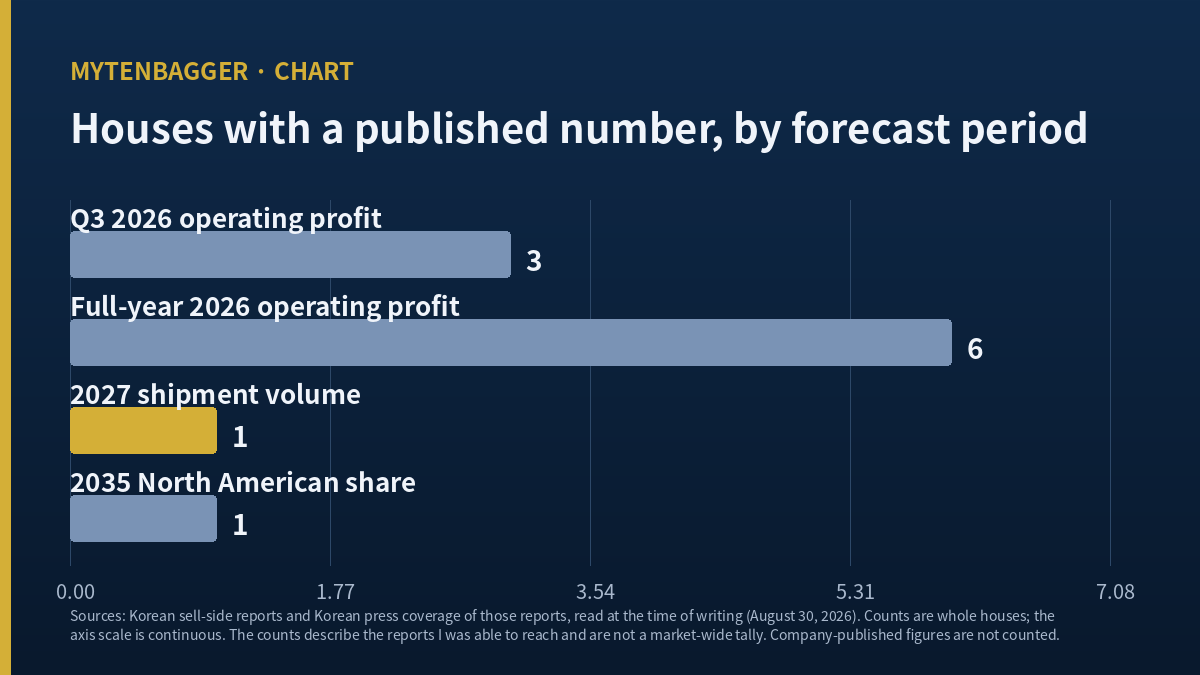
1. Three houses published an operating profit figure for the July-September 2026 quarter. Six published one for full-year 2026.
2. For 2027 shipment volume I found one outside house. The other figure in circulation for that year comes from the company.
3. One house values the anode business on an assumption about North American share in 2035.
4. The company earned 44.4 billion won of operating profit in the first half of 2026, on 1,437.0 billion won of revenue (DART consolidated filing, receipt 20260814000996).
5. I hold no position and have placed no order. This is an observation entry.
Contents
What POSCO Future M stock is, for readers outside Korea
POSCO Future M trades on the KOSPI under the code 003670. The KOSPI is the main board of the Korea Exchange, the larger of the two Korean equity boards; the KOSDAQ is the smaller, growth-oriented board, and two of the peers I use below sit there. The company was called POSCO Chemtech, then POSCO Chemical, and took its present name in 2023. It is the battery-materials arm of the POSCO group, and it makes three things: cathode materials, anode materials, and a set of basic industrial materials including refractories, lime and coal-chemical products.
On Friday, August 28, 2026, the shares closed at 186,300 won. Market capitalization that day was 16.57 trillion won, which converts to roughly 12.0 billion US dollars at about 1,377 won per dollar. I am writing on Sunday, August 30, so the Friday close is the last trading session available to me. The won is the reference currency throughout this entry, and that single conversion is the only dollar figure I use.
Counting the estimates behind POSCO Future M stock, year by year
I did not copy any valuation figure into this entry. What I did was open every report and report summary I could reach, and count how many houses had put an actual number against each forecast period. The count came out uneven in a way I did not expect.
| Forecast period | Houses with a published number | Which ones I saw |
|---|---|---|
| Q3 2026 operating profit | 3 | IBK (July 31), Hana (August 3), SK Securities (August 5) |
| Full-year 2026 operating profit | 6 | Samsung, Mirae Asset, Kiwoom, KB, Hana, Meritz |
| 2027 shipment volume | 1 | IBK. The other figure for that year is the company’s own |
| 2035 North American share assumption | 1 | Mirae Asset, used to value the anode segment |
Sources: Korean sell-side reports and Korean press coverage of those reports, read at the time of writing. The counts describe the reports I was able to reach, and they are not a market-wide tally.
A quarter is crowded and the year after next is not
Three houses were willing to put a figure on a three-month window. Six were willing to do it for a twelve-month window. One was willing to do it for shipment volume two calendar years out. The single house that did (IBK, July 31, 2026) put 2027 cathode shipments near 97,000 tonnes, which works out to about 65 per cent of the 150,000-tonne figure the company has put forward (my own division).
I am not going to build an argument on that gap. A sample of one is a view, and calling it a divergence would mean treating one analyst’s spreadsheet as a distribution. What I take from the row is narrower: for the year in which this company’s newly contracted volumes are supposed to begin, I could find one outside number.
Past that thin stretch there is a 2035 assumption. Mirae Asset values the anode business on a projected North American share in that year. I am not reproducing the figure it produces, because this entry does not carry valuation amounts. I am recording the placement: the assumption reaching furthest into the future sits on firmer-looking ground, in the sense that someone has committed a number to it, than the year immediately after next.
Forecasting further out than the next quarter is ordinary work and I do not treat the shape as a scandal. I do note that this company’s current earnings are close to zero. Return on equity for the first half of 2026 was 0.66 per cent on the consolidated filing. I keep those two observations on separate lines and I do not write the sentence that joins them.
The half-year the estimates are anchored to
First-half 2026 consolidated revenue was 1,437.0 billion won, operating profit was 44.4 billion won, and net profit was 30.9 billion won (DART, receipt 20260814000996). The comparable first-half operating profit a year earlier was 17.9 billion won.
The April-June quarter on its own produced 26.7 billion won of operating profit against 0.8 billion won in the same quarter of 2025. The percentage that comes out of those two figures is very large, and it is large because the earlier number is small. What I looked for was the composition. Korean coverage of the results pointed to nickel prices, an inventory valuation write-back, and coal-chemical product pricing tied to crude (Global Economic, July 30, 2026; Financial News, August 10, 2026). Cathode volume was absent from the three items those reports named.
That absence has a matching figure elsewhere. Korean coverage of SNE Research data put this company’s cathode loadings in batteries at 24,000 tonnes for the first half of 2026, down from 31,000 tonnes, a decline of 22.6 per cent (ZDNet Korea, August 11, 2026). The quarter also came in below the figure the market had been carrying, which Korean press reported at 29.7 billion won against the 26.7 billion won reported.
Where POSCO Future M stock has traded
I pulled 260 sessions of daily candles and recomputed the extremes on a closing basis, because the vendor screen I use labels its 250-day high and low as close-based and the values it returns are intraday. On closes, the high in that window was 296,000 won on Thursday, May 7, 2026, and the low was 122,100 won on Wednesday, July 29, 2026. The August 28 close of 186,300 won sits at 62.94 per cent of that high, 37.06 per cent below it, and 52.58 per cent above that low. All three are my own calculations from the closing series.
The vendor screen gives 299,500 won and 114,700 won for the same window. Those turn out to be the intraday high of Friday, May 8, 2026 and the intraday low of Thursday, July 30, 2026. Using them would put the gain from the low at 62.4 per cent, which is 9.82 percentage points away from the closing-basis figure. I use the closing-basis numbers throughout so that they match the close printed in this entry. This is the fourth stock in a row where I have found that label pointing at intraday values, and I have asked for the field definition to be confirmed.
One more detail from the same series. The one-month return the screen reports, 52.58 per cent, resolves to a base close of 122,100 won on July 29, and that day is also the lowest close in the 260-session window. The two figures agree because a month ago happened to be the bottom. The six-month and twelve-month returns on the same screen resolve to base dates 185 days and 379 days back, so their labels and their actual windows do not line up, and I have kept both out of my reasoning.
The segment carrying the furthest assumption is the smallest one today
POSCO Future M reports in two blocks: energy materials, which holds the cathode and anode lines, and basic materials, which holds refractories, lime and coal-chemical products. The segment note in the company’s DART filing for the first quarter of 2026 breaks the energy materials block down further. Segment revenue was 433.6 billion won, of which cathode accounted for 418.7 billion won and anode for 14.9 billion won. Company revenue that quarter was 757.5 billion won (DART consolidated, Q1 2026).
So the anode line produced about 2.0 per cent of what the company sold in that quarter, by my own division. It is the smallest of the three product families by current revenue, and by a wide margin.
It is also the line carrying the longest-dated assumption in my notes. The 2035 North American share projection I mentioned earlier is applied to the anode business, not to cathode and not to basic materials. I want to be careful about what I am claiming here, because there is an obvious sentence available and I am not writing it. A business can be small now and large later, and a supplier that is early in a market it expects to grow will always show this pattern. What I am recording is the arrangement, not a verdict on it: the shortest revenue line in the current quarter is the one holding the assumption that reaches furthest forward, and the year in between those two facts is the year where I found a single outside estimate.
The anode business is not idle while that assumption sits on it. Korean reporting through 2025 and 2026 describes a North American natural graphite anode supply arrangement running from October 2027, a Vietnamese synthetic graphite project with first-stage output targeted for 2028, and US anti-dumping and countervailing duties on Chinese graphite. Each of those has a date attached and none of them has revenue attached yet.
POSCO Future M stock against its peers, grouped by fiscal year end
I have grouped this table by when each company closes its books, because putting a March-year-end company in the same sorted list as December-year-end companies means the earnings in the denominators are measured over windows that are one quarter out of step. Reading the fiscal-year column first tells you which rows are actually comparable to each other.
December fiscal year end
| Company | Listing | P/E | P/B | ROE | As of |
|---|---|---|---|---|---|
| POSCO Future M | KOSPI 003670 | not shown | 2.65 | −0.15% | Aug 2, 2026 |
| EcoPro BM | KOSDAQ 247540 | 176.78 | 4.86 | 5.62% | Aug 2, 2026 |
| L&F | KOSDAQ 066970 | not shown | 4.30 | −76.11% | Aug 2, 2026 |
| Umicore | Euronext Brussels UMI | 11.16 | 2.20 | 22.86% | Aug 5, 2026 |
| Ningbo Shanshan | Shanghai 600884 | 34.27 | 1.11 | 3.54% | Aug 29, 2026 |
| Albemarle | NYSE ALB | 281.77 | 2.02 | 2.65% | Aug 29, 2026 |
| NOVONIX | Nasdaq NVX | not shown | 0.60 | −61.97% | Aug 25, 2026 |
| Syrah Resources | ASX SYR | not shown | 0.55 | −28.44% | Aug 29, 2026 |
March fiscal year end
| Company | Listing | P/E | P/B | ROE | As of |
|---|---|---|---|---|---|
| Sumitomo Metal Mining | Tokyo 5713 | 13.18 | 1.00 | 8.69% | Aug 5, 2026 |
Multiples from stockanalysis.com statistics pages, each with the as-of date that page carried when I read it. “Not shown” means the page reports a trailing net loss and prints no P/E. Two exclusions: Arcadium Lithium is gone as a listed company, since Rio Tinto completed its acquisition on March 6, 2025; and CATL is left out because the two pages I opened for it disagreed on the as-of date.
The POSCO Future M row needs a warning attached. Its as-of is August 2, 2026, and the price on that date was 137,700 won, well below the 186,300 won close this entry is written on. The Korean vendor screen I use elsewhere gives that same company a P/E of 487.22, a P/B of 4.07 and an ROE of 0.9 per cent as of August 28, on a trailing four-quarter earnings window. Two data providers, two earnings windows, and a 35 per cent gap between the prices on the two as-of dates, measured from the August 2 price of 137,700 won. I put the vendor figures in the paragraph and not in the table so that nobody reads down a column and compares them with the peer rows.
Four things I am holding against POSCO Future M stock
One. The August cathode announcement is an agreement and not a signed contract. What was made public is scale: more than 190,000 tonnes of LFP cathode material across 2027 to 2032. The contract value and the counterparty were not disclosed, and a definitive contract was reported as expected during the third quarter (Etoday, August 6, 2026). Revenue would begin in 2027, so none of it reaches the 2026 income statement.
Two. This company has a prior large supply contract that did not run to its headline size. The cathode agreement with the GM and LG Energy Solution joint venture Ultium Cells, covering January 2023 to December 2025, was originally 13.76 trillion won, and actual supply closed at 2.81 trillion won (Electric Times, January 2026, on a disclosure dated December 31, 2025). That is a fulfillment rate of 20.4 per cent by my own division. The disclosure gave falling lithium prices and slowing US electric vehicle demand as the reasons for the shortfall.
Three. The weight of the cathode market sits away from this company’s traditional product. Korean press citing SNE Research put 2025 global cathode shipments at 4.95 million tonnes with LFP at 3.47 million tonnes, and reported that the top ten producers by volume were all Chinese (Electronic Times, June 17, 2026). Dividing those two figures gives roughly 70 per cent. Moving into LFP means moving into that market.
Four. Free cash flow was negative in the first half. Operating cash flow of 189.0 billion won against capital expenditure of 363.2 billion won leaves −174.2 billion won (DART consolidated, first-half cumulative). Interest cover for the same period was 0.37 times, since half-year operating profit of 44.4 billion won did not reach the 119.5 billion won of interest expense. In the prior full year, operating cash flow itself was −33.6 billion won.
My position and the date I revisit it
I hold none of this and I have placed no order. This is an observation entry on a 16.57 trillion won company whose checklist score on the seven metrics I screen with is 43, three of seven passing (vendor data, August 28, 2026). I am not using the multiples as evidence in either direction, because a multiple built on an earnings line close to zero carries very little information.
The condition that closes this entry is a date and not a sentence. The statutory deadline for the third-quarter report is November 15, 2026, which falls on a Sunday, so the filing arrives on or after Monday, November 16, 2026. Three things I check that day. Whether a second outside house has put a number on 2027, because a row of one is the reason this entry exists. Whether the July to September single-quarter operating profit clears the 66.7 billion won the company posted in the same quarter of 2025 (DART, single quarter). Whether the August cathode agreement became a signed contract with a disclosed value, which would move it out of my objections list and into the table of things I count.
I have written about the cell makers and the upstream chemical side from other angles: LG Energy Solution, LG Chem, Lotte Chemical, and on the demand side Kia.
Related reading: the EcoPro BM entry
Prices and multiples reflect the close of Friday, August 28, 2026, checked while writing on Sunday, August 30. Publication may come later, so the figures can differ from live quotes by the time you read them. Financial statement figures are consolidated and filed with Korea’s DART system; the won is the reference currency, and the one dollar conversion uses roughly 1,377 won per dollar on the same date, which is an approximation. Anything I describe as my own division or recomputation was calculated from the filed or vendor values named beside it.