Lotte Chemical Price Target: Why Four Brokers Differ 2.13 Times
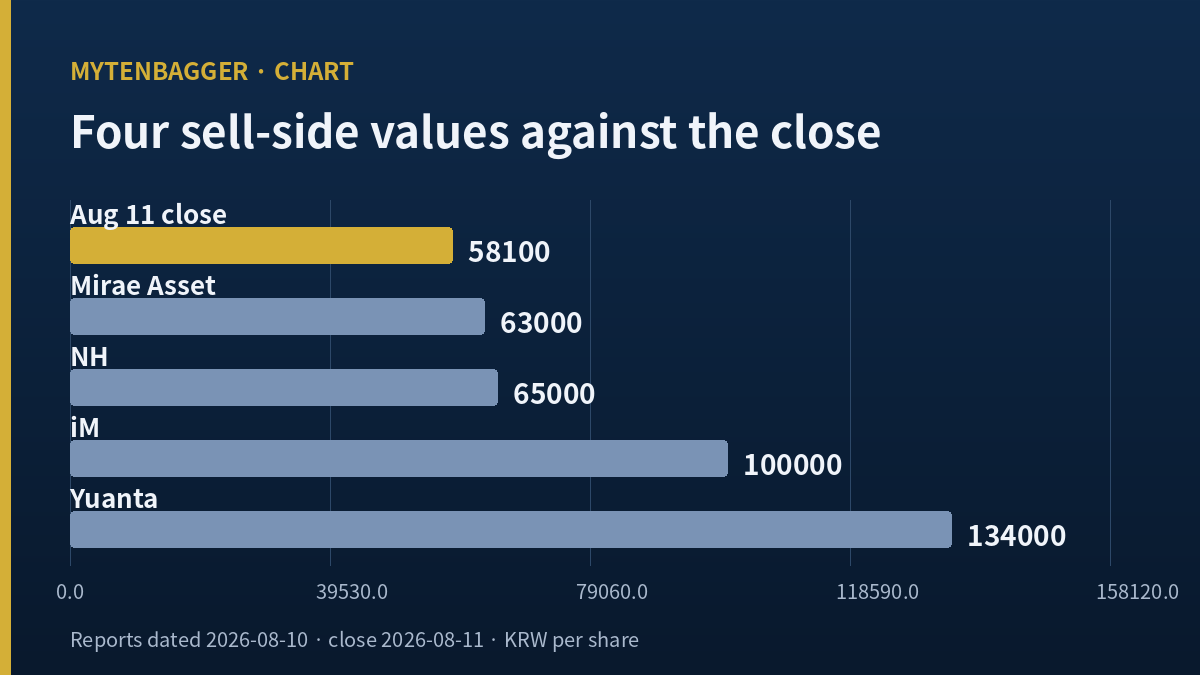
On August 10, 2026, four Korean brokerages published values for Lotte Chemical stock on the same day, reading the same set of quarterly results. The lowest was KRW 63,000 (about USD 44.49) and the highest was KRW 134,000 (about USD 94.63). One is 2.13 times the other. I spent most of my time on this company trying to explain that spread through earnings forecasts, and I could not, because all four of those houses expect the company to lose money in the second half of the year.
The arithmetic behind two of those four values
1. Mirae Asset Securities: forward book value per share KRW 280,000 times a price-to-book multiple of 0.23 equals KRW 64,400. Published value: KRW 63,000.
2. iM Securities: 2026 estimated book value per share KRW 288,595 times a multiple of 0.35 equals KRW 101,008. Published value: KRW 100,000.
3. The two calculated figures differ by KRW 36,608. The portion explained by the difference in book value estimates is KRW 1,977, or 5.40 percent.
4. The remaining KRW 34,631, or 94.60 percent, comes entirely from the multiple.
Lines 3 and 4 are mine. Hold the first multiple fixed and swap in the second book value estimate: KRW 288,595 times 0.23 gives KRW 66,377. So KRW 64,400 to KRW 66,377 is the stretch created by disagreement over net assets, and KRW 66,377 to KRW 101,008 is the stretch created by disagreement over the multiple. Two houses looking at the same loss-making balance sheet disagree about what fraction of book value it deserves, and that disagreement is almost the entire spread.
Contents
What I Checked First at the August 11 Close
The closing price on Tuesday, August 11, 2026 was KRW 58,100, or about USD 41.03. Everything in this piece is anchored to that close. The following session was still trading when I wrote this, so it has no close to use.
Reconciling the market capitalization to the last won
My data vendor screen showed a market capitalization of KRW 2,502.4 billion, with a refresh timestamp on the evening of Monday, August 10, 2026. Before using it I wanted to know which close built it. KRW 58,500, the August 10 close, times 42,776,068 shares gives KRW 2,502,399,997,920. That matched to the won, which told me the screen figure was built on the August 10 close, one session behind the price I wanted to use.
So I rebuilt it. The company investor relations page lists 42,775,419 common shares as of Friday, May 15, 2026. Multiplied by the August 11 close, that gives KRW 2,485.3 billion, or about USD 1.755 billion (my calculation). The vendor share count differs by 649 shares, which is 0.0015 percent. I could not establish which count is current, and the effect on market capitalization is under KRW 100 million, so I used the company figure throughout.
Position
| Item | Value | Basis |
|---|---|---|
| Close | KRW 58,100 (USD 41.03) | August 11, 2026 |
| Market capitalization | KRW 2,485.3bn (USD 1.755bn) | My calculation, 42,775,419 shares |
| Versus 250-day high | -51.38% | Intraday high KRW 119,500 |
| Versus 250-day low | +10.67% | Intraday low KRW 52,500 |
| Three-month change | -35.24% | Kiwoom data |
| Twelve-month change | -15.15% | Kiwoom data |
One thing jumps out of that table. This company posted positive operating profit in both the first and second quarters of 2026. The window in which both of those results were published is the same three-month window in which the share price fell 35.24 percent. I wanted an explanation for that before I put any value on the shares.
Lotte Chemical Stock Carries Four Values From a Single Day
All four reports below carry the date of Monday, August 10, 2026, three days after the second quarter release. I read them through Korean press coverage and did not open the original documents, which I am flagging because the estimates in the right-hand column reach me secondhand.
| House | Analyst | Value | Previous | Stance | View on 2026 to 2027 profit |
|---|---|---|---|---|---|
| Mirae Asset Securities | Lee Jin-ho | KRW 63,000 | KRW 112,000 | Neutral | Full negative lagging effect from the third quarter |
| NH Investment & Securities | Choi Young-kwang | KRW 65,000 | KRW 80,000 | Hold | 2026 operating loss KRW 321.0bn, 2027 operating loss KRW 452.0bn |
| iM Securities | Jeon Yu-jin | KRW 100,000 | KRW 130,000 | Buy | Annual profitability from 2027 |
| Yuanta Securities | Hwang Kyu-won | KRW 134,000 | KRW 165,000 | Buy | Second-half operating loss KRW 320.2bn |
Every one of the four cut its value. What separated them was how far: Mirae Asset cut 43.8 percent while Yuanta cut 18.8 percent, and the surviving figures ended up 2.13 times apart.
The right-hand column matters more to me. All four expect losses in the second half or for the 2026 fiscal year. Even iM Securities, the more constructive of the two buy ratings, places the return to annual profitability in 2027. The earnings view is close to unanimous and the published values are more than twice apart. I have written up a Korean name where the consensus value and the market price were two times apart before, and in that case the argument was about whether a new business line had started to pay. This one is different.
Splitting That Gap Into Its Two Components
Mirae Asset and iM both used the same method: take an estimate of net assets per share, multiply by a fraction of book value. The interesting part is that their net asset estimates are close together. KRW 280,000 against KRW 288,595 is a difference of KRW 8,595, or 3.07 percent. Their multiples are 0.23 and 0.35, which is 52.2 percent apart.
| Step | Calculation | Result |
|---|---|---|
| Mirae Asset as published | 280,000 times 0.23 | KRW 64,400 |
| Swap in the iM book value only | 288,595 times 0.23 | KRW 66,377 |
| Swap in the iM multiple as well | 288,595 times 0.35 | KRW 101,008 |
| Attributable to book value | 66,377 minus 64,400 | KRW 1,977 (5.40%) |
| Attributable to the multiple | 101,008 minus 66,377 | KRW 34,631 (94.60%) |
Of the KRW 36,608 difference between the two calculated figures, KRW 34,631 comes from the multiple. The disagreement about how much money this company will earn moved the answer by 5.40 percent.
The stated reasons for the two multiples are worth separating too. Mirae Asset cut its applied multiple from 0.40 to 0.23. iM Securities raised its earnings estimates and still discounted its multiple by 20 percent, citing deteriorating sentiment across the market and the sector. One house is marking down the asset itself and the other is marking down the mood around it, and those are not the same judgment even though they push the same direction.
At the August 11 close of KRW 58,100 against the vendor book value per share of KRW 294,208, the shares trade at 0.1975 times book. The market is currently applying a lower multiple than either house used.
Where the Second Quarter Profit Actually Came From
The company released preliminary second quarter figures on Friday, August 7, 2026: consolidated revenue of KRW 5,686.4 billion (about USD 4.016 billion), operating profit of KRW 110.1 billion (USD 77.7 million), and net profit of KRW 194.9 billion (USD 137.6 million).
Korean press coverage put revenue growth at 39.2 percent from the same quarter a year earlier. I checked that against the regulatory filings. Second quarter 2025 standalone-period revenue of KRW 4,085.2 billion against second quarter 2026 revenue of KRW 5,686.4 billion is a factor of 1.3919, so 39.19 percent growth holds. Against first quarter 2026 revenue of KRW 4,990.5 billion, revenue rose 13.94 percent, and against first quarter operating profit of KRW 73.5 billion, operating profit rose 49.84 percent. Both of those sequential figures are my calculation.
Lotte Chemical Stock Rests on a Segment Worth Two Percent of Profit
| Segment | Revenue | Operating profit | Share of revenue | Share of operating profit |
|---|---|---|---|---|
| Basic chemicals | KRW 3,940.3bn | KRW 2.3bn | 69.29% | 2.09% |
| Advanced materials | KRW 1,155.1bn | KRW 132.5bn | 20.31% | 120.35% |
| Lotte Fine Chemical | KRW 586.3bn | KRW 61.9bn | 10.31% | 56.22% |
| Lotte Energy Materials | KRW 194.2bn | KRW -16.9bn | 3.42% | -15.35% |
| Simple sum | KRW 5,875.9bn | KRW 179.8bn | — | — |
The segment that produces 69.29 percent of revenue produced 2.09 percent of operating profit. KRW 2.3 billion, about USD 1.6 million, is close to a rounding artifact inside a company of this size. The company described that segment only as affected by scheduled maintenance and by lagging effects from input cost movement.
The percentages are calculated against the consolidated figures, so they add to more than 100. The simple sum of segment revenue exceeds consolidated revenue by KRW 189.5 billion, and the simple sum of segment operating profit exceeds consolidated operating profit by KRW 69.7 billion. I assume intercompany elimination and corporate overhead, but I could not confirm the composition from the disclosure, so both differences are stated and used in no calculation.
What I took from the table is one sentence. This is a petrochemical company, and petrochemicals did not produce its profit. I compared that with a Korean steelmaker whose quarter was carried by one mill while another sat flat, because the segment split there ran the same way.
What the Company Said on Its Own Call
Several write-ups explained the second quarter profit as a windfall from falling feedstock prices working through inventory with a lag. The conference call transcript, as reported in Korean press, says close to the opposite.
Management described naphtha prices rising through April and May on Middle East conflict, then dropping sharply in June, which widened inventory valuation losses. They said April produced a positive lagging effect and that the May to June collapse in feedstock prices produced a negative lagging effect. The inventory valuation loss was given as roughly KRW 100 billion in basic materials and roughly KRW 100 billion at the Titan operation, about KRW 200 billion in total, with the negative lagging effect described as similar in scale.
Read that way, the second quarter profit is what survived after feedstock movement took roughly KRW 200 billion out, and what survived came from advanced materials and fine chemicals. The company itself credited production optimization and profitability-focused operation, and cited neither feedstock nor selling prices.
This is where my first reading broke. I had assumed the profit was a lagging windfall and would therefore reverse. After the call I still expect it to reverse, but for the opposite reason: the lagging effect has already been booked as a negative and the sell-side consensus is that it deepens.
The Case Against Lotte Chemical Stock
One, the spread sits at a third of breakeven
The margin in this business is the price difference between ethylene and naphtha. Korean press citing government commodity data put the ethylene spread at USD 78 per ton as of Friday, July 31, 2026, with naphtha at USD 801 per ton. The industry breakeven commonly quoted is USD 250 per ton, so 78 divided by 250 is 31.2 percent.
The figures conflict. Another Korean outlet put the spread near USD 200 with breakeven at USD 300 for the same period. The compilers appear to differ and I could not establish which is authoritative, so I am recording both and averaging neither. Under either set the spread is below breakeven, and what changes is how far below.
Two, the credit outlook fell in a year with two profitable quarters
Korea Investors Service, a domestic credit assessor, affirmed the unsecured bond rating at AA minus on Friday, June 12, 2026 while moving the outlook from stable to negative. NICE Investors Service moved in the same direction. The reasons given were four consecutive years of operating losses beginning in 2022, two consecutive years of large net losses, and renewed growth in net debt.
The four-year run is verifiable in the filings: operating losses of KRW 762.6 billion in 2022, KRW 347.7 billion in 2023, KRW 894.1 billion in 2024, and KRW 943.1 billion in 2025. Of those four years, 2025 was the largest. The 2025 net loss was KRW 2,476.2 billion, about USD 1.749 billion.
I have put a credit assessment ahead of an asset value calculation once before at another Korean chemical company, and that ordering is what kept me out of the shares. I used the same ordering here.
Three, a third quarter loss is the shared premise
NH wrote that the positive lagging effect from input timing disappears in the third quarter and the company swings back to a loss. Mirae Asset flagged the same period for the full negative lagging effect. Yuanta, which carries a buy rating, described the second quarter as panic buying of petrochemical products on Iran-related disruption pushing the spread temporarily into profitable territory. The constructive houses do not treat this quarter as a structural recovery either.
Four, funding terms
The company issued KRW 200 billion of three-year public bonds in July 2026 to refinance an equal amount of commercial paper, and Korean press reported the issue carried a bank guarantee. Net debt stood at KRW 8,063.1 billion (about USD 5.694 billion) at the end of the first quarter of 2026 on the credit assessor basis, against KRW 6,840.9 billion at the end of 2025. Yuanta put the figure closer to KRW 4,900 billion after reflecting the Daesan debt transfer. The two bases clearly differ and I could not reconcile them, so both are recorded.
Lotte Chemical Stock Next to LyondellBasell
The closest listed comparison I could verify is LyondellBasell Industries (NYSE: LYB), and I picked it for one specific reason: both companies are in the same down cycle with no trailing earnings multiple, and only one of them has a forward multiple attached.
| Measure | Lotte Chemical | LyondellBasell |
|---|---|---|
| Price | KRW 58,100 (USD 41.03) | USD 63.98 |
| Market capitalization | USD 1.755bn | USD 20.67bn |
| Trailing price to earnings | Not calculable, net loss | Not available, net loss |
| Forward price to earnings | Not provided by vendor | 7.80 |
| Trailing net income | KRW -2,476.2bn (FY2025) | USD -359.0m |
| Dividend yield | 1.64% | 4.32% |
LyondellBasell figures are as displayed on August 11, 2026. I reproduced two of them before using the table: USD 63.98 times 323.04 million shares gives USD 20.668 billion against the displayed USD 20.67 billion, and earnings per share of USD -1.12 times the same share count gives USD -361.8 million against a displayed USD -359.0 million, a 0.78 percent difference explained by rounding in the per-share figure. LyondellBasell reported second quarter 2026 net income of USD 559 million on July 31, 2026.
The comparison I am drawing is narrow. These two companies do not have the same asset base, the same feedstock slate, or the same geography, and Lotte Chemical is 8.49 percent of the American company by market capitalization. What I wanted was how the market currently treats each of them. Both are loss-making on a trailing basis. One has a forward multiple of 7.80 sitting on its screen, which means estimates have converged enough to divide by. The Korean name has no forward earnings per share and no forward multiple on my vendor screen at all. That absence is consistent with what the four Korean reports showed: the houses have not agreed on a number to divide by, so they are arguing about book value fractions instead.
Lotte Chemical Stock Loses Its Comparison Base in September
The share count itself has not moved. I found no rights issue, bonus issue, stock split, capital reduction, convertible bond, or warrant-linked bond in the past six months. There are no preferred shares, and treasury holdings are 608,272 shares, or 1.42 percent of shares issued.
Something else does move. On Sunday, March 29, 2026 the company resolved to spin off its Daesan plant into a wholly owned entity, and the new company launched on Monday, June 1, 2026. That entity is being absorbed into HD Hyundai Chemical, with Lotte Chemical receiving newly issued shares in exchange. The end state is a 50-50 split between Lotte Chemical and HD Hyundai Oilbank, with completion targeted for September 2026. Management said on the call that roughly KRW 1,600 billion (about USD 1.130 billion) of borrowings transferred with the Daesan restructuring.
The Yeosu complex is moving as well. A restructuring approved by the Korean government on Wednesday, July 22, 2026 brings together Lotte Chemical, Hanwha Solutions, DL Chemical, and Yeochun NCC to cut regional ethylene capacity from 3.52 million tons to 2.13 million tons, a reduction of about 1.39 million tons. The combined entity is to be owned one third each by three of the participants. Korean sell-side commentary notes the launch date has slipped.
The share count is stable, so I should explain why I am calling this a break in the comparison base. Once Daesan leaves the consolidation and moves to equity accounting, the revenue and segment profit series stop continuing from the third quarter. The KRW 3,940.3 billion basic chemicals line above will not mean the same thing in the next release. I decided not to judge trend from this company’s quarterly series until one full quarter has been reported on the new basis.
What I Watch, and What Breaks My Thesis on Lotte Chemical Stock
My stance is watching.
My reading is a single sentence. The argument about this company is about the multiple and not about earnings. The evidence is that four houses agreeing on second-half losses published values 2.13 times apart, and that 94.60 percent of the measurable part of that spread came from the multiple.
Numbers I left out
| Item | Screen value | Why it is not in my case |
|---|---|---|
| Price to earnings | 0 | Net loss, so the ratio does not exist |
| Forward earnings and multiple | Absent | Vendor supplies neither. Read only as an absence of converged estimates |
| EBITDA | KRW 73,478 million | Identical to the same quarter’s operating profit to the won, so depreciation was not added. Treated as a copied value |
| Payout ratio, raw | 44.0 | Cannot hold in a year with a net loss |
| Book value on total equity | KRW 423,631 (my calculation) | First quarter 2026 total equity divided by shares. Differs from the vendor figure of KRW 294,208 by KRW 129,423. I assume non-controlling interests and could not confirm it, so price to book stays out of my reasoning and appears only where I reproduce a broker calculation |
Dividends are a separate case. The 2025 fiscal year dividend was KRW 1,000 per share, down from KRW 2,000 for 2024, KRW 3,500 for 2023, and KRW 10,500 for 2018. At the August 11 close that is a yield near 1.64 percent. That the payment continued through four consecutive loss-making years is recorded, and it is not part of what I am arguing.
Two figures I am watching
First, third quarter basic chemicals operating profit. Whether it falls from KRW 2.3 billion into a loss, and how deep, is the test of the shared sell-side premise. Because the Daesan restructuring closes in September, I also want to see whether the company presents the segment on both the old and new bases.
Second, controlling-interest equity and net debt in the semi-annual filing. The KRW 129,423 book value discrepancy resolves there. I will look at whether the reported figure lands nearer to KRW 280,000 or KRW 288,595.
What breaks the thesis
If published values still sit more than two times apart after third quarter results, my reading holds. If the four houses converge in one direction after those results, then this spread was an argument about earnings all along and I was holding the wrong end of it. In that case the whole frame above goes, and I do not try to adjust around it.
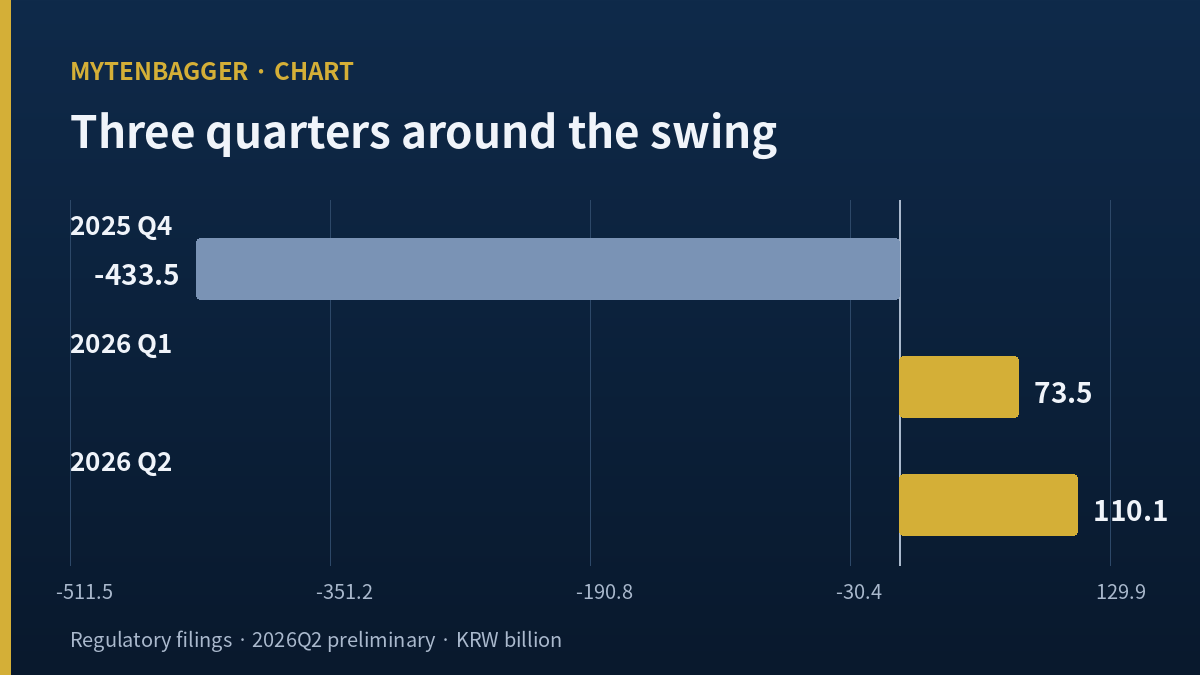
The conditions under which I would change my read are separate and both must hold: net debt visibly lower in the semi-annual filing, and a basic chemicals loss in the first post-restructuring quarter that is smaller than the KRW 433.5 billion consolidated operating loss of the fourth quarter of 2025. One without the other does not move me.
What I Can Record From the August 11 Close
First-half 2026 operating profit is KRW 183.6 billion, about USD 129.6 million. The 2025 full-year operating loss was KRW 943.1 billion. The two profitable quarters have recovered 19.47 percent of what the prior year gave up.
And one line below operating profit on the first quarter income statement sits interest expense of KRW 217.3 billion (about USD 153.4 million) against operating profit of KRW 73.5 billion. Operating profit covers 0.34 times the interest bill, which reproduces the interest coverage figure of 0.34 on my vendor screen to the decimal. The turn to positive earnings is accurate for exactly one line of that statement.
So what I can put down against the August 11 close of KRW 58,100 is a set of conditions instead of a value. What the semi-annual filing settles the net asset figure at, and what the remaining segments earn in a quarter without Daesan. Until those two numbers exist I am not adopting any point between 0.23 and 0.35 as mine.
The date I reopen this file is already set. Friday, August 14, 2026, the semi-annual filing deadline.
Price and market capitalization basis: closing price of KRW 58,100 on August 11, 2026. Indicator data is from Kiwoom, screen refreshed on the evening of August 10, 2026, and market capitalization is my calculation using the 42,775,419 shares reported by the company as of May 15, 2026. Earnings figures are from Korean regulatory filings and the company’s preliminary release of August 7, 2026. Currency conversions use KRW 1,416.10 per US dollar, the Seoul market close of August 7, 2026, which is two business days ahead of the price date used here; conversions are indicative and included once for each figure. Segment shares, sequential growth rates, price to book, and the decomposition of the two published valuations are all my calculations.
Sources. Korean-language outlets below are rendered into English by me, so the wording is my translation: Money Today, August 7, 2026, on the second quarter release · Asia Today on the conference call · ZDNet Korea on the debt transfer · Newspim on the Mirae Asset report · Newsway on the NH and Yuanta reports · Sidae on the ethylene spread compilation · Etoday on the credit outlook change · Bloter on the guaranteed bond issue · Stock Analysis for LyondellBasell figures · LyondellBasell second quarter 2026 release · Lotte Chemical investor relations share data
- Korean Chip Designer LX Semicon: Earnings and Its Product Mix
- Lotte Fine Chemical Earnings and the Segment That Lost Money