SK Ocean Plant Stock, Profit 18 Quarters and Cash Missing 8
SK Ocean Plant stock closed at 11,650 won, about USD 8.44, on September 21, 2026. That is 36.87 percent of its 250-day high of 31,600 won, a 63.13 percent drop from the top (11,650 divided by 31,600). What pulled me in is the other line. Across the same window, from the first quarter of 2022 through the second quarter of 2026, this company booked a positive single-quarter operating profit eighteen times in a row. Not one negative quarter.
A stock down to a third of its high, on top of eighteen straight quarters of operating profit. Read that sentence alone and either the market is wrong or I am missing something. So I set the cash flow statement next to the income statement and changed what I was counting. Instead of asking how large the profit was, I asked, quarter by quarter, whether the cash showed up when the profit did. Yes or no, eighteen times.
Contents
SK Ocean Plant stock fell to a third of its high while operating profit never turned negative
First, the anchor price. The vendor screen showed a current price of 11,640 won and a market value of 727.2 billion won. But the confirmed close row reads 11,650 won for September 21, 2026, on volume of 518,321 shares, the row flagged final. The screen market value of 727.2 billion is 62,474,227 shares times 11,640, the unconfirmed price. So I multiplied again with the confirmed close. 62,474,227 shares at 11,650 won is 727.8 billion won, about USD 527.0 million. That is 0.62 billion won above the screen figure. Small, but I do not carry a market value forward without knowing which price went into it.
Now the eighteen operating-profit quarters, in billion won: 2022 ran 17.07, 20.42, 21.94, 12.51; 2023 ran 18.57, 30.11, 16.38, 10.54; 2024 ran 8.95, 14.98, 15.20, 2.68; 2025 ran 11.04, 15.55, 19.25, 13.66; 2026 ran 16.86 and 19.34. The smallest of the eighteen is 2.68 billion won in the fourth quarter of 2024, and none is below zero. On the income statement, this business has not lost money at the operating line once in four and a half years.
The screen market value uses the unconfirmed price
Ten won separated the screen from the final row. Ten won is trivial on its own, but the moment a market value feeds a per-share figure, the price that went into it lives on in the result. For the rest of this piece I use 727.8 billion won for market value, the number I multiplied, and 11,650 won for the price. I do not copy the vendor figure because when a number later disagrees with itself, I want to know where it split.
Eight of SK Ocean Plant stock’s eighteen profitable quarters ran on negative cash
I stood the same eighteen quarters up again, this time on single-quarter operating cash flow, in billion won. 2022: plus 50.48, minus 14.22, minus 29.52, plus 61.85. 2023: all four negative, at minus 54.66, minus 74.65, minus 0.81, minus 8.09. 2024: all four positive, at plus 10.16, plus 51.88, plus 46.19, plus 27.14. 2025: plus 52.38, plus 46.46, minus 115.85, minus 22.76. 2026: plus 40.91 and plus 11.47.
Pick only the quarters where operating profit was positive and operating cash was negative, and there are eight: the second and third quarters of 2022, all four of 2023, and the third and fourth of 2025. Eight out of eighteen. The share of quarters where profit and cash pointed opposite ways is 8 divided by 18, or 44.4444 percent. In this company, profit and cash disagree close to once every two quarters.
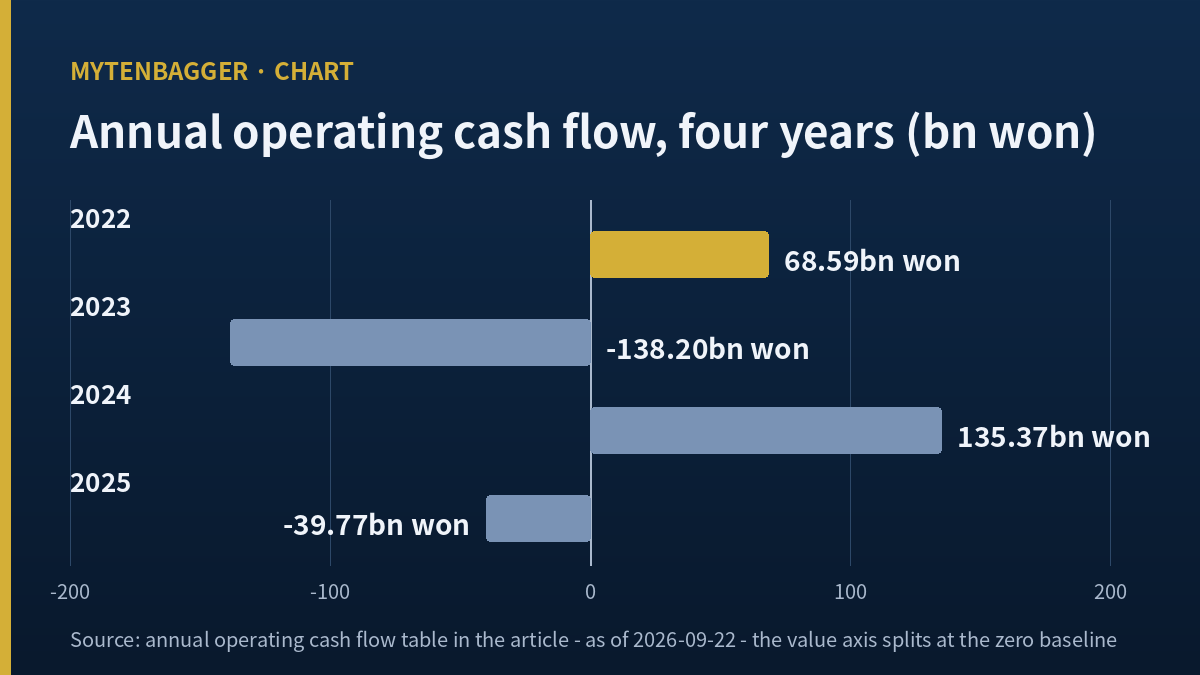
Fold it to the annual line and the sign flips are cleaner. Annual operating cash was plus 68.59 billion won in 2022, minus 138.20 in 2023, plus 135.37 in 2024, and minus 39.77 in 2025. Positive and negative, one year each, in turn. Operating profit over the same four years was 71.94, 75.60, 41.80, and 59.51 billion won, all positive. Read only the income statement and this is a four-year profit maker. Read only the cash flow statement and two of the four years bled cash. Same company.
| Year | Revenue (bn won) | Operating profit (bn won) | Operating cash (bn won) | The two signs |
|---|---|---|---|---|
| 2022 | 691.83 | 71.94 | 68.59 | agree |
| 2023 | 925.84 | 75.60 | minus 138.20 | split |
| 2024 | 662.62 | 41.80 | 135.37 | agree |
| 2025 | 965.39 | 59.51 | minus 39.77 | split |
Where the divergence comes from, and why 2023 bled while 2024 filled
The split is not spread evenly. In 2023 all four quarters lost operating cash; in 2024 all four gained it. Two neighboring years, mirror images. And operating profit was actually larger in 2023, at 75.60 billion won, than in 2024, at 41.80 billion. More profit, more cash out. That is not an accident, and it points at what this company sells.
SK Ocean Plant builds offshore-wind foundations, special-steel pipe, and ships. The vendor labels its sector energy equipment and services. This is order-based manufacturing. The company takes advance payments up front and recognizes revenue by how far a project has progressed, so the moment cash arrives and the moment profit is booked fall apart. When a large project is early, it buys steel and pours money into plant while the profit lands much later. The four straight quarters of cash outflow in 2023 line up with a stretch when this company was pushing several big builds through their early stages at once. I looked at the same trait in a covered piece on how Doosan Robotics booked half a year of revenue with the loss barely moving, and the lesson holds here too. One good line on the income statement does not summarize the business.
The single worst quarter shows the mechanism at full stretch. In the third quarter of 2025, operating profit was a healthy plus 19.25 billion won while operating cash was minus 115.85 billion, about USD 83.89 million out the door in three months. That is the largest cash draw in the whole series, and it sat right on top of the third-largest quarterly profit. A draw that size is not a bad quarter of trading. It is working capital and early-stage project spend running ahead of the revenue those projects will book later, which is exactly what a progress-billed order book does when several jobs load in at once. The profit line cannot see that timing, and that blindness is the reason I count cash separately at all.
More profit in 2023, more cash out
To put it plainly: 2023 carried the largest operating profit of the four years and the largest cash outflow, minus 138.20 billion won. 2024 carried the smallest profit and the largest inflow, plus 135.37 billion. Profit and cash moved in exact opposition. So I read SK Ocean Plant stock the way I read POSCO International, where the payout rose in a straight line while operating cash fell in two of four years. The headline line and the cash line are two different questions, and I answer both before I take a side.
I priced SK Ocean Plant stock, and its balance sheet, without trusting the screen
The debt-to-equity ratio ran 131.96 percent in 2022, 104.90 in 2023, 99.29 in 2024, 40.97 in 2025, and 44.33 percent at the second quarter of 2026. Four steps from 132 down to 41. On its face, a dramatic repair. But how it fell matters. From 2024 to 2025, liabilities dropped from 708.44 billion won to 333.70 billion, a fall of 374.74 billion. Equity rose only 101.04 billion over the same span, from 713.51 to 814.54 billion. Total assets fell 273.70 billion, from 1,421.94 to 1,148.24 billion. Liabilities and assets shrank together.
So the company did not retire debt out of profit. A large block of contract liabilities, the advances that sit against work in progress, converted into revenue as big projects finished, and the whole balance sheet got smaller. Much of the debt-ratio improvement traces to that shrinkage, not to the numerator falling on its own. That 2025 operating cash was minus 39.77 billion won supports the reading. If you paid down debt while earning a profit, cash would have come in.
The multiple and the screen part by one percent
On the multiple, briefly. The screen shows price-to-book of 0.89 and book value per share of 13,037 won. When I take controlling-interest equity of 838.20 billion won at the second quarter of 2026 and divide by 62,474,227 shares, book value per share is 13,416.76 won and price-to-book is 0.87 (11,650 over 13,416.76). About one percent apart. The source of the gap is not settled, so I use my own figure and flag the difference. The screen prints a P/E of 19.24, but on trailing four-quarter controlling net income of 48.51 billion won it comes out near 15, so it swings with the basis. Because the multiple itself moves, I build the stance on the frequency above, not on a multiple. The company also pays no dividend. Its capital is 31.24 billion won at a face value of 500 won across 62,474,227 shares, and I found no rights issue, bonus issue, or split disclosed in the last six months, so the price and the market value here sit on one share count.
SK Ocean Plant stock’s 2026 first half put cash back beside profit
The most recent two quarters cut the other way, and I weigh them because they are what the watch is watching. Single-quarter operating cash was plus 40.91 billion won in the first quarter of 2026 and plus 11.47 billion in the second. Two positive quarters in a row, on the same side as the profit. For the first half, operating cash was plus 52.38 billion won, about USD 37.93 million, against capital spending of 34.90 billion, which leaves free cash flow of plus 17.48 billion won, about USD 12.66 million. This is the first two-quarter stretch since 2024 where cash has sat beside profit instead of opposite it.
I do not read two quarters as a trend, and there is a caution inside them. First-half operating profit of 36.20 billion won covered first-half interest expense of 18.94 billion only 1.91 times. That is thin cover for a builder that funds early project stages on borrowed money, and it is one reason the positive cash of the first half does not, on its own, close the question the frequency opened. Inventory sits low at 5.36 billion won, on the order of a few days of sales, which fits a company that turns steel into delivered structures fast once a project is moving. What I want is a third and a fourth positive-cash quarter, not a second, before the frequency I built starts to move in the company’s favor.
Run the same test on Sif Holding and only the sign flips
To check whether this belongs to the company or the trade, I ran the same lens over a foreign builder of the same product. Sif Holding, listed in Amsterdam under SIFG, makes offshore-wind monopiles and foundations, a pure manufacturer. Note that KOSPI is the main board of the Korean exchange, comparable in role to a primary listing venue, while a European name like Sif trades on its own market, and I keep the two currencies apart below. On the figures stockanalysis.com carried as of September 4, 2026, Sif posted 2025 revenue of 597.04 million euro with an operating loss of 41.50 million and a net loss of 39.31 million. Yet operating cash that year was positive, at 32.37 million euro. Sif ran positive operating cash in each of the last four years: 50.36 million in 2022, 106.48 in 2023, 67.87 in 2024, and 32.37 in 2025.
The symmetry is the point. In 2025, SK Ocean Plant had positive operating profit and negative operating cash; the same year, Sif had negative operating profit and positive operating cash. Same industry, same product, the same split between the income statement and the cash flow statement, with only the sign reversed. I do not use this as a valuation comparison. Sif is lossmaking, so a multiple does not form (P/E not applicable on the stockanalysis basis). What I borrow from the peer is one thing, direction. In offshore-wind foundation building, the income statement and the cash flow statement pointing opposite ways is the rule, not the exception, and what differs by company is which way they split. For SK Ocean Plant, it splits profit positive, cash negative.
That distinction matters for how I read the price. A profit-positive, cash-negative builder can look sound on the earnings line for years while the cash line quietly funds the next order book, which is a setup a market can lose patience with well before any loss appears. Sif shows the reverse risk: the earnings line can go red on a downturn while cash still comes in from work already sold. Neither profile is safer than the other in the abstract. The point is that for a company of this kind, the choice of which statement to read decides the verdict, and I would not want to own either name on the strength of one statement alone. SK Ocean Plant is the one whose profit line looks the healthier of the two, and that is precisely why I make myself read its cash line first.
The sell-side cut SK Ocean Plant stock to a 19,000 won valuation and pointed at the same seam
Named analysts cover this name. Ahn Ju-won of DS Investment & Securities, in an August 13, 2026 note, kept a buy rating while cutting the valuation from 25,000 won to 19,000 won, a 24 percent reduction. The reason lands exactly on my frequency. Ahn wrote that new orders keep coming, but that offshore-wind and large merchant ships only begin recognizing revenue in earnest from 2028, leaving a gap in between, and that the domestic Anma offshore-wind project is being delayed. The conclusion was that revenue and operating profit both contract into next year.
That recognition gap is the same thing I counted, seen from the other side. Orders arrive, and revenue and cash follow much later. The second-quarter 2026 result Ahn cited was revenue of 170.48 billion won, down 29.1 percent from a year earlier, operating profit of 19.34 billion, and an operating margin of 11.3 percent. Revenue fell while margin rose because the mix of recognized revenue leaned to higher-margin work. For reference, second-quarter 2026 operating profit of 19.34 billion won is 24.39 percent above the 15.55 billion of the second quarter of 2025 (19.34 over 15.55). One outlet printed that increase as 14.7 percent; I use the 24.39 percent I get from single-quarter source figures, and, the way one HD Construction Equipment quarter carried two growth rates, when a single quarter carries two rates I keep the rate off center.
Three other houses had this as a buy. Kyobo Securities set a 25,000 won valuation on May 13, 2026, citing a strong margin in the first-quarter review; Mirae Asset Securities held a buy at 25,000 won; Eugene Investment kept a BUY on February 24, 2026. The most conservative of the four is DS at 19,000 won. The price is 11,650. Even the most cautious sell-side valuation sits 63 percent above the current price (19,000 over 11,650, minus one). The street still calls it cheap while the price keeps falling. That gap is where a watch belongs.
Where I stand on SK Ocean Plant stock, and what would move me
I hold this as a watch, unowned. With a market value of 727.8 billion won it sits outside the top 100 by size, so this journal does not take a buy or hold stance to begin with, and the data then supports the watch. The bear case stands on five legs.
- Profit and cash disagree 44.4444 percent of the time. Positive operating profit does not, by itself, summarize this company.
- Named sell-side cut its valuation 24 percent, and the reason is a revenue-recognition gap running to 2028. The street itself is calling for two years of shrinking revenue and profit.
- The domestic Anma offshore-wind project is delayed. The moment the order book turns into revenue slides further out.
- Much of the debt-ratio repair came from a shrinking balance sheet, not from earnings. 2025 operating cash was negative.
- The operating margin fell from 10.40 percent in 2022 to 6.16 percent in 2025. The direction of the margin is down.
A bear case with no other side is fear, not a stance. This piece rests on three premises, and I name who can falsify each. First, that operating profit was positive in all eighteen quarters: the company can disprove this in its third-quarter report, due by law on November 16, 2026. Second, that the eight cash-out quarters are the company’s rhythm and not a one-off: the sign of operating cash in the next two quarters disproves it. Third, that the market’s 63 percent drawdown is pricing the cash swing, not the profit: this is where I can be wrong, and if cash comes in hard in the third quarter and the price does not react, my reading is disproved. What would move me off the watch is narrow and stated: two straight quarters of positive operating cash in the second half of 2026, plus a company disclosure that the recognition schedule for the order book, Anma included, is pulling forward. The 160.5 billion won German North Sea substation-jacket order won in July 2026, its first European contract, is a positive on the backlog side. Whether that backlog turns to cash is the thing I still have to count.
Figures: single-quarter and annual financials from DART-based statements through the second quarter of 2026. The 11,650 won price is the confirmed close for September 21, 2026; the 727.8 billion won market value is computed directly from 62,474,227 shares. USD conversions use 1,381.0 won per dollar, the Seoul close for 2026-09-21 reported by Korean press. Sell-side valuations and result commentary are from DS Investment & Securities (Ahn Ju-won, 2026-08-13), Kyobo Securities (2026-05-13), Mirae Asset Securities, and Eugene Investment (2026-02-24). Global peer Sif Holding figures are from stockanalysis.com as of 2026-09-04. The German order is from July 2026 disclosure and reporting. Vendor screen values are Kiwoom data on the 2026-09-21 close.