Kumho E&C Stock Ran Limit-Up on the Chip Cluster: I Watch
I have not bought a single share of Kumho E&C stock through this limit-up run. I accept the two things driving it — Korea’s giant new chip-cluster plan and a real Q1 earnings turnaround. But with the stock hitting consecutive daily limit-ups, a debt ratio over 500%, and a price now trading at more than double its pre-rally analyst target, chasing it here isn’t my kind of trade. If the froth cools and the cluster turns from plan into actual orders, I’ll look again. That’s my line.
On a single trading day, three Korean stocks closed limit-up together: Kumho Tire, Kumho Electric, and Kumho E&C stock. The only thing all three share is the word “Kumho” in the name. Watching that screen, my first reaction wasn’t the urge to buy — it was suspicion. Same name doesn’t mean same company, and same theme doesn’t mean same beneficiary. So I didn’t buy. This is my watch journal on why I’m sitting on my hands with Kumho E&C, and what would have to change for me to move.
Let me be clear up front: I’m not saying this is a bad company. Look at the Q1 print and it’s plainly getting better. My problem isn’t the company — it’s the seat. Buying a company that’s improving, at a price that has already priced in several years of that improvement, on top of a theme that hasn’t been confirmed yet — that’s the thing I keep turning over. And honestly, this caution is partly a personal scar: I once chased a regional-development theme stock the day after a limit-up, convinced “this time is different,” and got burned. The setup back then looked just as reasonable. That’s why “consecutive limit-ups plus an unconfirmed mega-catalyst” now makes me stop for a beat. Kumho E&C is exactly that combination.
Contents
Why I’m Watching Kumho E&C Stock — Three Reasons
Watching isn’t the same as ignoring. If anything it’s the opposite — I watch the names I’m preparing to buy. Kumho E&C sits on my watch list for three reasons, and the third is exactly where the “buy” turns into “wait.”
First: the Southwest chip-cluster catalyst is real
The trigger for this rally is concrete, not a rumor. On June 30, Korea’s government folded a Southwest (Gwangju–South Jeolla) semiconductor cluster into a national balanced-growth mega-project. Tied to it, Samsung and SK Hynix are backing a plan that CNN reported at roughly $576 billion in AI-chip investment, with Seoul Economic Daily putting the figure as high as ₩900 trillion for the Southwest cluster. For a US reader: think of it as Korea’s version of a CHIPS-Act-scale build-out, but concentrated in one region that hasn’t historically hosted the big fabs.
Here’s why a builder rallies on a chip plan. A single leading-edge fab drags a whole trail behind it — land grading, access roads, water and power infrastructure, worker housing. The fab tools come from someone else; the ground and the surrounding town get built by construction firms. A builder with deep roots in the Honam region can plausibly sit near the front of that queue when public and provincial infrastructure orders go out. The market’s logic in tagging Kumho E&C as a “Southwest order leader” candidate isn’t crazy.
But I draw one hard line here. A direction being set is not the same as Kumho E&C actually winning the work. What’s confirmed is the plan; what the stock has priced is the assumption that the orders land in this company’s lap. Those are two different things, and only the first one has happened.
Second: earnings turned, independent of the theme
Theme with no earnings, and I don’t even look. Kumho E&C isn’t that. Q1 2026 operating profit rose roughly 112% year over year — and the shape of it matters. This wasn’t an order explosion; it was margin repair, as high-cost residential projects that had been dragging profitability rolled off and the construction segment’s cost ratio improved. Profit grew because less leaked out, not because revenue spiked. I trust that kind of structural turnaround far more than I trust a theme.
Margin repair also tends to have a longer tail than an order spike: once the loss-making legacy sites are fully off the books, the improved cost ratio carries into subsequent quarters rather than reversing, which is exactly what the August Q2 print will test. There’s something tangible on the order side too: Kumho E&C recently won a public wastewater-treatment project in Gwacheon worth about ₩225 billion ($163M at ₩1,380/$). Set against a $576B cluster that’s peanuts — but I actually like the small confirmed contract better. A hope isn’t a number; a signed contract is. Proof that this company can actually win public-infrastructure work is a down payment on the argument that it could win Honam cluster work later, if and when it materializes.
Third: this is where “watch” beats “buy”
The first two are reasons to own it. The third is the reason I don’t — yet. I accept the catalyst and the earnings, but the price has already pulled both forward by a wide margin. I separate buying a good company expensively from waiting to buy a good company. Right now I choose the second. The numbers below are why.
Kumho E&C Stock by the Numbers — What the Rally Priced
My caution is arithmetic, not vibe. Company figures are from the Q1 results and Korean market reporting; share and target figures are pre-rally brokerage numbers. Because the post-spike price has been volatile, I use ranges rather than a single quote. USD at ₩1,380/$.
| Metric | Figure | Read |
|---|---|---|
| Q1 2026 operating profit | ~+112% YoY | High-cost housing rolled off → margin repair |
| Recent confirmed order | $163M (₩225B) | Gwacheon public wastewater plant |
| Debt ratio (Q1) | ~551% | High even for construction; structural drag |
| Pre-rally analyst target | ~₩5,650–6,000 ($4.1–4.4) | Price now well above this |
| Short-run move | 4 straight limit-ups | Shinhan Sec.: ~+43% Jun 29–Jul 3 |
Sources: Q1 results; Korean market reporting; Shinhan Investment & Securities commentary | Pre-rally target basis | USD at ₩1,380/$.
I built that table and sat with it. The top two rows are reasons to own; the bottom three are reasons to wait — and they live in the same stock. The line that holds my eye is the target. Brokerages had this builder pegged in the high-₩5,000s to ₩6,000 before the theme hit, and the price has since blown past double that. Yes, those are pre-theme numbers that could be revised up if orders confirm. But flip it around: right now this is a price no analyst has yet justified with a number. It’s pure expectation premium.
The debt ratio compounds my caution. Around 551% in Q1 is heavy even allowing for how leveraged construction runs, and Korean reporting flags high-cost hybrid capital raising layered on top, meaning interest expense keeps pulling against the earnings recovery. A company whose profit is improving while its balance sheet stays this stretched is a turnaround in progress, not a turnaround complete.
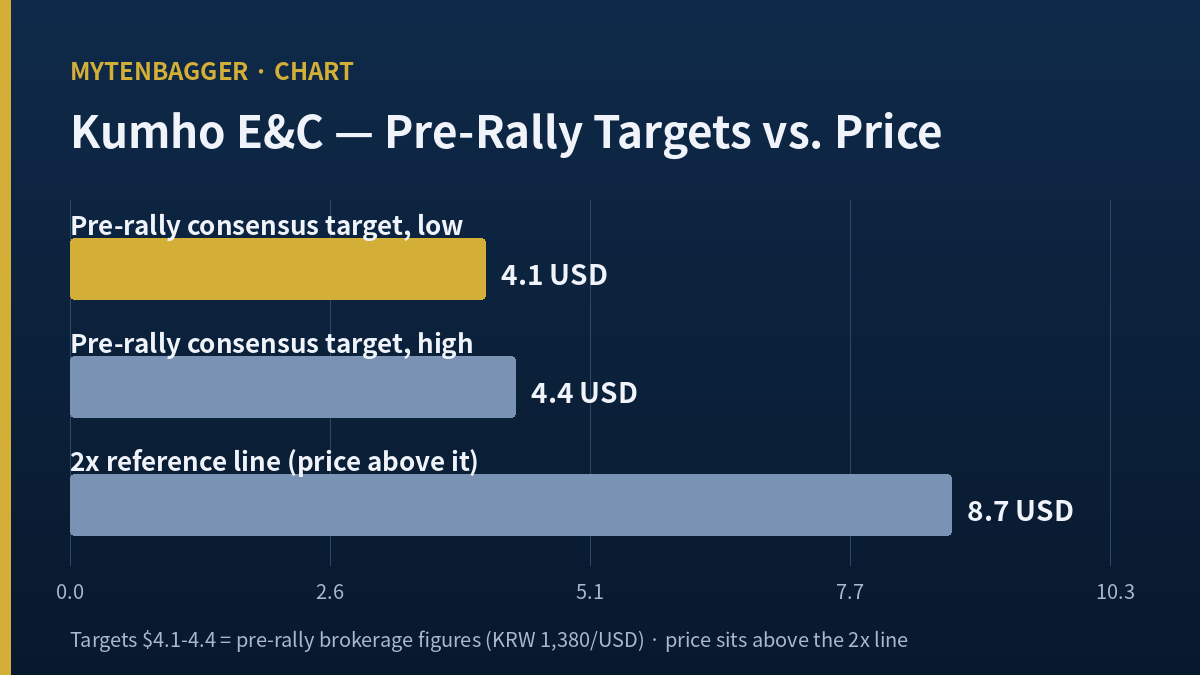
The test I run on myself here is simple. If I erase the four words “Korea semiconductor cluster” from the story, do I buy this company at this price? The margin repair is genuinely attractive, but at a 500%-plus debt ratio and more than double the pre-rally target, my answer is close to no. Which means most of what would make me buy right now is the theme, not the company. I don’t call betting on a theme “trading.”
Kumho E&C Stock and the “Kumho” Illusion — What I Actually See
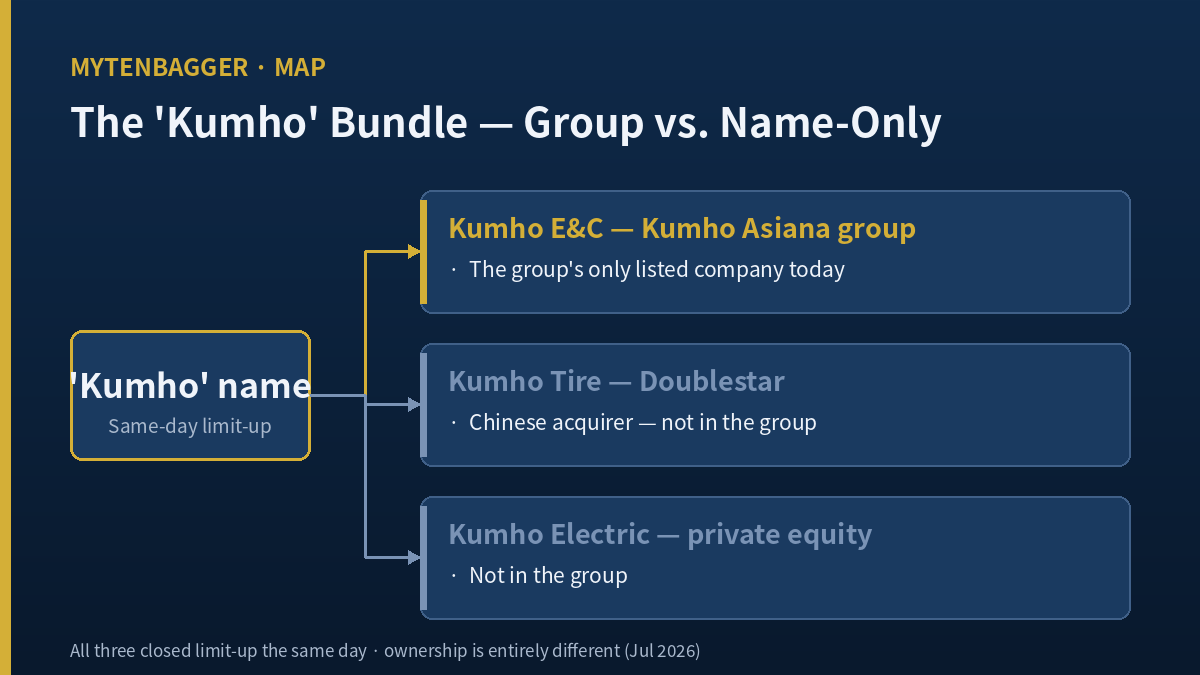
This is where I read the situation differently from the tape. In this rally the market treated “Kumho” as a single bundle: Kumho E&C rises, so Kumho Tire rises, and names like Kumho Electric go limit-up alongside. Pull the ownership apart, though, and the bundle is hollow.
Today, essentially the only listed company still in the Kumho Asiana group is Kumho E&C. The rest just share the name.
Kumho Tire passed to China’s Doublestar years ago; Kumho Electric was sold to a private-equity vehicle in 2020 and sits under separate control. The name says “Kumho,” but they don’t roll up into one group. Each moved on its own thread — a former Gwangju military-airfield site floated as a cluster location lifted land-value hopes for the nearby Kumho Tire plant, for instance — yet the market smeared all of it into a single phrase: Kumho equals Honam equals chips.
Why does that matter to me? Because a name-bundle rally breaks the same way it rose — by the name. If one of the three prints bad news or sees profit-taking, the logically unrelated others can wobble simply because they’re “Kumho.” I think a large chunk of the premium on Kumho E&C stock right now rests not on this company’s fundamentals but on the heat around that shared name. That makes me more careful, not less. And it’s not just my read: as Korean market reporting framed it, the exchange placed Kumho E&C on an investment-caution list and Kumho Electric and others on an investment-warning list — the market flagging its own overheating.
I don’t treat those exchange flags as decoration. Once a stock is tagged an investment-warning name, a further sharp jump can trigger a single-day trading halt. In plain terms: the higher this runs from here, the higher the odds a regulatory brake slams on. Upside room shrinking while the odds of a halt grow — for a chaser, that’s the worst possible risk-reward. That asymmetry is a real part of why I’d rather miss some upside than get stuck unable to exit through a halt or a gap down.
For a US-legible frame: this is the Korean cousin of the CHIPS-Act construction trade, when engineering-and-construction names ran on the promise of fab build-outs. Some of that promise turned into real backlog; a lot of it was theme first, contracts later. The reason I invoke that analogy is the warning inside it — the builders that held their gains were the ones that converted the theme into signed work, and DigiTimes has already flagged that Korea’s Southwest cluster faces real hurdles between announcement and groundbreaking.
How I See Kumho E&C Stock Playing Out — My Scenarios
These probabilities are my personal weighting, not math. Since I’m watching, not holding, I frame them around “which path gets me to start buying.”
The path that turns me into a buyer (~35%)
The froth cools, the limit-up streak ends, the exchange’s caution/warning flags come off, and in the meantime Samsung and SK’s Southwest plan advances into something concrete — a site, a groundbreaking schedule. Add a Q2 print that extends Q1’s margin repair, and I can start scaling in where the theme premium has drained out. That’s the picture I’m most hoping for.
The path where I keep watching (~40%)
The cluster stays a “plan,” actual orders slip out on a lag, and the stock gives back part of the spike and grinds sideways while the debt load and interest burden come back into focus. This isn’t a stretch — even as Samsung and SK back the $576B plan, government mega-projects historically take years from announcement to first shovel. In this path I just keep watching.
The tails (~25%)
Upside (~15%): cluster orders firm up faster than expected and Kumho E&C actually lands on the award list, so the premium gets justified after the fact and the stock steps higher — I’d have to eat missing the entry. Downside (~10%): the theme cools hard, the “Kumho” bundle unwinds together, the debt overhang reasserts, and most of the spike is handed back. That’s the path where watching turns out right.
Where My Watch Turns Into a Buy
Watching isn’t just “not buying” — it’s writing down what would make me buy. Here’s the order I’m checking it in.
The fastest answer is whether the froth settles. Do the limit-ups stop and do the exchange’s caution/warning designations come off? Until they do, every good argument is still just chasing to me. Next is whether the catalyst becomes real: does the Southwest cluster move past a press release into site selection and an order timeline, and is Kumho E&C actually positioned to reach that work? Last is the direction of the balance sheet: does the Q2 print, due in August, carry Q1’s margin repair forward without the debt ratio getting worse?
The moment those three line up in the same direction is when I stop watching and act. If instead the froth persists while the orders stay on paper and the balance sheet only gets heavier, I move this one down my watch list. Right now nothing is confirmed enough to make that call either way — so I keep my hands off and I watch.
My take — I haven’t bought
To sum up where I stand: through this limit-up run I haven’t bought a share of Kumho E&C stock. Not because I dislike the company — I accept the +112% Q1 margin repair, the Gwacheon order, and the Southwest cluster as a real direction. What stops me is that those good things already sit at more than double the pre-rally target, layered on a theme with no confirmed orders yet, over a 500%-plus debt ratio and an exchange overheating flag. My next checkpoints are clear: does the froth cool, does the cluster convert to orders, does Q2 extend the margin gains.
That’s my read, laid out with the numbers I could stand behind. If you see the actual cluster award list forming faster than I think — the real orders, not the headline — tell me; I’ll look at it with you.
Related reading
- TCK Stock Up 4x: Watching the SiC Ring Leader, Not Buying
- Hansung Enterprise Stock: I Cheer the Crab Stick, I Don’t Buy