Korean Brokerage Stocks: The 2026 Law That Re-Rated the Sector
- I opened Korean brokerage stocks as a whole sector before picking any single name. In this KOSPI cycle — the index cleared 5,000 and kept going — brokers sit at the center of Korea’s value-up reform, not on its sidelines.
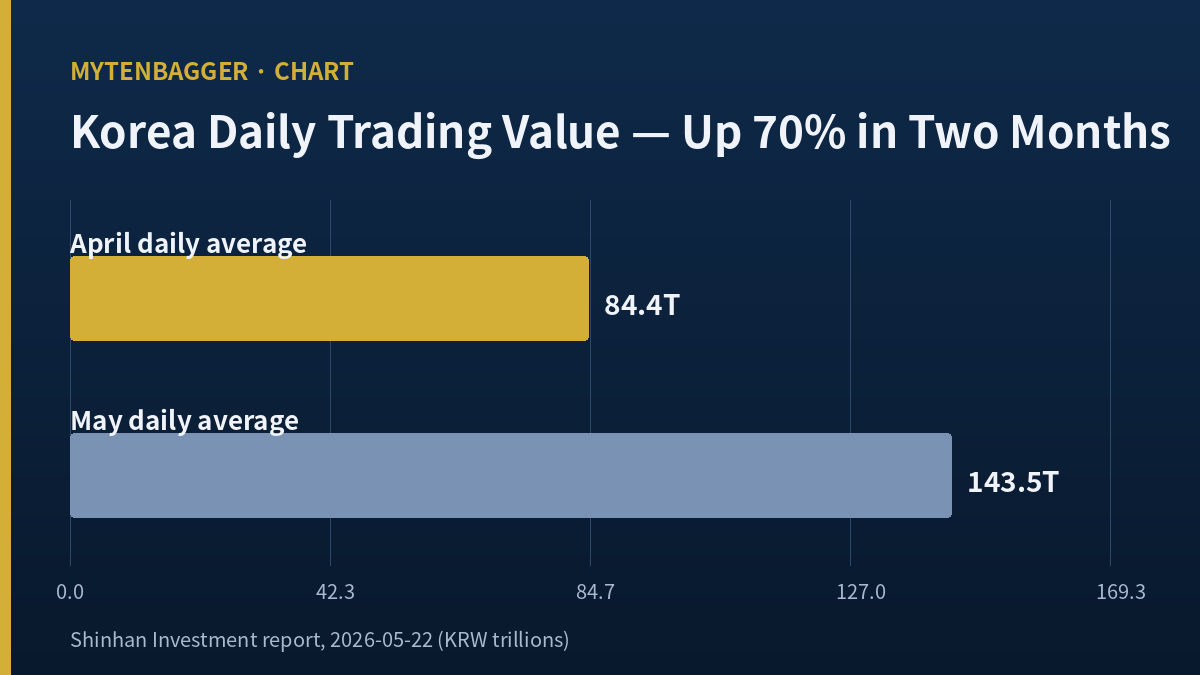
- Two engines point the same way: a trading-volume super-cycle (May daily turnover ₩143.5T / ~$104B, per Shinhan Investment) and a March 2026 law that forces listed companies to cancel their treasury shares.
- But these are high-beta stocks. Kiwoom fell 5.4% in a single session this week. My breakpoint is whether that structure survives one sharp market drawdown — and whether the ₩130T in customer deposits starts draining.
This is where I start doing sectors differently. From here on, when I dig into an industry I lay down the whole board first, then set each company on top of it one at a time. Korean brokerage stocks are the first test of that habit — and honestly, they’re a clean one to start with, because two forces that usually have nothing to do with each other happen to be pushing in the same direction right now.
Let me put the numbers down first. Korea’s daily average stock-trading value jumped from ₩84.4T (~$61B) in April to ₩143.5T (~$104B) in May — a near-70% move in one month, per a Shinhan Investment report dated May 22, 2026. Customer deposits at brokers crossed ₩130T (~$94B); margin-loan balances passed ₩36T (~$26B). That’s the market side. Then, sitting behind it, an amended Commercial Act that took effect on March 6, 2026 began forcing listed Korean companies to cancel their treasury shares. One of those is cyclical. The other is structural. It’s rare for an industry to have both a hot tape and a hard rule pointing the same way — and Korean brokerage stocks are standing exactly on that spot. (All KRW-to-USD conversions here use ₩1,380/$. KOSPI is Korea’s main stock index, the rough equivalent of the S&P 500.)
So instead of grabbing one broker first, I decided to map why this setup exists. My conclusion up front: I’m structurally bullish on the sector as a whole. That is not the same as “buy every broker.” As you’ll see below, fitness for the value-up test varies wildly *inside* the sector. Miss that split and being bullish on the group actually works against you.
Contents
Why Korean brokerage stocks sit at the center of the reform — the rule changed
When people talk value-up, they usually reach for banks, insurers, and holding companies first — the names that traded at 0.4x or 0.5x book. That’s a reasonable instinct. But I think Korean brokerage stocks are the real lever of this theme, and the reason is a duality unique to the industry: a broker is both the beneficiary of Korea’s value-up reform to narrow the “Korea discount” and one of its subjects.
First, mandatory treasury cancellation shrinks the share count directly, not just the earnings line
The core of the amended Commercial Act is mandatory cancellation of treasury stock. Bloomberg reported the bill’s passage on February 25, 2026; per governance advisors summarizing the text, a listed company must in principle cancel treasury shares it acquires within one year, with existing holdings given an extended window (18 months from the effective date for direct holdings). Miss the cancellation or breach an approved retention plan and directors face a fine. A cancellation is different from a dividend — it reduces the share count itself. Shrink the denominator and per-share value rises. The shift from “companies may buy back and sit on stock” to “they must retire it” is the real change in this cycle.
Here’s why I zero in on Korean brokerage stocks specifically: brokers are an industry that hoarded treasury shares more than most. Thick equity capital and lumpy cash flows meant treasury stock was often used as a buffer. Now that buffer is on a forced-cancellation track. What is a “someday, maybe” event in other sectors is a dated calendar item for brokers. I think that difference matters more than the market has priced.
Second, dividend-tax reform lifts the after-tax appeal of high-yield Korean brokerage stocks
Korea’s 2025 tax overhaul moved toward taxing the dividends of shareholder-return-friendly companies separately, at lower rates, rather than lumping them into aggregate income. The more a company pays out, consistently, the better the investor’s after-tax return. Brokers are a traditionally high-payout industry, and they’ve been raising dividends aggressively. As the table below shows, Korea Investment Holdings more than doubled its 2025 dividend per share from ₩3,980 to ₩8,690 (DART filings); Kiwoom took its own from ₩7,500 to ₩11,500. Policy is tilting to reward companies that pay a lot — and the industry that happens to be scaling its payout is the brokers. The overlap is what caught my eye.
Korean brokerage stocks aren’t the graders of the value-up exam — they’re the candidates sitting it. They have to do the cancelling and the dividend-raising themselves. That’s why I won’t close the case with “brokers = beneficiary.”
That’s the policy picture. Policy is direction, not speed. What turns direction into earnings is trading volume — so that’s where I go next.
The second engine behind Korean brokerage stocks — a trading-volume super-cycle
The first line on a broker’s income statement to move is brokerage (commission) revenue. The more retail investors trade, the more the broker collects, sitting still. So trading value is the fastest leading indicator for the group. May’s ₩143.5T daily average against April’s ₩84.4T is an explosion, and Shinhan Investment’s base case for the second half is a ₩113.1T (~$82B) daily average, with a best case near ₩140T. The same report put a KOSPI band of 7,000–9,300, midpoint 8,500. I don’t adopt that target as my own. But that a brokerage published that band from its own research is worth logging as market information.
What I weight more heavily than brokerage itself is the capital compounding spinning behind it. More trading lifts brokerage; the extra profit stacks into equity capital; thicker equity capital expands the balance-sheet firepower of the IB, wealth-management, and sales-and-trading desks. The faster a large house builds equity, the faster this flywheel turns. Shinhan flagged exactly this as a coming polarization between big and small houses. I think that polarization is the core screen for picking names in this series.
There’s a mechanism where the compounding meets the regulation: short-term financing bonds and the IMA (comprehensive investment account) license. Both open only to the largest houses above an equity threshold, so the thicker your capital, the bigger the funding-and-deployment board you get to play on. That’s why it matters that Korea Investment Holdings — Shinhan’s own top pick — carries roughly ₩11T of equity, the largest in the industry. Where capital *is* the license, the size of the leader is a moat in itself. Kiwoom completing its retirement-pension operator registration in April 2026 reads the same way to me: moving brokerage-earned money onto a recurring, asset-based revenue base. I plan to watch this “capital-as-license” angle, name by name, more closely than the raw turnover number.
One more structural piece sits under the tape: the deposit base. The ₩130T (~$94B) parked in customer accounts and the ₩36T (~$26B) in margin balances aren’t just fuel for today’s turnover — they’re the raw material the wealth-management and financing desks convert into recurring, fee-based revenue that outlasts any single hot month. Kiwoom’s April 2026 pension-operator registration is one firm reaching for exactly that: turning transient trading flow into sticky, asset-based income. When I judge whether this cycle is structural or just a spike, how much of that deposit pile gets converted into recurring revenue — rather than draining back out when the tape cools — sits near the top of my list.
But this engine has a twin that runs the other way. Trading value falls as fast as it rises. That’s exactly what “high beta” means for Korean brokerage stocks — they swing more than the market. Kiwoom dropping 5.4% in a single session this week within a weak financial sector is that character on display. I like this engine, but I write down with equal weight that it can spin in reverse. That leads straight to my breakpoints later.
Five Korean brokerage stocks, the way I split them — the core data
Below are the five companies I’ll take apart one at a time in this series. Figures are recent metrics (share-price data and DART dividend records). I cross-checked every cell against its source; dividend yields are on the 2025 fiscal-year payout. USD prices use ₩1,380/$.
| Company | P/E | P/B | ROE | Div. yield | How I read the character |
|---|---|---|---|---|---|
| Korea Investment Holdings | 6.8x | 1.14x | 18.7% | 3.9% | Lowest P/E, highest ROE; #1 equity capital (holdco of Korea Investment & Securities) |
| Kiwoom Securities | 7.8x | 1.26x | 18.1% | 3.7% | #1 retail brokerage; most direct trading-volume leverage |
| Samsung Securities | 9.5x | 1.18x | 13.1% | 3.8% | Wealth-management and retail client-asset heavyweight |
| NH Investment & Securities | 10.1x | 1.16x | 11.8% | 4.4% | IB strength; highest dividend yield in the group |
| Mirae Asset Securities | 18.7x | 2.14x | 12.4% | 0.75% | Equity-capital and overseas build-out; low payout, high multiple |
Sources: per-company financial metrics (P/E, P/B, ROE) and DART FY2025 dividend records | As of: July 2026 | USD at ₩1,380/$
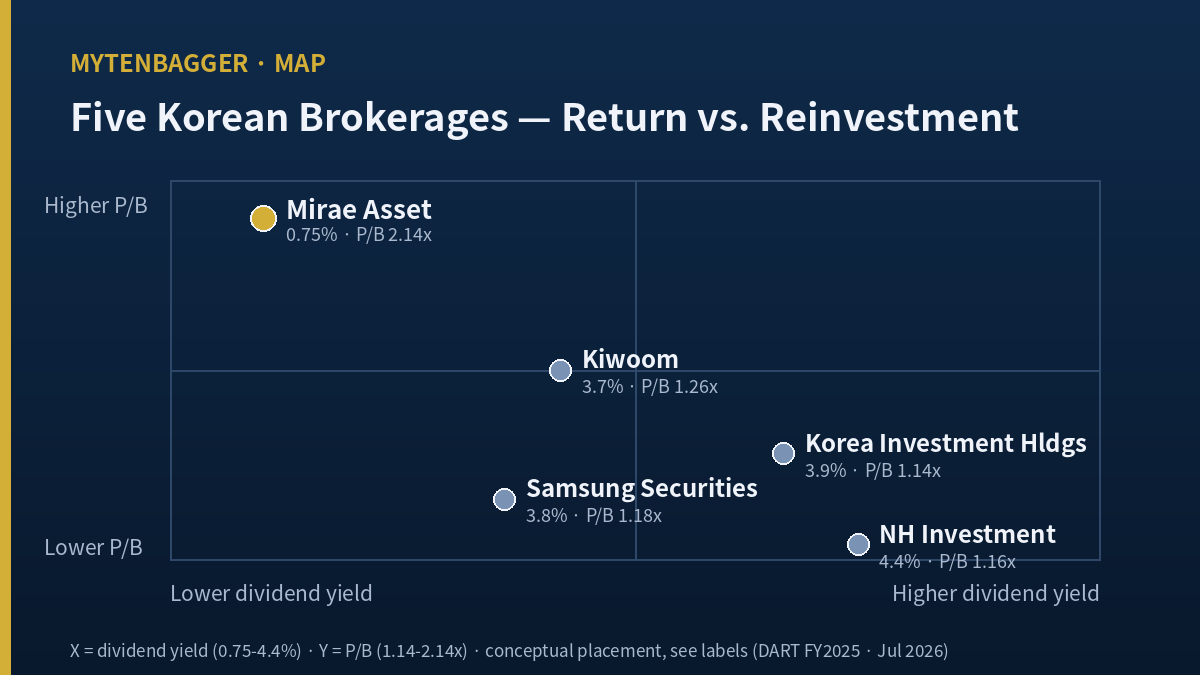
Two columns held my attention longest. The first is P/B. All five are above 1.0x. Korean brokerage stocks historically traded below book; today the cheapest, Korea Investment Holdings, is 1.14x and the priciest, Mirae Asset, is 2.14x. That says the re-rating isn’t “about to start” — it’s “already well underway.” I read that as opportunity and warning at the same time.
The second is dividend yield. NH at 4.4% versus Mirae Asset at 0.75%. Same sector, and the after-tax dividend appeal differs by nearly six times. I called brokers the candidates sitting the value-up exam; this column is the score sheet. Apply the payout-and-cancellation yardstick and the five spread this far apart.
What the market keeps missing on Korean brokerage stocks — my differentiated read
The consensus lumps Korean brokerage stocks together as “the thing that goes up when KOSPI goes up.” I think that bundle is especially dangerous this cycle, and the P/B and dividend spread above is why. If these were pure index proxies, all five would carry similar multiples. Instead P/B runs from 1.14x to 2.14x. The market is already pricing them as *different* companies.
Here’s the yardstick I settled on. The alpha in this cycle isn’t brokerage itself — it’s what a firm does with the swollen profit. All five catch the trading-volume tailwind to some degree. But a firm that returns that profit through cancellations and dividends and a firm that reinvests it into overseas and new businesses score completely differently on the value-up sheet. The former stands in front of the policy-driven re-rating; the latter has to prove a growth story separately. I’ll frame the series as “return-type brokers versus reinvestment-type brokers.”
For a global reference, US readers already know this movie — it just played in Japan. When the Tokyo Stock Exchange began pressing companies trading below 1x book in 2023, effectively naming and shaming them into buybacks and cancellations, Japanese equities re-rated and foreign money followed. Korea’s treasury-cancellation law is a harder, statutory version of that same playbook. I’m not pinning a precise multiple on the comparison — I’ll leave that to the individual-name articles — but the direction of travel is one American investors have watched pay off once already.
There’s a foreign-flow tell underneath all this. Foreign ownership of these names is already high and uneven — roughly 35% of Korea Investment Holdings and 27% of Kiwoom are foreign-held, versus about 9% of Mirae Asset (per exchange holding data). The value-up trade is, in large part, a foreign-flow trade: the same global money that chased Japan’s re-rating is the marginal buyer in Seoul. In a sector where P/B has already crossed 1.0x across the board, that incremental foreign bid is what decides whether the re-rating extends or stalls, so I watch the names foreign investors already crowd into on a different setting from the ones they’ve ignored. It’s not a clean signal — heavy foreign ownership can also mean crowded and quick to unwind — but it’s a variable I don’t leave off the board.
Two scenarios I’m watching for Korean brokerage stocks
The path I see as more likely — the rule cushions the cycle’s volatility
My base case: trading volume will ebb and flow, but treasury cancellation and rising dividends are rules that run independent of the tape. When the market cools, retired shares and higher payouts don’t come back. So this re-rating differs from the old kind that got handed back whole when the cycle turned. As long as KOSPI holds in the 8,000s for a stretch, brokerage profit and the policy effect overlap, and the sector’s earnings floor steps up a level. I put meaningful weight on this path.
Where I could be wrong — the high beta breaks first
I write the other side down with equal weight. Brokers are market leverage. If KOSPI takes a real correction from the 8,000s, trading value, deposits, and margin balances drain together, and these brokers fall harder than the index. This week’s 5.4% Kiwoom drop can be the trailer. In that case the policy effect is intact but the near-term price breaks first. And the fact that every P/B in the table is above 1.0x means a good deal of the re-rating hope is already in the price. When expectations are pre-loaded and the cycle turns, the drawdown runs deeper. That’s exactly why I’m bullish on the sector and still not buying it all at once.
The order I’ll work through these Korean brokerage stocks
This piece lays the board. From the next article I set the companies down one by one. Here’s my order and the question I bring to each.
Korea Investment Holdings goes first. At 6.8x P/E and 18.7% ROE it has the best balance of valuation and profitability in the table, and as the #1 equity-capital house it’s the cleanest test of the capital-compounding thesis. The catch is the holdco structure — how to carve out the non-brokerage subsidiaries is the thing to watch.
Kiwoom Securities is the purest expression of the trading-volume engine. As the #1 retail brokerage, a ₩143T tape hits its P&L fastest. It’s also the highest beta, which the 5.4% single-session drop showed plainly. How well it holds up when volume cools is this name’s exam.
Samsung Securities leans more wealth-management than pure brokerage. Client-asset-based revenue swings less than trading commissions — and has less explosive upside. I’ll use this name to test whether WM actually defends when the tape cools. For the record, I hold a very small starter position here, watch-only. It isn’t a core weight yet; I’ll size it after I’ve worked through the whole series.
NH Investment & Securities is IB-heavy and carries the group’s highest dividend yield — the leading candidate for the return-type bucket. I’ll test how independent its dividend durability and IB pipeline are from the tape.
Mirae Asset Securities is the odd one out. As a reinvestment-type house routing profit into equity and overseas, its yield is 0.75% and its P/B the highest at 2.14x. On the value-up sheet that’s a mark-down; as a growth story it needs its own evaluation. I plan to look at this one less as a “broker” and more as a global asset-management growth name.
If you’d rather own the whole basket, a Korean securities-sector ETF buys the group in one line. But an ETF averages away the very company-level differences I just laid out. I’m building the series precisely to see those differences, so I go name by name.
One practical note for US readers: none of the pure brokers here carry US-listed ADRs. That access gap is part of the setup: because most global investors can only reach these names through direct-KRX brokers or a broad Korea ETF, the foreign bid tends to concentrate in the largest, most liquid holding companies first — another reason the capital leaders tend to re-rate ahead of the pack.
My breakpoints — the line that tells real from fake
I said I’m bullish on the sector, so I’ll pin the line where I’d admit that picture is wrong. Three things are on my screen.
The fastest to answer is trading volume and deposits. Whether May’s ₩143T was a one-off spike or whether the tape bases near the ₩113T second-half figure is the first gate. If the ₩130T in deposits and ₩36T in margin balances start draining meaningfully, I read that as the brokerage engine cooling. Next is execution of the rule — whether mandatory cancellation actually turns into cancellation filings, and whether dividends rise as planned, company by company. If the policy stays on paper and execution lags, half the re-rating evaporates. Last is the August Q2 earnings season, where I check, per name, that the volume surge actually prints as brokerage revenue and ROE.
If volume and deposits roll over first and earnings confirm it, I drop the big-sector picture and rebuild around each company’s defensive quality alone. Only when all three point the same way does it become clear whether this was structure or just cycle.
I read Korean brokerage stocks not as a single entry-timing call but as one of those uncommon windows where policy and cycle point the same direction. That’s why I laid the board first. Next article, I set Korea Investment Holdings down on it. How would you order these five?