TCK Stock Up 4x: Watching the SiC Ring Leader, Not Buying
TCK stock has run roughly 4x off its 52-week low to near record highs. I think the SiC ring near-monopoly is real, but so much good news is already in the price that I am not opening a new position — I am watching. Below I write down what would make me start buying, and what would tell me the moat is actually cracking.
Writing this semiconductor supply-chain moat series, the first two names I covered happened to both be cut in half. HPSP and Park Systems had each fallen more than 50% from their peaks, and in both cases I chose to buy the dip. Tokai Carbon Korea — traded on Korea’s KOSDAQ exchange (the tech-heavy secondary board, loosely Korea’s answer to the Nasdaq) under ticker 064760, and the name I’ll shorten to TCK throughout — is the mirror image. Its 52-week range runs from a low near ₩81,400 (about $59 at ₩1,380 to the dollar) up to roughly ₩312,000 (about $226). That is nearly a fourfold move. So when I sat down to think about TCK stock, I reached the opposite conclusion from the last two entries: this time I am not buying, I am watching.
Let me be clear up front: watching does not mean “bad company.” If anything, the moat here is cleaner than any stock I’ve covered in this series. My problem isn’t the business — it’s the entry price. Honestly, part of me wanted to buy it anyway; I drew up a couple of tables and talked myself back down. Here is the reasoning, in order.
One confession first. When I put TCK on the series list, I half-assumed it would become another “buy the dip” entry like the previous two. Anything good enough to belong in a moat series is a good company, and good companies dragged down by a supply-chain correction are usually worth accumulating. It was only when I put the chart and the earnings table side by side that I re-confirmed this one sits near a high, not a low. The inertia of the prior entries had quietly pre-written my conclusion, and it was wrong. That is exactly why this piece reads differently from the last two.
Contents
Why I rate TCK stock the dominant SiC ring leader
First, a near-monopoly in an etch-chamber consumable
Most of TCK’s revenue comes from Solid SiC (silicon carbide) parts — around 77% of sales in the most recent quarter. The flagship product, the SiC ring (or focus ring), is a consumable used inside plasma etch chambers to hold the wafer in place and keep the plasma field uniform. As THE ELEC has reported, SiC offers 1.5 to 2 times the plasma durability of the silicon or quartz rings it replaces, and as chip processes add more steps, demand keeps shifting toward SiC.
TCK’s global share of this niche has long been described at roughly 80% — some trade profiles put it even higher, above 90%. Its largest shareholder is Japan’s Tokai Carbon, which also supplies the raw material; you can confirm the parent relationship through Tokai Carbon’s investor relations. That near-monopoly shows up in the numbers: operating margin has swung between the mid-30s and, in one quarter, roughly 39%. For a materials company, that is not normal — it is the kind of margin you only get when customers have few real alternatives.
Second, the real moat was qualification and lock-in, not patents
Here I have to admit I once read this wrong. I used to believe TCK’s dominance was protected by patents. But in a long-running dispute with rival DS Techno, Korea’s courts invalidated the patent covering the ring’s material properties while upholding only the manufacturing-method patent — a split that the Supreme Court affirmed in March 2023. The patent fence, in other words, is largely down. And yet the share didn’t collapse.
Watching that happen re-taught me what the moat actually is. In this corner of the industry the real barrier isn’t a patent — it’s qualification history. TCK is a “before-market” supplier: its parts flow through the big etch-equipment makers (Tokyo Electron, Applied Materials, Lam Research) and get designed into their tools. Once a consumable passes a tool maker’s qualification, customers don’t casually swap it out — changing a ring means halting the process and re-cleaning the chamber, so sticking with the proven part is simply cheaper. This is the same structure I flagged when I wrote about HPSP: the patent is the surface, but the installed base and switching cost are the body.
Third, taller 3D NAND pushes structural demand
The nice thing about a consumables business is downside stickiness — as long as a fab runs, rings wear out and get replaced. Growth then rides on top of that, and the growth engine here is 3D NAND layer stacking. SK Hynix’s most advanced mass-produced NAND is the 321-layer V9, and both it and Samsung are pushing toward the 300-to-400+ layer generation, per TrendForce’s roadmap coverage. The catch is that ultra-high stacks bring steep etching challenges — the deep, high-aspect-ratio holes you punch through hundreds of layers are punishing on chamber parts.
That is exactly why SiC rings become almost unavoidable at higher layer counts. When a focus ring wears, etching degrades in a zone of the wafer — a “dead zone” — and yield drops. The taller the stack, the more you need a ring that resists wear, which means SiC. A consumable whose adoption is forced by rising process difficulty: that is the backbone of TCK’s growth story. Choosing to watch the stock does not mean I doubt this thesis. I think it is real.
The generation after V9 sharpens the point. SK Hynix is moving its 300-layer V10 to wafer-to-wafer hybrid bonding, targeting a pilot line in 2026 and full production in 2027, as TrendForce has reported. Hybrid bonding fabricates the cell and peripheral wafers separately and bonds them, which raises overall process complexity and multiplies the etch and deposition steps a consumable supplier feeds. More steps, more chambers, more ring wear. The direction of travel for the next several NAND nodes runs toward exactly the kind of demand TCK sells into — which is also why the market was willing to pay up for it.
Fourth, customer and product diversification makes earnings less jumpy
TCK’s old weakness was over-dependence on a few domestic customers and the NAND cycle; when the cycle turned, so did earnings. Over the past few years, though, Greater China has grown to roughly the high-20s percent of sales, per Korean sell-side estimates. A large new YMTC plant in China is ramping this year, and TCK’s high-purity graphite segment has added Chinese customers too. Lowering single-customer dependence makes the trough shallower. The product axis is widening as well: TaC (tantalum carbide) coated rings sit alongside the SiC ring business and gain visibility as automotive-chip demand recovers. On top of that, in early 2025 the company set up a ₩50 billion (about $36M) share-buyback trust, signaling some shareholder return. None of these is huge alone, but together they describe a business evolving toward “one thing wobbles and the whole doesn’t shake.” A large part of my “good company” verdict lives in this paragraph.
TCK stock financials and valuation — the shape in numbers
Why a good company can still be a hard entry becomes clear in a table. Figures below are in Korean won with USD conversions at ₩1,380 to the dollar; the 2025 and 2026 columns are Korean sell-side estimates.
| Item | 2024 | 2025E | 2026E |
|---|---|---|---|
| Revenue | ₩275.7B ($200M) | ₩301.9B ($219M) | ₩352.6B ($256M) |
| Operating profit | ₩80.7B ($58M) | ~₩84B ($61M) | ~₩94B ($68M) |
| Operating margin | ~29% | ~28% | ~27% |
| Share price range (52-wk) | — | low ~$59 | high ~$226 |
Sources: 2024 revenue and operating profit are company-reported; 2025E and 2026E revenue are Korean sell-side (Kiwoom Securities, Jan 16, 2026) estimates. 2025E/2026E operating profit is derived (derived) by applying a high-20s% margin assumption to estimated revenue; operating margin is that assumption. Price range from Investing.com (as of Apr 2026); USD at ₩1,380/$. | As of: July 2026
Here’s how I read it. The trajectory is genuinely up and to the right. The most recent fourth quarter dipped on one-off items — year-end customer inventory adjustment and bonuses (Kiwoom’s preview pegged operating profit around ₩17.9B / $13M) — but the first quarter snapped back, with standalone revenue of about ₩78.4B ($57M) and operating profit of roughly ₩23.5B ($17M), up more than 30% year over year. The question isn’t whether the business is improving. It’s how much of that improvement the stock has already priced in.
The answer: a lot. The shares have re-rated from the ₩80,000s to the ₩300,000s, nearly a fourfold move. To cite third-party targets as market information: Kiwoom set a target of ₩220,000 ($159) in its January 2026 note, and the analyst mean compiled by Investing.com sits around ₩300,000 ($218), in a ₩200,000-₩400,000 band across five analysts. Two things jump out. First, the stock blew past the ₩220,000 target back in spring and reached the ₩300,000s. Second, the consensus mean is now basically level with the price, so the headroom above looks thin. I don’t set a price target of my own. But this is clearly not a “buy because it’s cheap” setup.
The macro backdrop explains why the crowd was willing to pay up. NAND pricing has been climbing as AI-data-center SSD demand tightens supply, and both Korean memory makers have been steering capital toward it. That is a real tailwind for a consumables supplier — a rising fab-utilization tide lifts ring replacement. But it cuts both ways for an entry decision: buying a picks-and-shovels name at the point where the up-cycle is already the consensus narrative is precisely when the price has the least margin of safety. The backdrop I like is the same backdrop that makes the timing awkward.
I’m not knocking the re-rating itself. Back in the ₩80,000s, TCK stock was oversold — NAND winter, follower-competition fears, and worries about Lam Research share all piled on at once. Those fears unwound one by one, and the return to a normal valuation makes sense to me. The issue is that it went past “normalization” and pulled forward a “growth premium.” To justify today’s price, not just 2026 but a smooth 2027 layer-penetration surge has to play out. Good company plus good expectations, all in the price — which leaves plenty of room for a pullback on even a small disappointment. That’s where I stopped, table in hand.
The one place TCK stock breaks from the rest of the series
This is the part I most wanted to write. HPSP, Park Systems, and TCK are strikingly similar businesses. All three hold dominant share in a specific process consumable or tool; all three look monopoly-like on patents or first-mover status but are really protected by qualification and installed base; and all three have started to see that moat challenged as followers push in.
The structures rhyme; only the price geography is reversed. So the conclusion reversed too.
HPSP and Park Systems were sitting in a hole — good companies whose bad news was over-reflected in the price — so I acknowledged the cracks and still leaned in. TCK is the opposite: a good company whose good news is fully, maybe generously, reflected. Apply the same logic consistently, and a hand that bought the halved names shouldn’t chase the 4x name at its high. That is the discipline running through this whole series — I’m buying moat relative to price, not moat quality in the abstract.
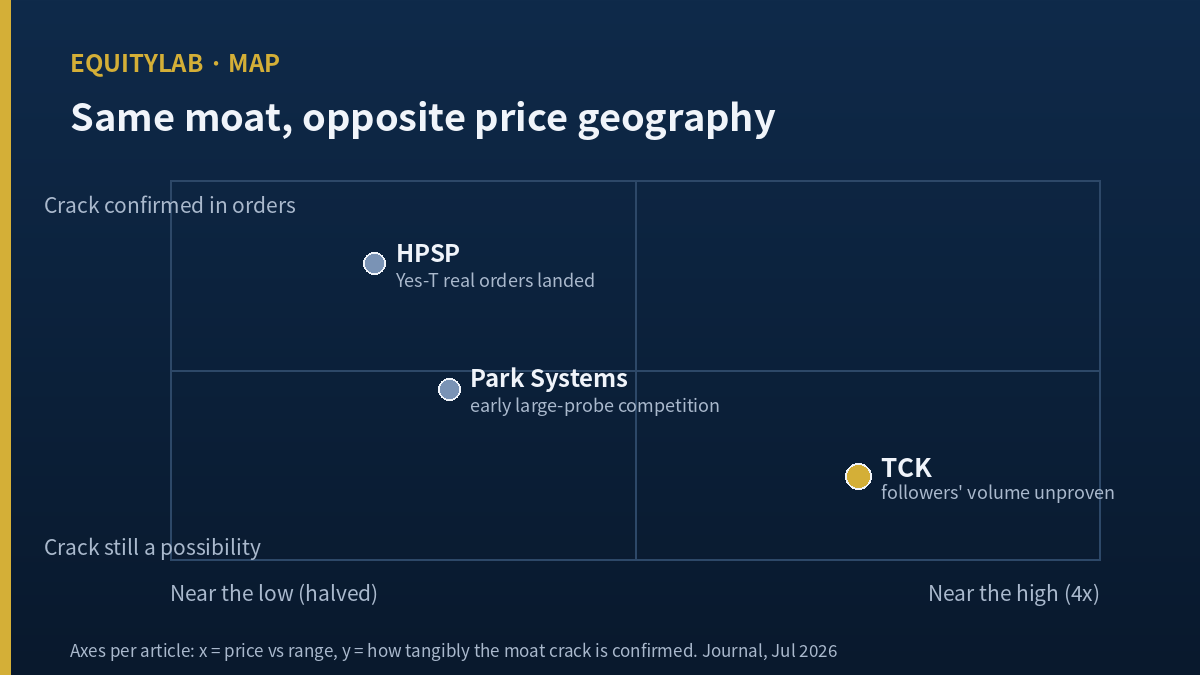
There’s a second crack worth naming: the followers. As THE ELEC has documented, Hana Materials won after-market qualification paths, DS Techno and KNJ have pushed to enter, and Samsung has been keen to diversify supply for cost reasons — the same report notes Samsung delayed sourcing rings from DS Techno while the patent fight ran. But here is where TCK diverges decisively from HPSP. In my HPSP entry, what I weighted most heavily was that its challenger, Yes-T, landed real equipment orders from Samsung worth about $30M (₩40+ billion) — the crack showed up “in the numbers.” TCK’s followers, by contrast, have not yet shown repeat physical volume at that level in public. The patent fence is down, but actual share erosion is still at the “possibility” stage. Put differently, TCK sits in an unusual spot compared with Park Systems and HPSP: the price is far more expensive, yet the moat crack is actually less advanced. That asymmetry is why I can say both “not cheap” and “moat still intact” at the same time.
For a US reader placing this: the closest legible analog is Entegris — a specialty semiconductor-materials and consumables maker whose moat, like TCK’s, is built on qualification and switching cost rather than headline patents. TCK is essentially a picks-and-shovels supplier to the memory-layer race, the way Entegris is to the broader fab. Entegris is a multi-billion-dollar NYSE name with deep liquidity; TCK is a far smaller, thinner-traded stock whose price can move hard on a single order announcement or one broker note — a reason on its own to size any position modestly and mind the fill. For most US readers this is a watch-list name reached deliberately, not a one-click buy, and that friction is itself part of why I’m content to wait for a better entry rather than chase.
TCK stock, the three paths I see
The path I think most likely (probability 50%)
NAND layer penetration and Chinese expansion keep pulling earnings higher, so the business grinds up and to the right. But the stock has already pulled much of that expectation forward, so from here it becomes a phase where earnings “catch up to” the valuation rather than the other way around. That is, the company keeps doing well while the share’s upward tempo cools from its spring pace — a dull digestion stretch. In that path I have no reason to rush in; I’d rather wait for earnings to fill in the multiple as the price drifts.
Where I could be wrong (probability 30%)
This isn’t a stretch. If second-half Samsung HBM and leading-edge DRAM qualification results come in strong and cryogenic-etch demand stacks on top, TCK — as a supply-chain bellwether — could jump above consensus again. Then watching would make me the one who was wrong. Missing a good company because it looked expensive is also a mistake. I keep this at 30%, and if it happens I pay for it with the patience to wait for the next pullback.
The rest (probability 20%)
Worst case (about 12%): customer inventory adjustment recurs, quarterly earnings roll over, and the high-end valuation retraces — the last fourth quarter was a preview of that. Best case (about 8%): follower erosion stays stuck, dominance is re-confirmed, and the multiple steps up another notch. Either way, buying new at the ₩300,000s isn’t a scenario I want to underwrite today.
What would end my watch — TCK stock breakpoints
Watching is a position too, and unless I write down when I’d change it, it’s just bystanding. I split the signals in two directions.
First, the signal to start buying. If earnings keep climbing while the stock corrects meaningfully off the ₩300,000s and the valuation pressure eases, that’s where I take a first position. Given the recurring-revenue stability of a consumable, a correction that brings the price down toward its earnings-based value — stripped of the growth premium — becomes a welcome opportunity, not a threat. In particular, if the Q2 print due in late July clears the inventory-adjustment worry and shows the SiC penetration story in the numbers while the stock stays subdued, that combination is my first litmus test for ending the watch.
Second, the signal that would make me abandon the name entirely. If a follower like Hana Materials or KNJ breaks through at an end customer such as Samsung or SK Hynix with what you could honestly call “repeat volume,” visibly denting TCK’s ~80% structure — and if that erosion drags quarterly operating margin below 30% — then the basis for the premium is gone. In time order, the follower’s physical volume should show up first, so from the moment that signal appears I plan to weight the margin trend more heavily each quarter.
So, where I land now
I haven’t bought TCK stock, and at this price I won’t open a new position. The moat — an ~80% SiC ring share plus consumable lock-in — is the cleanest I’ve covered in this series. But that good story is already generously priced into a stock that has quadrupled off its low, and since I buy moat relative to price rather than moat quality alone, I’m keeping my hands off this time. My next checkpoint is the Q2 print in late July: whether the inventory phase clears, whether the penetration story shows up in the numbers, and how the stock digests both. I’ll look at those three together and decide whether to keep watching.
This post is part of my semiconductor supply-chain moat series – the earlier entries cover HPSP and Park Systems.
→ Also in the moat series: EO Technics Stock Fell 45% While Estimates Rose: Why I Buy
Related reading
- Kumho E&C Stock Ran Limit-Up on the Chip Cluster
- Harim Stock Tops Two US Chicken Peers And No Analyst Covers It