
Daejoo Electronic Materials Missed Profit Forecasts, Not Sales
I open badly beaten names expecting the math to have gotten easier. Daejoo Electronic Materials stock was down 52.2 percent from its 250-session high of KRW 183,300 to its August 24, 2026 close of KRW 87,600 (about USD 63.18), so I assumed the multiple had come down with it. The screen showed a price-to-earnings ratio of 65.64 times. When I rebuilt that number from the quarterly filings myself, I got 136.3 times. The price fell by half and the multiple went the other way.
Second quarter 2026, estimate and outcome side by side
| Line | Estimate | Actual | Gap |
|---|---|---|---|
| Revenue (NH Investment Securities) | KRW 100.6bn | KRW 100.58bn | 0.02% low |
| Operating profit (NH Investment Securities) | KRW 8.4bn | KRW 6.78bn | 19.2% low |
| Operating profit (street average) | KRW 9.7bn | KRW 6.78bn | 30.1% low |
| Operating margin (NH Investment Securities) | 8% | 6.74% | 1.26pt low |
Estimates come from a July 1, 2026 note by analyst Joo Min-woo at NH Investment Securities as reported in the Korean press, and the street average is the figure that same note cited. Actuals are single-quarter consolidated numbers from the semiannual report filed August 14, 2026. The shipping volume was called almost exactly. Only the keep rate was wrong.
Contents
What the Daejoo Electronic Materials stock forecast got right
NH Investment Securities put second-quarter revenue at KRW 100.6 billion (about USD 72.5 million). The filed number is KRW 100.58 billion. That is an error of 0.02 percent, and I do not often see a Korean small-cap materials name modeled that closely. The company crossed KRW 100 billion in a single quarter for the first time, up 58.6 percent from KRW 63.4 billion a year earlier and up 10.6 percent from KRW 90.9 billion in the first quarter.
The same note was 19 percent too high on operating profit
Operating profit for the same quarter came in at KRW 6.78 billion (about USD 4.9 million) against the KRW 8.4 billion estimate. Against the street average of KRW 9.7 billion it was 30.1 percent low. A model that nails the top line and misses the operating line by nearly a fifth is not a sloppy model. It is a model working on a company whose margin is set somewhere the model cannot see.
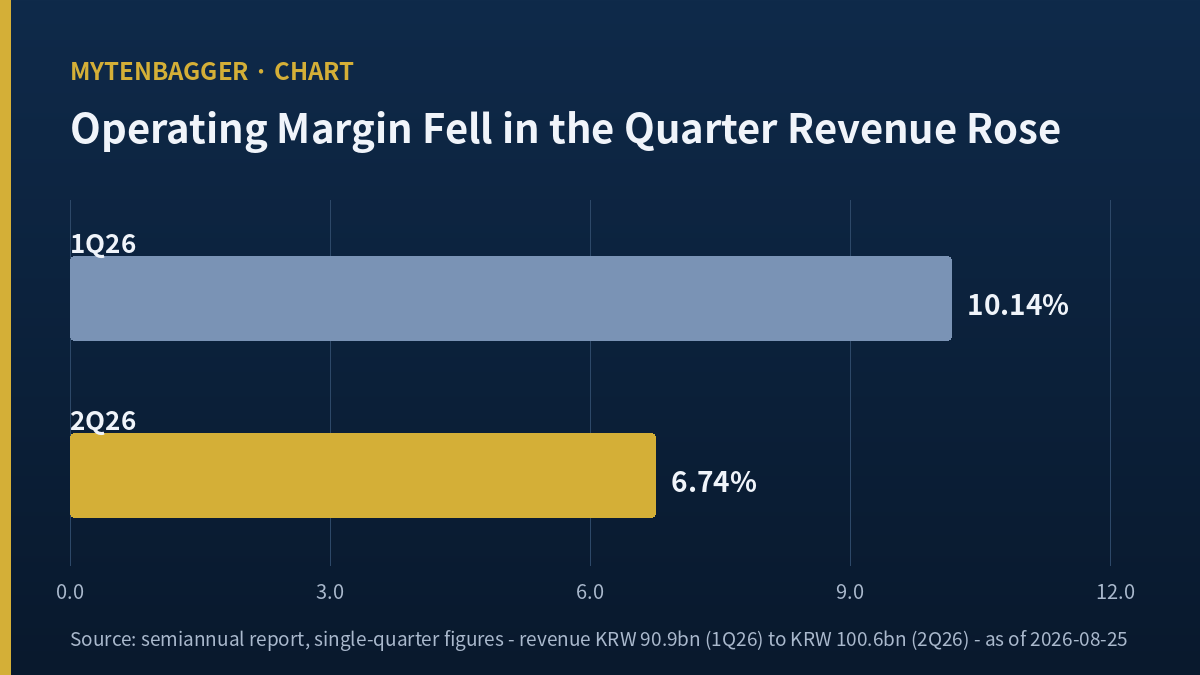
Laying the operating margin out by quarter shows where. It ran 10.14 percent in the first quarter and 6.74 percent in the second, a drop of 3.40 percentage points in the quarter when revenue rose 10.6 percent and operating profit fell 26.4 percent. First-quarter segment disclosure puts conductive paste at KRW 47.8 billion, or 52.6 percent of revenue, and precious metal purchases at KRW 42.7 billion, or 72.2 percent of raw material buying. When half the revenue sits on a metal price, the volume is predictable and the margin is not. That is how I now read this business.
Daejoo Electronic Materials stock got cheaper and its multiple did not
I threw out the 65.64 times figure on the screen. The vendor field flagged its earnings-per-share basis as computed from price divided by the ratio itself, which makes the calculation circular. Checking it, that EPS of KRW 1,334.55 matches fiscal 2025 consolidated net income of KRW 20.9 billion divided by shares outstanding. The screen multiple is standing on last year’s profit.
Adding the last four quarters myself doubles the number
So I summed the four single-quarter net income figures attributable to owners of the parent, from the third quarter of 2025 through the second quarter of 2026: KRW 6.55 billion, KRW 3.10 billion, negative KRW 3.83 billion, and KRW 4.27 billion. The total is KRW 10.09 billion (about USD 7.3 million). Divided by 15,704,338 shares that is KRW 642.5 per share, and the August 24 close of KRW 87,600 sits at 136.3 times that (my own back-calculation). Same company, and the answer is 65 times or 136 times depending on which twelve months of profit you stand on.
The book multiple needed rebuilding too. The screen carried a book value per share of KRW 16,874, which does not reconcile with second-quarter equity attributable to owners of KRW 282.5 billion (about USD 203.8 million) divided by shares outstanding, or KRW 17,989. That gives 4.87 times and not the 5.19 times displayed. This is the seventh name in my own log where that vendor field failed to reproduce.
Market capitalization was the one line that matched exactly. Multiplying 15,704,338 shares by KRW 87,600 gives KRW 1,375.7 billion (about USD 992.2 million), identical to the displayed value. Whatever survives a single multiplication holds. Everything that divides by profit splits apart.
Three fiscal years say the same thing the half-year does
This is not a one-half pattern. Consolidated revenue ran KRW 184.99 billion in 2023, KRW 219.32 billion in 2024 and KRW 254.61 billion in 2025, a rise of 37.6 percent across the two years. Operating profit over the same three years went KRW 6.21 billion, KRW 29.35 billion, KRW 20.69 billion. It peaked in the middle year and fell 29.5 percent in 2025 while revenue rose. Net income attributable to owners followed it down harder, from KRW 36.87 billion in 2024 to KRW 20.66 billion in 2025, a decline of 44.0 percent. Operating margin over the three years reads 3.36 percent, 13.38 percent and 8.12 percent.
So the first half of 2026 did not introduce the disconnect between the top line and the bottom line at this company. It widened one that was already visible in the annual filings, and the derivative charge stacked on top of a margin that had been sliding for a year before it. I find that a more useful frame than treating the half-year as an accident.
Why Daejoo Electronic Materials stock stays on my list anyway
Here is the other side, and I want it high in the piece, not buried near the end. Read only the paragraphs above and this is the story of screening out an expensive name. That is not how I read it.
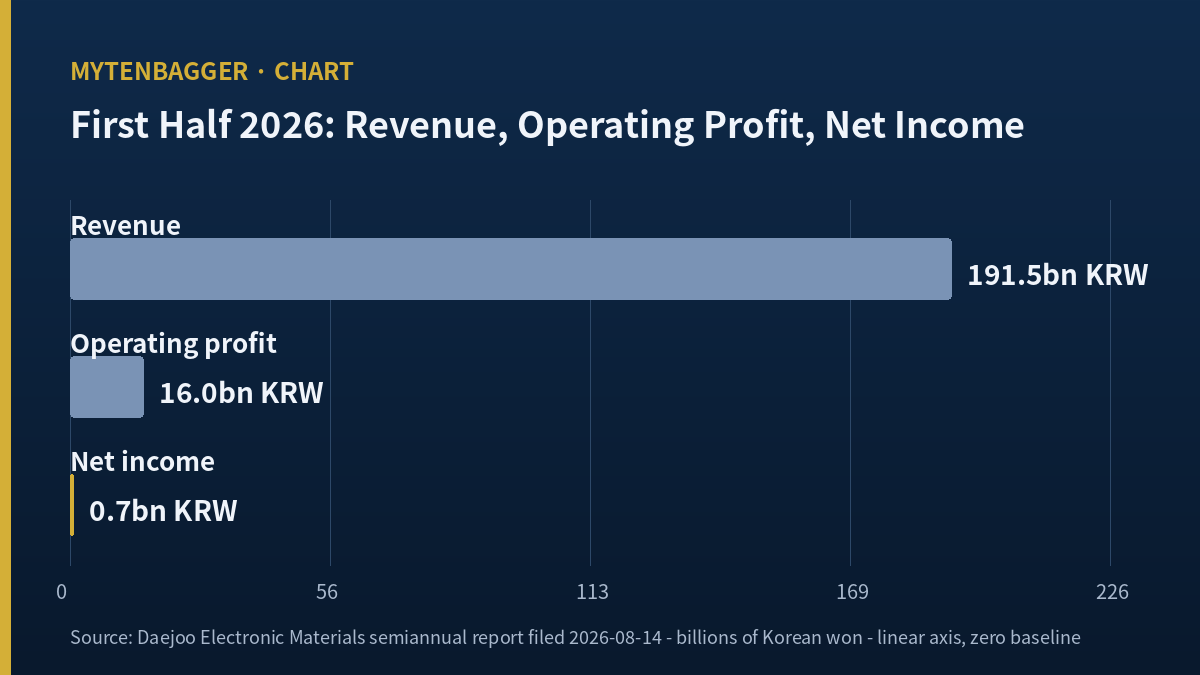
Revenue genuinely grew. First-half consolidated revenue was KRW 191.5 billion (about USD 138.1 million), up 63.0 percent from KRW 117.5 billion a year earlier. Operating profit also grew, to KRW 16.0 billion (about USD 11.5 million) from KRW 10.1 billion, up 58.1 percent. Nothing broke above the operating line.
The forward view has more than one house behind it. The same NH Investment Securities analyst raised his valuation from KRW 160,000 to KRW 200,000 on May 15, 2026, modeling conductive material revenue of KRW 250 billion in 2026, up 92 percent, and KRW 350.1 billion in 2027, up 40 percent, on demand from multilayer ceramic capacitors and chip components. Analyst Yoo Min-ki at Sangsangin Securities carried KRW 150,000 on March 6, 2026 with 2026 revenue of KRW 313.7 billion, up 23.3 percent, and operating profit of KRW 33.9 billion, up 97.6 percent. Both numbers were set before the shares reached the August 24, 2026 level, and I flag that instead of presenting them as current.
The product mix is also moving the way the bulls describe. The same May 2026 NH note put first-quarter conductive material revenue at KRW 61.0 billion, up 156 percent, split as KRW 34.6 billion for chip components, KRW 14.8 billion for multilayer ceramic capacitors and KRW 12.6 billion for solar cells, with silicon anode material adding KRW 12.0 billion, up 38 percent. Those are estimates carried in the Korean press and not filed segment data, and I treat them as such, but the direction matches what the filings show on revenue.
The tape is not one-directional either. The August 24 close is 48.7 percent above the 250-session low of KRW 58,900, and the 250-session range on an adjusted-close basis runs from there to KRW 183,300. In the daily series I pulled, the July 21 close was KRW 72,300, the stock fell to KRW 62,400 on July 30, reached KRW 98,500 on August 10, a gain of 57.9 percent in seven sessions, and closed at KRW 87,600 on August 24 after giving back 11.1 percent over the following nine. Low to high inside about a month was a spread of KRW 36,100. I left the vendor’s period return and moving average fields out of this piece because their calculation date and my reference date do not necessarily match, so only closing prices appear here.
Where KRW 15.3 billion of Daejoo Electronic Materials stock profit went
This is the part of the half-year that took me longest. Operating profit was KRW 16.0 billion and net income for the same six months was KRW 0.7 billion (about USD 0.5 million). On an owners basis it was KRW 0.4 billion. Against KRW 11.1 billion a year earlier that is a decline of 93.4 percent, and 96.0 percent on the owners line. KRW 15.3 billion vanished between the two lines.
It went below the operating line, not through it
The first quarter shows the mechanism most clearly: operating profit of KRW 9.2 billion and a net loss of KRW 3.5 billion. Korean trade press (DailyInvest, May 18, 2026) attributed that loss to derivative valuation charges. The company issued a seventh series of unregistered, unguaranteed private convertible bonds of KRW 43.0 billion on June 14, 2024, with a conversion price of KRW 109,824 per share.
Where a mezzanine instrument carries a conversion price reset clause, Korean accounting classifies it as a financial liability, and a rising share price shows up on the income statement as a derivative loss. The structure is common among Korean listed issuers; a 2021 Korean feature in inews24 walks through the same treatment across several names, and I cite it only for the mechanics, not for anything about this issuer. I could not open the exchange filing for this company’s own charge. A derivative trading loss disclosure exists dated January 19, 2026 with a correction filed May 18, 2026, but the exchange system refused my requests during this session, so I am leaving the exact filed amount out and keeping only the KRW 15.3 billion gap that the semiannual report reproduces plus the cause the press named.
What matters to me is that this charge has a direction. When the shares rise the income statement worsens, and when they fall it improves. The August 24 close of KRW 87,600 sits 20.2 percent below the KRW 109,824 conversion price. The item that weighed on the first half is currently hanging the other way. I think that is the single most useful sentence about this stock right now, and I also think it describes the direction of profit and not the size of it.
Part of the instrument is already settled. Meritz Securities exercised a purchase option on May 15, 2026 over KRW 15.05 billion of the KRW 43.0 billion issue, or 35.0 percent, for consideration of KRW 15.66 billion payable June 15, 2026. The shares underlying that slice come to 137,037, or 0.87 percent of shares outstanding (KRW 15.05 billion divided by KRW 109,824, which I checked by hand). How the remaining balance is handled decides how large the derivative line is next quarter.
Daejoo Electronic Materials stock cash said what its profit did not
Multiples and derivative charges are arithmetic. The next line is not. Operating cash flow for the first half of 2026 was negative KRW 11.1 billion (about negative USD 8.0 million), against positive KRW 1.2 billion a year earlier. With operating profit at KRW 16.0 billion for the same period, KRW 27.1 billion separates the two.
Inventory rose by a third in six months
Inventory went from KRW 32.2 billion at the end of 2025 to KRW 43.1 billion (about USD 31.1 million) at the end of the second quarter, an increase over six months of KRW 10.9 billion, or 33.7 percent. In a half where revenue grew 63 percent, more inventory is ordinary. What I note separately is that it grew by a third in the same half that cash turned negative. Capital expenditure of KRW 11.5 billion on top of that put free cash flow at negative KRW 22.7 billion. The debt-to-equity ratio stood at 138.37 percent at the end of the second quarter.
I have written up the profit-versus-cash split once before, when KEPCO KPS earned money in every quarter its cash did not. There the collection timing sat with one customer family. Here it sits with raw materials and inventory. The operating-profit-to-net-loss split has its own precedent in the year CJ CheilJedang left its earnings multiple blank, though that gap came from asset revaluation and this one is tied to the issuer’s own share price. Different causes mean different recovery conditions.
A global peer to Daejoo Electronic Materials stock without the profit
The cleanest listed comparison I could verify is Enovix (ENVX), the Nasdaq-listed silicon anode battery developer. On the same August 24, 2026 date it closed at USD 3.24 with a market capitalization of USD 693.40 million on 214.01 million shares, which I reproduced by multiplication. Trailing revenue was USD 35.88 million, up 34.9 percent, against a trailing net loss of USD 170.03 million and earnings per share of negative USD 0.79. There is no earnings multiple because there are no earnings.
I chose it on one axis only: same silicon anode thesis, opposite income statement. Daejoo Electronic Materials generated USD 138.1 million of first-half revenue, roughly four times Enovix’s trailing annual figure, and it did so profitably at the operating line. What it could not do was carry that profit down to the bottom. Enovix never gets the chance to fail that way. I did not build a broader multiple table because a company with no earnings and a company whose earnings disappear below the operating line do not share a bottom line worth tabulating.
My stance on Daejoo Electronic Materials stock and what breaks it
I am leaving it as a watch item. At KRW 1,375.7 billion of market value it sits outside the largest hundred Korean listings.
My caution is not because I dislike the business. A company that grew revenue 63 percent and crossed KRW 100 billion in a quarter for the first time is doing something right. It comes from one reason: the layer where the profit disappeared has not closed, and nothing before the third-quarter report will tell me whether it has.
I am watching which of these four arrives first
One. Does the third-quarter operating margin climb back above the second quarter’s 6.74 percent? If it does not, the precious metal cost line is structural and forecasts of this company’s profit will keep missing.
Two. Does third-quarter net income recover to more than half of operating profit? The derivative item is hanging favorably at the current price, so a miss here would mean the cause was never only the derivative.
Three. Does operating cash flow return to positive? Whether negative KRW 11.1 billion was one half-year or the start of a third consecutive quarter decides how I read the inventory build.
Four. Is the remaining seventh-series convertible balance disclosed as settled? Beyond the KRW 15.05 billion Meritz Securities took, the treatment of what is left changes the size of the derivative line itself.
The first three settle in the third-quarter 2026 report, legally due November 15, 2026. The fourth could surface earlier as a filing.
Numbers I decided not to put in this piece
I want to close on the exclusions. Five figures were on my screen and stayed out of the text, and writing down why helps whoever reopens this later, including me.
The displayed 65.64 times earnings came out because its basis is circular, and I replaced it with 136.3 times built from single-quarter filings. The displayed book value per share of KRW 16,874 came out because it does not reconcile with the KRW 17,989 I get from owners’ equity, so the book multiple in this piece is my own 4.87 times. The displayed EBITDA of KRW 9.2 billion came out because it cannot sit alongside first-half operating profit of KRW 16.0 billion on the same screen. The displayed interest expense of KRW 39.4 billion came out because it is not a plausible size against KRW 191.5 billion of half-year revenue. The payout ratio came out because the same screen showed both 7.5 percent and 70.8 percent, so I kept only the direction and the fiscal 2025 dividend of KRW 100 per share, a yield of 0.12 percent.
Two more items are missing because I failed to confirm them: the filed amount in the derivative loss disclosure, and the detail of the April 16, 2026 treasury share disposal decision. The exchange filing system refused both requests. Those are the first two things I open if I come back to this company.

Sources
- Semiannual report for the period ended June 30, 2026, filed August 14, 2026, via the Korea Exchange filing system. Consolidated revenue, operating profit, net income, operating cash flow, inventory and leverage. Korea Exchange KIND
- Newspim, July 1, 2026, reporting an NH Investment Securities note by Joo Min-woo. Valuation of KRW 153,000, second-quarter estimates of KRW 100.6 billion revenue and KRW 8.4 billion operating profit, street average of KRW 94.8 billion and KRW 9.7 billion. My translation of the Korean original.
- Edaily, May 15, 2026, reporting the same house raising its valuation from KRW 160,000 to KRW 200,000 and modeling conductive material revenue of KRW 250 billion for 2026 and KRW 350.1 billion for 2027.
- DailyInvest, May 18, 2026, attributing the first-quarter 2026 net loss to derivative valuation charges and citing Sangsangin Securities and Kiwoom Securities estimates.
- Hankyung consensus page, as of August 14, 2026. Street valuation of KRW 150,000 and estimated earnings per share of KRW 1,721.
- Investing.com filing summary, May 15, 2026, on the Meritz Securities purchase option over KRW 15.05 billion of the seventh convertible series, conversion price KRW 109,824.
- Investing.com filing summary, May 14, 2026, on first-quarter segment revenue, conductive paste at KRW 47.8 billion and precious metal purchases at KRW 42.7 billion.
- inews24, February 25, 2021, on how conversion-price-reset mezzanine instruments produce derivative valuation losses. Cited for the accounting mechanics only, not for this issuer.
- Enovix (ENVX) data, August 24, 2026 close.
- Price, market capitalization and the 250-session range from Kiwoom data as of the August 24, 2026 close. Shares outstanding 15,704,338. All USD conversions in this piece use KRW 1,386.5 per USD, the Seoul onshore close of Friday, August 21, 2026, reported as the prior session close by Edaily on August 24, 2026.
- Korea’s BHI Price to Book: Why 10.45x Rests on a Stale Book Value
- Why Hanwha Systems Shares Fell 66% as Operating Profit Tripled
- Sungeel Hitech Earnings: Battery Metal Prices Drive Its Revenue