Samsung Epis Holdings Outlook: The Goal Needs Record Sales
Where I stand, in one line: the Samsung Epis Holdings outlook depends on July-December revenue beating the company’s best three months by about 9%, and until the Q3 report shows that pace, I am watching from outside with no position.
The Samsung Epis Holdings outlook comes down to one sum I could not stop redoing. Its operating subsidiary, Samsung Bioepis, told investors on July 24 (Fri) that it still expects revenue to grow by 10% or more this year. Revenue in 2025 was a record KRW 1,672.0bn (about $1.23bn), so the goal sits at KRW 1,839.2bn or higher. After January-June brought in KRW 847.1bn, the remaining six months need at least KRW 992.1bn (about $730m). That is 17.1% more than the first six months delivered, by my calculation.
I did not plan to write about a revenue goal. I came to this company because it is new to the KOSPI, Korea’s main stock index, and because its share price has fallen more than 50% in under a year. Then I lined up the three-month figures and the guidance stopped looking like a routine sentence in a press release. It became the most testable claim the company has made since it listed.
Samsung Epis Holdings is the holding company created in November 2025 when Samsung Biologics split off its biosimilar business. It owns 100% of Samsung Bioepis, which develops and sells biosimilars, lower-cost versions of biologic drugs whose patents have expired. Almost all of the holding company’s revenue is Samsung Bioepis revenue, so the subsidiary’s guidance is the group’s guidance in practice.
Contents
Samsung Epis Holdings outlook: the guidance, worked out in won
Here is the arithmetic laid out plainly. All revenue figures are Samsung Bioepis figures as reported in Korean press on the day of the release (Daily Pharm and Herald Business); dollar figures use one exchange rate, explained at the end.
| Period (Samsung Bioepis) | Revenue, KRW bn | Approx. USD m |
|---|---|---|
| Full year 2025 (record) | 1,672.0 | 1,231 |
| January-March 2026 | 454.9 | 335 |
| April-June 2026 | 392.2 | 289 |
| Minimum full year 2026 under the 10% goal | 1,839.2 | 1,354 |
| Minimum July-December 2026 | 992.1 | 730 |
Sources: company release via Korean press (July 24 and April 23, 2026). The last two rows are my own calculation from the goal.
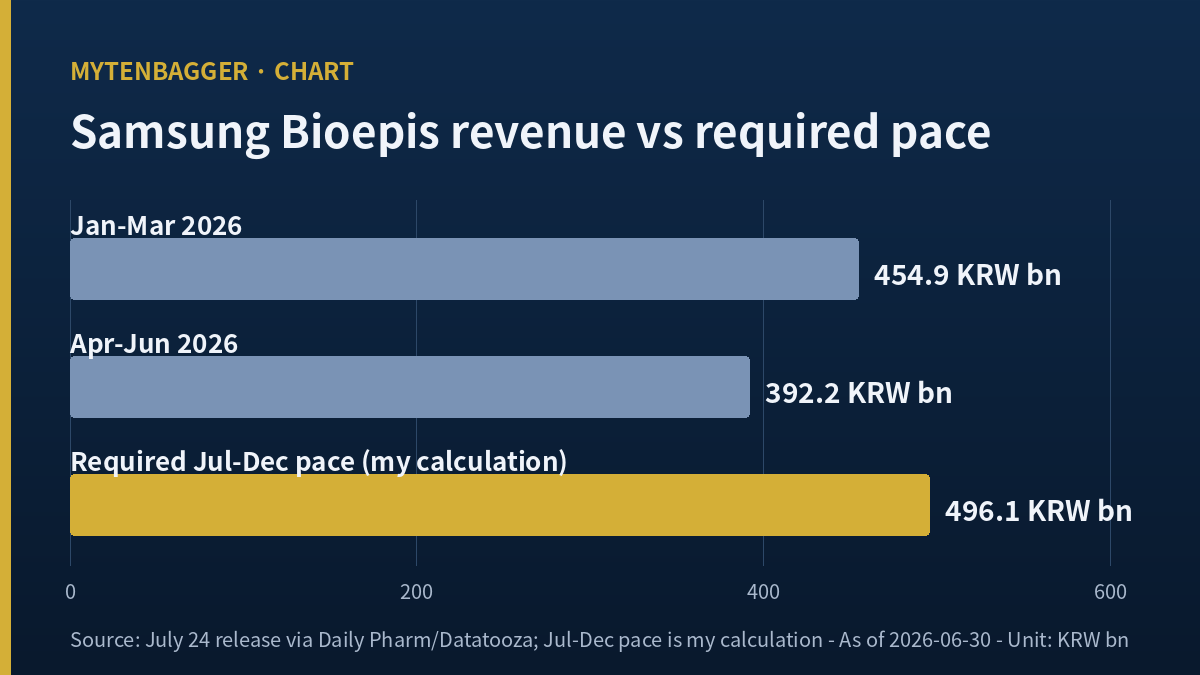
Spread evenly, KRW 992.1bn over July-December means about KRW 496.1bn for each three-month period. The best three months the company has reported so far are January-March 2026, at KRW 454.9bn. So each of the next two periods needs to come in roughly 9.0% above that record. Measured against April-June, the step-up is about 26.5%. Those two percentages are mine, worked from the table, and they are the core of this entry.
There is a gentler way to read it. Biosimilar sales are lumpy because partners order in batches and milestone payments arrive when regulators sign off. They never follow a smooth monthly line. A goal like this can be met with one very strong period and one ordinary one. Even so, the floor I worked out does not move. Somewhere in July-December the company needs revenue it has never shown in a single reported period, or two periods that both beat January-March.
Last year’s pattern makes the goal look less odd than it first does. January-March 2026 revenue was up 14% from a year earlier, according to a Korean bio-industry outlet, which puts January-March 2025 at roughly KRW 399bn. Add the reported KRW 401.0bn for April-June 2025 and the first six months of 2025 come to about KRW 800bn. That leaves about KRW 872bn for July-December 2025, so last year the second six months were already about 9% larger than the first. All three figures are mine, worked from the reported growth rate, and are accurate only to within a few KRW bn.
Seen that way, the 2026 goal asks July-December revenue to grow about 13.8% over July-December 2025. That is a demanding number after an April-June period that shrank, but it is not out of character for a company whose January-March grew 14%. The question is which of those two recent periods is the better guide to the next two.
What happened in April-June
April-June revenue was KRW 392.2bn, down 2.2% from KRW 401.0bn a year earlier, and operating profit was KRW 86.6bn (about $63.8m), down 3.6% from KRW 89.8bn, according to the July 24 release as covered by Daily Pharm and by Datatooza, which printed the same subsidiary figures under the holding company’s name. The company’s explanation, in my translation, pointed to changes in the supply timing of key products and higher spending on research and development.
How far below expectations it fell
A Korean outlet, Sidae, reported that the market had expected about KRW 448bn in revenue and KRW 116bn in operating profit for the period. It did not name whose forecast that was, so I treat it as a loose consensus. Against it, actual revenue came in at about 87.5% of the expected figure and operating profit at about 74.7%, by my calculation. Revenue was also KRW 62.7bn lower than in January-March.
Operating profit fell faster than revenue. My calculation puts April-June operating profit at about 22.1% of revenue, down from about 31.7% in January-March, when operating profit was KRW 144.0bn on KRW 454.9bn of revenue, according to Herald Business. Part of that is fixed costs spread over less revenue. Part of it is research spending, which the company named itself. A Korean trade outlet, Medicopharma, reported in January that research and development costs in October-December 2025 had risen 138% from a year earlier, to KRW 154.2bn, and that operating profit for that period dropped sharply from the prior three months. The outlet did not spell out whether it meant the subsidiary or the group, so I use it only for direction. Spending at that level does not switch off in a year in which the company is pushing several new biosimilars and its first antibody-drug conjugate into trials.
Samsung Securities called the weakness temporary in a July 27 (Mon) note reported by Newspim. As that Korean report described it, the dip came from the lack of the milestone income that had lifted the prior year and from deliveries pushed back under what the broker called a Wave 2 contract structure. If that is right, part of the missing revenue simply moved into July-December, which helps the goal arithmetic. If it is wrong, the gap gets wider.
I find the timing reading plausible for one practical reason: the company kept its full-year goal in the same release that reported the soft quarter. Companies that expect a miss usually soften the language at that moment. This one did the opposite.
The product list behind that confidence is longer than it was a year ago. According to Money Today, the company launched its aflibercept biosimilar in Europe in May 2026, is moving its Prolia and Stelara biosimilars further into commercial markets, and reported Phase 1 and Phase 3 results for SB27, its proposed Keytruda biosimilar, showing equivalence to the reference drug. News1 added that SB27 has been filed for Korean approval across 16 indications. None of these is a July-December revenue figure I can verify today, but they explain why the company did not cut its goal.
Samsung Epis Holdings outlook against two sell-side views
Two forecasts help me size the July-December test. The first is from HSBC, as reported by News1 on September 22 (Tue). The bank expects Samsung Bioepis revenue of KRW 1.89tn in 2026, rising to KRW 2.33tn in 2028, with EBITDA reaching KRW 497bn in 2028. HSBC is positive on the shares.
HSBC’s 2026 number is more demanding than the company’s own floor. Take out January-June and it leaves KRW 1,042.9bn for July-December, about 23.1% more than the first six months, by my calculation. The bank is effectively assuming that the delayed deliveries arrive and that new products add on top. The 2028 figure implies annual growth of about 11.0% from 2026, which is close to the company’s current goal carried forward.
The EBITDA forecast is the part I find most useful. KRW 497bn on KRW 2.33tn of revenue works out to about 21.3% of revenue in 2028, by my calculation. That is close to the April-June ratio and well below January-March. In other words, HSBC is not assuming that profitability snaps back to the early-2026 level. It is assuming revenue grows while research spending keeps profitability near where it fell. That reading lines up with Daishin’s view below, even though the two firms differ on how much to pay for it.
The second view is more cautious. Daishin Securities analyst Hong Ga-hye cut the firm’s valuation of the shares by about 9.7% on July 27, citing heavier research spending, according to Asia Economy. The firm kept a buy rating and argued that the market was not yet paying for the new-drug pipeline. The cut was to profit forecasts, which matters here: higher research spending can coexist with the revenue goal while still pulling operating profit away from where the guidance alone would put it.
The company that Samsung Epis Holdings was split from offers a useful contrast. When I looked at Samsung Biologics in July, it traded at a P/E of about 52.7 as a pure contract manufacturer. The biosimilar side carries different risks, mainly launch timing and price competition, and the revenue goal is where those risks show up first.
Samsung Epis Holdings outlook and the October 1 Teva deal
On October 1 (Thu), Korean press including Etoday reported that Samsung Bioepis signed a partnership with Teva Pharmaceutical for two immunology biosimilar candidates: SB41, referencing Fasenra (benralizumab), and SB44, referencing Ilaris (canakinumab). Teva receives commercial rights in the US, Europe and Canada, while Samsung Bioepis handles development, approval and manufacturing. The terms were not disclosed.
The shares closed up about 7% that day at KRW 371,000 (about $273), though the closing-price report in JKN said no clear catalyst was confirmed. I do not put the Teva deal into my 2026 numbers. Both products are candidates, and without disclosed upfront terms there is nothing I can responsibly add to July-December revenue. What it does show is that the partner model behind the April-June delay is still how the company grows: someone else sells, and Samsung Bioepis ships when the partner orders.
That model is also why I expect the revenue line to stay uneven. A biosimilar business like the one at Celltrion, which sells more of its products directly, can show a smoother path; a partner-heavy business depends on when partners restock. Neither is better in principle. It just changes how much a single soft period should worry me.
One European peer in the same window
For a reader who follows global generics, the natural comparison is Sandoz (SIX: SDZ), the Swiss-listed generics and biosimilars company. I chose it for one reason: it reports biosimilar sales on their own for the same January-June window, so the growth rates can sit side by side without any valuation multiple.
Sandoz reported on August 5 that biosimilar net sales reached $1,875m in January-June, up 25% from $1,496m, and $1,022m in April-June, up 24% from $825m, according to RTTNews and the company’s own release. Group net sales rose 5% at constant currencies to $5,761m.
Two further details from the same release are worth keeping. April-June group net sales were $3,005m, up 7% at constant currencies, and core EBITDA for January-June rose 15% to $1,206m, or 20.9% of net sales. Sandoz also reaffirmed its 2026 guidance of mid-to-high single-digit net sales growth at constant currencies. Biosimilars were about 32.5% of Sandoz’s January-June net sales by my calculation, so its group guidance blends a fast-growing biosimilar business with a slower generics business. Samsung Bioepis sells nothing but biosimilars, which is why its own goal sits higher, at 10% or more. The two goals are not directly comparable, and I do not treat them as if they were.
Set next to each other, the April-June numbers point in opposite directions: Sandoz biosimilars up 24% in dollars, Samsung Bioepis revenue down 2.2% in won. Currency and product mix explain some of that and I cannot strip either out cleanly. What the comparison does tell me is that the period was not weak for the category. Whatever held Samsung Bioepis back was specific to its own deliveries, which is consistent with the company’s explanation and with the Samsung Securities note. That makes a July-December catch-up more believable to me.
How I will size the next report
The Q3 report is due by November 16 (Mon). When it arrives, I will look at July-September revenue first and ask a single question: is it above KRW 454.9bn? If it is, the company has set a new three-month record and needs only an ordinary October-December to reach the floor. If it is between KRW 392.2bn and KRW 454.9bn, the goal still survives on paper, but October-December would then have to carry most of the weight.
I can see three ways the next two periods unfold. In the first, July-September revenue clears KRW 454.9bn because the delayed partner orders arrive, and the goal looks easy by November. In the second, July-September comes in between the two recent periods, the company leans on October-December, and the goal becomes a coin toss decided in January. In the third, July-September comes in near April-June again, which would tell me that the delay was more than timing and that the 10% figure is at risk. I am not putting odds on these. I only know which one the first data point will rule out.
A note on how the numbers arrive, for readers new to Korean listings. Companies on the KOSPI usually publish preliminary revenue and operating profit through an exchange disclosure a few weeks after a period ends, and the full quarterly report follows within 45 days. Samsung Epis Holdings released preliminary April-June figures on July 24 and filed its six-month report in mid-August. I expect a similar sequence for July-September, which means a preliminary figure could appear in late October, before the November deadline.
I learned to look at it this way the hard way. The stock’s first trading day was November 24, 2025, and I remember reading the spin-off coverage and filing the company away as a biosimilar maker with a nice growth rate. I never checked how that growth rate was spread across the year. When April-June came in soft, my first reaction was that the growth story had stalled. It took the guidance arithmetic to see that the more useful question was when the delayed sales would arrive, and whether the company’s own target leaves room for that.
The share price has moved in the same direction as the April-June figures. On my data provider’s numbers, measured at the October 1 close, the stock was still down about 4.4% over one month, 14.0% over three months and 30.3% over six months, even after the 7% gain that day. Those moves came while the company kept its full-year goal, so the market has been pricing in doubt about the goal well ahead of any evidence against it.
For context on price, the stock trades about 52.0% below its 250-day high close of KRW 773,000, set in January, by my calculation. At KRW 371,000 the market value is roughly $6.8bn. I am not using a trailing P/E: the holding company’s 2025 figures cover only the two months after the spin-off, which makes any trailing multiple misleading.
Samsung Epis Holdings outlook: what could prove me too cautious
- The delay is timing, by the company’s own words. If the deliveries pushed back in April-June simply arrive in July-September, a record period is almost built in. Samsung Securities said as much, and the unchanged goal supports it.
- The category is growing fast. Sandoz’s biosimilars grew 24% in April-June. A company with a long product list and partners in every major market should not stay flat in that environment for long.
- The sell-side sees more than the floor. HSBC’s KRW 1.89tn implies July-December revenue well above what the 10% goal needs. If HSBC is closer to the truth than I am, my caution costs me the move.
I take all three seriously. My answer to them is that each one is a claim about July-December, and the first real evidence on July-December arrives with the Q3 report. Waiting one report costs less than guessing.
Samsung Epis Holdings outlook: five things that would change my view
- July-September revenue above KRW 454.9bn, a new three-month record.
- The company repeats the 10%-plus goal in the Q3 release without new conditions attached.
- Operating profit in July-September recovers above KRW 89.8bn, the April-June level of a year earlier, showing that research spending is not eating the extra revenue.
- A disclosed upfront payment from the Teva partnership or another deal that is recognized inside 2026.
- Sell-side forecasts for 2026 revenue hold near HSBC’s figure after the Q3 report instead of moving down toward the company’s floor.
Each item tests something different. The first is a pure revenue test and the cleanest read on the delayed orders. The second checks whether management still stands behind the number after seeing July-September, which matters because a goal repeated with fresh conditions is a softer goal. The third checks the profit side, since revenue that arrives with even heavier research spending does less for shareholders than the headline suggests. The fourth would give me a cash figure I can add to the year with some confidence. The fifth tells me whether the analysts who know the company best are still above the floor after seeing the same data.
One thing this entry deliberately leaves out: the holding company’s consolidated operating profit sits below the subsidiary’s because of amortization tied to the 2022 purchase of the remaining stake in Samsung Bioepis. That gap is a separate question from the revenue goal, and I do not mix the two here.
The first item answers soonest and carries the most weight. If it fails, the second and third tell me whether the gap is still timing or something larger. Items four and five move slower and matter more for 2027 than for this year.
For now I hold no shares. I will read the Q3 revenue line, put it against KRW 454.9bn, and write the next entry from that one comparison.
Prices reflect the October 1, 2026 close of KRW 371,000 as reported by JKN; the exchange’s regular-session daily bar shows KRW 369,500, and hosts differ slightly. Dollar amounts are approximate, at roughly KRW 1,358.4 per dollar, the Seoul foreign exchange market close on the same date reported by Newsis. Sandoz figures are in US dollars as reported and were not converted. Figures marked as my calculation are worked from the reported numbers above.