Lotte Shopping Dividend Exceeded Earnings in Two of Three Years
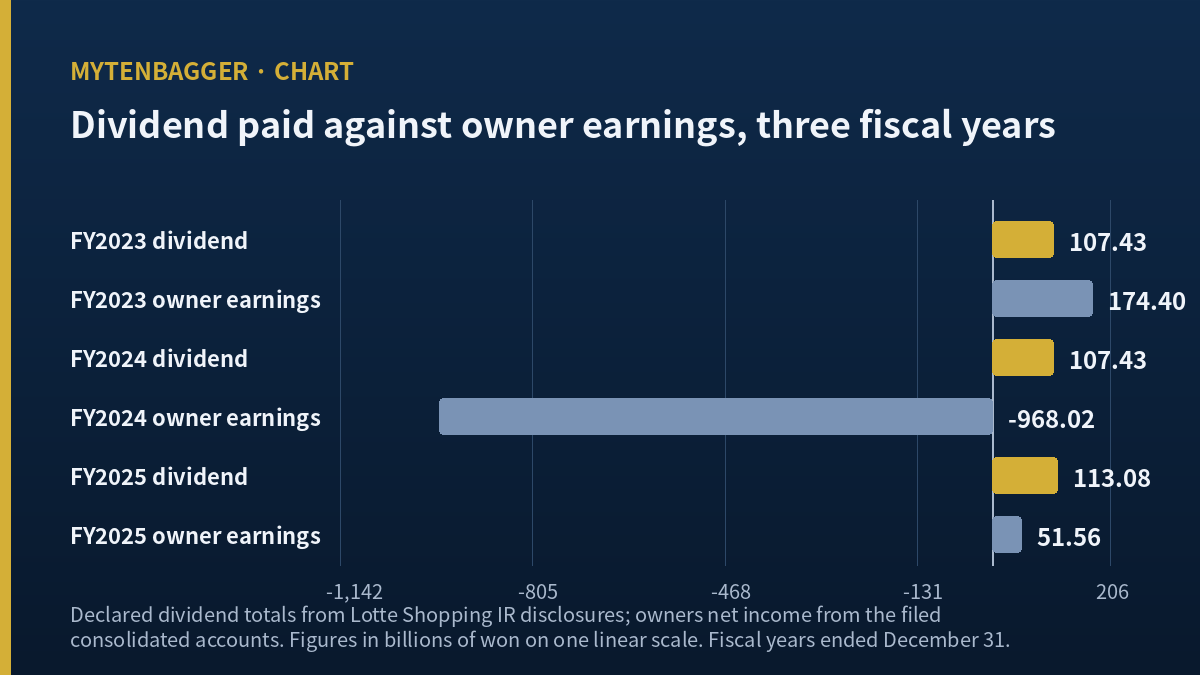
Lotte Shopping stock came onto my screen because of a dividend line, not a price line. The company paid out 113.08 billion won in cash for fiscal 2025. In that same fiscal year, the profit that belonged to its own shareholders came to 51.56 billion won. I ran the division twice because the first result looked like a typing error: the payout was 2.193 times the earnings it was drawn against.
At a market value of 2.97 trillion won on the August 26 (Wed) close of 105,100 won, it falls outside the size band where I take a stance, so this is a watching note. What I wanted to know was narrow. Was 2025 an odd year, or is paying more than you earn something this company has been doing for a while?
Contents
What Lotte Shopping stock paid out in 2025 and what it earned
| Cash dividend declared, fiscal 2025 | 113.08bn won (about 81.7 million dollars) |
| Profit attributable to owners of the parent, fiscal 2025 | 51.56bn won (about 37.2 million dollars) |
| Ratio, my own division | 2.193x |
The dividend figure is the company’s own. Lotte Shopping’s investor relations page lists a fiscal 2025 payment of 4,000 won per common share, split into an interim 1,200 won and a year-end 2,800 won, for a declared total of 113,083 million won (Lotte Shopping IR, dividend disclosures). The earnings figure comes from the audited consolidated statements filed for the year ended December 31, 2025: group net income of 73.56bn won, of which 51.56bn was attributable to owners of the parent and the rest to non-controlling interests.
Which of those two earnings numbers you use matters. Against group net income the payout is 1.537x. Against the owners’ line it is 2.193x. A dividend is paid to the parent’s own shareholders, so the owners’ line is the one I hold it against, and I have used that line consistently through this piece.
The share count the dividend was actually paid on
Dividing the declared total by the per-share amount gives 28,270,750 shares carrying the dividend. The share count I see quoted for the company is 28,288,755. The gap of 18,005 shares is presumably treasury stock, but I could not find a disclosed treasury holding to confirm that, so I am calling it an inference and not a fact. A separate data feed I use lists 28,288,297 shares, a further 458 apart. On a market value stated to the nearest hundred million won none of this moves the total, and it does move the per-share arithmetic, which is why I am flagging it instead of quietly picking one.
Three fiscal years of the same payout line
| Fiscal year | Dividend per share | Declared total | Owners’ net income | Cover |
|---|---|---|---|---|
| 2023 | 3,800 won | 107.43bn won | 174.40bn won | 61.60% |
| 2024 | 3,800 won | 107.43bn won | -968.02bn won | no cover |
| 2025 | 4,000 won | 113.08bn won | 51.56bn won | 219.34% |
Dividend amounts from the company’s IR disclosures. Owners’ net income from the filed consolidated accounts, converted from millions of won. The cover column is my own division and rounds to two decimals.
So the answer to my narrow question is that 2025 was not a one-off. Of the three years, only 2023 produced enough owner earnings to cover the cash. In 2024 the company reported a loss of 968.02bn won on the owners’ line and still paid 3,800 won a share. In 2025 it raised the per-share amount to 4,000 won against earnings that had barely returned to positive.
The company has said what it is doing. Its stated policy for 2024 through 2026 is a shareholder return ratio of at least 35% with a floor of 3,500 won per share. A floor is a promise that does not bend when earnings do, and the last three years are what that promise looks like when earnings bend a long way. It has kept going into 2026: the board declared an interim dividend of 1,300 won a share on June 11 (Thu), worth 36.75bn won, with a record date of June 30 (Tue) and payment on July 31 (Fri). That is the second consecutive year with an interim payment.
Where the 2024 loss came from
The 2024 loss is not a trading collapse. Revenue that year was 13.99 trillion won and operating profit was 473.1bn won, both roughly in line with the years either side. What happened below the operating line was an accounting event with a very large balance sheet effect. The company revalued its land for the first time in fifteen years. Reporting around the fiscal 2024 results put the land carrying value at 17.7 trillion won, up 9.5 trillion won, and the company’s stated debt-to-equity ratio down from 190.4% to 128.6% (Kyunghyang Shinmun, February 2025, in Korean).
The filed accounts show total equity going from 10.84 trillion won to 17.03 trillion won across that year, a rise of 6.20 trillion won, while total assets rose 8.36 trillion won. My own division of filed liabilities by filed equity gives 182.79% for 2023 and 128.98% for 2024, so my starting point and the company’s differ by 7.6 percentage points. I did not resolve which basis accounts for that, and I have used my own figures with the company’s quoted separately.
This matters for the dividend question in one specific way. The equity base against which any return ratio is measured jumped by more than half in a single year, and it jumped because of a valuation exercise on land that sits under operating stores. A Korean credit analyst put it plainly at the time of a January 2026 bond sale, describing the leverage improvement as something that had happened on the surface of the ratios (The Public, January 2026, in Korean).
Where the earnings line sits after two quarters of 2026
If the payout is going to be covered again, the earnings line has to come up. Through six months of 2026 it has. First-half revenue was 7.07 trillion won, up 3.82% year on year, operating profit was 342.79bn won, up 81.49%, and owners’ net income was 125.36bn won. That six-month owners’ figure is already 2.43 times the whole of fiscal 2025.
The second quarter on its own is where I slowed down. The company reported quarterly revenue of 3.485 trillion won and operating profit of 89.9bn won on August 7 (Fri), against a compiled consensus of 114.2bn won, a miss of 21.3% (The Korea Economic Daily, August 2026, in Korean). The stock closed 12.9% lower that day. Group net income for the quarter was 14.62bn won. The owners’ line was negative 2.85bn won, because 17.47bn won of that quarterly profit went to non-controlling interests, a figure I arrived at by subtraction and which matches the reported owners’ loss of 2.853bn won (Youth Daily, August 2026, in Korean).
What the price did while the payout stayed flat
The yield on a fixed dividend moves entirely with the price, and this price moved a long way in 2026. The stock opened the year at 68,600 won on January 2 (Fri) and closed at 203,500 won on June 17 (Wed), a gain of 196.6% in five and a half months, on a combination of inbound tourist spending lifting department store comparable sales, a live legislative debate about relaxing hypermarket trading restrictions, and a run of upward valuation revisions from Korean brokers. It then gave most of that back. By August 24 (Mon) it was at 96,200 won, 52.7% below the June close, before recovering to 105,100 won on August 26 (Wed). A 4,000 won dividend was a 5.83% yield at the January open and a 1.97% yield at the June 17 close, on my own division, without the company changing anything at all.
One division carries four losing ones
Second-quarter operating results by division were department stores plus 119.7bn won, the electronics chain plus 1.0bn won, hypermarkets minus 37.8bn won, supermarkets minus 1.8bn won, e-commerce minus 7.4bn won and the cinema business minus 13.7bn won (ZDNet Korea, August 2026, in Korean). The four loss-makers add to 60.7bn won of losses. Department stores alone made just under twice that, 1.97 times by my division. Department store revenue was 891.2bn won, up 9.2% year on year, which the company called its best second quarter on record. Adding all six divisions gives 60.0bn won against a group operating profit of 89.9bn won, and I could not source the 29.9bn won of difference, so I have not built anything on it.
For a company whose case rests on paying a dividend out of what it earns, that concentration is the thing I keep returning to. One format is funding the payout. Five are not.
The opposite arrangement also exists: a company that held its dividend at 200 won a share for four straight years while a single day’s bond redemption ran 9.43 times the annual payout.
Lotte Shopping stock against ten listed global retailers
I wanted to see whether a loss year followed by a maintained dividend is normal in this industry. Below are ten other listed department store and general merchandise operators, in reported currency, with the prior fiscal year set beside the latest one. I have not converted any of these into won or dollars, because the conversion would add a rate to figures that are already on different fiscal calendars.
| Company | Ticker | Fiscal year end | Revenue (m) | Owners’ net income (m) | Prior year (m) |
|---|---|---|---|---|---|
| Macy’s | NYSE: M | 2026-01-31 | USD 22,621 | USD 642 | USD 582 |
| Kohl’s | NYSE: KSS | 2026-01-31 | USD 15,527 | USD 272 | USD 109 |
| Dillard’s | NYSE: DDS | 2026-01-31 | USD 6,563 | USD 570.19 | USD 593.48 |
| Marks and Spencer | LON: MKS | 2026-03-28 | GBP 17,273.6 | GBP 259.4 | not confirmed |
| Seven and i Holdings | TYO: 3382 | 2026-02-28 | JPY 10,430,269 | JPY 292,760 | JPY 173,068 |
| Aeon | TYO: 8267 | 2026-02-28 | JPY 10,715,342 | JPY 72,677 | JPY 28,783 |
| Isetan Mitsukoshi | TYO: 3099 | 2026-03-31 | JPY 545,626 | JPY 76,096 | JPY 52,814 |
| J. Front Retailing | TYO: 3086 | 2026-02-28 | JPY 445,094 | JPY 28,282 | JPY 41,424 |
| Takashimaya | TYO: 8233 | 2026-02-28 | JPY 492,370 | JPY -8,194 | not confirmed |
| Central Retail | BKK: CRC | 2025-12-31 | THB 246,075 | THB 7,411 | not confirmed |
| Lotte Shopping | KRX: 023530 | 2025-12-31 | KRW 13,738,354 | KRW 51,555 | KRW -968,017 |
Peer figures from company filings as compiled on stockanalysis.com. The Marks and Spencer net income figure is the owners’ portion stated in the company’s own full-year results release, and its revenue growth includes a newly consolidated online grocery business, so it should not be read as organic. The Takashimaya loss is confirmed against Japanese trade press reporting of an 8,194 million yen net loss (Ryutsuu News, April 2026, in Japanese). Lotte Shopping’s group net income for the same year was 73,555 million won; the 51,555 million shown is the owners’ portion, to keep the column on one basis.
Eight of the eleven rows have a confirmed prior year. Five improved, two declined, and one moved from a loss to a profit. Three I could not confirm and have left blank. The single row that carried a loss into the comparison year is Lotte Shopping, and it is also the row where the company paid a full dividend through that loss. Three of these operators sit on a January fiscal year, four on February, two on March, and two including Lotte on December, which is why the fiscal year end column is in the table at all instead of being tucked into a note.
What Lotte Shopping stock’s two multiples say about the same fact
There is one more piece of arithmetic that belongs here, because it is the reason a 2.19x payout can sit on a stock that also looks cheap on assets. On the August 26 (Wed) close, the price to earnings ratio quoted for this stock is 57.67 and the price to book ratio is 0.20. Those look like opposite verdicts. Recomputed against the owners’ lines to two more decimals they come to 57.6685 and 0.1958, and dividing the book multiple by the earnings multiple gives 0.3395%. That is exactly the return on equity I get from dividing 2025 owner earnings of 51.56bn won by 2025 owner equity of 15.19 trillion won.
The share price cancels out of that division, which means the two multiples were never disagreeing. They were describing a company that earns a third of one percent on its own book. A dividend of 113.08bn won against equity of 15.19 trillion won is 0.74% of book, which is 2.19 times what the business generated in return that year.
What analysts covering the stock expect for the full year is available and points upward. Shinhan Investment’s Cho Sang-hoon published 2026 estimates of 14.16 trillion won of revenue and 802.5bn won of operating profit on August 10 (Mon), the latter a 46.7% increase (Edaily, August 2026, in Korean). Samsung Securities’ Baek Jae-seung had 14.21 trillion won and 798.0bn won in May, with a net income line of 431.0bn won. That last figure is the only full-year owner earnings estimate I found from a named house, and if it landed the dividend would be covered several times over. One estimate is not a consensus, and I am recording it as one house’s number.
Where this listing sits, and what I could not confirm
This is a Korea Exchange listing. KOSPI is the senior board of the Korean market, the one that carries the large industrial and consumer names, and Lotte Shopping trades there under 023530, in won, in Seoul hours.
I also went looking for index membership, since that is how a name ends up in a portfolio without anyone deciding on it. I usually check the two broad Korea equity funds for a name and a weight before writing anything about them. This time I could not confirm from a current holdings file whether Lotte Shopping appears in either, and a weight I cannot source is not a weight, so I am naming neither number. That gap is mine, not the company’s, and it is the sort of thing I would want to close before treating index flows as part of any story here.
My stance on Lotte Shopping stock and what would break it
One more input on whether the payout is sustainable came from the ratings side, not the earnings side. Lotte Shopping’s unsecured corporate bonds carry an AA minus rating with a stable outlook from all three domestic Korean agencies as of a January 2026 review. That matters more than the letter itself: in late June 2025 several Lotte group entities were downgraded together, and Lotte Shopping was not among them. A company that keeps its rating while affiliates lose theirs is being read by the agencies as having the balance sheet to keep refinancing, which is the same balance sheet the dividend is drawn against. The counterpoint from the same agencies is the one quoted earlier, that the improvement in leverage ratios has not been matched by cash generation.
The size band puts it outside where I take a stance, so what I have is a watching note with one line to watch. The test is whether nine-month 2026 owner earnings come in above the 125.36bn won posted at the half-year. The third quarter filing is legally due November 15, which falls on a Sunday, so it lands on November 16 (Mon) or later. If that line keeps thickening, the payout stops being funded out of a policy floor and starts being funded out of earnings. If a quarter like the second of 2026 repeats, where group profit is positive and the owners’ line is not, the half-year improvement was arithmetic rather than direction.
My reading breaks in a specific way, and I want it written down before the fact. I have framed one fiscal year’s ratio as if it described a policy. The company’s stated policy is a return ratio with a per-share floor, measured over three years, and a floor deliberately produces exactly the pattern I found: cover in good years, no cover in bad ones. If that is the right frame, then calling 2.193x a gap is me imposing an annual lens on a multi-year commitment, and the honest description would be that the policy worked as designed through a loss.
What I nearly skipped
Two yields. Early on I had three different dividend yields for this one stock in front of me: 3.81%, 4.14% and 6.9%. My first instinct was to quote the one that best supported a piece about a large payout. Instead I back-solved each. The 3.81% is 4,000 won over the August 26 (Wed) close, which I can reproduce. The 4.14% implies a reference price of 96,618 won. The 6.9% implies 57,971 won, which is below this stock’s own 250-day low of 62,700 won and which I therefore cannot explain at all. Picking the largest of three numbers because it flatters the argument is not analysis, and I came closer to doing it than I would like.
Six places this read could be wrong
- The one that stings. A one-year payout ratio measured against a three-year policy is a frame I chose. Read on the company’s own terms the 2024 payment through a loss is the policy functioning, not failing, and my number describes a bad year, not a habit.
- The treasury share count behind the 18,005 share gap is an inference from dividing the declared total by the per-share amount. I did not find a disclosed holding, and a different feed puts the share count 458 shares away again.
- Three of the eleven peer rows have no confirmed prior year. A stricter version of this piece would not have published a comparison column that is three-elevenths empty, and the counts I drew from it are counts of eight rows, not eleven.
- The peer table mixes four different fiscal year ends. Only Central Retail closes its books on the same date as Lotte Shopping, so most of these comparisons are of overlapping but non-identical periods.
- I could not source the 29.9bn won difference between the six divisional operating results and the group figure, which means the concentration point rests on divisional numbers I have not fully reconciled.
- Six months of 2026 already show owner earnings at 2.43 times the whole of fiscal 2025. Choosing fiscal 2025 as the denominator was a choice, and the period immediately after it points the other way.
Prices and multiples reflect the August 26 (Wed), 2026 close as I checked them while writing; this note may be read later, so live figures can differ. The Korean won is the reference currency throughout, and the two dollar amounts are approximate conversions at roughly 1,384.8 won per dollar, the Seoul market close on that same date. Every ratio labeled as my own division is arithmetic I performed on the sourced figures rather than a number I found.
Related notes on Korean consumer names: how much of a Korean retail name’s underperformance belongs to its sector, and what happens when a peer group’s returns on equity spread across 23 points, and why a department store’s estimates went up while the shares fell 47 percent.