Hanwha Solutions Q2 Earnings and Its Petrochemical Business
There is a line in this company’s segment disclosure that none of the five companies I lined up beside it carries at all.
I built a comparison table for Hanwha Solutions stock the way I usually do, with revenue and profit for each company. Then I added a column asking how much of each company’s revenue comes from something other than sunlight. Five of the six rows came back as zero, and the sixth came back as 42.94%.
That is the whole piece. Everything below explains where the 42.94% comes from and why I think it matters more than the U.S. solar headlines this company has been generating all year.
Contents
What Hanwha Solutions stock looks like on August 25, 2026
The company trades on the Korea Stock Exchange under code 009830. KOSPI is the senior board of the Korean market, the one that carries Samsung Electronics and Hyundai Motor, as distinct from KOSDAQ, the smaller growth board. Foreign ownership of this particular name sits at 12.67%, which is modest for a KOSPI constituent of this size.
The close on Tuesday, August 25, 2026 was 32,350 won. I am writing on the early morning of Wednesday, August 26, so what I have is the prior session’s close. Multiply that by 224,893,354 shares and I get 7,275.3 billion won, which reproduces the market capitalization my data screen gives me down to the last won. In dollars that is roughly 5.26 billion, using 1,382.4 won per dollar.
Two halves of one company, 2025 full year
| Renewable energy (Qcells) Revenue 6,859.4 billion won Operating profit minus 85.2 billion won Share of revenue 51.4% |
Chemicals plus advanced materials Revenue 5,735.0 billion won Operating profit minus 242.9 billion won Share of revenue 42.94% |
Segment figures as disclosed by the company. Shares of revenue are my own division against 13,354.4 billion won of 2025 consolidated revenue.
The quarter that earned 306.5 billion won and kept 92.5
On Wednesday, July 29, 2026 the company reported second quarter consolidated revenue of 4,582.6 billion won, operating profit of 306.5 billion won and net profit of 292.9 billion won. Operating profit was up 200.3% on the same quarter of 2025. Korean sell side estimates collected just before the release put the quarter at 187.7 billion won, so the print came in 63.3% above that mark by my own division.
In the same release the company said 214.0 billion won of U.S. advanced manufacturing production credit, known as AMPC or the 45X credit, was recognized in the quarter. The credit pays a set amount per watt for ingots, wafers, cells and modules made inside the United States, and this company books it inside operating profit.
So I subtracted. 306.5 minus 214.0 leaves 92.5 billion won. That is what the quarter produced from selling things.
The first quarter of 2026, reported on Tuesday, April 28, showed operating profit of 92.6 billion won. My constructed figure and that reported figure differ by 0.1 billion won, which is a coincidence and nothing else, because the first quarter number still contains its own credit and mine does not. The two are measured differently and I will not pretend otherwise.
Hanwha Solutions stock sits on a credit worth 69.82% of one quarter
What I do take from those two lines is the ratio. 214.0 divided by 306.5 is 69.82%. Close to seven tenths of a single quarter’s operating profit came from a rate set by a foreign government.
The company guided to 230.0 billion won of the credit in the third quarter and 310.0 billion won in the fourth, and on Wednesday, June 10, 2026 it put the full year figure at 675 million dollars. I read those as neither good news nor bad news. I read them as a statement about what kind of earnings these are.
I have been reading the word subsidy in earnings commentary without ever checking which line of the income statement carries it. I assumed it sat somewhere below operating profit, and so I skimmed past a headline about tripled operating profit last quarter without asking anything. Looking it up took me about ten minutes. The subtraction at the top of this piece is not clever work, it is work I had skipped.
A column where five of six rows read the same thing
Here is the table. I deliberately built no ratio column at all, no return on equity and no margin, because the point of the table is the last column and ratios would have pulled attention away from it.
| Company | Fiscal year end | Revenue | Net income | Revenue outside solar |
|---|---|---|---|---|
| First Solar (FSLR) | Dec 31, 2025 | USD 5,219m | USD 1,528m | none |
| Enphase Energy (ENPH) | Dec 31, 2025 | USD 1,473m | USD 172m | none |
| Canadian Solar (CSIQ) | Dec 31, 2025 | USD 5,595m | USD minus 104m | none |
| LONGi Green Energy | Dec 31, 2025 | CNY 70,347m | CNY minus 6,420m | none |
| JinkoSolar (JKS) | Dec 31, 2025 | CNY 65,498m | CNY minus 4,445m | none |
| Hanwha Solutions | Dec 31, 2025 | KRW 13,333.1bn | KRW minus 906.9bn | 42.94% |
Revenue and net income for all six rows come from one third party financial data series, so the rows are internally consistent with each other. The 42.94% in the last row does not come from that series, because segment revenue is disclosed only by the company itself. I flag that mixture instead of burying it.
Three notes on how to read this. The three currencies sit side by side untranslated, so the revenue column supports no cross row comparison of size and I make none. Three of the five peers lost money in 2025, which means this group is not a set of healthy companies against which Hanwha looks weak, it is an industry in a bad year. And I have made no statement about where this company places among the six, because with a sample I picked myself that placement would be my construction.
The column that matters is the last one. First Solar makes modules. Enphase makes microinverters and storage. Canadian Solar makes modules and develops projects. LONGi makes wafers and modules. JinkoSolar makes cells and modules. Every won or dollar or yuan on those five rows arrives because somewhere a photovoltaic system got built. That is not true of the sixth row.
Hanwha Solutions stock carries a chemicals business its peers do not
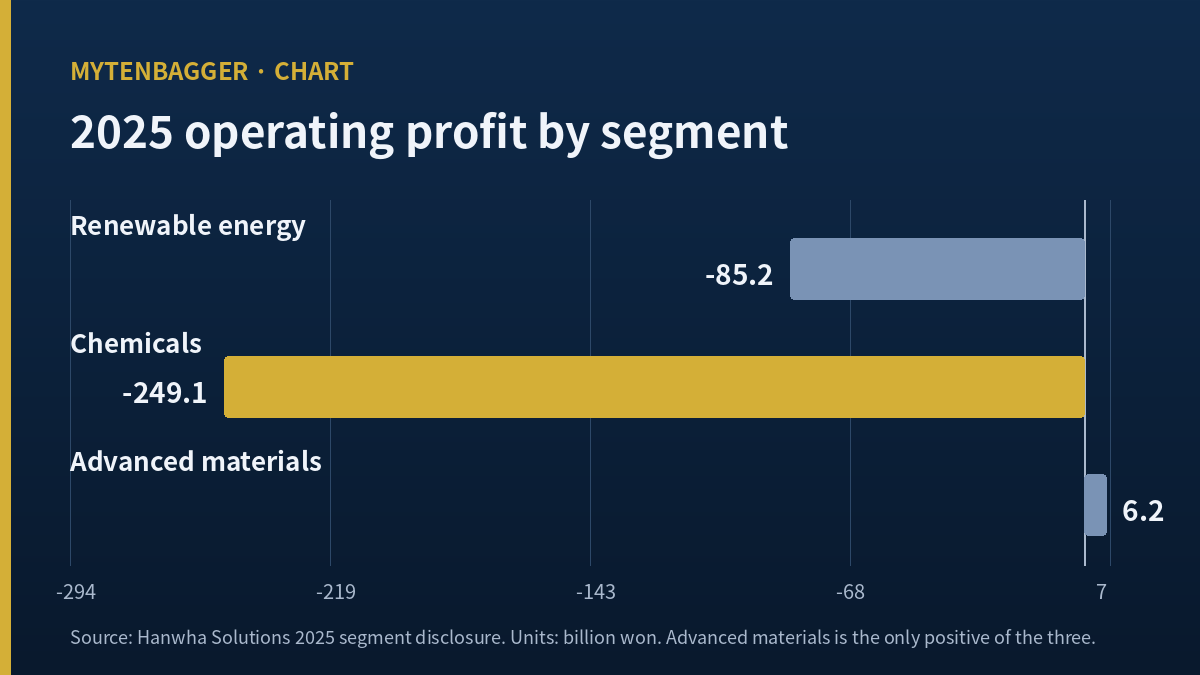
In 2025 this company reported segment operating profit of minus 85.2 billion won for renewable energy, minus 249.1 billion won for chemicals, and plus 6.2 billion won for advanced materials. Add the three and I get minus 328.1 billion won. Of the two segments that lost money, chemicals accounts for 74.51% by my own division.
That happened in the year renewable energy posted its largest revenue ever at 6,859.4 billion won. Someone reading only the solar coverage would have watched a record top line and concluded the loss came from there.
The chemicals business makes PVC and caustic soda. It swung to a 87.1 billion won operating profit in the second quarter of 2026, and I do not take that at face value, because on the same earnings call the chief financial officer said the third quarter would see chemicals profitability decline on a reverse lagging effect. Korean industry coverage on Tuesday, August 11, 2026 pointed the same way, describing second quarter petrochemical profits across Korean producers as partly an accounting echo of cheap feedstock bought earlier and reporting that the ethylene spread had fallen from around 250 dollars a tonne to the low 100s. The same coverage noted that a price fixing investigation covering eight products including PVC and caustic soda had widened. I could not verify tonne level prices for PVC or caustic soda from a source I trust, so no such figure appears in this piece.
I have run into this pattern before, in a Korean chemicals name where the single largest business by revenue turned out to be the one estimated to have lost money. The lesson there was that a segment table and a headline can point in opposite directions, which is exactly what happened here in 2025.
The same trade remedy put this company on both sides in one year
The policy package that pays the manufacturing credit also builds tariff walls, and in 2026 this company stood on both sides of one.
On Friday, April 24, 2026 the U.S. Commerce Department set preliminary antidumping duties on solar cells and modules from India, Indonesia and Laos, at 123.04% for India and 35.17% for Indonesia. Those three countries supplied about two thirds of U.S. solar imports in 2025. Qcells, this company’s solar arm, was a member of the manufacturing alliance that brought that petition, alongside First Solar. Final determinations for India and Indonesia landed on Monday, July 13, 2026, the Laos determination is set for Wednesday, September 9, 2026, and the injury vote at the International Trade Commission is set for Monday, October 19, 2026.
Then on Tuesday, June 23, 2026, three U.S. manufacturers filed a petition aimed at Korea, arguing that Chinese polysilicon, ingots and wafers receive only minor processing there before shipping to the United States. Qcells was named first among the Korean producers. One of the petitioners is a U.S. subsidiary of Canadian Solar, which sits in my peer table above. A preliminary determination is expected somewhere between September 2026 and January 2027, and an affirmative finding can carry retroactive duty exposure.
I do not read this as a moat collapsing. Anza, which tracks U.S. module pricing, put modules made with U.S. cells at 0.46 dollars per watt in the first quarter of 2026 against 0.265 for imports outside the tariff wall. That 0.195 gap is why this company built factories in Georgia. The point is what creates the gap. It is policy, and policy can seat the same name at either table within two months.
What Cartersville finished and what it did not
On Wednesday, June 10, 2026 the company announced completion of its Cartersville complex in Georgia, with 3.3GW each of ingot, wafer and cell capacity and 3.5GW of module capacity, bringing total U.S. module capacity to 8.6GW when the existing Dalton plant is included. It describes itself as the only vertically integrated solar factory in the United States. It holds 38.5% of the U.S. residential module market and 15.5% of the commercial market.
Cell production was originally scheduled for the fourth quarter of 2025 and slipped into 2026 on customs delays and equipment faults, taking the 2025 volume guidance down from 7.5GW to 6GW. Full cell production began in July 2026. So the 214.0 billion won I subtracted above was earned before the chain was fully turning.
Hanwha Solutions stock absorbed 53 million new shares on August 11
A quarter that beat estimates by 63.3% did not lift the share price. The August 25 close of 32,350 won is 57.84% of the 250 session high of 55,932 won, a drawdown of 42.16%, and the six month return reads minus 41.37%.
The reason is not in the income statement. It is in the share count.
The board approved a rights issue of 72 million shares worth 2,397.6 billion won on Thursday, March 26, 2026. Korea’s Financial Supervisory Service sent it back for correction twice, on Thursday, April 9 and again on Friday, May 1, asking among other things why roughly 5 trillion won of non operating assets had not been sold for cash first. The final version, confirmed on Monday, July 20, 2026, was 53 million shares at 22,100 won, raising 1,171.3 billion won. Payment settled on Thursday, July 30 and the new shares listed on Tuesday, August 11, 2026.
Against a pre issue count of 171,892,536 shares, that is 30.83% dilution by my own division. The earnings beat printed on July 29 and the new shares arrived thirteen days later. Of the proceeds, 907.7 billion won goes into equipment at the Jincheon plant in Korea, split as 96.3 billion for a perovskite tandem pilot line, 399.4 billion for gigawatt scale tandem production and 412.0 billion for a high efficiency TOPCon conversion, which sums exactly. The remaining 263.6 billion won retires debt. The August 25 close sits 46.38% above the 22,100 won issue price.
A sister company in the same group produced a similar mismatch for different reasons, and I wrote at the time that an order backlog is not the same thing as cash arriving. That gap was about timing. This one is about arithmetic.
What the indicator screen shows about Hanwha Solutions stock is last year
My data screen labels revenue of 13,333.1 billion won, operating profit of minus 364.8 billion and net profit of minus 615.3 billion as the trailing four quarters. Adding the actual four quarters gives a different answer: 3,364.3 plus 3,757.0 plus 3,882.0 plus 4,582.6 equals 15,585.9 billion won. The screen figure is the 2025 full year.
Every derived field on that screen follows the same base. Operating margin of minus 2.74% is minus 364.8 divided by 13,333.1. Net margin of minus 4.61% uses the same divisor. Price to sales of 0.55 is market capitalization over that same revenue. All three reproduce exactly.
Which means the 399.1 billion won of operating profit this company earned in the first half of 2026 appears nowhere on that screen. Earnings per share of minus 3,676 won, return on equity of minus 7.0% and a two out of seven score on the screen’s own checklist are all portraits of the year the company was in the red. The indicators are internally correct. The year they describe has ended.
One reconciliation before I move on. The company’s own 2025 revenue figure, released on Thursday, February 5, 2026, is 13,354.4 billion won against the screen’s 13,333.1, a 21.3 billion won gap, and its operating loss reads 353.3 against the screen’s 364.8. Discontinued operations reclassification is the likely cause and I did not confirm it. So this piece uses company figures for segment shares and screen figures for checking screen arithmetic, and never mixes the two inside one division.
Ordinary shares trade only in Seoul, in won, during Korean market hours, and a foreign individual generally needs a broker that supports Korean market access. I searched for a sponsored American depositary receipt program for this issuer and did not find one, and I want to be careful here: not finding a program is not the same as confirming none exists, and I could not confirm the second thing. Korea focused exchange traded funds hold KOSPI constituents broadly, but I was unable to load a current full holdings file for any of them, so I will not assert either inclusion or exclusion.
There is a direction of exposure that runs the other way, though, and I think it is the more useful observation for an American reader. This company holds 38.5% of the U.S. residential solar module market and has done so for eight consecutive years. A reader who put panels on a roof in the last few years has a reasonable chance of having already bought this company’s product without owning a single share. The economics I have been dissecting above are, in part, the economics of that roof.
My standing position and the number that ends it
At 7,275.3 billion won of market capitalization this is not a small company, so I worked through earnings, then indicators, then flows, and I came out at watching.
The reason compresses to one sentence. Profitability improved in 2026 and that is real, but a large share of it comes from a rate a foreign government sets, and within a single year that same policy machinery seated this company as petitioner in April and as target in June.
My threshold is arithmetic. Third quarter operating profit needs to exceed 322.5 billion won, because the company guided to 230.0 billion won of credit in that quarter, and 322.5 minus 230.0 leaves the 92.5 billion won I calculated for the second quarter. Above that line, the selling business is genuinely growing. Below it, the second quarter improvement was the credit getting bigger. Korea’s statutory filing deadline for the third quarter report falls on Sunday, November 15, 2026, so the filing itself arrives on Monday, November 16 or later.
Here is what would retire this thesis. If the company sells or spins off the chemicals or advanced materials business, the 42.94% column I built collapses to zero and this company comes to look exactly like the five rows above it. My whole argument would then have described a moment before a divestment, and not a structural feature. That is not a remote scenario: Korean coverage in April and May 2026 discussed asset sales as a route to the cash the regulator wanted, and the advanced materials unit came up in that discussion.
Where I could be wrong about Hanwha Solutions stock
- The part that bothers me most. The 42.94% mixes two reporting series. Segment revenue exists only in company disclosure, while the peer table runs on a third party series whose Hanwha revenue differs by 21.3 billion won. I put the percentage in a column next to five values drawn from the other series, and a stricter treatment would have refused to place them in one table.
- Outside solar is my label, not the company’s. The advanced materials unit sells lightweight parts to carmakers and electronic materials, and I grouped it with chemicals because neither depends on installed photovoltaic capacity. A reader who counts only the chemicals segment gets 34.63% instead, and that reader is not wrong.
- The subtraction that opens this piece assumes the manufacturing credit is recognized inside operating profit. I took that from Korean press coverage of the earnings release, and did not trace the amount to a note in the financial statements. A different treatment would break the 92.5 billion won figure.
- Treating a tax credit as money the company did not earn is itself a bias. Building an ingot to module chain in Georgia was a corporate decision, and without it the credit would not exist. My clean separation between what policy gave and what the business made may not survive contact with how the business actually works.
- Segment revenue does not sum to consolidated revenue. For the second quarter of 2026 the three segments total 4,247.6 billion won against 4,582.6 reported, leaving 335.0 unexplained, and the company does not break out the residual. Every segment share in this piece carries that hole.
- The new shares listed on August 11 and I am writing on August 26. The market has had two weeks with that information, so pinning current weakness on dilution may be describing something already finished.
Sources: company second quarter and first quarter releases as carried in the Korean press including Money Today and Etoday; the company’s 2025 results release; Korea Economic Daily on Korean sell side revisions; Korean petrochemical sector coverage; pv magazine USA on U.S. module pricing; and company financial series from stockanalysis.com, which is also the source for the five peer rows. Korean language sources are quoted in my own translation. Prices and multiples reflect the Tuesday, August 25, 2026 close as checked at the time of writing. Dollar conversions are approximate, at roughly 1,382.4 won per dollar on Monday, August 24, 2026.
- Pan Ocean Tanker Orders Ahead of a 2028 Delivery Wave
- Why Hanwha Systems Shares Fell 66% as Operating Profit Tripled
- Hansol Chemical 2026 Earnings Forecast Has No Analyst Behind It