Korea Land Trust First Half Revenue Up 28.2% From a Low Base
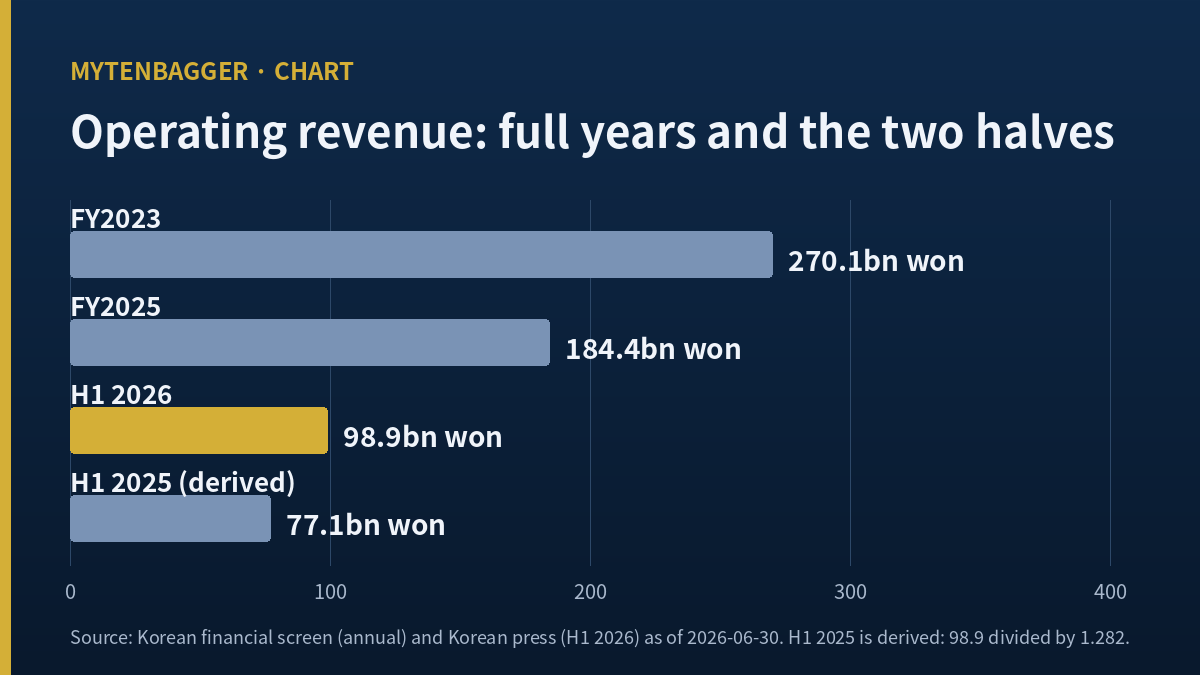
- Stated first-half operating revenue of 98.9 billion won, up 28.2 percent.
- Rebuilt the half it stands against: 77.1 billion won, which I got by dividing the stated figure by the stated growth rate.
- Unresolved whether that base half was low because of the property cycle or because of how completed projects were billed. I could not open the note.
Korea Land Trust stock closed at about 84 US cents on Wednesday, September 23, 2026, which puts the whole company at roughly 211.3 million dollars. That is a small number by the standards of anything I usually write about, and it is the first filter I apply: at this size I observe and I do not buy. What kept me reading anyway was a single percentage that every report about this company has been repeating since the start of September.
The percentage is 28.2. First-half operating revenue came in at 98.9 billion won, and the sell-side note that carried the number described it as 28.2 percent growth against the same half a year earlier. The word attached to it, in the Korean coverage and in the analyst headline both, was turnaround.
I do not doubt the 28.2. I doubt what it is subtracted from. So I rebuilt the base, and once the base was on the page the sentence read differently.
Contents
The half that Korea Land Trust stock is growing away from
Divide 98.9 by 1.282 and you get 77.1 billion won. That is the comparison half, and I built it myself out of two stated numbers, so it carries whatever rounding sits inside the growth rate I divided by. Call it approximately 77 billion won and the argument does not move, because what I need from that figure is its order of magnitude relative to a full year; its third significant digit does no work here.
Now put that half inside the annual line. This company reported 270.1 billion won of operating revenue in 2023, 236.3 billion in 2024, and 184.4 billion in 2025. From the first of those to the last is a decline of 31.74 percent over two years, worked out on the unrounded annual values; divide the rounded ones in the table below and you get 31.73 percent instead. The 2025 operating line was negative: a loss of 20.9 billion won on that 184.4 billion of revenue.
So the base half sits at the bottom of a two-year slide, inside the year the operating line went below zero. A 28.2 percent increase taken from that point is a sum I accept and a business recovery I have not been shown. In dollars, the reported half is about 72.8 million and the base half is about 56.8 million, which is the same statement in a different currency and no more informative.
| Billion won | 2023 | 2024 | 2025 | H1 2026 |
|---|---|---|---|---|
| Operating revenue | 270.1 | 236.3 | 184.4 | 98.9 |
| Operating profit | 31.2 | 33.9 | -20.9 | 4.9 |
| Operating margin (%) | 11.56 | 14.36 | -11.33 | 4.95 |
Sources: a Korean financial screen for the three annual columns; Korean press on the company’s half-year figures for the fourth. The half-year margin is my own working. Consolidated figures throughout.
Three things in that table are worth holding separately. The first is that 2024 carried the highest operating margin of the three full years even though its revenue was already falling, which tells me the decline started in volume and only later reached profitability. The second is that 2025 is the only column with a sign change, and a single negative column makes every ratio built on it behave strangely. The third is that the half-year column is not comparable to the annual ones in the way a reader instinctively wants it to be, because half a year of a business that recognizes revenue across multi-year construction projects is not simply half of a year.
For readers outside Korea, the listing context matters here. This company trades on the KOSPI, the senior board of the Korean exchange and the rough equivalent of the New York Stock Exchange in the way Korean investors talk about it, as opposed to the KOSDAQ, which carries smaller and more growth-oriented names. A KOSPI listing at this market value means the company is a small name on a large board, and it is followed by two domestic houses, where the large Korean industrials an American reader has met would carry a dozen or more.
One quarter Korea Land Trust stock filed and one quarter I had to subtract
The quarter with a filing date
The first quarter is the one I did not have to build. It was filed on May 15, 2026: operating revenue of 43.7 billion won, operating profit of 0.5 billion, net profit of 9.9 billion. Revenue was up 17.3 percent against the same quarter a year before. On that revenue the operating margin is a little over one percent, and the net line is roughly twenty times the operating line.
It helps to say plainly what this revenue is, because the phrase operating revenue does different work here than it does at a manufacturer. A Korean real estate trust company takes legal title to a development site and administers the project on behalf of the owner, and it is paid a fee for that administration. In one variant of the arrangement it also advances money into the project itself. So the top line is fees earned across the life of construction, and not units shipped in a period, which is why a quarter of it can look almost arbitrary and a half of it still cannot be annualized by doubling. The fee accrues while buildings go up, and buildings go up on their own clock.
A listed company in the same trust business, read through the promise sitting under its balance sheet, is covered in an earlier record. That piece asked what the size of the exposure meant; this one asks what the size of a growth rate means, and the two questions sit closer together than they look.
That also explains why the two houses that follow the name talk about order intake more than about this half. Orders won today become revenue recognized across the next several years, and an order book is the only forward-looking series a business like this really has. I do not have a verified order figure I trust, so I am not using one, and the absence is worth saying out loud: the single most predictive number for this company is the one I could not confirm.
I am deliberately not building a thesis on that last ratio. A company whose revenue is fee income on projects it also funds will book gains and losses below the operating line as a matter of routine, and I did not open the note that would tell me which ones. What I take from the quarter is narrower: the operating line was almost flat and the revenue line was already growing.
The quarter I had to work out myself
The second quarter I do not have as a filed figure. I have the half, and I have the first quarter, so I took one from the other. Operating revenue of 55.2 billion won and operating profit of 4.4 billion. Both are my own working, and I flag them as such everywhere they appear in this piece.
Taken together the half earned 4.9 billion won of operating profit on 98.9 billion of revenue, a margin of 4.95 percent. The comparison half was an operating loss of 0.6 billion. That is the turnaround in its entirety: a swing of about 5.5 billion won at the operating line, which at the September rate is under four million dollars. Net profit for the half was 29.0 billion won against 9.3 billion a year earlier, and once again the bottom line moved far more than the operating line did. I am leaving that gap open and I am not filling it with a guess.
What the revised model asks of the rest of this year
One house revised its published model on September 2, 2026. Operating revenue for the full year went from 237.8 billion won to 233.9 billion. Operating profit went from 37.3 billion to 35.0 billion. Net profit belonging to controlling shareholders went the other way, from 76.8 billion to 85.8 billion.
The revised full-year operating margin implied by those two numbers is 14.96 percent. The half that has already happened ran at 4.95 percent. I am not going to build the usual sentence out of that pair, because that sentence has been written too many times in this journal and it stops being an observation once it becomes a reflex of mine. I will state the two margins, note that they are far apart, and leave the reader to hold both.
Percentages I could not rebuild
The report that carried those revisions also gave the change for each one. Revenue down 1.7 percent, operating profit down 6.3 percent, net profit up 11.1 percent. I divided the pairs myself and got 1.64 percent, 6.17 percent, and 11.72 percent. Three for three, what I got and what the report showed come apart in the first decimal place.
The likely explanation is dull: the underlying model carries more decimal places than its published table shows, and those percentages were worked out on the unrounded values. I cannot confirm that, because I read the revision through a news write-up and never through the note itself. So I am using the six absolute figures and none of the three percentages that came with them, and I am writing down that I checked, because a percentage I copy without dividing is a number I have not actually read.
Where I went wrong first
The word turnaround is what I got wrong, and I got it wrong in the ordinary way. I read it as a statement about the company and it is a statement about a comparison. A business that loses half a billion won at the operating line and then makes five billion has turned around against itself; whether it has turned around against anything else depends entirely on what the first half was, and the first half was the floor of a two-year decline.
The practice I am changing is small and I can state it as a rule. When a report gives me a growth rate and the level it produced, I divide before I read the surrounding sentence, and I put the base on the page next to the result. It takes one sum. On this company it changed what the headline meant.
I keep a second Korean property-linked record for the same reason: a Korean listed property vehicle read against its own reported net assets. It shares no figure with this piece.
A US lender I named without comparing it to Korea Land Trust stock
There is no clean American equivalent of a Korean real estate trust company. The legal structure does not port, and the revenue is a fee on a mandate, and not interest on a loan book, so any side-by-side table would be comparing two different definitions of the same words. I still wanted one name on the page, and I chose it on a single criterion that has nothing to do with business model.
The name is Ladder Capital Corp, listed on the New York Stock Exchange under LADR. It describes itself as an internally managed real estate investment trust running loans, securities, and real estate, and it makes balance sheet loans that give interim funding to borrowers buying or repositioning commercial property. I picked it because an English-language reader can open its filings in the same accounting language they already read, and because lending into property on a short clock is the part of this Korean company’s work that actually does travel.
And here is what I did not do. I did not open Ladder Capital’s filings for this piece. I am borrowing the name of a category and nothing else, no figure, no multiple, no margin. If I had opened them I would have been tempted to line something up, and lining something up is exactly what the definitions do not support.
The reason that restraint is worth stating out loud, and not just doing quietly, is that the temptation runs in one direction. When I have a Korean company whose revenue line I find hard to read, an American company with cleaner disclosure looks like a way to make the Korean one legible. It is not. It is a way to make my own uncertainty look resolved. The Korean company funds projects it also administers and collects a fee for administering; the American company lends and holds securities. Those are different businesses that happen to touch the same asset class, and a shared asset class is not a shared income statement.
Where I stand on Korea Land Trust stock
I hold none of it and I have no order working. At roughly 211.3 million dollars of market value this sits well outside the size range where I take a position, and that filter runs before anything in this piece does. So the stance is observation, and the reason I am writing the observation down is that the base-effect question will be answered by a document with a date on it.
What would make me read it as something other than a base effect is a second half that grows against a half that was not itself depressed. The second half of the comparison year is the harder base, and the third-quarter report is where the first piece of that shows up. Until then, what I have is one honest sum and one borrowed word.
I want to be precise about what I am not saying, because the distance between the two is where people get hurt. I am not saying the recovery is fake. I am not saying the two houses covering this are wrong; they have models and project pipelines I do not have, and both of them have been closer to this company for longer than I have. What I am saying is narrower and entirely about me. I cannot tell, from what I was able to open, whether the number that made the headline describes the business improving or the comparison weakening, and I do not take positions on numbers I cannot tell apart.
That distinction has a cost, and the cost is that I will be late if this is real. A company at this size with two positive ratings and a recovering revenue line can move a long way before a third-quarter filing lands. I have accepted being late on small names before, and the trade I am making is deliberate: I would rather miss a move I could not explain than hold a position whose thesis I would have to reconstruct after the fact.

Ten things that cut into this reading of Korea Land Trust stock
- A low base is still a base. If the comparison half was depressed by a cycle that has turned, growth taken from it is real growth and my framing understates the improvement.
- My 77.1 billion won base comes from dividing by a rounded growth rate, so it carries a margin of error I cannot size.
- The second-quarter figures in this piece are my own working and were never disclosed. If the half and the quarter were prepared on different consolidation scopes, that working is wrong.
- I read the half-year figures through news write-ups of an analyst note and never through the filing itself.
- Revenue for a company like this is recognized across the life of a project, so a two-year decline can reflect when projects completed more than how many were won.
- The 2025 operating loss may contain one-time items that make the annual line a poor comparison point for a half.
- Net profit moved far more than operating profit in both the quarter and the half, and I did not establish what sits between them.
- Two separate houses publish on this company and both carry a positive rating, which is the direct opposite of my reading.
- The revised model raised net profit while cutting operating profit, which suggests the modelled recovery is not supposed to come through the operating line at all.
- I could not rebuild three of the three percentage changes the revision report gave, which means either the report or my reading of it is imprecise, and I cannot tell which.
Five conditions that would change how I read Korea Land Trust stock
- Third-quarter operating revenue grows against a comparison quarter that was not itself a low point.
- The nine-month operating margin comes in above 4.95 percent.
- The filing separates the second-quarter figures so that my working can be checked against a disclosed number.
- The gap between net profit and operating profit narrows, or the filing names what is in it.
- The published full-year operating profit figure is cut again and not held.
The first four are answered by one document. The statutory deadline for the third-quarter report is Monday, November 16, 2026.
None of the five is a price level, and that is on purpose. A price level would tell me what other people had concluded, and the whole problem in this piece is that I cannot yet tell what there is to conclude. Every condition above is something a filing either says or fails to say, which means I can check each one in an afternoon and none of them depends on the market agreeing with me first.
What this piece never used, and when the numbers are from
Three things stayed out. The per-share figures the two covering houses published, because this piece is about a revenue base and a per-share figure would have pulled it toward a valuation argument I am not making. The multiples on the quote screens, because no two of them agreed. And the balance sheet, which is a longer story than a half-year revenue line and does not belong in the same piece.
Prices and the market value in this piece reflect the close on Wednesday, September 23, 2026. Dollar figures are approximate, converted at roughly 1,358.4 won per dollar, the Seoul close on the same date. Annual revenue and operating figures are consolidated full-year reported values; the first-half and first-quarter figures are as reported in coverage of the company’s filings; the second-quarter figures are my own working, taken by taking one from the other, and flagged as such wherever they appear.
One scheduling note that matters for anyone checking the price against a screen. Korean markets are shut for the Chuseok holiday on Thursday and Friday, September 24 and 25, 2026, so the close used here is the last one available until Monday, September 28.
One more thing I am carrying forward unresolved. The first-quarter filing and the half-year coverage both came to me at one remove, through write-ups and never through the documents, and everything in this piece that depends on a single decimal place therefore depends on someone else’s transcription as well as on my own sums. That is a real limit and I am not writing it here as a formality. It is also the reason the conditions I listed above are written as things a filing will settle and not things a quote screen will settle, because a quote screen would only tell me that other people had decided before I did.
That is the whole of my record on this name for now. If the third-quarter revenue line grows against an ordinary quarter and not a weak one, I will have been reading a base effect that was not one, and I will say so in the piece that follows this one.
Related reading