Jeju Air Aircraft Order Worth 11 Times Its Market Value
I had two documents open at the same time and that is the whole reason this note exists. On one screen sat a Korean regulatory disclosure describing an aircraft purchase contract worth 3.98 trillion won. On the other sat a quote screen showing that the company signing that contract is worth 363.7 billion won. Jeju Air stock closed at 4,510 won on Wednesday, August 26, 2026, and I could not stop looking at the gap between those two figures.
THREE FIGURES, ONE CURRENCY, ONE DATE
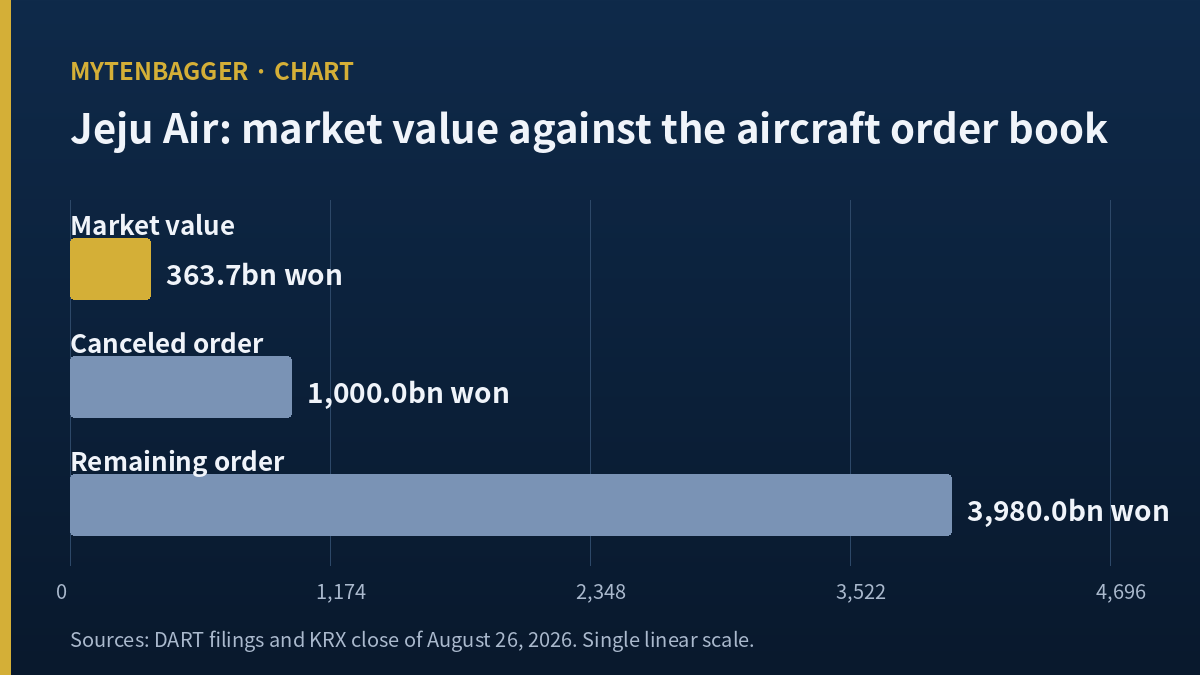
363.7 billion won — what the market says the airline is worth, at the August 26, 2026 close.
1.00 trillion won — the value struck out of its Boeing contract on Monday, August 24, 2026.
3.98 trillion won — what is still on that contract for 32 aircraft.
That makes the canceled slice 2.75 times the company and the remaining commitment 10.94 times it. Both multiples are mine, calculated from the two contract values as reported and the closing market capitalization on the same date.
Contents
What Jeju Air stock costs, and what it has agreed to spend
Jeju Air is a low-cost carrier listed on the KOSPI, the senior board of the Korea Exchange, under the code 089590. The KOSPI is where Korea’s larger companies list; the junior board, KOSDAQ, carries most of the country’s smaller technology names. Jeju Air sits on the senior board but is small by its standards, with a market capitalization of 363.7 billion won on August 26, 2026, which works out to roughly 263 million dollars at that day’s Seoul closing exchange rate.
The airline booked 1.58 trillion won of revenue in the 2025 fiscal year. Against that, consolidated equity at the end of the first half of 2026 stood at 239.4 billion won. I have looked at a lot of Korean filings this year and I do not often see revenue running at 6.6 times book equity. Airlines are built that way, because leased aircraft put a right-of-use asset and a lease liability on the balance sheet at the same moment, and the sheet swells past the size of the business flying on it.
So the ratio itself did not surprise me. What made me open the purchase contract was a different thought: if this balance sheet is already carrying that much, what is still queued behind it?
The order book that bills instead of pays
On Monday, August 24, 2026, Jeju Air cut its Boeing 737-8 purchase agreement from 40 aircraft to 32. The contract value moved from 4.98 trillion won to 3.98 trillion won and the delivery window slid out to the end of 2028, according to the Korean financial outlet Newspim, which quoted the company describing the move as risk management in service of stable growth.
Dividing the contract by the aircraft count
The first thing I did was divide. Four point nine eight trillion won across 40 aircraft gives 124.5 billion won each. Three point nine eight trillion across 32 gives 124.375 billion each. The two unit prices differ by 125 million won, which is close enough that I am satisfied the company removed eight airframes without renegotiating what it pays for the rest. That makes the deleted value exactly one trillion won.
The same Korean report also described the reduction as roughly 995.5 billion won, which leaves 4.5 billion won unaccounted for against my own subtraction. I could not find the exact original contract figure to reconcile that, so throughout this piece I use only the two contract values as published and the difference between them.
Now put the unit price next to the company. One aircraft at 124.5 billion won equals 34.23 percent of the entire market capitalization. Three of these jets cost about what the whole airline is worth. The 32 still on order equal 10.94 times the market capitalization and 16.62 times the 239.4 billion won of consolidated equity reported at the half-year mark. Even the eight that were struck out on August 24 were worth 2.75 times the market value and 4.18 times the equity.
A backlog you receive, a backlog you pay
I write about Korean order books often, and the habit that forms is to treat a large one as a good thing. A shipbuilder or a defence contractor with a backlog several times revenue is holding a queue of future receipts. I once worked through a Korean rolling-stock and defence maker whose record backlog sat alongside a halved share price, and even there the argument was about how quickly receipts convert, not about whether they were receipts at all.
This one runs the other way. The biggest forward number on Jeju Air’s books is an obligation to pay. Same order of magnitude, opposite sign, and the reading flips completely. I have also compared spending with market value before, in a KOSDAQ contractor priced below three years of its own equipment spending, and I want to mark the difference plainly: that was money already gone. This is money promised. The first is a fact about the past, the second is a claim on cash that has not been earned yet.
The cash statement shows what the earlier tranche of that promise already costs. Operating cash flow in the first half of 2026 came to 148.9 billion won. Capital expenditure over the same six months came to 248.1 billion won. Free cash flow was therefore negative 99.2 billion won, which is 27.26 percent of the market capitalization burned through in half a year. Capital spending alone equaled 68.22 percent of what the market says the whole company is worth.
Jeju Air stock against ten low-cost carriers I checked
To see whether this is an industry condition or a company condition, I pulled the most recent completed fiscal year for ten listed low-cost carriers and put Jeju Air on the same page. I have not converted anything. Each row stays in the currency the company reports in, because a conversion would smuggle eleven different exchange-rate dates into one table. What I added instead is a column recording whether the operating line and the net line agree with each other.
| Carrier | Listing | FY end | Revenue | Operating income | Net income | Prior year net | Two lines |
|---|---|---|---|---|---|---|---|
| Ryanair Holdings | NASDAQ RYAAY | 2026-03-31 | EUR 15,544.3M | EUR 2,374.2M | EUR 2,173.7M | EUR 1,611.6M | both positive |
| Southwest Airlines | NYSE LUV | 2025-12-31 | USD 28,063M | USD 478M | USD 441M | USD 465M | both positive |
| JetBlue Airways | NASDAQ JBLU | 2025-12-31 | USD 9,062M | USD -338M | USD -602M | USD -795M | both negative |
| Frontier Group | NASDAQ ULCC | 2025-12-31 | USD 3,724M | USD -451M | USD -137M | USD 84M | both negative |
| Wizz Air Holdings | LON WIZZ | 2026-03-31 | EUR 5,691M | EUR -116.2M | EUR 2.2M | EUR 225.8M | split |
| easyJet | LON EZJ | 2025-09-30 | GBP 10,106M | GBP 696M | GBP 494M | GBP 452M | both positive |
| Spring Airlines | SHA 601021 | 2025-12-31 | CNY 21,460M | CNY 3,303M | CNY 2,317M | CNY 2,273M | both positive |
| Cebu Air | PSE CEB | 2025-12-31 | PHP 119,928M | PHP 11,501M | PHP 12,293M | PHP 5,401M | both positive |
| InterGlobe Aviation | NSE INDIGO | 2026-03-31 | INR 849,619M | INR 102,026M | INR -23,919M | INR 72,584M | split |
| AirAsia X | KLSE AAX | 2025-12-31 | MYR 3,351M | MYR 101.11M | MYR 179.25M | MYR 207.13M | both positive |
| Jeju Air | KRX 089590 | 2025-12-31 | KRW 1,579,940M | KRW -111,661M | KRW -116,401M | KRW 21,739M | both negative |
Peer figures from company financial summaries compiled by StockAnalysis, read on August 26, 2026; the Ryanair row was checked a second time against the company’s own full-year results announcement. The Jeju Air row is taken from its Korean consolidated statutory filing, in millions of won. The final column is mine.
Eleven carriers and the sign test
Six of the eleven earn on both lines. Three lose on both. Two disagree with themselves, and they disagree in opposite directions: Wizz Air lost money at the operating line and finished barely positive, while IndiGo earned 102 billion rupees of operating income and still closed the year with a net loss. Six plus three plus two is eleven, which is the check I ran before writing that sentence.
Jeju Air sits in the group of three that lose on both lines, and it belongs to a smaller group as well. Reading the final two columns together, three carriers crossed from a profitable prior year into a loss: Frontier, IndiGo and Jeju Air. JetBlue lost money in both years but lost less in the second. So the loss itself is not unusual in this table. The combination that is unusual is a carrier crossing into loss while still holding a purchase commitment worth more than ten times its own market value.
I want to be careful with that last clause. I did not gather market capitalizations for the other ten carriers, so I am not claiming Jeju Air is alone in that combination. I am saying I checked it for this one and the figure is what it is.
Where the equity went, quarter by quarter
Six discrete quarters
Korean quarterly filings report flow items cumulatively, so a raw quarter-on-quarter subtraction gives the wrong answer. I stripped the cumulative figures back to single quarters, in billions of won: operating income of -32.6, then -41.9, then -55.0, then +17.8, then +69.0, then -45.0 for the second quarter of 2026. Net income across the same six quarters ran -32.7, -9.9, -60.2, -13.6, +16.7, -49.2.
One of those six quarters is profitable at the net line, and it is the first quarter of 2026. It also carries the whole first half. Half-year operating income of 24.0 billion won is simply 69.0 minus 45.0. Remove the first quarter and the half turns negative.
The row I kept coming back to is the third quarter of 2025. July, August and September are peak season for an airline. That quarter produced the largest operating loss of the six. Revenue was higher than the quarter before it and the loss was bigger anyway. Meanwhile the first quarter of 2026, which is off-season, produced the only double-digit operating margin in the set. The seasons are standing in the wrong places, and I read that as a business whose earnings still answer to events more than to the calendar.
The perpetual bond inside the equity line
There is one more thing sitting inside that 239.4 billion won of equity. In July 2025 Jeju Air issued 100 billion won of perpetual notes, thirty-year paper carrying a 6.5 percent coupon with a call from July 2027, as reported by the Korean business outlet Bloter. Accounting treats that hundred billion as equity because repayment is not compelled. On the half-year balance sheet it accounts for 41.77 percent of the equity line.
Why I keep pulling the equity line apart on a transport name: in Korea that line is not only a valuation input, it is a listing rule. Below a certain point the exchange starts attaching labels. Jeju Air is nowhere near that point even after I strip the perpetual notes, but I have a smaller KOSPI transport operator in this journal where the same line has already crossed it — Cheonil Express closed June 2026 with KRW 6.4 billion of equity against roughly KRW 7.1 billion of paid-in share capital, and under about KRW 3.6 billion it meets the condition for administrative-issue designation. That is the version of this question where the answer has a deadline, which is why I read Jeju Air’s 239.4 billion won as room rather than as a number to argue about.
A Korean sell-side analyst at LS Securities, Lee Jae-hyuk, wrote on Wednesday, May 27, 2026 that stripping the perpetual notes leaves first-quarter equity around 190 billion won. When I subtract 100 billion from the 290.2 billion won reported in that quarter I get 190.2 billion, so his number and mine point at the same place. What I could not reconcile is the quarter the notes arrived: equity rose only 1.6 billion won between the second and third quarters of 2025, even though 100 billion supposedly landed against a 60.2 billion quarterly loss. I have no explanation for that step, so I treat the 41.77 percent as an observation and not as load-bearing evidence.
It sold roughly what it spent
While that capital expenditure was going out, money was also coming in from disposals, and the two amounts land close enough together that I checked the arithmetic twice. Across the first half of 2026 Jeju Air sold its hotel business for 54 billion won, sold its holding in the affiliate AKIS for 43.3 billion won, and agreed to sell three older Boeing 737-800 airframes to the Nigerian carrier Air Peace for 144.7 billion won in a deal reported on Wednesday, May 13, 2026. Those three disposals total 242.0 billion won. Capital expenditure over the same six months was 248.1 billion won. The company sold 97.5 percent of what it spent, and it sold assets that were producing revenue to do it.
I find that more informative than either figure alone. A carrier funding new airframes out of operating cash would show capital expenditure inside operating cash flow. This one covered the gap by handing over a hotel, an affiliate stake and three flying aircraft. That is a financing choice available once per asset.
The half-year did improve
None of the above says the trading business is going backwards, and I want the improvement on the page because it is real. First-half revenue came to 977.97 billion won against 717.08 billion a year earlier, a gain of 36.38 percent. The operating line moved from a 74.4 billion won loss to a 24.0 billion won profit. The net loss narrowed from 42.6 billion won to 32.5 billion, an improvement of 23.69 percent. Interest expense fell 15.74 percent year on year, to 30.2 billion won.
So the income statement turned during the first half of 2026 and the balance sheet did not. Equity was 275.2 billion won at the end of 2025 and 239.4 billion at the end of June 2026. That is the tension I am recording here: a company earning its way back at the operating line while the capital underneath it keeps thinning, and a purchase commitment sitting on top of both.
My stance on Jeju Air stock and where this breaks
A 363.7 billion won market capitalization puts it outside the size band where I take a stance, so this is a watch note, and the specific thing I am watching is the size of that purchase commitment. The airline reduced it once, on August 24, 2026. My checkpoint is whether it moves again before the merged Jin Air launches in March 2027, with the December 2026 extraordinary meetings as the first fixed date on that path. If the commitment holds at 3.98 trillion won through that window, the company is choosing to carry an obligation more than ten times its own market value into a market where it is no longer the largest operator. If it shrinks again, the fleet plan I have been reading is not the fleet plan being executed.
Five places this reading breaks
- The one that hurts most. An order total is a gross multi-year commitment running to the end of 2028, and aircraft are commonly funded through lease and sale-leaseback structures that never land on the buyer’s balance sheet as a lump sum. Setting that gross figure beside a single day’s market capitalization compares a stretched-out obligation with a point-in-time price. If most of those 32 airframes arrive under lease rather than purchase, my central multiple is measuring the wrong thing.
- The two published figures for the reduction do not reconcile. Contract values imply exactly one trillion won removed; the same coverage described the cut as roughly 995.5 billion. I could not close the 4.5 billion won gap.
- Balance-sheet figures vary by source. Working from the consolidated statutory filing I get 239.4 billion won of equity and a 1,009.03 percent debt-to-equity ratio at the half-year mark. The Korean outlet Seoul Finance reported 211.8 billion won and 1,134.2 percent for the same period. I could not establish which basis each set uses.
- The peer table mixes four fiscal year-ends across eleven rows, and only three carriers close their books on the same date as Jeju Air. Comparing a March 2026 year against a December 2025 year folds a quarter of different fuel and currency conditions into the comparison, and I did not adjust for it.
- My peer figures come from a data compiler, not from eleven sets of primary statements, and whether each net income line is the parent’s share or the consolidated total follows that compiler’s convention. For carriers with meaningful minority interests, that distinction can move the number I put in the table.
Unit price
Unit price is the check I nearly skipped. I had the two contract totals and the two aircraft counts in front of me, and my first instinct was to subtract the totals and move on. Dividing each total by its own count is what told me the eight airframes were simply removed at an unchanged price, which is the only reason I can say the deleted value is one trillion won rather than the outcome of some renegotiation I cannot see. Had the two unit prices come out far apart, the entire arithmetic in this piece would have needed a different frame, and I would have found that out after publishing instead of before it. The lesson I am writing down is that when a total and a count both change, neither number alone tells you what happened.
One further note on how I read balance sheets at this leverage level: I worked through a Korean company whose reported interest coverage reconstructed perfectly and still could not be used, because the denominator was not what its label implied. The same caution applies here. Jeju Air’s half-year operating income of 24.0 billion won against 30.2 billion won of interest expense produces a coverage figure below one, and I hold that figure loosely for the same reason.
Prices and multiples reflect the Wednesday, August 26, 2026 close as I checked them while writing, so live quotes will differ. Financial figures run through the 2026 half-year filing. Korean won is the reference currency throughout, and the dollar figure quoted is approximate, converted at 1,384.80 won per dollar, the Seoul closing rate that day as reported by Business Korea. Second-quarter results as announced by the company on Tuesday, August 4, 2026 and carried by Korean press are on a separate-entity basis and differ from the consolidated figures used here.
- Kakao Pay Balance Sheet: Liabilities Tripled, Equity Barely Moved
- Hyundai Department Store Buyback: Shares Not Yet Canceled