Korea District Heating Stock Yields 8% on a 21% Payout Ratio
Contents
Korea District Heating Stock Has Two Dividend Numbers That Point Different Ways
Korea District Heating stock (KRX: 071320, Seoul) closed at KRW 75,700 on Tuesday, September 1, 2026, which is roughly $55 a share and about $640 million of market value for the whole company. Two figures attached to that price disagree with each other, and the disagreement is the reason I spent an evening on a Korean heat utility instead of something I would normally look at.
The first figure: a yield above eight percent
The company declared a dividend of KRW 6,157 a share for its 2025 fiscal year. Against the September 1 close that is a yield of 8.13 percent, by my calculation. In dollars the dividend is about $4.49 a share. I have seen higher yields on Korean names, but almost always on something with a broken income statement behind it.
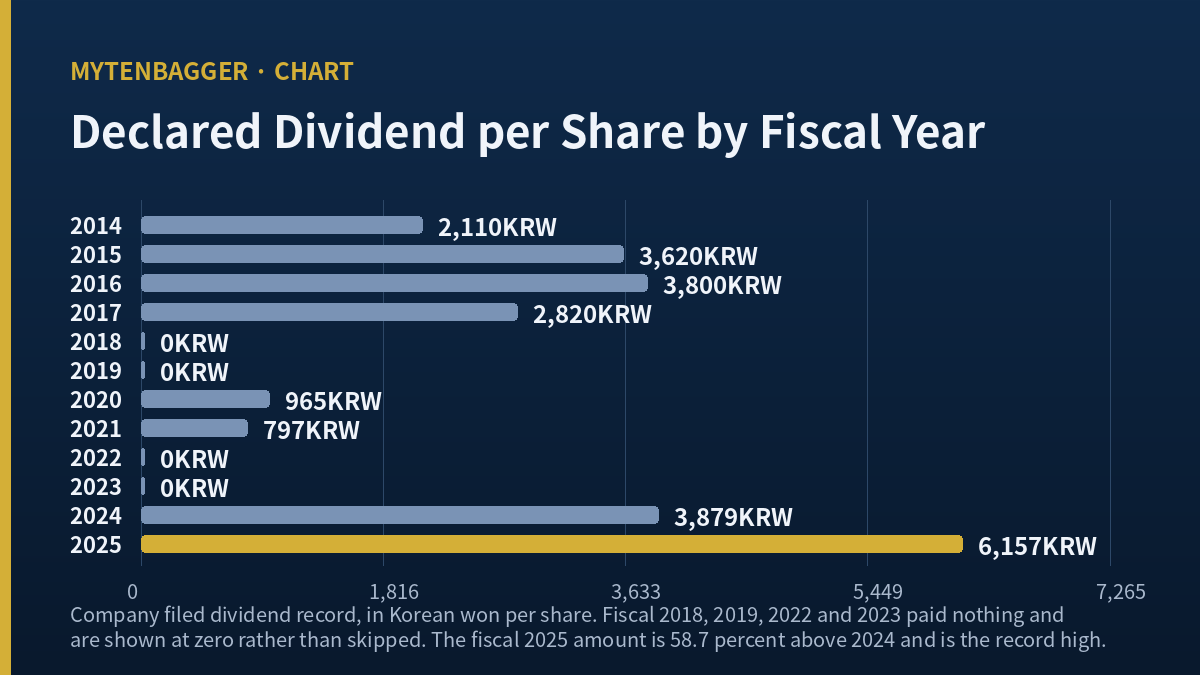
That KRW 6,157 is also the largest annual dividend in this company’s filed record. The full record, in won per share, runs 2,110 for 2014, 3,620 for 2015, 3,800 for 2016 and 2,820 for 2017; nothing for 2018 or 2019; 965 for 2020 and 797 for 2021; nothing for 2022 or 2023; then 3,879 for 2024 and 6,157 for 2025. The gaps are the interesting part. The best of the pre-gap years was KRW 3,800 for 2016. The 2024 payment of KRW 3,879 restarted the sequence and set the prior high, and the 2025 payment of KRW 6,157 is 58.7 percent above it, by my calculation.
So the yield I am dividing into is attached to a dividend that has been absent from this company’s record four times in the last eight years, and the current amount is one year old. That matters for how much weight the eight percent can carry. A payout with holes in its own past is a different object from a payout with a twenty-year streak, even when the arithmetic on any single year looks identical.
What the record does not tell me is why the gaps happened. I did not open the years around them for this piece, and I am not going to assume the obvious explanation just because it is available.
The second figure: a payout ratio near a fifth
The payout ratio is 21.04 percent. That is the share of earnings handed over. Trailing earnings per share of KRW 29,268 against a KRW 6,157 dividend gives 21.04 percent, and the vendor screen I use shows 21.0, so the two agree.
Put those side by side and something is off. A company handing out a fifth of what it earns is being conservative with its holders. A company yielding eight percent is being generous to them. Both descriptions cannot be true of the same dividend at the same time.
Dividing one by the other recovers a third number
The resolution is arithmetic. Divide the yield by the payout ratio and the dividend cancels out of both halves, leaving earnings over price. That is the earnings yield.
Divide 8.13 by 0.2104 and you get about 38.6 percent; carrying the unrounded figures through gives 38.66 percent, by my calculation. Flip a price-to-earnings multiple of 2.59 and you get 38.61 percent. Those two agree to within 0.05 of a percentage point, which is what you would expect, since I built the first one out of the same dividend the second one never touched.
So the eight percent is not a generosity signal at all. It is an earnings-yield signal wearing a dividend costume. The company is paying out a fifth of its profit, and a fifth of a 38.66 percent earnings yield is 8.13 percent. Nothing unusual is happening on the payout side. Something unusual is happening on the price side.
What the pair does not tell me
It does not tell me whether the earnings are durable. The 2.59 multiple divides the September price by full-year 2025 profit of KRW 338.9 billion, and my vendor screen has not rolled its income statement forward to the 2026 half-year figures yet. It also does not tell me anything about the dividend continuing. A payout ratio is a description of one decision already made, and this company’s dividend decisions are not made entirely inside the company, which I get to further down.
| What I measured | This company | Six-utility median |
|---|---|---|
| Dividend yield | 8.13% | 4.07% |
| Payout ratio | 21.04% | 97.89% |
| Earnings yield recovered from the pair | 38.66% | not compared |
| Market value | about $640m | all six are larger |
Company figures: KRW 75,700 close of September 1, 2026, 11,578,600 shares outstanding, and the fiscal 2025 dividend of KRW 6,157 a share. Peer medians are computed by me from the six companies in the table further down. The earnings yield in the last row is the dividend yield divided by the payout ratio, which is the identity this piece is built on.
Korea District Heating Stock Next to Six Utilities That Pay Their Holders
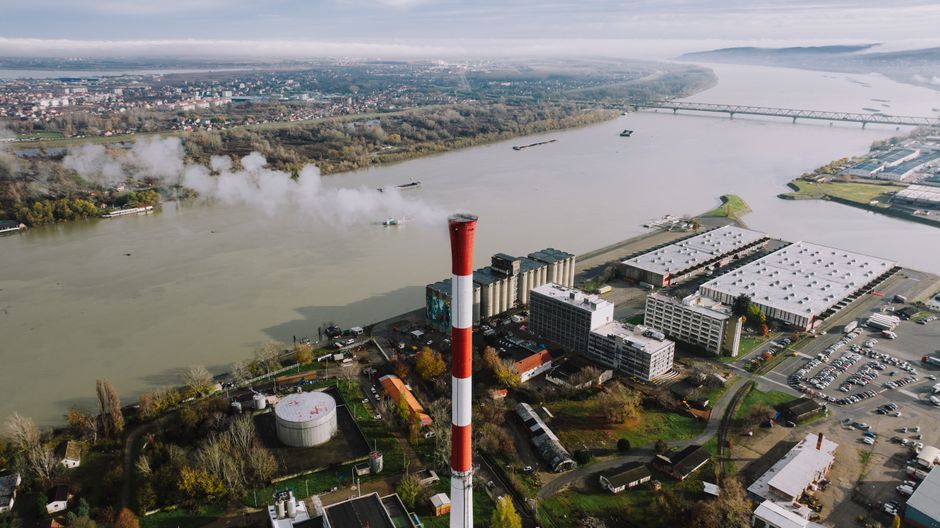
Before the table, some ground. KOSPI is the main board of the Korea Exchange in Seoul, the larger of the country’s two listed markets and the one that holds Samsung Electronics, Hyundai Motor and the state-linked utilities. Korea District Heating Corporation sits there. It sells heat and electricity from combined heat and power plants into apartment complexes and industrial users, and its heat price is the benchmark the country’s other district energy operators are measured against.
How I chose the six
I did not select by industry classification code. I selected by behavior: listed utilities that actually pay a dividend and publish a payout ratio, pulled from one provider so the two columns mean the same thing in every row. Three of the six are European multi-utilities that own heat networks alongside power generation, which is the closest structural match I could find to a district heating operator. One is a German generator that has moved heavily into renewables. One is Italian and one is Korean. That last inclusion is deliberate and I explain it below.
The table, sorted by yield
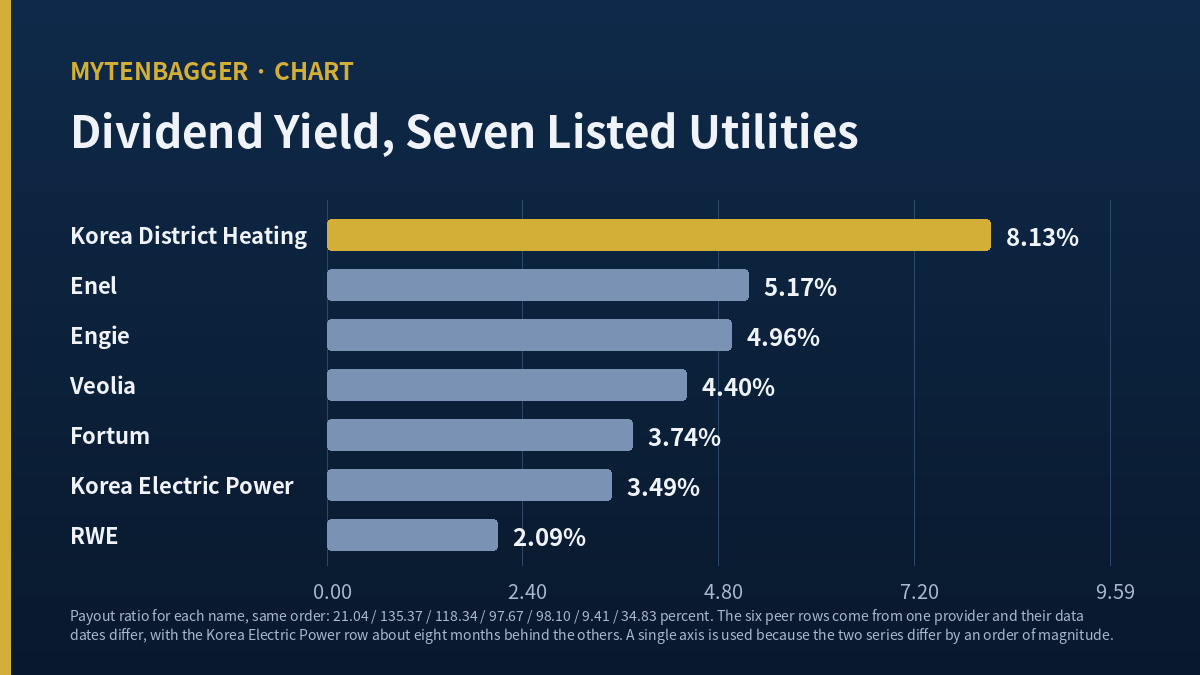
| Company | Dividend yield | Payout ratio | Data as of |
|---|---|---|---|
| Korea District Heating (KRX: 071320) | 8.13% | 21.04% | Sep 1, 2026 |
| Enel (BIT: ENEL) | 5.17% | 135.37% | Aug 21, 2026 |
| Engie (EPA: ENGI) | 4.96% | 118.34% | Jul 7, 2026 |
| Veolia (EPA: VIE) | 4.40% | 97.67% | Aug 25, 2026 |
| Fortum (HEL: FORTUM) | 3.74% | 98.10% | Jun 12, 2026 |
| Korea Electric Power (NYSE: KEP) | 3.49% | 9.41% | Dec 31, 2025 |
| RWE (ETR: RWE) | 2.09% | 34.83% | May 4, 2026 |
Peer yields, payout ratios and as-of dates are taken from stockanalysis.com, one provider for all six rows so the columns are defined the same way. The Korea District Heating row is mine, built from the September 1, 2026 close and the fiscal 2025 dividend. Medians in the earlier table are computed by me across the six peer rows only.
Read the two middle columns together. This company yields almost exactly twice the six-company median of 4.07 percent, on a payout ratio that is 21.5 percent of the median payout of 97.89 percent, by my calculation. Four of the six are paying out essentially everything they earn, and two of those are paying out more than they earn. This one is paying out a fifth and still leading the yield column by a wide margin.
Only one peer has a lower payout ratio, and that is the other Korean name in the table. Its yield is 3.49 percent. Two Korean state-linked utilities, both restrained on payout, and one of them yields more than twice the other. That gap is not about dividend policy. It is about what the market is willing to pay for the earnings underneath.
The two rows above 100 percent deserve a word, because a payout ratio over 100 is not automatically a warning. It means the declared dividend exceeded reported earnings for whatever period the provider used, which happens routinely at large utilities carrying heavy non-cash charges against reported profit while cash generation stays intact. Enel at 135.37 percent and Engie at 118.34 percent are both doing something in that family. I am not treating those two as distressed. I am treating them as evidence that in this group, the normal thing is to hand over essentially the entire reported profit, and that the company I am looking at is doing the opposite while yielding more.
The comparison has an obvious weakness, which is that a payout ratio is only as meaningful as the earnings figure underneath it, and seven companies in six jurisdictions do not compute that figure the same way. I am leaning on one provider for the six peer rows precisely to hold that definition steady across them, but my own row is built by hand from Korean filings. The two halves of the table are not assembled by the same pair of hands, and I would rather say that than pretend otherwise.
Korea District Heating stock is the row where those two rankings diverge most sharply. It ranks first of seven on yield and sixth of seven on payout. No other company in the set moves that far between the two columns, and most of them sit roughly where their generosity would put them.
The as-of column, and the one US-listed row
The right-hand column is there because the rows are not measured on the same day. The Korea Electric Power row carries a December 31, 2025 dividend date, roughly eight months behind the others. I could have dropped that row to make the set tidy. I kept it and printed the lag instead, because dropping a row for being inconvenient is how a person ends up building a median by hand.
Korea Electric Power is the only company in that table with a US listing, and it is a name I have written about separately. Korea District Heating Corporation has no American depositary receipt. There is no US-listed vehicle that gives exposure to Korean district heating specifically, and the company is far too small, at roughly $640 million, for the broad Korea funds a US investor would reach for by default. Reaching this one means a broker with direct Korea Exchange access. I have not checked whether any small-capitalization Korea product holds it, and I am not going to imply I did.
Korea District Heating Stock Trades Below the Price Its Own Dividend Was Measured Against
The company published its own yield, and it was not eight percent
Korean dividend filings carry a field that most markets do not: the company states the yield its own dividend represents, measured against the share price around the record date. On its 2025 dividend decision, filed February 25, 2026 and reported by Digital Today, the company put that figure at 6.65 percent on a total distribution of about KRW 71.3 billion, with a record date of March 30, 2026.
Work backwards from 6.65 percent and a KRW 6,157 dividend and the implied share price is about KRW 92,586, by my calculation. The September 1 close of KRW 75,700 is 18.24 percent below that figure.
So the eight percent I opened with is not the yield this company declared. It is the yield the market has since manufactured by marking the shares down. The company set a dividend against roughly KRW 92,600 and the market has spent the six months since deciding the shares are worth KRW 75,700. The dividend did not move. The price did.
I find that framing more useful than the raw yield, and it is the same move I made when I looked at what a private equity buyer actually paid for a Korean renewables developer against what the public market was paying at the same moment. In both cases there is a price somebody committed to in writing, and a different price on the screen, and the interesting question is which one is doing the explaining.
What I did not check here
I did not verify how the Korean rule computes that declared yield, beyond understanding that it references a price window near the record date instead of a single close. So the implied KRW 92,586 is my own reconstruction from two published figures; the company never printed that price. I also did not check whether the 2026 dividend will be set on the same basis, because it has not been declared.
There is one loose thread in the same filing that I could not tie off. Divide the exact total distribution stated in that filing, KRW 71,290,326,808, by KRW 6,157 a share and you get 11,578,744 shares. The share count I used for market value, which comes from my vendor screen, is 11,578,600. The difference is 144 shares, or 0.0012 percent, and it changes nothing in this piece. I use the smaller figure because multiplying it by the September 1 close reproduces the reported market value to the won, which is the check I trust most. But I could not account for the gap, and I would rather leave it visible than round it away.
Where I Could Be Wrong, and the Questions I Get
Five places this comes apart
- The dividend is not entirely this company’s decision. Its 2026 outlook was filed on February 10, 2026 as a budget drawn up under the Korean government’s public enterprise budget guidelines, and it projected operating profit of KRW 271.1 billion on a parent-only basis. A company whose annual budget arrives through a government guideline is a company whose distribution policy can change for reasons that have nothing to do with its earnings.
- Heat prices are set outside the building too. Korea’s Ministry of Trade, Industry and Energy has been phasing down the cap on what other district energy operators may charge, from 98 percent of this company’s tariff to 97 percent and then 95 percent. The direct subject of that rule is the other operators; this company is the yardstick, and its own tariff is set separately. But the whole regime is built on this company’s tariff as the market benchmark, and the direction of travel is downward pressure on heat prices generally.
- There is a receivable waiting on those prices. Korean outlet SR Times put the balance at roughly KRW 600 billion on August 26, 2026, describing it as the accumulated difference between what heat cost to produce and what customers were charged, held as an asset to be recovered later. Recovery requires tariff increases, and a company representative in that same piece pointed to fuel-cost pass-through as the tool for limiting further build-up, and did not point to any near-term increase.
- The 2.59 multiple divides a stale profit figure. My vendor screen’s income statement still sits on full-year 2025. The 2026 first-half consolidated net profit of KRW 226.7 billion is not inside it. When that rolls forward, the earnings yield I recovered from the dividend arithmetic changes, and so does the story I built on it.
- A cheap regulated utility can stay cheap for a very long time. Nothing in this piece is a mechanism for the discount closing. I found an arithmetic identity and a price gap. Neither is a catalyst.
Here is what would end this piece for me. If the company’s 2026 dividend, when declared, comes in at a payout ratio materially above the 21.04 percent I used, then the yield stops being a pure price signal and starts being a policy signal, and the whole argument above needs rewriting, and updating would not be enough. And if it comes in below, the discount is doing even more of the work than I claimed. Either way the number that settles it is a payout ratio and never a yield, which is the point I would keep even if everything else here turns out wrong.
Am I holding this?
No. I own none of it and I have no order in. At about $640 million of market value this sits well outside the size band where I take positions, so what I am doing here is recording the arithmetic and coming back when the next dividend is declared.
One more datum bears on how firmly I hold that view. Foreign ownership of Korea District Heating stock stands at about 3.1 percent of shares, against a credit-financed holding of 0.1 percent. For comparison, foreign ownership across large KOSPI names commonly runs several multiples of that. Very little outside money is in this register, which is consistent with a company that has no US listing and is too small for the index products a foreign allocator would use. It also means the price I am measuring against is being set by a domestic holder base, and a domestic holder base is the one most directly exposed to the political question of whether Korean heat tariffs go up.
Why divide a yield by a payout ratio at all?
Because the dividend per share appears in the top of one and the top of the other, so it cancels, and what survives is earnings over price. It is a quick way to check whether a headline yield is telling you about the distribution or about the valuation.
Is a 21 percent payout unusual for a utility?
In this group, yes. Four of the six peers pay out more than 97 percent of earnings and two exceed 100 percent. Only the other Korean utility in the table is lower, at 9.41 percent. Restraint on payout looks like a Korean state-utility trait here more than a district heating trait.
What is district heating?
Centrally produced hot water piped to buildings across a service area, usually generated alongside electricity so one fuel input yields two salable outputs. It is common across Northern Europe and in Korean new-town developments, and it is priced as a regulated utility, the way water is priced.
Does an eight percent yield mean the shares are cheap?
It means the market is applying a high earnings yield, which is a different claim. Whether that is cheap depends on whether the earnings hold and whether a holder ever receives more of them, and both of those questions run through Korean tariff policy instead of through the income statement.
Do the sell-side houses agree with any of this?
They were not writing about the dividend arithmetic. iM Securities analyst Jeon Yu-jin published on February 11, 2026 with a KRW 135,000 valuation while arguing 2026 brings both a lower realized power price and lower plant utilization, as renewables reshuffle which plants run. Hana Securities analyst Yoo Jae-sun carried a KRW 140,000 valuation the same day. Yujin Investment moved to KRW 128,000 from KRW 104,000 on November 10, 2025. Those are figures those houses published, quoted here as fact and not adopted by me.
One structural note on that company outlook, since it is the lowest profit figure anyone has published for 2026 and it is easy to misread. The KRW 271.1 billion is a parent-only number. The analyst estimates and every financial figure I use in this piece are consolidated. Those two accounting bases do not cover the same set of entities, so lining them up and concluding that management is the most cautious voice in the room would be reading a difference in scope as a difference in opinion. I keep them apart for that reason, and the only figure I carry forward from the company filing is the fact that its annual budget is drawn under a government guideline.
One estimate I can check, and it missed
The November 2025 Yujin note estimated a fiscal 2025 dividend of KRW 7,000 a share. The company declared KRW 6,157. The estimate was 13.7 percent high, by my calculation. I mention it not to score a point against an analyst but because my entire piece runs on that declared figure, and it is worth knowing that a named house looking at the same company three months earlier had it wrong by double digits.
Prices and multiples reflect the September 1, 2026 close as checked at the time of writing. Dollar conversions are approximate, at about KRW 1,370.4 per dollar, the September 1, 2026 close in the Seoul foreign exchange market as reported by Money Today. Korean won is the reference currency throughout, and the dollar figures are there for convenience only. Financial statement figures are consolidated and come from Korean regulatory filings; a restatement would move them.