Hyundai Rotem Stock: Record Backlog, Halved Share Price. My Read
Hyundai Rotem stock has lost 53% from its 52-week high, and I just moved it to the top of my watch list — not into my portfolio. The Q2 operating miss was real, but what broke was the revenue mix, not demand. Two things decide my next move: whether Poland’s third K2 executive contract gets signed this year, and whether the defense export ratio turns back up in Q3. Until at least one of those prints, I watch.
Two numbers from the same company, the same quarter. Order backlog: ₩30.4 trillion (about $21.4 billion) — the first time in the company’s history it crossed the 30-trillion-won line. Share price: ₩133,700 (about $94), down 53% from its 250-day high of ₩282,000 (derived: ₩133,700 is 47% of the peak). A record backlog and a 52-week low landed in the same earnings season. One of these numbers is overstating something, or the market found a crack between backlog and profit. I spent the past week deciding which — and I think the market found something real. This journal is me taking that crack apart.
Contents
Hyundai Rotem stock in one quarter: demand held, the mix broke
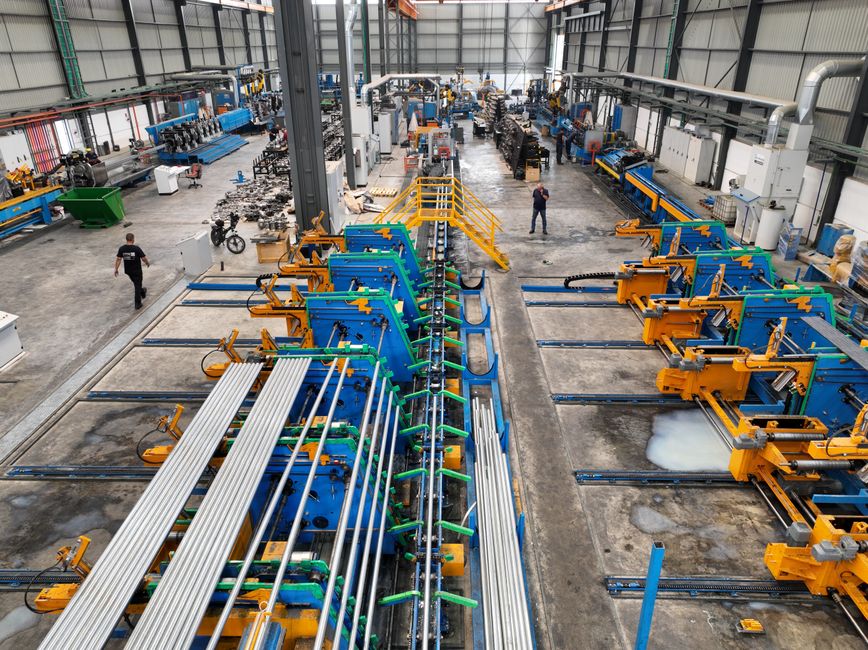
First, the company for readers who don’t track Korea daily. Hyundai Rotem (064350) trades on KOSPI, Korea’s main board, at a market cap of roughly $10.2 billion. It builds two very different things: K2 main battle tanks — the product behind Korea’s defense-export boom to Poland — and passenger trains. There’s no US ADR; if you want exposure you’re buying Seoul directly through a broker with KRX access such as Interactive Brokers, or approximating it through Korea ETFs like EWY or FLKR, where it sits as a mid-weight industrial. Two structural notes if Seoul is new to you: KRX enforces a ±30% daily price limit with volatility interruptions (one of which this stock triggered on July 8), and everything here is won-denominated — a dollar-based holder is stacking currency risk on top of the equity thesis, in both directions.
Some program history, because the Poland relationship is the reason this company re-rated in the first place. In 2022, Poland signed a framework agreement covering roughly 1,000 K2 tanks — the largest tank export deal Korea has ever landed. The first executive contract delivered 180 units built in Korea. The second, signed in August 2025 at about $6.5 billion per Korean press reports at the time, shifts part of the work into Poland itself, with local production ramping at the Bumar-Łabędy plant, per Korean trade-press accounts of the third-contract talks. That local-production pivot is strategically right — it embeds the K2 in Poland’s industrial base against European competitors — but it is also exactly why near-term margins thinned: early local-production phases carry setup costs that Korean-built units didn’t. The margin pain the market punished in July is, in large part, the cost of making the program durable.
On July 24 the company reported second-quarter consolidated revenue of ₩1.61 trillion ($1.13 billion), up 13.3% year over year — and operating profit of ₩232.4 billion ($163 million), down 9.7%. Revenue up, profit down. The operating line came in about 14% below the street’s consensus, and on July 27, the next trading day, the stock fell 14.1% intraday to a 52-week low, as reported by Korean financial daily Hankyung.
What I care about is where the miss lived. The defense segment itself stayed strong: ₩918.9 billion ($645 million) in revenue at a 24.5% operating margin. The problem was composition. Daishin Securities — a Seoul sell-side house — estimates that exports fell from 75.0% of defense revenue in Q1 to 59.8% in Q2, as covered by Financial News, a Korean outlet. High-margin Poland deliveries handed the baton to lower-margin domestic orders. The first Poland contract is winding down; the second is in its early, thinner-margin phase. That is the entire earnings story in two sentences, and it is a mix story, not a demand story.
The rail business barely makes money — and that reframes everything
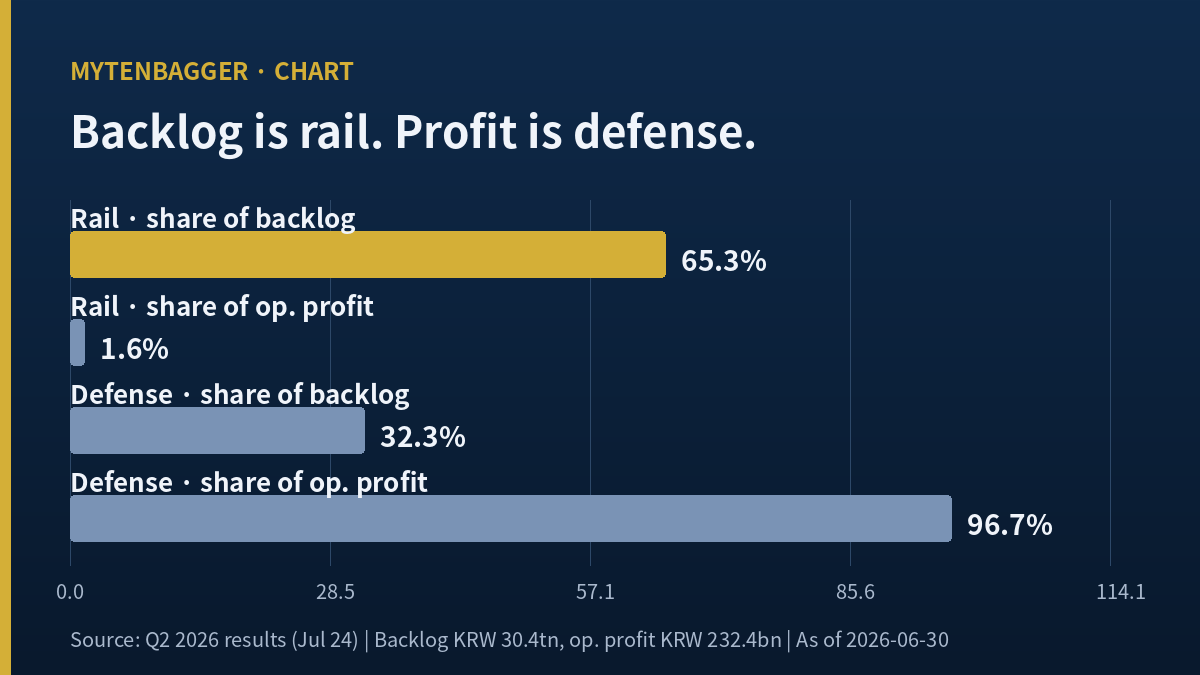
Here is the number that stopped me when I read the segment table. Rail: revenue of ₩584.8 billion ($411 million), operating profit of ₩3.7 billion ($2.6 million). That’s a 0.6% margin, per the segment figures reported by Korean outlet Edaily. Of the company’s ₩232.4 billion in quarterly operating profit, defense contributed ₩224.8 billion — 97%. Functionally, this is a defense company with a large train factory attached.
I’ll admit something before going further: I missed this rally. When the stock crossed ₩200,000 last year I thought the defense premium had run ahead of itself, and that opinion cost me the entire ride to ₩282,000. I’m not writing this to catch a falling knife out of regret. I’m writing it because the valuation risk I was afraid of back then is the thing that has now been half-removed, and I want to know if the other half — the earnings engine — is still intact.
The half-year view says it mostly is. First-half revenue reached ₩3.06 trillion ($2.15 billion), up 18.1%, with operating profit of ₩456.6 billion ($321 million), down just 0.8%. Profit didn’t collapse; the expectation that profit would grow as fast as revenue collapsed. New orders kept landing too — a ₩748.2 billion ($525 million) train-maintenance contract in Morocco, a ₩491.1 billion ($345 million) metro-car order for Ho Chi Minh City. The Morocco deal is maintenance rather than new-build, and that detail matters: long service contracts are where rail margins eventually come from.
Balance-sheet vitals, from Kiwoom data as of the July 31 close: trailing ROE 30.1%, free-cash-flow yield 14.7%, debt-to-equity 188%. The debt number looks scary out of context, but order-based manufacturers book customer advances as liabilities — I read it as evidence of work in the pipeline rather than leverage stress. The dividend is ₩600 per share for fiscal 2025, triple the prior year but still a 0.45% yield. Nobody owns this for income.
Why Hyundai Rotem stock fell 45% in three months — three layers, not one
Blaming the whole drawdown on one earnings miss would be lazy. I count three layers.
Layer one: geopolitical premium unwinding. Korean defense names rallied through early 2026 partly on Middle East tension; from May, ceasefire expectations began deflating the whole sector. Layer two: beta. On July 8, a sharp index-wide selloff day in Seoul, this stock fell 9.9% and triggered a volatility interruption, per Korean market reporting — a high-beta defense name absorbing an index-level risk-off move. Layer three: the July 24 print and the 14% single-day repricing that followed. Sector, then market, then company. The earnings miss was the last punch, not the only one.
Seoul’s sell side moved fast. On July 27–28, price objectives came down in a block: Korea Investment & Securities cut from ₩320,000 to ₩270,000, Samsung Securities from ₩306,000 to ₩250,000, Shinhan from ₩290,000 to ₩230,000. Korea Investment also cut its 2027 operating-profit estimate by 19.7%. The shared logic, as one Korean daily summarized it: without additional export orders, the pressure doesn’t lift. I treat that sentence as the canonical bear case — recovery here is conditional on order events, not automatic.
And yet — after all that cutting, the objective band sits at ₩230,000–280,000 ($162–$197) against a ₩133,700 share price. What interests me isn’t the implied distance; sell-side numbers get revised. It’s the shape of the move: estimates were slashed while the underlying story was kept. They marked down the timing, not the thesis.
Hyundai Rotem stock’s record backlog is two very different piles
This is the section I’d keep if I had to cut everything else.
| Segment | Backlog | Q2 revenue | Q2 op. profit | Margin |
|---|---|---|---|---|
| Defense | $6.9B | $645M | $158M | 24.5% |
| Rail | $14.0B | $411M | $2.6M | 0.6% |
| Total (incl. eco-plant) | $21.4B | $1.13B | $163M | 14.5% |
Source: company Q2 2026 results (July 24) as reported by Korean outlets Edaily and E-Today | Converted at ₩1,424.0/USD (July 31 close — see footnote)
Two-thirds of the backlog is rail. Ninety-seven percent of the profit is defense. If you buy the “record $21.4B backlog” headline, you are mostly buying train orders that earn half a percent. If you buy the earnings, the backlog that matters is the defense pile — $6.9 billion. The market’s violent reaction to the Q2 print was, in my reading, the moment it re-noticed this asymmetry: backlog converts to revenue, and revenue converts to profit, at wildly different exchange rates depending on the segment.
The same translation problem also runs along the time axis. Samsung E&A rebuilt its backlog from 18.04tn won at the end of the third quarter of 2025 to 22.7tn won at the end of the second quarter of 2026, and 2.51 years of coverage buys revenue visibility, not margin visibility — every one of those years was priced at a bid date that has already passed. At Rotem the segment mix bends the backlog-to-profit rate; at Samsung E&A it is the bid date.
But the same asymmetry maps the way back up. The event that refills the pile that matters is Poland’s third executive contract for the K2 — around 210 tanks (120 built in Korea, 90 locally in Poland) plus 35 derivative vehicles, in final-stage working talks with signing targeted within this year, per Financial News reporting from July 9. And on June 11, Poland’s defense ministry publicly reaffirmed its plan for roughly 1,000 K2s in total, as reported by Global Economic. The timing of that reaffirmation — mid-drawdown — is the kind of detail I keep.
Hyundai Rotem stock next to Rheinmetall — the gap is the story
For a US reader, the cleanest comp is Germany’s Rheinmetall, Europe’s rearmament flagship. Its own guidance for 2026 calls for revenue of €14.0–14.5 billion, up 40–45%, at roughly a 19% operating margin, per the company’s official annual-report release. Its market cap sits around $61.4 billion — six times Hyundai Rotem’s — and consensus aggregators put it near 30x expected 2026 earnings, versus Rotem’s 18.9x trailing (different bases, so treat the comparison as directional, not precise). Europe is paying a growth premium on guidance; Korea just handed its premium back over one messy quarter.
I also tried a currency-free comparison: backlog divided by annual revenue. Rheinmetall’s €63.8 billion backlog against €9.9 billion of 2025 revenue is about 6.4 years of work; Rotem’s backlog is about 5.2 years (my back-of-envelope, derived). The thickness of the order books is closer than the market caps suggest. What differs is quality: Rheinmetall’s backlog is defense backlog with European budgets behind it, while two-thirds of Rotem’s is 0.6%-margin rail. Re-rating here won’t come from the backlog total. It comes from the defense share of it.
One more data point on the human side. On June 12, thirty-seven Hyundai Rotem executives — the CEO included — bought 8,683 shares, about ₩1.6 billion ($1.1 million), with personal money, the first company-wide purchase in a decade, per Korean outlet E-Today. The amount is small. The timing, mid-slide, is what I filed away: insiders marking the gap between their view of value and the tape.
This whole setup rhymes with what I wrote about Hanwha Aerospace’s backlog-versus-cash question, and with the trigger-waiting structure in my Hanwha Ocean journal. Korean defense as a group is solving the same equation right now: the orders are certain, the timing of the margins is not. Korea Aerospace’s multiple rising while its price fell is that same equation read off the income statement instead of the backlog.
What a US-based holder is actually buying at this price
Let me run the numbers the way I actually think about them, because “18.9x trailing” hides the interesting part.
Take the Q2 defense operating profit — $158 million — and annualize it crudely to about $630 million (my arithmetic, and yes, annualizing one quarter of a lumpy contract business is rough; treat it as a sketch, not a model). Against a $10.2 billion market cap, you’re paying roughly 16 times the defense segment’s operating run-rate — and at that price, the rail business, its $14 billion backlog, and the eco-plant unit come attached for approximately nothing. That’s the bull framing. The bear framing uses the same numbers: the quarter I just annualized is the one where defense profit fell 9%, and if the export mix keeps deteriorating, that $630 million run-rate is the ceiling, not the floor. Both framings are honest. Which one wins is decided by the Poland signature and the Q3 mix line, which is precisely why my break-points sit where they do.
The American comp set helps calibrate what “cheap” and “expensive” mean in this sector. General Dynamics — whose land-systems division builds the Abrams, the K2’s closest American analogue — carries a market cap around $100.9 billion per the same aggregator data, roughly ten times Rotem’s. I couldn’t verify GD’s current earnings multiple to a standard I’d publish, so I won’t put a number on it; the size gap alone makes the point that matters here. US primes are priced as mature, budget-anchored cash machines. Rheinmetall is priced as a growth stock riding European rearmament. Hyundai Rotem sits in between and currently gets neither treatment: growth-stock volatility on the way down, no mature-prime valuation floor on the way up. That in-between-ness is the discomfort — and the opportunity, if the growth leg reasserts itself.
One more thing I want on the record about the sector backdrop. European rearmament isn’t a quarter-to-quarter trade; NATO members have been walking defense budgets structurally higher since 2022, and Poland — carrying the highest defense-spending share of GDP in the alliance, by NATO’s own published tallies — is the single most committed buyer on the continent. The K2 program is plugged directly into that spending stream. Nothing in the Q2 print touched that demand backdrop. What Q2 damaged was the market’s confidence in when that demand converts into reported margin. Timing risk and demand risk deserve different discounts, and I think July’s tape priced the first as if it were the second.
Hyundai Rotem stock six months out — the three paths I’ve sketched
My base path (55%)
Poland’s third contract signs this year and the export mix turns in Q3. The reference numbers are Daishin’s estimates from its July 15 preview: 2026 operating profit of ₩1.19 trillion ($834 million), 2027 ₩1.54 trillion ($1.08 billion), 2028 ₩2.06 trillion ($1.45 billion) — a path where operating profit roughly doubles by 2028 as the second Poland contract matures into its higher-margin phase. Those figures predate the Q2 miss, so shave them mentally. If this path confirms, today’s 18.9x trailing multiple starts reading very differently.
The path where I’m wrong (30%)
The contract slips past year-end and the export ratio keeps sliding in Q3. Then the sell-side cut logic plays out in full: forward earnings shrink under the same multiple, and 18.9x quietly flips from “cheap” to “fair, maybe rich.” In this branch I don’t buy the dip — I demote the name down my watch list. A falling price with falling earnings isn’t a discount; it’s a treadmill.
The upside tail (15%)
The third contract signs and a Middle East order becomes concrete. Iraq has been reported — by Korean trade press back in September 2025 — to be pursuing roughly 250 K2s in a deal that could reach the ₩9 trillion range. I could not find a credible follow-up within the last 90 days, and forum chatter about an “imminent signing” doesn’t count as evidence in my process. Unconfirmed good news goes into my math at zero. That’s why this is a tail, not a thesis.
The order in which my hypothesis gets tested
I keep my break-points in the order they’ll resolve, earliest first.
The Poland announcement comes first. A signed third executive contract, confirmed by disclosure, pushes the defense backlog from $6.9 billion back toward double digits — and moves me from watching to actively working out an entry. If the year ends without it, the bears’ conditional turns into fact, and I act accordingly by stepping back.
Next, the Q3 report in late October. The single line I’ll read before anything else is the defense export ratio. If it bases and turns from that 59.8% estimate, the “early low-margin phase” explanation holds. If it keeps falling with no contract on top, that explanation stops being context and becomes a warning.
Last, and slowest: the rail margin. Whether 0.6% is structural or cyclical needs at least two more quarters. The Morocco maintenance win points the right way — service revenue is where train builders eventually find margin — but one contract isn’t a trend. I’m not rushing a verdict on the slowest variable while the fastest one — Poland — is about to print.
And a note on how I’d act if the first two break-points resolve well, because “I’d get interested” is not a plan. This is a lumpy-earnings contractor, not a compounder — quarterly numbers will keep swinging with delivery schedules even in the good scenario. So my approach, if the Poland signature lands, is staged rather than single-shot: an initial position sized so that another 14% single-day repricing — which this stock has just demonstrated it can produce — is an annoyance rather than a problem, then adding only after the Q3 mix line confirms. The sequence matters more than the level. Buying the announcement and averaging into confirmation is a different trade, with different risk, than bottom-fishing a falling knife because it’s 53% off its high — even at the identical price.
Worth remembering the tape context too: KOSPI came into July at record-territory levels after a historic run, and the July 8 session that clipped this stock 9.9% was an index-wide risk-off day. Part of this drawdown is simply what high-beta looks like inside a hot market cooling off. I don’t pay myself for insights the index gave everyone; I only care about the company-specific layers I can actually track — the mix, and the contract.
What I did this week was specific: I didn’t buy Hyundai Rotem stock, and I didn’t look away either. A 53% drawdown earns a place at the top of my watch list; it doesn’t earn my capital. The mix broke this stock, and I want to see the mix fix it. Next checkpoints: the Poland disclosure, and the late-October print.

Figures: price, market cap, PER, ROE from Kiwoom data as of the July 31, 2026 close. The 53% drawdown is derived directly from the ₩282,000 250-day high against the ₩133,700 close. Q2 results per company release (July 24) as reported by Korean press. All USD conversions in this article use ₩1,424.0 per dollar, the Seoul FX market daytime closing rate on July 31, 2026 (cross-checked across Newspim and Money Today); Rheinmetall’s market cap is quoted natively in USD from aggregator data. Rheinmetall’s ~30x figure is a consensus-aggregator estimate of 2026 expected earnings and sits on a different basis than Rotem’s trailing multiple. Backlog-years figures are my own derivation (backlog ÷ annual revenue).