Hyundai Elevator Dividend After a 20-Year Shareholder Dispute
Contents
Hyundai Elevator stock carries the settlement of a fight that lasted twenty years
I went looking for a Korean industrial with a double-digit trailing yield and found a legal history instead. Hyundai Elevator (KOSPI: 017800) closed at KRW 72,200 on Friday 21 August 2026, which puts the whole company at KRW 2.82 trillion, roughly USD 2.04 billion. For a Korean market leader with a 32 to 37 percent domestic share, that is a small number. The reasons it stayed small are written in court filings, not in an income statement.
Here is the compressed version of what I found. A Swiss competitor bought a quarter of this company, watched its stake get diluted for a decade, sued the chairwoman on the company’s behalf, won KRW 170 billion for the company, filed an international arbitration claim against the Republic of Korea, lost that, sold down below the disclosure threshold, and sold its Korean operating business to Otis. The award money and a set of asset sales then went out to shareholders as one of the largest payouts a Korean mid-cap has made relative to earnings.
30 March 2023 (Thursday) · Korea’s Supreme Court finalized an order for the chairwoman to pay KRW 170 billion to the company · that fiscal year, net profit came in at 3.75 times operating profit
14 March 2026 (Saturday) · Korean press reported the Permanent Court of Arbitration dismissing Schindler’s claim against the Republic of Korea · the last open front of the dispute closed
26 February 2026 (Thursday) · the ex-dividend date for a KRW 12,010 final dividend · the share fell more than eight percent intraday and has not returned to the level it left
What follows is my working note on why the settlement of a dispute is a poor foundation for a valuation, and on the one disclosure that would let me judge whether the business underneath can stand without it.
Prices and multiples reflect the Friday 21 August 2026 close as I checked them at the time of writing. I wrote this on the Saturday morning that followed, so Friday was the most recent trading session. Publication comes later, and live quotes can differ. Korean won is the reference currency here; dollar figures are approximate conversions at KRW 1,386.5 per dollar, the Seoul spot close on the same Friday.
What a Swiss elevator maker was doing on a Korean share register
Schindler Holding is the world’s third-largest elevator company. In 2006 it bought 25.54 percent of Hyundai Elevator as a friendly holder during a control fight inside the Hyundai group, and by late 2013 its position had grown to roughly 35 percent.
The relationship broke over what Hyundai Elevator did with its balance sheet. Between 2011 and 2015 the company entered derivative contracts with several financial institutions to defend control of Hyundai Merchant Marine, contracts that guaranteed the counterparties annual returns in the range of 5.4 to 7.5 percent. Shipping collapsed. The losses ran into the hundreds of billions of won, and the company raised more than KRW 900 billion in rights offerings during the same window, with a large share of that going to cover the derivative positions. Schindler declined to participate in the repeated raises, so its holding was diluted from about 35 percent toward 15 percent.
I want to be precise about the mechanism, because it matters for how I read the payouts now. Schindler was not diluted by a hostile action aimed at it. It was diluted because it refused to fund a defense it disagreed with, and the defense turned out to be expensive.
The court order that moved KRW 170 billion toward Hyundai Elevator stock
Schindler brought a shareholder derivative suit, which in Korean law directs any damages to the company itself. The plaintiff collects nothing directly. On Thursday 30 March 2023, the Supreme Court’s third civil division finalized the lower court’s order. Lawtimes reported the confirmed award at KRW 170 billion, with KRW 19 billion of that jointly owed by a former chief executive. Korean press later described the figure including accrued interest at around KRW 280 billion.
Now look at what the fiscal year containing that ruling produced. These are consolidated figures filed with Korea’s electronic disclosure system, in Korean won.
| Fiscal year | Revenue | Operating profit | Net profit | Net over operating |
|---|---|---|---|---|
| 2022 | KRW 2,129.3bn | KRW 43.0bn | KRW 78.2bn | 1.82x |
| 2023 | KRW 2,602.1bn | KRW 82.6bn | KRW 309.9bn | 3.75x |
| 2024 | KRW 2,885.3bn | KRW 225.7bn | KRW 193.9bn | 0.86x |
| 2025 | KRW 2,467.4bn | KRW 209.2bn | KRW 269.3bn | 1.29x |
| 2026 first half | KRW 1,238.7bn | KRW 125.0bn | KRW 194.0bn | 1.55x |
Source: consolidated statements as filed with Korea’s Financial Supervisory Service disclosure system. The 2026 half-year figures come from the semi-annual report accepted on Friday 14 August 2026, receipt number 20260814003691. The final column is my own division, not a filed line item.
In the first quarter of 2023 alone, the quarter that contains the ruling, the company recorded KRW 227.1 billion of net profit against KRW 20.6 billion of operating profit. I have matched the timing of the judgment to the quarter and nothing more. I could not open the filed statements to read the account line, so I will not claim the award and the profit are the same money. I will say the two sit in the same three months and that the size fits.
Hyundai Elevator stock and the arbitration that ended in The Hague
Schindler opened a second front in 2018, this time against the Republic of Korea itself under an investor-state dispute settlement mechanism. The argument was that Korean financial regulators had failed to supervise the 2013 to 2015 rights offerings properly, and the claim was eventually pared to roughly KRW 320 billion.
Korean press reported on Saturday 14 March 2026 that the Permanent Court of Arbitration had dismissed it. Seoul Finance covered the ruling and the twenty-year arc behind it, and The Korea Times carried the Yonhap wire on the same day. Korea recovered its costs. Schindler recovered nothing.
Its stake had already been going out the door. News1 reported the holding at 4.25 percent as of Thursday 28 August 2025 after two months of steady selling. Below five percent, Korean large-holding disclosure stops, so that reading is the last one I can verify. What Schindler holds today, if anything, I do not know.
The corporate ending arrived a few months later. On Monday 1 December 2025 Otis completed the purchase of Schindler’s Korean operating business and launched it as Otis EM Korea, as the Korean trade press reported at the time.
Where that money went once the dispute closed
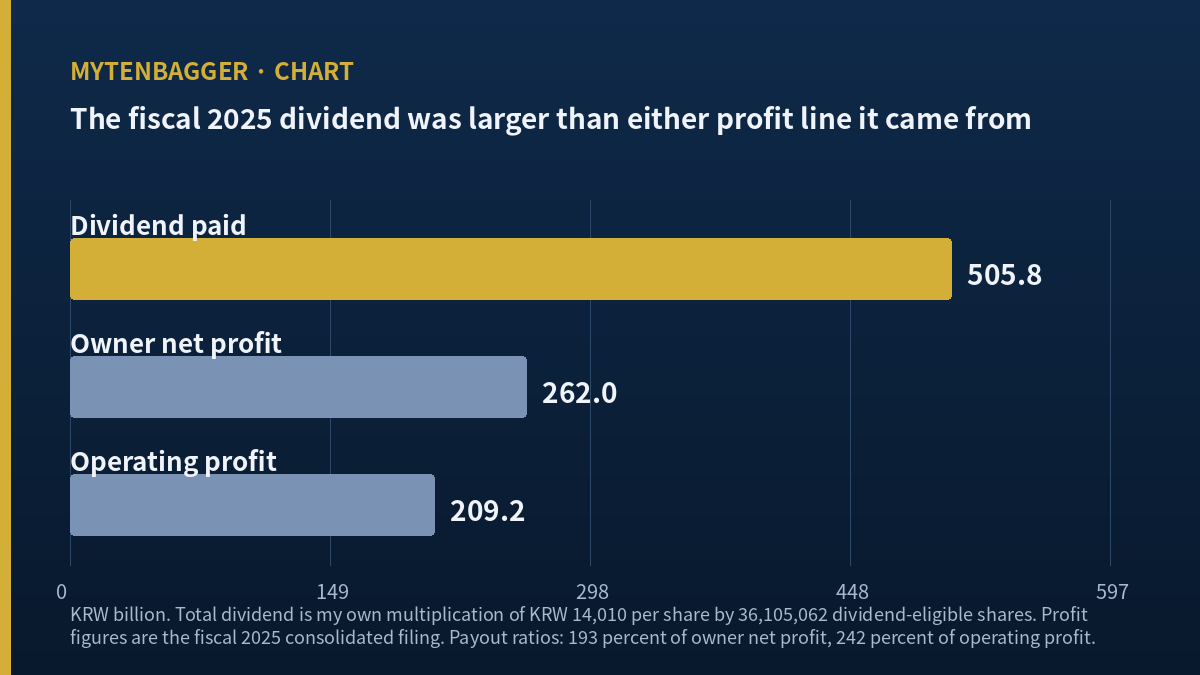
The company paid it out. For fiscal 2025 the total dividend came to KRW 14,010 per share, made up of two quarterly payments of KRW 1,000 during the year and a KRW 12,010 final dividend declared by the board on Tuesday 10 February 2026.
The arithmetic is worth doing slowly. Shares outstanding are 39,092,385. Treasury shares are 2,987,323, which leaves 36,105,062 shares eligible for the dividend. Multiplying gives KRW 433.6 billion for the final dividend and KRW 505.8 billion for the fiscal year in total. Against fiscal 2025 net profit attributable to owners of KRW 262.0 billion, that is a payout ratio of 193 percent. Against operating profit of KRW 209.2 billion it is 242 percent.
A company cannot do that out of the year’s trading. It did it out of three other pockets. Smart Today reported that shareholders approved a KRW 307.2 billion reduction of capital reserves into distributable retained earnings, which converted a balance-sheet item into dividend capacity. Korea Financial Times attributed the profit swing to the sale of the Yeonji-dong office building and part of the stake in listed subsidiary Hyundai Movex. And the litigation recovery sat underneath all of it.
A payout that outruns the year’s profit is not unique to this name. POSCO M-Tech paid a 2024 dividend larger than the profit it earned that year, and Hanil Cement handed over 99 percent of an owner profit that had halved. What separates either of those from 193 percent is whether the money was inside the year’s earnings at all.
So the headline yield that brought me here is the settlement of a two-decade dispute, a property disposal and a reserve reclassification, expressed as a percentage of a share price. The board declared a KRW 1,000 quarterly dividend on Thursday 14 May 2026, and that single payment is the only 2026 distribution I can confirm. It is 7.1 percent of the KRW 14,010 figure.
The operating business under Hyundai Elevator stock is genuinely getting better
This is the part that argues hardest against me, so I want it stated at full strength before I qualify anything.
| Period | Operating margin |
|---|---|
| Fiscal 2022 | 2.02% |
| Fiscal 2023 | 3.18% |
| Fiscal 2024 | 7.82% |
| Fiscal 2025 | 8.48% |
| 2026 first half | 10.09% |
Operating profit divided by revenue, my calculation from the filed consolidated figures. The second quarter of 2026 on its own came to 12.19 percent, which is the highest single quarter I located.
Four consecutive improvements with no down year. That curve is not the sort of thing a one-time gain produces. Sell-side reads it as structural: when Samsung Securities opened coverage on Friday 10 April 2026 it put the maintenance division’s operating margin above 20 percent and tied the growth to the installed base, according to the Korean brokerage briefing I could reach.
The reason the improvement is happening at the same time revenue is shrinking is visible in the end market. Newslock, citing the Korea Elevator Safety Agency, reported new elevator installations in Korea at 48,905 units in 2021, 46,090 in 2022, 46,945 in 2023, 48,884 in 2024, and then 36,211 in 2025, a fall of 25.9 percent. New installation is the low-margin half of this business. Losing it lifts the average.
The one number Hyundai Elevator stock does not publish
Here is where I get stuck. Samsung Securities gave me a margin for the maintenance division. To use it I need the share of revenue that division represents, and the company does not disclose it.
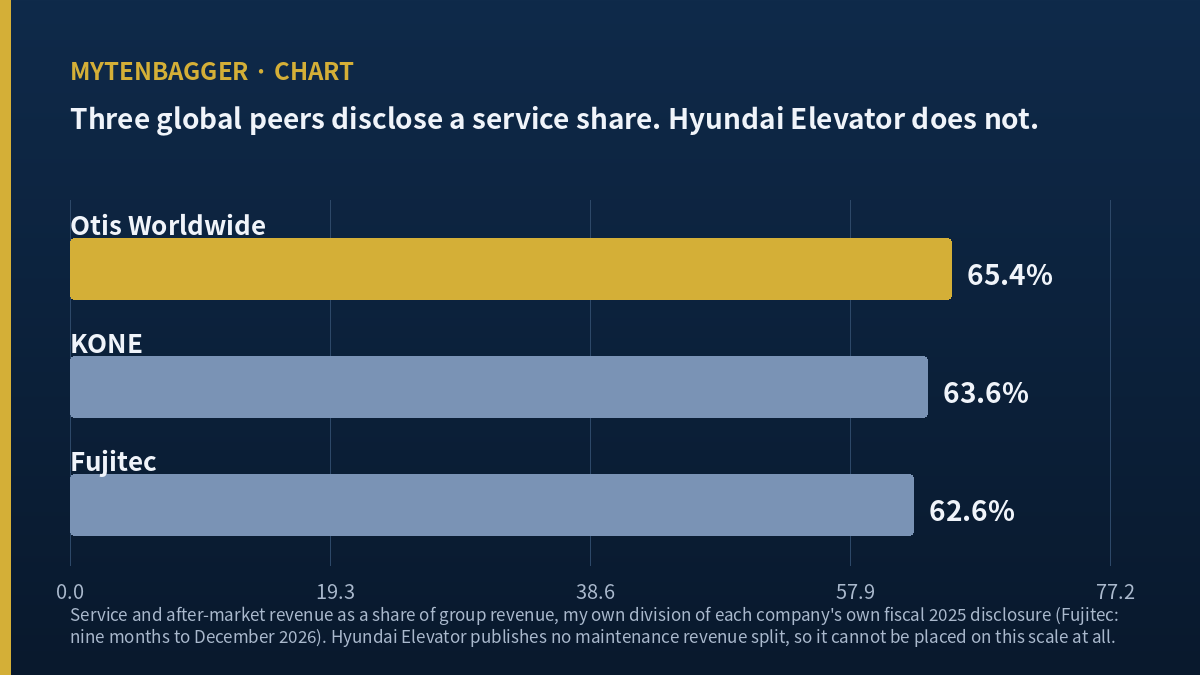
Its global peers do, which is what makes the gap conspicuous.
| Company | Fiscal year | Revenue | Service share of revenue |
|---|---|---|---|
| Otis Worldwide | 2025 (December) | USD 14.43bn | 65.4% |
| KONE | 2025 (December) | EUR 11,245m | 63.6% (service 42.3 + modernization 21.3) |
| Fujitec | 2026 nine months (December) | JPY 177.4bn | 62.6% |
| Schindler | 2025 (December) | CHF 10,947m | not broken out |
| Hyundai Elevator | 2025 (December) | KRW 2,467.4bn | not disclosed |
Each company reports in its own currency and I have converted none of them, because the comparison here works on ratios and size does not enter it. The Otis share is my division of segment revenue into group revenue from the fiscal 2025 release. The KONE figure adds its service and modernization segments together. The Fujitec figure is its after-market segment, which bundles maintenance, repair and modernization, so the three are close in intent but not identical in definition.
The Otis breakdown adds a second number that changes how I read all of this. In fiscal 2025 its service operating margin was 25.1 percent while new equipment came in at 4.8 percent. Five times the profitability in the same building, from the same elevator, sold by the same company. Samsung Securities’ 20 percent figure for the Korean maintenance business is not an outlier claim. It is what this industry looks like everywhere.
Which leaves me holding a rate with no base to apply it to. If maintenance is 60 percent of Hyundai Elevator’s revenue, the operating engine is large enough to carry a high return on equity without any help. If it is 25 percent, it is not, and the recent numbers lean on the pockets I listed earlier. I cannot tell which, and I am not willing to guess a number that would decide the whole question.
What I can see in place of the number
Two indirect readings. Dealsite’s company profile put the domestic market share at 37.3 percent as of March 2025 with a maintained fleet of more than 200,000 units, about a quarter of every elevator in Korea. Newslock puts the share lower, at 32.6 percent for 2025. Neither source states whether the count is by units or by revenue, so I read it as a range of 32.6 to 37.3 percent and treat the maintained fleet figure as the more durable of the two facts.
Why US passive money owns none of Hyundai Elevator stock
KOSPI is Korea’s main board, the senior of the country’s two listing tiers, and Hyundai Elevator has been on it since 1996. That does not make it reachable.
There is no sponsored American depositary receipt. The ticker HYEVF that appears on US over-the-counter venues is an ordinary foreign share. No sponsored receipt program sits behind it, and I could not verify its traded volume or spread, so I would not describe it as a route without checking that first.
The index funds do not help either. I checked the two Korea funds a US investor is most likely to already hold. The Franklin FTSE South Korea fund listed 162 positions as of 14 August 2026, also without it. The second of those goes well past 150 Korean names and still does not reach a KRW 2.8 trillion industrial. Both funds hold seven or eight other companies carrying the Hyundai name.
On that last point, the won closed the same Friday at 1,386.5 per dollar, its strongest reading in about eleven months, which cuts both ways for anyone converting into or out of the position.
The share register, for whoever is on the other side of the trade
| Holder | Stake | As of |
|---|---|---|
| Hyundai Holdings Company and related parties | 24.93% (20.13% held directly) | 8 July 2026 |
| National Pension Service | 9.97%, described as selling | 26 June 2026 |
| Foreign investors in aggregate | 22.25% | 21 August 2026 |
| Treasury | 7.64% | 21 August 2026 |
| Schindler | 4.25%, last verifiable reading | 28 August 2025 |
Compiled from Korean data providers with the reference date carried on each row, because these were not all read on the same day. The chairwoman holds no shares directly; her control runs through the holding company.
Nine arguments against the position I am taking
- The margin curve has improved four years running with no reversal, and 12.19 percent in the second quarter of 2026 is the best single quarter in my data. A trend that persistent usually reflects something real about the business.
- Samsung Securities called the improvement structural and supported it with a divisional margin above 20 percent. I have no data that contradicts the direction, only a missing weight.
- A company that decides to hand one-time proceeds to shareholders and then actually does it has demonstrated something about its policy. Dividends per share went KRW 4,000, then KRW 5,500, then KRW 14,010 across three years.
- Second-quarter 2026 revenue came in about 4.9 percent above the consensus estimate that Investing.com compiles, ending three straight quarters of missing by 15 to 23 percent.
- I never confirmed what produced the second-quarter 2026 non-operating income. Korean press points at a holding in SpaceX, which listed on Nasdaq on Friday 12 June 2026, but the reported acquisition dates and amounts conflict across three outlets and I refused to use any of them. If that income turns out to be a recurring equity-method item, half my case collapses.
- Linking the 2023 profit to the court award rests on the two falling in the same quarter. That is timing, not causation, and I have said so twice.
- Coverage is thin enough that the sell-side view may simply be underinformed, which is a different failing from being wrong. Data aggregators count one analyst on this name. A published mean of KRW 107,500 turns out to be the arithmetic midpoint of exactly two numbers, KRW 120,000 from Samsung Securities and KRW 95,000 from Leading Investment and Securities, which opened coverage on Tuesday 21 July 2026. Neither is a figure I adopt.
- Korea’s residential completion count fell 49.5 percent in the first half of 2026 while starts rose 14.4 percent and presales rose 60.7 percent. Completions drive installation revenue today; starts drive it several years out. Someone reading the same ministry table could reasonably conclude the trough is already visible.
- The one that bothers me most. My whole case rests on treating “non-operating” as a single category, and the items inside it are not alike. A litigation recovery happens once. Selling down a listed subsidiary across several years, which is what this company has been doing with Hyundai Movex, is closer to a repeatable policy than to an accident. I wrote that the four sources have nothing in common. What I actually established is that they have different names, and a different name is not proof of a different nature. I built the argument anyway.
Where I stand on Hyundai Elevator stock and what would end this view
Watching, not owning. At KRW 2.82 trillion this sits outside the hundred largest names on the Korean market, which is where my default sits for a company I have not held before, and nothing I found moved me off it.
What I think is true: the elevator business here is improving on its own merits, and the reported return on equity of 20.1 percent and the trailing yield near 19 percent were not produced by that improvement. They were produced by a court, a building, a subsidiary stake, a reserve reclassification and possibly a rocket company. Those are five different pockets, and four of them are now empty.
The condition that would end it
I have not set a threshold on this one, because the number is not what I am arguing about. What would end my view is a disclosure.
If Hyundai Elevator publishes the share of revenue that maintenance and modernization represent, and that share lands anywhere near where its global peers sit, then the operating engine is large enough to carry the returns on its own and my case for a discount disappears the day the filing arrives. The company holds the number that settles this. Until it releases it, I am reasoning from a rate without a base, and I would rather say that plainly than build a model on an assumption I picked myself.
When I will check
The third-quarter report has a statutory deadline of Sunday 15 November 2026, so the filing itself lands on Monday 16 November 2026 or after. Korean exchange preliminary announcements sometimes run two to three weeks ahead of the formal report, which could bring a first reading into late October. Everything above is written for the period before that.
What I looked for and did not find
The account-level detail behind the second-quarter non-operating income. The maintenance revenue share. Who bought and sold during the gap on Tuesday 18 August 2026 and the three sessions that erased it. Any credit rating from the Korean agencies. The company’s dividend intention for the rest of 2026. And what becomes of the 2,987,323 treasury shares, which Korean commentary suggests a company law amendment will force the company to cancel or dispose of, on a timetable I could not pin down. Six open items, all of them left out of the argument above, none of them filled in with a guess.
Hyundai Elevator stock at a glance
| Item | Value |
|---|---|
| Close, Friday 21 August 2026 | KRW 72,200 (about USD 52.07) |
| Market capitalization | KRW 2,822.5bn (about USD 2.04bn) |
| Shares outstanding / treasury | 39,092,385 / 2,987,323 |
| Price to earnings / price to book | 10.77x / 1.91x |
| Return on equity, fiscal 2025 | 20.1% (owners’ profit over average owners’ equity, reproduced by my own division) |
| Closing high / low, past year | KRW 111,700 (23 Feb 2026) / KRW 65,000 (29 Jul 2026) |
| Against that high / that low | −35.36% / +11.08% |
| Beta against KOSPI, 244 sessions | 0.312 |
| One-year return vs KOSPI vs machinery sector | −8.72% vs +120.04% vs +22.18% |
Market capitalization and the two distance-from-extreme figures are all computed from the same KRW 72,200 close shown in the first row. The sector series is an equal-weighted basket of 96 machinery names with this company removed. Dollar conversions use KRW 1,386.5 per dollar on the same date and are approximate. Every judgment above is made in won.
One sentence to close on. A twenty-year argument between two elevator companies produced a great deal of money for this one, and the argument is finished; what I want to know now is the size of the business that has to stand in its place, and the company has not told me.
A companion piece in Korean covers the same filings from a different angle, working through the five reporting periods where net profit sat above operating profit.
- Hyundai Department Store Buyback: Shares Not Yet Canceled
- Korea Ratings Valuation: 4.3 Times Sales Against Moody’s
- Hyundai Greenfood Revenue Growth and a Ten-Month First Year