Hancom Stock Rests On a Second Half That Has to Double
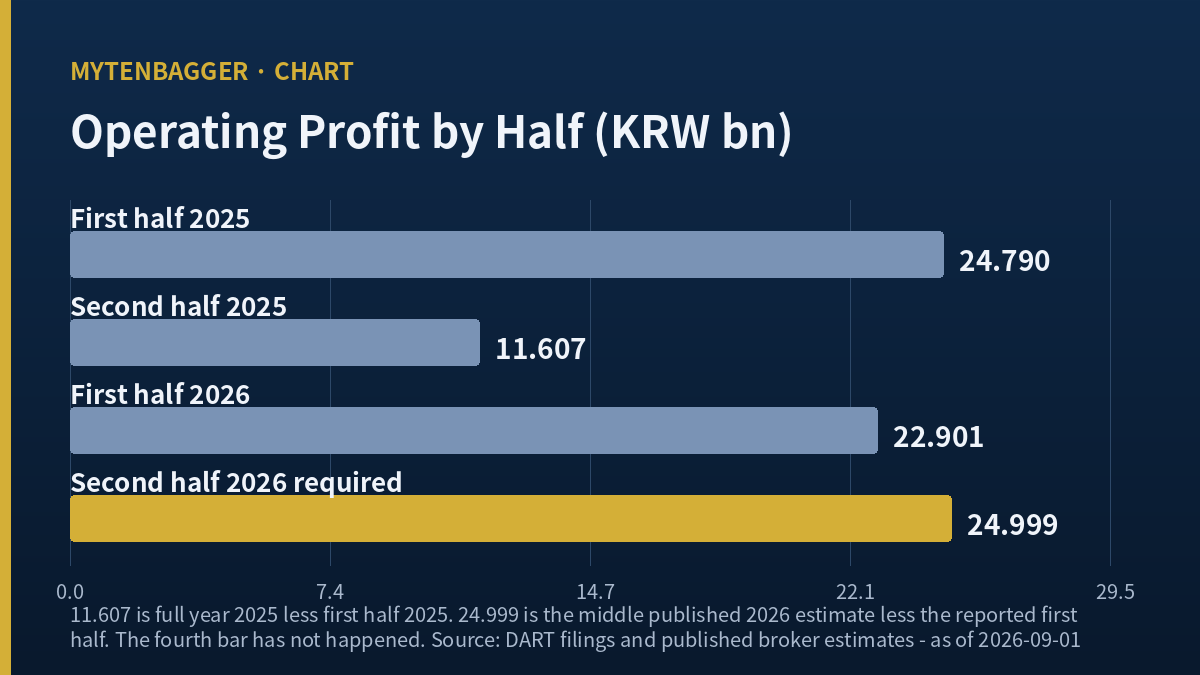
| The requirement | To reach the middle published 2026 estimate of KRW 47.9 billion in operating profit, the second half has to produce KRW 24.999 billion against KRW 11.607 billion in the second half of 2025. That is a 115.4% increase. |
| What already happened | First half 2026 operating profit was KRW 22.901 billion, down 7.62% from KRW 24.790 billion a year earlier, on revenue up 24.60%. |
| My position | No shares, no order, watching. The price I read was KRW 17,990 at the September 1, 2026 close, a market value near KRW 435 billion. |
Contents
What Hancom Stock Is Being Asked To Deliver In One Half Year
Hancom trades on KOSDAQ under 030520. KOSDAQ is the smaller of Korea’s two main boards, the venture and technology tier that sits alongside the larger KOSPI, and it is where most Korean software companies of this size list. The company sells the office suite that Korean government offices and schools have written documents in for three decades, and in July 2026 it shortened its legal name from Hangul and Computer to Hancom.
I opened Hancom stock in my file because three separate published estimates for its 2026 operating profit agree with each other to within KRW 6 hundred million, which is unusual, and because the half year that had already been reported points the other way. So I did the only piece of arithmetic that connects the two. What I found is a requirement that none of the three notes writes down.
The three numbers that agree
| Published | Source and named author | 2026 operating profit estimate | Valuation the house put on it |
|---|---|---|---|
| 2026-02-25 | Eugene Investment, Park Jong-sun | KRW 68.0 billion | KRW 35,000 |
| 2026-05-15 | Eugene Investment, Park Jong-sun | KRW 48.2 billion | KRW 35,000 |
| 2026-06-02 | Kiwoom Securities, Kim Hak-jun | KRW 47.9 billion | KRW 34,000 |
| 2026-06-24 | Korea IR Council, Lee Na-yeon | KRW 47.6 billion | none published |
These valuations belong to the houses that published them and I have not adopted any of them. The Korea IR Council is a corporate research body and not a brokerage, so it publishes no valuation. The Eugene note of May 15, 2026 (Fri) I read as the original PDF. The Kiwoom figures reached me through Newspim of June 2, 2026 (Tue) and the Korea IR Council figures through Infostock Daily, both Korean-language outlets, so I am carrying their reporting and not the source documents in those two cases.
Set against the 2025 full year figure of KRW 36.397 billion, the three live estimates imply growth of 30.78%, 31.60% and 32.43%. Three independent authors landing inside a 1.65 percentage point band is either a well understood business or a shared starting point. I cannot tell which from outside.
The half that already happened
The half year report filed on August 14, 2026 (Fri) gives consolidated operating profit of KRW 22.901 billion for the six months to June 30, 2026. A year earlier the same six months produced KRW 24.790 billion. That is a decline of 7.62%. Over the same span consolidated revenue went from KRW 147.328 billion to KRW 183.568 billion, an increase of 24.60%.
So revenue grew by roughly a quarter and operating profit shrank. I want to be precise about what that does and does not tell me. It does not tell me the full year estimates are wrong. It tells me that everything those estimates depend on now has to happen in the six months that remain.
The division
| Estimate for full year 2026 | Less first half actual | Second half required | Second half 2025 actual | Increase required |
|---|---|---|---|---|
| KRW 47.6 billion | KRW 22.901 billion | KRW 24.699 billion | KRW 11.607 billion | 112.8% |
| KRW 47.9 billion | KRW 22.901 billion | KRW 24.999 billion | KRW 11.607 billion | 115.4% |
| KRW 48.2 billion | KRW 22.901 billion | KRW 25.299 billion | KRW 11.607 billion | 118.0% |
The second half 2025 figure of KRW 11.607 billion is derived: full year 2025 operating profit of KRW 36.397 billion less first half 2025 operating profit of KRW 24.790 billion. Both inputs are consolidated and both come from regulatory filings. The percentages in the last column are mine, computed from the two columns beside them, and the company has never framed its year this way.
The middle row is the one I keep looking at. To land on the middle of the three published estimates, this company has to more than double the operating profit of its own most recent second half. Not improve it. Double it, and then add another fifteen percent of that same base.
There is a version of this that is ordinary. Second half 2025 was a weak base, and a weak base is easy to beat. That is a real argument and I do not dismiss it. But it cuts both ways: if second half 2025 was weak because something specific went wrong, the comparison is easy; if it was weak because that is what the second half of this business looks like, the comparison is the problem.
One quarter inside the half
The second quarter on its own shows the same pattern more sharply. Revenue for the three months to June 30, 2026 was KRW 119.952 billion against KRW 86.412 billion in the same quarter of 2025, an increase of 38.81%. Operating profit for those three months was KRW 14.337 billion against KRW 16.405 billion, a decline of 12.61%.
Single quarter figures are derived by subtracting the first quarter cumulative from the half year cumulative in each year, because Korean filings report flow items cumulatively. So the 38.81% and the 12.61% are both my arithmetic on filed cumulative numbers.
Revenue up almost 39% while operating profit falls almost 13% in the same three months is a specific thing, and I could not close it. Part of it is that a defense and safety equipment subsidiary sits inside this consolidation and delivered a large order in that quarter, which lifts revenue at a margin unlike the software business. I could not get the segment detail that would let me say how much.
The same analyst, twice
The first two rows of my estimate table carry the same house and the same author. On February 25, 2026 (Wed) the 2026 operating profit estimate was KRW 68.0 billion. On May 15, 2026 (Fri) it was KRW 48.2 billion. That is a cut of 29.1%. The valuation attached to the note stayed at KRW 35,000 across both.
I put the same analyst in the table twice on purpose. Collapse those two rows into one house and the table reads as three independent views converging. Keep them apart and it reads as four dated observations, one of which is the earlier version of another. The second reading is the one that carries information, because it shows the direction estimates have been moving in this name during 2026.
I wrote an earlier piece of my own on a Korean education company where two estimates had gone unrevised after the half year came in below them. This is the opposite failure mode and it is more honest: here the estimate did get revised, and it was the valuation attached to it that did not move.
Four peers around one anchor
I picked the comparison set anchor first. The anchor is Beijing Kingsoft Office, which sells WPS Office into a home market where a domestic document format holds the installed base, which is the same structural position Hancom occupies in Korea. Then I placed four others around it so the anchor was not sitting alone: the global incumbent, a large creative software business, a mature information management vendor and a smaller subscription company. All five come from one provider, so both columns carry one provider’s definition even though the periods behind them differ.
| Company | Listing | Revenue growth | Operating margin | Figures as of |
|---|---|---|---|---|
| Hancom, first half 2026 | KOSDAQ 030520 | 24.60% | 12.48% | 2026-06-30 half year filing |
| Beijing Kingsoft Office | Shanghai 688111 | 20.08% | 25.69% | 2026-03-31 |
| Microsoft | Nasdaq MSFT | 17.79% | 46.78% | trailing twelve months to 2026-06-30 |
| Adobe | Nasdaq ADBE | 11.49% | 36.72% | 2026-05 |
| Docusign | Nasdaq DOCU | 8.43% | 10.64% | quoted 2026-09-01 |
| Hancom, full year 2025 | KOSDAQ 030520 | 7.21% | 11.14% | 2025-12-31 annual filing |
| Open Text | Nasdaq OTEX | 1.51% | 22.89% | fiscal 2026 |
The five peer rows come from stockanalysis.com on whatever trailing basis that provider publishes for each name, which is not the same period for all of them, so I printed each row’s as of label instead of flattening them into one claim. Only the Microsoft row is explicitly a trailing twelve month figure. The stalest of the five is Kingsoft, by roughly five months against my read date. The two Hancom rows are computed from Korean regulatory filings on a different basis, half year and full year, and I did not convert them to a trailing basis, so those two rows are not like for like with the five and I am not treating them as if they were.
This is why Hancom appears in the table twice. On revenue growth the company sits at the top of the list on one basis and second from the bottom on the other, and which one you use decides the whole impression. On operating margin the answer does not move: both Hancom rows sit in the bottom three either way. That asymmetry is the finding. The growth question depends on which period I choose. The margin question does not.
The estimate I could not check
The weakest part of what I have written is the middle column of my own table. Two of the three 2026 estimates reached me through Korean press coverage instead of the research documents, so I am carrying a reporter’s transcription of a number that decides my arithmetic. I read the Eugene note directly and its figures held up. I could not get to the Kiwoom or Korea IR Council originals. If either of those two numbers is off by even a billion won, the required second half moves by the same billion, and my whole division moves with it. I am saying this here because it sits upstream of everything else on this page.
Where the Numbers Came From and What I Could Not Confirm
Prices and the date I read them
Hancom stock closed at KRW 17,990 on September 1, 2026 (Tue), and that is the price everything above is measured against. I am writing before the Korean market opens on September 2, 2026 (Wed), so the previous session’s close is the one I can use, and September 1 was a normal trading day. Shares outstanding are 24,180,100, which multiplies out to KRW 434,999,999,000 of market value against a screen figure of KRW 435 billion. At roughly 1,370.4 Korean won to the dollar, reported by Money Today as the Seoul market close on the same date, that is about 317 million US dollars.
Prices and multiples here reflect the September 1, 2026 close as I checked them while writing. The dollar figure is approximate and the Korean won is the reference currency throughout. One provider lists shares outstanding as 24,179,744, a difference of 356 shares from the number I used, and I took the one that closes the market value exactly.
Where the financial figures come from
Revenue, operating profit and the half year splits all come from consolidated regulatory filings: the 2025 annual report and the half year report for the six months to June 30, 2026. Single quarter and second half figures are subtractions I performed on those cumulative filings and I have labeled each one where it appears. Price, share count and market value come from a Korean market data vendor with a screen timestamp of 16:31 on September 1, 2026.
What the local press reported
- Half year results. Digital Daily, July 30, 2026 (Thu), Korean language. Artificial intelligence product revenue of KRW 13.5 billion in the first half.
- Company target for AI revenue. ZDNet Korea, August 4, 2026 (Tue), Korean language. The chief executive put 2026 AI revenue at KRW 31.5 billion, while the Korea IR Council note estimated KRW 36.0 billion. I did not put either number in a table because the two disagree.
- Subsidiary quarter. ZDNet Korea, August 14, 2026 (Fri), Korean language. The listed safety equipment subsidiary reported a second quarter in which revenue more than doubled from a year earlier, on completed deliveries of a defense product.
- Governance. Bloter, May 21, 2026 (Thu), Korean language. The chairman’s appeal on a shareholding disclosure case was dismissed and a KRW 20 million fine stood.
A note on the peer table’s origin: the Kingsoft, Microsoft, Adobe, Docusign and Open Text rows are from stockanalysis.com, one provider for all five, which is the reason I did not mix in a second data service to fill gaps.
What I left out
I left out every valuation multiple. The reported earnings line for this company splits between two classes of owner in a way that changes what a multiple means, and I handled that question separately instead of compressing it into a ratio here. I left out the balance sheet. I left out the convertible bond position because I could not confirm it. I left out segment margins because I could not get them. And I left out a 2026 revenue target, because the figure the company gave and the figure a research body published disagree, and I could not settle which was current.
Hancom Stock, My Position and the Six Ways I Could Be Wrong
I hold no Hancom stock and I placed no order. At roughly 317 million US dollars this is well outside the range where I take positions from a first reading, and watching is my default there. What I did here was one division, and one division does not make a view.
What it does give me is a dated test. If the second half of 2026 produces operating profit near KRW 25 billion, the three estimates were right and my doubt was noise. If it produces something closer to last year’s KRW 11.607 billion, the estimates were carrying a second half that never arrived. Either outcome resolves in a single filing.
Here is what survives either way. On September 1, 2026 three published estimates for this company’s 2026 operating profit sat between KRW 47.6 and 48.2 billion, and by that date the first half had already reported KRW 22.901 billion. Those two facts are dated and cannot be revised backwards. If I turn out to be wrong about the doubt, the page still records what was being modeled and what had already been filed at the moment the doubt was reasonable. That pairing is the part I want to be able to look at later, and it does not depend on my being right.
The condition I will judge it by: Korean quarterly reports are due within 45 days of the quarter end. Forty-five days from September 30, 2026 is November 14, 2026 (Sat), so the filing itself lands on Monday, November 16, 2026 (Mon). The data screen I use lists the date as November 15, one day off that count, and I could not settle which convention it applies. Take the nine month cumulative operating profit, subtract the first half figure of KRW 22.901 billion, and compare the remainder against KRW 12.355 billion, which is what the third quarter of 2025 produced on the same subtraction. That figure carries a second fact worth stating out loud: 12.355 against a second half of 11.607 means the fourth quarter of 2025 was an operating loss of KRW 0.748 billion. If the third quarter alone does not clear that, the second half cannot get to KRW 25 billion without a fourth quarter unlike any fourth quarter in this company’s recent record, the only one on this page being a loss, and I will say so here.
A related case: I once watched a Korean materials company where the sell-side model hit the revenue line almost exactly and missed operating profit by 19%. That is the failure mode I am watching for in this name too, and the first half already shows its signature: revenue up 24.60% while operating profit fell 7.62%. I should be clear that no house’s group revenue estimate reached me. The only revenue estimate I have from any of them is the Korea IR Council’s KRW 36.0 billion for AI product revenue alone, which covers a slice and not the whole. So I am comparing reported revenue against nothing but its own prior year.
The six ways I could be wrong
- Two of the three estimates reached me through press coverage and not the research documents. If a transcription is off, my required second half is off by the same amount.
- A weak second half 2025 base makes a 115.4% increase easier than the percentage sounds. I did not establish why that base was weak.
- This business may simply be back-weighted. Public sector software contracts and defense deliveries can land late in a Korean fiscal year, and if that is the pattern then the estimates are describing normal seasonality and I am describing arithmetic. The one fourth quarter I can see on this page runs against that defense, since it was a loss, but one is not a pattern either.
- The second quarter revenue jump of 38.81% came substantially from a consolidated subsidiary and not from software. I could not size the split, so my picture of where profit has to come from is incomplete.
- The two Hancom rows in the peer table use half year and full year bases while the five peer rows use whatever trailing basis their provider publishes for each, which is not one common period. Those rows are not strictly comparable and any ranking I drew from them inherits that.
- Governance risk sits outside my arithmetic entirely. A dismissed appeal and a standing fine against the chairman are facts I recorded and did not price.
Why does an office software company report revenue growth of 24.60%
Because the consolidated group contains more than office software. A listed safety and defense equipment subsidiary sits inside these numbers and delivered a large order in the second quarter of 2026.
Are the three estimates wrong
I do not know and I did not claim it. What I established is what they require: operating profit of roughly KRW 25 billion in the second half against KRW 11.607 billion a year earlier.
Did any house cut its number
Yes. The same Eugene Investment author went from KRW 68.0 billion to KRW 48.2 billion between February 25 and May 15, 2026, a cut of 29.1%, and left the valuation on the note at KRW 35,000.
How does the margin compare with peers
Both Hancom rows in my table, 12.48% for the first half of 2026 and 11.14% for full year 2025, sit in the bottom three of seven rows. Only Docusign at 10.64% is lower.
What would make this page out of date
The third quarter filing, due 45 days after the quarter end and therefore arriving on or about Monday, November 16, 2026 (Mon), settles the central question. The price stops being current when Korea opens on September 2, 2026 (Wed). The company has also said it will publish a shareholder return plan in the fourth quarter of 2026, reported by ZDNet Korea on August 4, 2026 (Tue), and a buyback inside it would change the share count.
Did the company change its name
Yes, in July 2026, from Hangul and Computer to Hancom. The KOSDAQ code 030520 is unchanged, and searching the old name misses recent coverage.