LG Electronics Stock: A 56% Crash Into Record Earnings
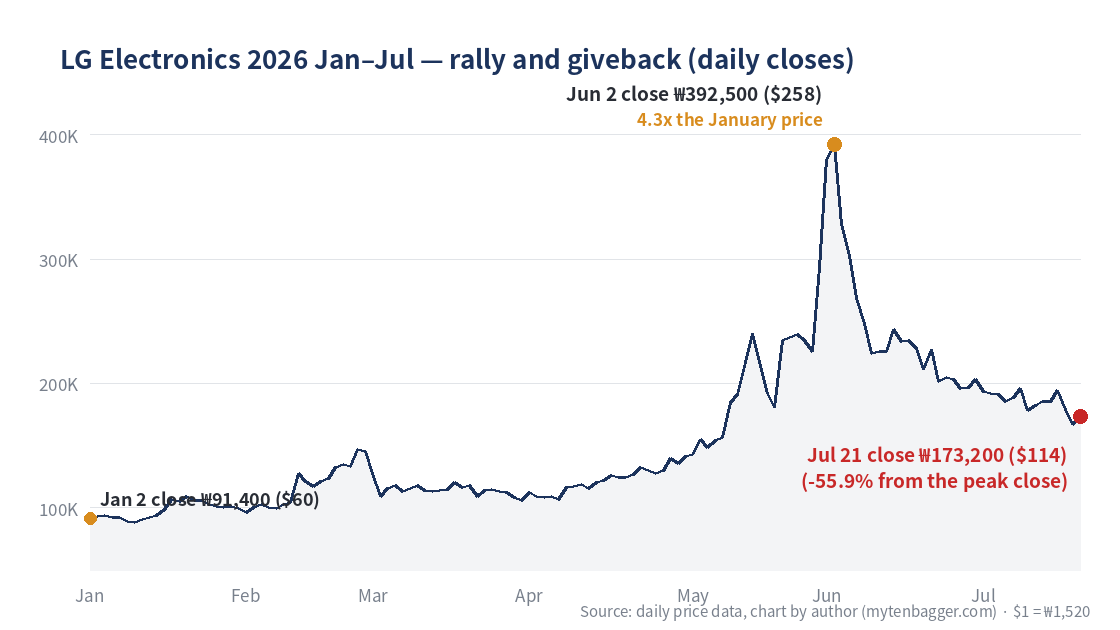
LG Electronics stock closed at ₩173,200 (about $114) on July 21, down 55.9% from its June 2 closing peak of ₩392,500 — my math, at ₩1,520 per dollar. That happened while first-half operating profit, at ₩3.25 trillion ($2.1B), already beat all of last year. I read the gap as the market settling out a robot story, not rejecting the earnings. I hold no shares, and the late-July earnings call is my first checkpoint before that changes.
Here is the question that pulled me back into this name: how does a company print its best second quarter ever and trade lower two weeks later? That is LG Electronics stock in July 2026. On July 7 the company pre-announced Q2 revenue of ₩23.83 trillion (about $15.7B) and operating profit of ₩1.58 trillion ($1.04B) — roughly 50% above the market’s ₩1.06 trillion consensus, as reported by Korean daily Hankook Ilbo. The shares bounced for two sessions and then gave the whole bounce back. The obvious answer is “the robot bubble is deflating.” Obvious answers make me suspicious. If something underneath the deflating story is quietly making real money, that something deserves its own valuation math.
I know who searches for this ticker in a week like this. Someone who bought in the ₩300,000s during the June euphoria and is sitting on a 40% hole, wondering whether to average down or surrender. Someone who watched from the sidelines, like me, and now wants to know if a 56% markdown on record earnings is the entry the June chasers never got. I can’t answer either question for you. What I can do is show you exactly how I separated what this company earns from what it promises — because that separation, not the drawdown percentage, is what my own decision hangs on.
Contents
LG Electronics Stock: From ₩392,500 to ₩173,200 in Seven Weeks
Quick scene-setting for readers who don’t follow Seoul’s main board. LG Electronics trades on the KOSPI, the senior market of the Korea Exchange, under ticker 066570. It is the global appliance and TV maker most Americans know from their laundry room — and in 2026 it briefly became Korea’s hottest AI-adjacent trade. The stock started the year around ₩100,000 ($66). Then the story machine started. In late April, CEO Ryu Jae-cheol met Nvidia senior director Madison Huang. In late May, Bank of America lifted its price objective to ₩350,000 (about $230). On June 8, Jensen Huang himself visited Yeouido — Seoul’s financial district — and the next day Citi went to ₩400,000 ($263). Per Korean outlet Bizwatch’s June 10 roundup, Citi’s case framed LG as a comprehensive robot-solutions provider positioned to absorb physical-AI demand, while BofA anchored on three axes — robots, AI data-center cooling, and vehicle components — plus long-term work with U.S. big tech, with LG’s appliance-bred motor know-how and the Bear Robotics service-robot unit as supporting cast.
The market front-ran the whole storyline. On June 2 the stock closed at ₩392,500 ($258) — nearly four times the January price. Then the giveback: in the first three sessions from June 4 it shed roughly 31% from the June 2 close, on profit-taking and faded event momentum, per Korean daily Geumgang Ilbo’s June 8 tally. By July 6 it sat at ₩185,700, down 52.7% from the peak — and on the same day Doosan Robotics, Korea’s flagship robot pure-play, was also down more than half from its high, as Seoul Economic Daily noted. Everything wearing a robot name tag slid together. July 21 close: ₩173,200, a 55.9% drawdown from the peak close by my math — though still up roughly 70% year to date, which is only fair to write down next to the crash number.
I’ll admit the June ride stung a little. I watched those alerts stack up one evening and told myself it was all “Nvidia-adjacency premium.” I keep half of that verdict. The fuel was story, yes. What I missed — and I only saw it when I pulled the segment table later — was how hard the underlying business was inflecting while the story did the driving.
Record Earnings, a Two-Day Bounce — What LG Electronics Stock Is Settling
The numbers first, all from company disclosures. Q1 2026 final results (April 29 earnings call, transcribed in full by Korean trade press The Elec): revenue ₩23.73 trillion ($15.6B), operating profit ₩1.67 trillion ($1.1B), a 7.1% operating margin. Q2 2026 preliminary (July 7): revenue ₩23.83 trillion, operating profit ₩1.58 trillion, up 147% from a year earlier. First-half operating profit: ₩3.25 trillion ($2.1B) — versus ₩2.48 trillion ($1.6B) for the entire year of 2025. The company said the beat came despite booking voluntary-retirement costs, crediting cost discipline and its handling of U.S. tariffs, as paraphrased from the Korean-language release coverage. Premium appliances, TVs, peak-season air conditioning, the vehicle unit, and webOS subscription revenue all contributed.
Now the tape. The stock closed the announcement day up 2.3%, added 2.9% the next day, then dropped 9.0% in a single session on July 9 and spent the following ten days drifting in the ₩170,000s — all my arithmetic off daily closes. A 50% earnings beat, absorbed in two sessions. My read: the market is not pricing this quarter at all. It is still settling the residual value of the robot story it bought in June. When earnings strength and price direction decouple like this, the decoupling can run longer than feels reasonable — which is exactly why I am not rushing. NAVER, which I covered at its own 52-week low, has been running the same record-earnings-but-unloved experiment for months.
The sell-side spread tells the same story from another angle. Citi at ₩400,000, BofA at ₩350,000, and Meritz Securities analyst Yang Seung-soo — who on July 7 raised his objective from ₩120,000 all the way to ₩260,000 ($171) while keeping his Buy call, per Money Today — sit more than two-to-one apart depending on how much future robot and cooling business each is willing to capitalize. I adopt none of those numbers. The width of that range is the data point: nobody agrees how much story is still embedded in this price.
One more framing number. On 2025 full-year earnings, the stock trades near 32x — a multiple I computed off the filed financials, and a distorted one, because last year’s profit was the weak denominator this year is demolishing. What this year’s denominator will actually be, I could not pin to a named broker’s full-year estimate in this round of research. I flag that as a hole rather than papering over it.
The Chiller Business Is Already Making Money — My Read of the Segments
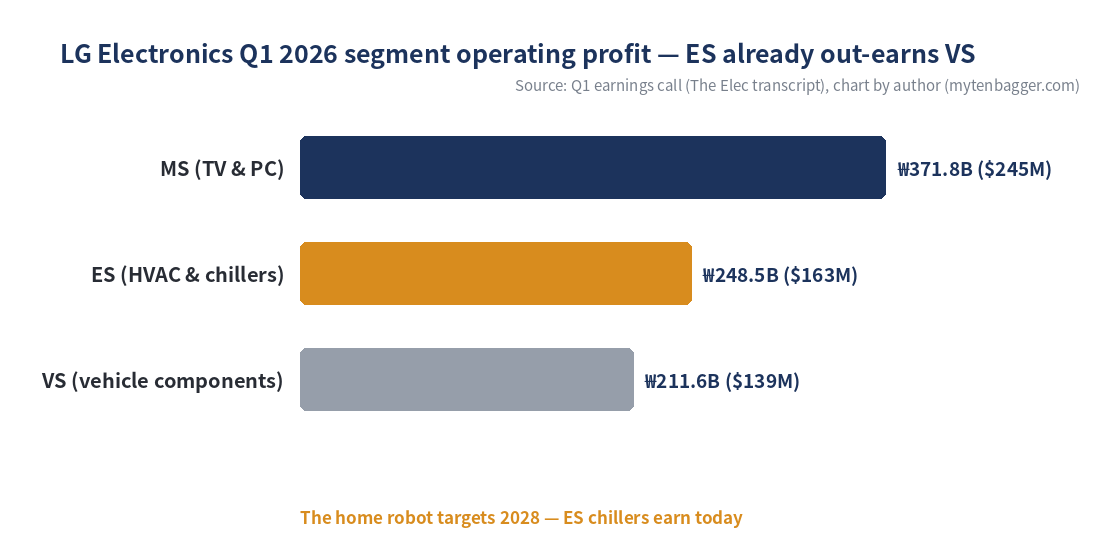
This is the part I actually want on the record. Line up the Q1 segment operating profits from the earnings call (The Elec transcript): MS — the TV and PC unit — earned ₩371.8 billion ($245M). ES, the HVAC division that houses data-center cooling, earned ₩248.5 billion ($163M). VS, the vehicle components unit, earned ₩211.6 billion ($139M) in what the company called its best quarter ever. Read that again: the division the market treats as a “future story” already out-earns the record-setting auto business, on ₩2.82 trillion ($1.86B) of revenue — an 8.8% margin by my math, above the company-wide 7.1%.
The margin ranking makes the point even cleaner. Off the same call numbers, MS earned about 7.2% on its ₩5.17 trillion of TV and PC revenue, and VS earned about 6.9% on ₩3.06 trillion — both my divisions, both respectable. ES beat them both. The HVAC division is not just present at the AI table; it is currently the most profitable of the three segments the company broke out that quarter. The home appliance flagship HS, for its part, posted ₩6.94 trillion in revenue, its best quarter on record, though the call did not disclose its standalone profit — a blank I’m noting rather than filling. None of this is exotic hidden data. It sat in a public earnings call transcript while the market spent seven weeks arguing about robots.
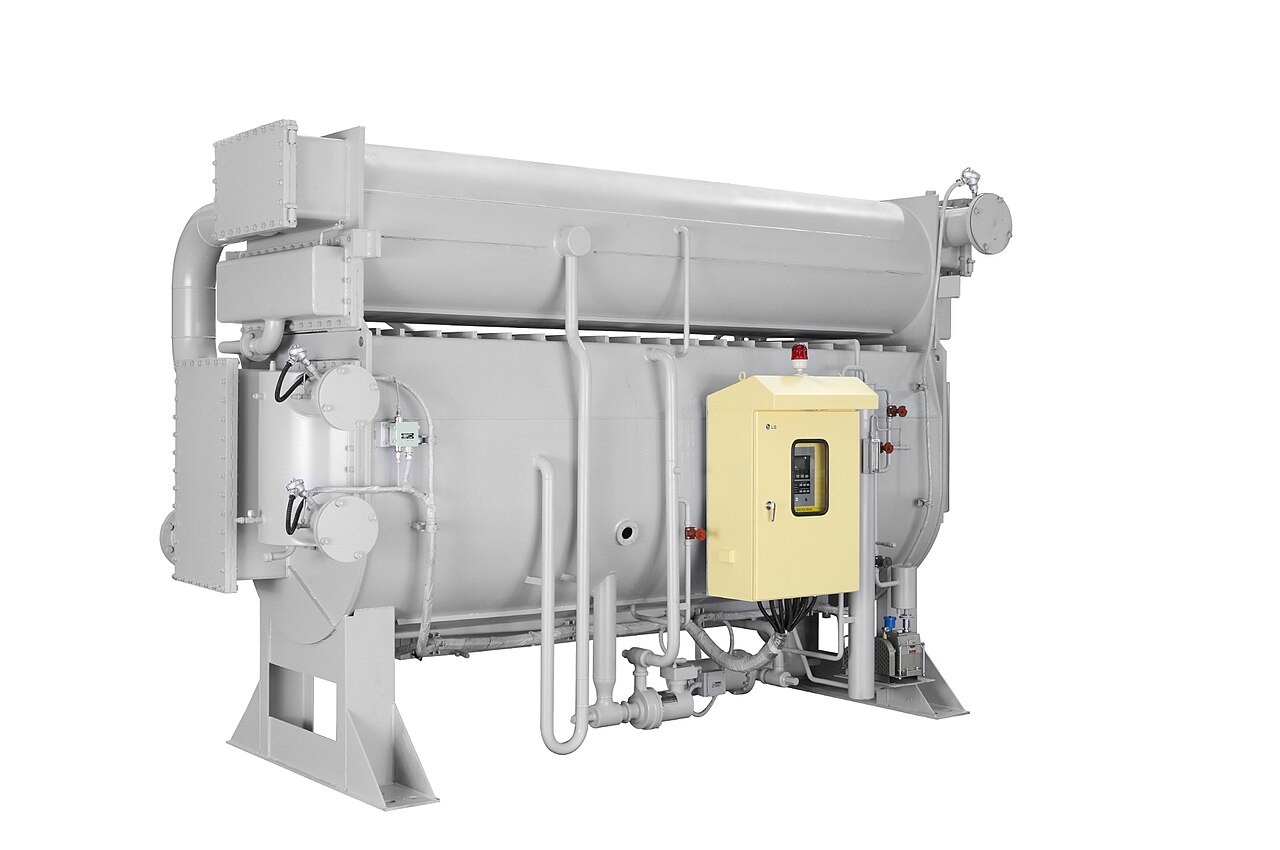
The company’s own timeline is worth restating precisely. Management said on the April call that data-center cooling revenue roughly tripled year over year in 2025, and that it expects the chiller business to reach its ₩1 trillion (about $660M) revenue milestone early — ahead of the original 2027 goal. Standard chillers run on roughly six-month lead times after an order, custom units about nine. And there is a second product lane: liquid-cooling CDUs undergoing quality testing with an AI GPU customer, per the Meritz note as reported by Money Today. The home robot, meanwhile, is targeted for commercialization in 2028. Same “AI story” umbrella, completely different tenses — one business earns now, the other is a promise two years out. June’s rally bought them as one lump; July’s unwind is selling them as one lump. I think that lumping is lazy, and I say that as someone who lazily filed this company under “robot stock” myself until the segment table corrected me.
The robot is a 2028 promise. The chiller out-earned the car business in Q1. The market is currently selling both at the same price.
The honest counter-ledger, because a journal without one is just cheerleading. First: a quality test is not a contract. The Meritz note describes a North American hyperscaler in the final stage of qualification, with revenue starting six to nine months after a definitive order. I have heard “final stage of testing” in other industries a year before anything was signed. Until a contract hits the disclosure system, this is expectation, not revenue. Second: second-half seasonality. Unwinding the reported 71.3% first-half growth rate implies 2025’s second half produced only about ₩580 billion ($380M) of operating profit — my back-calculation, not a filed number. If that thin-second-half body type repeats, the full-year picture will disappoint people annualizing the first half. Third: the India subsidiary — which listed separately in Mumbai last year — posted record quarterly revenue in its May release while net income fell more than 8%, per Korean daily Financial News. Growth markets do not automatically deliver profit quality.
What Vertiv’s 73x Says About LG Electronics Stock at 32x
Here is the global comparison I kept coming back to. Vertiv, the NYSE-listed data-center power and cooling pure-play, trades at a $112 billion market cap — 73x trailing earnings, 43x forward — on $10.2 billion of 2025 revenue, per stockanalysis.com data as of the July 20 close. LG Electronics, the whole company, is worth about $18.6 billion at today’s price, on 2025 revenue of roughly $59 billion. Let me be precise about what I am not claiming: LG does not deserve Vertiv’s multiple. Vertiv is a focused, higher-margin machine and its entire income statement is the AI data-center trade; LG’s chiller line is a slice of one division inside a sprawling appliance company. But the asymmetry is still striking. The market pays 73 times trailing earnings for pure exposure to the exact market LG’s ES division is entering with tripled revenue and an early milestone — while pricing all of LG at 32 times a depressed denominator and, judging by seven weeks of selling, treating the cooling business as part of the deflating story rather than the surviving one. If even a modest hyperscaler contract lands, the sum-of-parts conversation starts itself.
One trap I want to defuse in advance: do not annualize the first half. Doubling the ₩3.25 trillion half-year profit gets you a seductively cheap forward multiple, and that arithmetic ignores the company’s own history — the reverse-engineered ₩580 billion second half of 2025 says this P&L breathes seasonally, with marketing-heavy holiday quarters eating margin. Vertiv’s 43x forward is at least anchored on analyst estimates; my LG forward multiple would be anchored on a guess. That asymmetry of confidence, more than any single number, is why the comparison informs my watching rather than triggers my buying.
The tariff file deserves its own paragraph, because it cuts both ways. On the April call, management fielded the 25% U.S. tariff question — finished goods containing steel and aluminum — and answered that its diversified North American production footprint keeps additional exposure limited. The July release then credited “tariff response” as one reason profitability held. Twice now, the first-half numbers have sided with management’s version. I still hold the claim at arm’s length: it is the company grading its own homework, and the risks management itself listed in April — prolonged geopolitical conflict feeding oil and raw-material costs, supply-chain-driven demand swings — do not need a tariff headline to bite an appliance maker in the second half.
A practical note for U.S. readers, since this comes up every time I write about Korea: LG Electronics has no U.S.-listed ADR. The Mumbai-listed India subsidiary is a different security with different economics; the parent on the KOSPI is where the chiller-versus-robot repricing plays out. Currency matters too: my dollar figures throughout use ₩1,520 per dollar, and a weaker won quietly shrinks dollar returns even when the local price goes nowhere.
Three Paths for LG Electronics Stock — My Odds
My base case — the operating business builds the floor (45%)
The story liquidation finishes near current levels, the late-July final results show ES holding its Q1 earning power, and a chiller contract materializes during Q3. The market slowly refiles LG from “robot theme” to “appliance company whose cooling division earns real money,” and the price rebuilds from the operating floor. In this path, today’s ₩173,200 sits only a notch above the ₩150,000s where the stock traded in early May before the Jensen Huang rally — meaning the story premium is nearly settled out. At about $18.6 billion of market cap, 1.3x book, with foreigners holding roughly 29% of the register, the valuation grammar is back to pre-rally form.
Where I’d be wrong — the unwind swallows the operating story too (35%)
Theme liquidations rarely stop at fair value. If everything robot-tagged stays orphaned, if the second half re-runs 2025’s thin seasonality (that ₩580 billion back-calculation), and if the tariff or raw-material variables from the paragraph above start biting, then record earnings coexist with a grinding slide toward the January range. The supply-demand tape already leans this way: since late June, foreign and institutional flows have rarely aligned into sustained buying. Appliances are, in the end, a demand business — this path needs nothing to go wrong with the chiller story to play out, which is precisely what makes it dangerous to dismiss.
The tails (20%)
Best case (15%): a disclosed hyperscaler contract and a fresh robot catalyst land in the same quarter, and the upper half of that sell-side range gets quoted again. Worst case (5%): the qualification quietly stalls and appliance demand rolls over together — the 2025 earnings body returns, and the 32x trailing multiple stops being an illusion.
My Checkpoints, In Order — the Late-July Call, Then a Contract
I am running this one as a sequence, not a shopping list. I do not put money on a later stage before an earlier stage answers.
Stage one — the late-July final results and conference call. Two lines only: does ES hold the earning power it showed with ₩248.5 billion in Q1, and does management’s cooling-order language move forward or backward from April’s “₩1 trillion milestone early” framing? The preliminary release carried no segment detail, so this call is where my whole chiller-versus-robot thesis meets its first real data. If ES cracks and the order talk goes vague, the frame I built this post on goes back to the shop — and I stop waiting for stage two.
Stage two — a contract inside Q3. The Meritz-described “final-stage qualification” has to become a disclosure or a signed announcement. Given the six-to-nine-month lead time to revenue, no Q3 contract means the early-milestone timeline starts slipping as a whole. If stage one is green and stage two lands, the ₩150,000–160,000 area ($99–105) — the pre-rally range, near the 120-day average — is where I would consider a small scouting position. Chasing above that is not my trade.
Stage three — the year-end dividend direction. Per regulatory filings, the annual dividend has climbed ₩700 → ₩800 → ₩1,000 → ₩1,350 (about $0.89) over three straight increases. At under 1% yield on today’s price — my division — this is no income stock. But a fourth consecutive raise would tell me management trusts the cash flows behind the record P&L; a freeze would tell me something too. For context, the payout has been running at roughly a quarter of earnings by my read of the screening data off the filings — low enough that a raise is a choice about confidence, not a strain on the balance sheet. In a year when Korean regulators keep pushing listed companies toward better shareholder returns, how LG plays this card is a small but honest tell.
So, for the record: I own no LG Electronics today and I am not buying at ₩173,200. The record first half is real. What is not yet knowable is how much robot-story residue is still priced in, and the late-July call plus a Q3 contract will answer that better than my guessing can. What I am keeping from this round of work is the refiling — out of the robot-theme folder, into the “chiller already earns” folder — and a two-stage tripwire that tells me when to act instead of how to feel. I will write the follow-up when stage one reports. What you do with any of this is, as always, your call.
Sources:
Hankook Ilbo — Q2 preliminary results (Korean, July 7) ·
The Elec — Q1 2026 earnings call transcript (Korean, April 29) ·
Money Today — Meritz Securities note coverage (Korean, July 7) ·
Bizwatch — Citi and BofA objectives (Korean, June 10) ·
Seoul Economic Daily — LG and Doosan Robotics drawdowns (Korean, July 6) ·
Financial News — India subsidiary quarterly results (Korean, May 22) ·
stockanalysis.com — Vertiv (VRT) statistics as of July 20
Related reading
- Celltrion Stock: Record Earnings, 52-Week Low
- Korea Zinc Stock: Record Earnings Meet a 50% Governance Discount
- Dongwon Industries Stock: Capex Follows the Cash It Earns
- Hyein Stock Cleared Seven Screens on Two Share Counts