Daesang Earnings: A Provision 60% Above the Final Regulatory Fine
The largest single number in Daesang’s 2025 accounts is one the company wrote down itself, months before any regulator told it what to pay. I want to walk through what that means for anyone looking at Daesang stock today, because every profitability figure on the screen still runs through it.
Contents
One line item, priced twice
Daesang Corp (KRX: 001680) is a Korean food and ingredients group listed on the KOSPI, Korea’s main board for large and established companies, as opposed to the KOSDAQ where smaller and growth-stage names trade. Its consumer brands, Chung Jung One and Jongga, sit alongside an industrial arm that grinds corn into starch, sweeteners and lysine. In 2025 the group booked its largest revenue ever, KRW 4.40 trillion (roughly USD 3.11 billion), along with an operating profit of KRW 169.3 billion. It also reported a net loss of KRW 303.1 billion.
I spent a while on the gap between those last two figures, which comes to KRW 472.4 billion by my calculation. Korean press coverage gives two causes at once: weakness in the ingredients division, and a price-fixing case at the Korea Fair Trade Commission. I think those two need separating, because only one of them describes money that actually moved.
| Date | What happened | Amount (KRW bn) | Where it sits now |
|---|---|---|---|
| Dec 31, 2025 | Company books a provision for an expected fine | 375.3 | Inside the reported 2025 net loss |
| Jul 7, 2026 | Regulator sets the actual fine | 234.1 | Not yet in any published ratio |
| Difference | Over-accrual, by my calculation | 141.2 | Unresolved |
| Aug 14, 2026 (Fri) | Half-year report due, provision note included | n/a | The document I am waiting for |
Where the Daesang stock loss actually came from
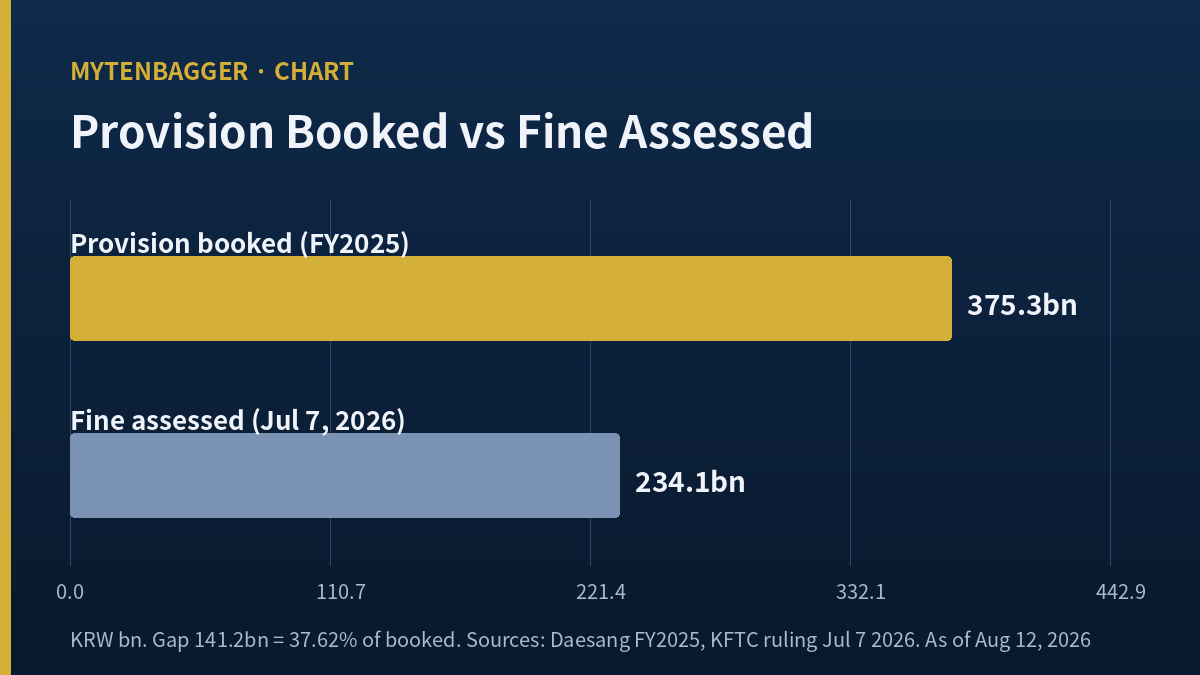
At the end of 2025 the group’s other current provisions stood at KRW 384.6 billion, against KRW 9.6 billion a year earlier, as reported by the Korean outlet Bloter on April 16, 2026. Of that balance, KRW 375.3 billion represented management’s own estimate of a fine the Fair Trade Commission had not yet imposed. The company filed it under a line called other provisions.
I read that as conservative accounting and I do not hold it against the company. What interests me is the consequence. A single estimate, made by the party being investigated, became the dominant number in the income statement for a year in which the underlying business was profitable at the operating line.
The quarterly split makes this concrete. Discrete net income for the first three quarters of 2025 ran KRW 28.4 billion, KRW 18.2 billion and KRW 22.4 billion. All three were positive. The fourth quarter shows a discrete net loss of KRW 372.1 billion, which I obtain by subtracting the nine-month cumulative figure from the full-year total. That single quarter accounts for 99.15% of the provision amount by my calculation. Whatever else happened in those three months, this one entry defines them.

What the regulator decided on July 7, 2026
The Korea Fair Trade Commission ruled on the starch and sweetener price-fixing case on July 7, 2026 (Tue). Korean press reporting from The Fact on July 9, 2026 (Thu) describes conduct running from May 2018 to October 2025, seven years and five months, across thirteen episodes of coordinating the size and timing of price moves. Total penalties across four companies came to KRW 747.6 billion, the largest the regulator has issued in this category.
The allocation matters more than the headline. Daesang drew KRW 234.1 billion, the largest of the four and 31.31% of the total by my calculation. Samyang Corp took KRW 210.3 billion, Sajo CPK KRW 200.1 billion, and CJ CheilJedang KRW 103.0 billion. Adding the four gives KRW 747.5 billion, one billion won short of the reported total, which I take to be rounding in the individual figures; I have not read the original decision document.
So the company’s own estimate exceeded the assessed fine by 60.32%, and the difference of KRW 141.2 billion equals 37.62% of what was booked. The Fact wrote that Daesang had set the amount at a maximum and was therefore in a manageable position, and my reading points the same way.
CJ CheilJedang is worth a sideways glance here, since it appears on the same decision. I looked at the gap between CJ CheilJedang’s operating profit and its net loss earlier, and that gap ran to roughly KRW 1.65 trillion, which the KRW 103.0 billion fine explains only a small fraction of. Two companies on one decision, one of them with a loss the case largely accounts for and one of them with a loss it barely touches. That contrast is why I do not treat cartel exposure as a general explanation for Korean food-sector losses.
Daesang stock screens on numbers that predate the ruling
Shares closed at KRW 18,320 on August 11, 2026 (Tue), the most recent session before I wrote this. Multiplied by 34,648,884 shares outstanding, that gives a market capitalization of KRW 634.8 billion, about USD 448 million. The stock sits at 74.17% of its 250-day intraday high of KRW 24,700 and 15.37% above the KRW 15,880 low, both computed from that close. On a closing basis the peak was KRW 24,000 on February 23, 2026 (Mon) and the trough KRW 15,980 on June 26, 2026 (Fri), leaving the shares 25.83% below the peak.
One housekeeping note, because it changes some cells. The indicator feed I use, sourced from Kiwoom Securities and stamped August 10, 2026 at 20:12, anchors on the previous session’s close of KRW 18,370. Its market capitalization of KRW 636.5 billion, its price-to-book of 0.62 and its dividend yield of 4.58% all derive from that anchor. I recomputed every price-derived figure in this piece from the August 11 close and flag the vendor-anchored cells where I quote them. The 0.27% difference changes nothing structural, and I would still rather label it.
The profitability column is where the ruling has not landed. Return on equity reads negative 24.4%. Earnings per share reads negative KRW 8,447. The price-to-earnings cell computes nothing at all. The seven-metric checklist I keep scores three of seven. Every one of those runs on trailing twelve-month earnings, and that window still contains the fourth quarter of 2025. In other words, the screen is still describing a world in which the fine is KRW 375.3 billion.
The balance sheet shifted for a related reason. The debt-to-equity ratio moved from 142.46% at the end of 2024 to 217.17% at the end of 2025, and stood at 232.86% at the close of the first quarter of 2026. Liabilities grew by KRW 319.9 billion over that year, and equity shrank by KRW 350.7 billion. Holding equity flat and applying only the liability increase produces 164.56%; holding liabilities flat and applying only the equity decline produces 188.00%. The second effect is 2.06 times the first by my calculation, so most of the deterioration traces back to the provision eating into book value.
Interest cover is worth one caveat while I am here. The feed shows 2.63 times, which I traced to first-quarter 2026 operating profit of KRW 57.0 billion over the same quarter’s interest expense of KRW 21.7 billion. On a full-year 2025 basis the figure is 2.21 times. Anyone comparing this to Lotte Chilsung, where interest consumes half of operating profit, should check which period each vendor ratio covers before lining the two up.
What Daesang stock looks like operationally in 2026
First-quarter 2026 results are already filed. Revenue of KRW 1,109.9 billion came in 1.82% below the prior-year quarter, operating profit of KRW 57.0 billion was down 0.46%, and net income of KRW 32.6 billion rose 14.77%. The operating margin of 5.14% edged past the 5.07% of the first quarter of 2025 and is the highest first-quarter margin since 2022. Management told Korean media it would focus on cash-generating products and supply chain optimization, as reported by Digital Daily on May 16, 2026 (Sat).
Forward visibility is thin, and I would rather say so than dress it up. Newsway reported on July 31, 2026 (Fri) that brokerage estimates put second-quarter 2026 consolidated revenue between KRW 1,070 billion and KRW 1,110 billion with operating profit between KRW 37 billion and KRW 41 billion, and full-year operating profit modestly above the KRW 169.3 billion of 2025. That article did not name the houses behind the range. The one named report I located, a Hana Securities earnings review dated December 11, 2025 and titled around weakness in the ingredients division, was behind an access restriction, so I could not lift its figures. The forward fields in my own indicator tool for estimated earnings per share, forward multiples and peer multiples are all empty, as they have been for every Korean mid-cap I have run through it.
What a corn grinder outside Korea says about Daesang stock
To keep the cartel story from swallowing the operating story, I picked a comparison from outside Korea: Ingredion Incorporated (NYSE: INGR). It grinds corn into starches and sweeteners, sells into overlapping end markets, and carries no exposure to this Korean decision. My question was whether Daesang’s ingredients weakness is local to this case or global to the product.
Ingredion reported second-quarter 2026 results on August 6, 2026 (Thu). Net sales of USD 1,850 million rose 1%. Reported operating income of USD 188 million fell 31%, and the reported operating margin came in at 10.2% against 14.8% a year earlier. The segment closest to Daesang’s ingredients arm, Food and Industrial Ingredients for the U.S. and Canada, posted sales of USD 488 million, down 7%, and operating income of USD 58 million, down 33%, for a segment margin of 11.89% by my calculation.
That settles the question for me. Corn grinding is under pressure well beyond Korea, so explaining Daesang’s lysine and starch weakness through the cartel case would be wrong. The two coincided in one fiscal year and have separate causes. I include the comparison to fence in my own argument: even if the entire over-accrual reverses, the earning power of the ingredients division does not improve by a single won.
Three limits on that comparison. Ingredion runs a December fiscal year, so the quarters align, but the product mix does not; Daesang derives more than half of revenue from branded consumer food while Ingredion is close to a pure ingredients business; and I worked from the company’s earnings release, having not pulled the underlying quarterly filing.
Eight ways I could be wrong
1. The fine is still cash going out. Even with a reversal, KRW 234.1 billion has to be paid. That equals 36.88% of the current market capitalization and 138.29% of 2025 operating profit by my calculation. The accounting timing moved; the obligation did not.
2. I do not know when a reversal lands. The decision came on July 7, 2026 (Tue), and the second quarter closed on June 30. Whether that qualifies as an adjusting event after the reporting period is an accounting judgment call I am not qualified to settle. It could appear in the half-year accounts or in the third quarter.
3. Litigation would change the picture. Samyang Corp and Korea Sugar have already filed administrative suits and suspended payment, with proceedings due to begin in late August 2026. Daesang has said only that it will respond after receiving the final written decision. If it litigates, the provision may stay where it is and legal costs accrue on top.
4. I calculated the fourth-quarter figure myself. The KRW 372.1 billion discrete net loss comes from subtracting nine-month cumulative results from the annual total. No filing states that number directly, and it is the one value in this piece I could not confirm against a primary document.
5. A widely quoted ratio divides by a figure I could not verify. The Fact put Daesang’s fine at 155.5% of operating profit, working from an operating profit of KRW 150.5 billion. The consolidated figure filed with the regulator is KRW 169.3 billion, which yields 138.29% by my calculation. The discrepancy may reflect a parent-only basis or a different year, and since I could not settle it, I give both.
6. Prior-year net income also varies by source. CEO Score Daily reported on April 16, 2026 (Thu) a swing from KRW 75.7 billion of net income to a KRW 303.1 billion loss, while the consolidated 2024 figure is KRW 96.7 billion. I could not confirm whether the smaller number is the controlling-interest measure, so both appear here.
7. Criminal and civil exposure sits outside the accounts. An arrest warrant sought against chief executive Lim Jung-bae was rejected by the Seoul Central District Court on grounds that the case was insufficiently established and that the right to a defense needed protecting, according to Korean press reporting from March and April 2026. That does not end the criminal process, and a confirmed cartel finding can invite damages claims from customers, none of which appears in any figure above.
8. My argument says nothing about the operating decline. Operating profit fell 4.33% from KRW 176.9 billion in 2024 to KRW 169.3 billion in 2025, and the Ingredion comparison suggests the pressure behind it is structural. Getting the provision arithmetic exactly right leaves that decline entirely intact.
Numbers I left out of the Daesang stock case
Earnings multiples
Summing the last four discrete quarters of net income gives negative KRW 298.9 billion. Dividing by shares outstanding produces negative KRW 8,626 per share, 2.08% away from the vendor’s negative KRW 8,447, which suggests a controlling-interest basis I could not confirm. While the fourth quarter of 2025 sits in the value being divided, this whole family of ratios describes an accounting entry instead of a business.
Dividend
The declared dividend is KRW 850 per share. The vendor shows a 4.58% yield, the August 11 close implies 4.64% and the August 10 close implies 4.63%, so three anchors give three answers. The dividend record carried an August 8, 2026 update stamp, which likely explains the third. I left the payout out of the argument entirely.
Market and sector performance
Over the year to August 11, 2026, across 244 trading sessions, the stock fell 22.7% while the KOSPI rose 97.88% and the food sector index fell 10.06%. That is 120.58 percentage points behind the index and 12.64 points behind the sector, ranking 54th of 77 sector constituents, with a beta of 0.131. Decomposing the shortfall assigns 89.5% of it to the sector and the remainder to the company. It does not bear on the provision question, so it stays here.
EBITDA
The feed’s EBITDA field reads 57,011 in millions of won, identical to first-quarter 2026 operating profit of KRW 57.0 billion. No depreciation has been added back, so I discarded the field. This is the third consecutive company where I have found that same defect, and I no longer use the field without checking it against operating profit first.
Cash flow
Operating cash flow of KRW 188.1 billion in 2025 was almost unchanged from KRW 187.7 billion in 2024, and free cash flow of KRW 50.9 billion improved on KRW 39.8 billion. The income statement broke while the cash flow statement held, which restates the fact that a provision is not a payment. Bloter published free cash flow of KRW 47.2 billion for the same year, and I could not reconcile the capital expenditure definition behind the difference.
Share count and par value
Paid-in capital of KRW 34.6 billion divided by 34,648,884 shares gives KRW 998.6, close to a par value of KRW 1,000 without landing on it, because a separately listed preferred class also draws on paid-in capital. I did not retrieve the preferred share count, so that check stays open. No stock split, bonus issue or buyback cancellation appeared in the last six months of filings.
Book value per share
Book value per share of KRW 29,733 multiplied by the share count gives KRW 1,030.2 billion, while consolidated equity at the end of the first quarter of 2026 was KRW 1,116.1 billion, a 7.69% spread that I read as non-controlling interests. Since I could not confirm it, the price-to-book ratio appears in this piece only as the vendor reports it.
Who decides what Daesang stock is worth
What strikes me about it is that my own view has very little to do with the company’s operations right now. The number that determines whether the last twelve months read as a disaster or a manageable year was set by the Fair Trade Commission on July 7, 2026 (Tue), and the number that determines whether the excess comes back is an accounting judgment and, possibly, a court. Management can run the food division well and none of that will move the ratios on my screen.
That is an uncomfortable footing for committing capital, and it is why I have written no valuation into this piece. When the half-year report on August 14, 2026 (Fri) shows what the provisions note now says, the arithmetic becomes mine again and I can start pricing the business instead of pricing a legal process. Until then I am reading a filing calendar and a court schedule, and I would rather admit that than dress it up as analysis of a food company.
Prices and price-derived figures reflect the August 11, 2026 close of KRW 18,320 as checked at the time of writing, so the numbers can differ from live quotes. Financial statement figures are consolidated and filed with Korea’s electronic disclosure system. Where a vendor cell is anchored to the August 10 close of KRW 18,370 I say so in the sentence that uses it. USD conversions are approximate, at roughly KRW 1,415.9 per dollar on August 11, 2026, and every figure in this article is stated in Korean won first.
Sources: Korea’s Financial Supervisory Service electronic disclosure system, annual and quarterly filings · The Fact, July 9, 2026 (Thu) · Bloter, April 16, 2026 (Thu) · CEO Score Daily, April 16, 2026 (Thu) · HuffPost Korea, March 31, 2026 (Tue) · Newsway, July 31, 2026 (Fri) · Digital Daily, May 16, 2026 (Sat) · Ingredion second-quarter 2026 results · Seoul Finance, foreign exchange close for August 11, 2026 (Tue)