NAVER Stock at a 52-Week Low: Record Profit, AI Fear
I’ve been adding to NAVER stock in the ₩180,000s (~$131 at ₩1,400/$) through this year’s slide. Revenue and operating profit just hit a record Q1, yet the shares are pinned to a 52-week low — that gap is my thesis. The market is valuing NAVER as a search company about to lose its core to generative AI, and in doing so it’s handing me the Dunamu crypto merger and a US stablecoin bet at basically no cost. If AI monetization keeps slipping or commerce keeps bleeding share to Coupang, my read is wrong.
Everyone frames NAVER — Korea’s dominant search-and-commerce platform, the closest local analog to Alphabet — as the next victim of AI chatbots eating search advertising. I don’t dismiss that fear. But the thing that pulled me back into NAVER stock wasn’t search at all; it was a second board the company is quietly laying down inside its fintech arm, one the market hasn’t put a price on. KOSPI, Korea’s main index (think S&P 500), rallied hard over the past year. NAVER went the other way.
As of July 14, 2026, NAVER trades at ₩183,200 (~$131), a market cap near ₩28.8 trillion (~$20.6B), per Kiwoom Securities data. The 52-week high was ₩304,000 (~$217); the stock is down about 40% from there and roughly 29% over twelve months, while the index climbed. Meanwhile the money the company actually earns went up, not down. That mismatch is where my journal starts.
Contents
What the market is pricing into NAVER stock — a death sentence for search
At ₩183,200 the stock carries a P/E of 14.8 and a P/B of 1.02 (Kiwoom, July 14). For a company that all but monopolizes Korean search, commerce, and payments, and grows revenue in the double digits, that’s not a growth multiple — it’s what you pay for a bank or a telecom. The market’s reasoning compresses to one sentence: generative AI will hollow out the search fortress.
The fear isn’t baseless. In April, NAVER shut down the standalone version of its own HyperCLOVA X chatbot, and that optics left the impression the company had fallen behind in the global AI race, as Korean market coverage put it at the time. From there, the heavy AI spend started reading as pure cost rather than a growth engine. And as I’ll show, the earnings do carry that cost.
The market is valuing NAVER stock on “what’s left after AI takes search.” I’m valuing it on “search holds, and something new gets bolted on top.” That difference in framing is the whole 40% drawdown.
Honestly, I skipped this decline at first too. “Platform growth is maturing,” I figured, and moved on. Then I put the Q1 segment numbers into a spreadsheet and changed my mind. The share price was falling while the operating numbers were doing the opposite.
Why NAVER stock fell while the quarter set records
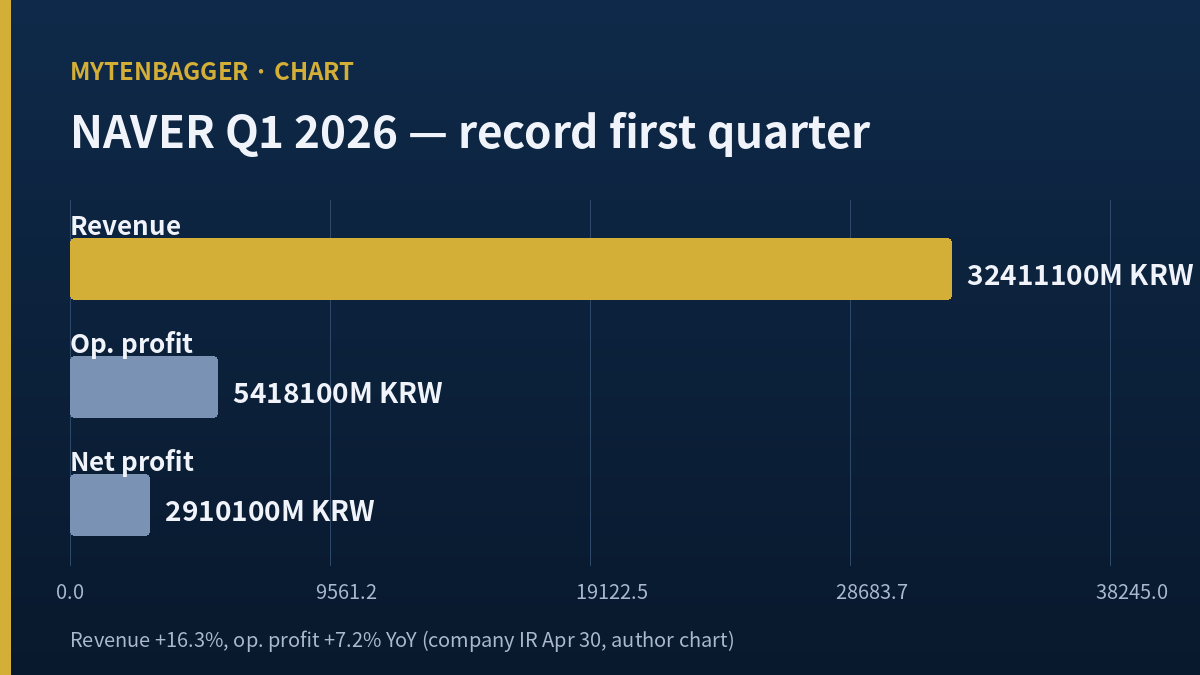
NAVER’s Q1 2026 was a record first quarter on the company’s own reporting: revenue of ₩3,241.1 billion ($2.3B), up 16.3% year over year, and operating profit of ₩541.8 billion ($387M), up 7.2% (NAVER Corp IR, April 30, 2026; Seoul Economic Daily). Net income, though, fell 31.3% to ₩291 billion ($208M). That split is the crux — top line and operating line at records, bottom line going backward.
The reason, per the company, is AI infrastructure. Buying GPUs and expanding data centers pushed infrastructure costs up 32.5% year over year and total operating expenses to the ₩2.7 trillion range, up 18.3% (AJU Press, April 30, 2026). Operating margin compressed to 16.7%. That’s exactly the figure the market reads as “AI equals cost.” I read it a little differently, and I’ll get to why.
Break it out by segment — the company reclassified into three units this year (Platform, Financial, Global), with search, ads, and commerce all sitting inside Platform — and the picture sharpens.
| Segment (Q1 2026) | Revenue | YoY | Note |
|---|---|---|---|
| Platform (search·ads·commerce) | $1.31B (₩1.84T) | +14.7% | ads $0.99B (₩1.39T, +9.3%); commerce services +35.6% |
| Financial | $328M (₩459.7B) | +18.9% | Naver Pay volume $17.3B (₩24.2T, +23.4%) |
| Global | $673M (₩941.6B) | +18.4% | C2C transaction volume +57.7% |
Sources: NAVER Corp Q1 2026 IR · AJU Press (2026-04-30). USD at ₩1,400/$ | As of: Q1 2026
The cell that stopped me was advertising. The market is selling the story that AI kills search ads — yet that same search-ad line grew 9.3% year over year. Those aren’t the numbers of a dying business. Commerce services grew 35.6%, and Naver Pay volume reached ₩24.2 trillion ($17.3B). This is data the company puts in its own filings, verifiable by anyone. The fear is qualitative; the rebuttal is quantitative. I weight the quantitative side.
The line I think gets buried is fintech. The Financial segment grew 18.9% to ₩459.7 billion ($328M), and Naver Pay’s transaction volume hit ₩24.2 trillion ($17.3B), up 23.4% (NAVER Corp Q1 2026 IR). That’s a payments business scaling in the low-to-mid 20s inside a company the market values like a no-growth utility. In the US, a payments network compounding at that rate trades at a premium multiple on its own; here it’s tucked inside a 14x P/E and, as far as I can tell, assigned almost nothing. When I model NAVER, I keep coming back to the idea that I’m being asked to pay for search-and-ads and getting the payments network, the commerce arm, and the AI capex thrown in. That’s the opposite of how the headlines read it.
One more thing. The AI the market reads only as “cost” is already showing up as revenue inside that ad line. NAVER is scaling an AI-driven ad-optimization tool called ADVoost, and the sell-side treats it as a growth driver: Hanwha Investment & Securities models Q1-style ad growth of 9.6% for Q2, citing ADVoost and commerce-ad strength (Hanwha, Kim So-hye, July 1, 2026). So AI is wearing two faces here — the GPU cost gnawing at net income, and the tool lifting ad pricing at the same time. The market is staring at the first face. I’m betting the second one compounds quarter after quarter.
I’ve watched this movie before. Alphabet — Google’s parent — got de-rated through 2023-2024 on the identical fear that ChatGPT would kill search advertising. Same logic: the core franchise falls to generative AI. Instead, Alphabet defended search and layered AI onto ads and cloud, and the scenario the fear was selling didn’t play out as scripted. I’m not claiming NAVER walks Alphabet’s exact path in Korea — the share structure and competitive intensity differ. But “AI ends the search company” is a narrative that has been priced in first and unwound later, and I keep that precedent as a map.
The card NAVER stock hasn’t priced — Dunamu and stablecoins
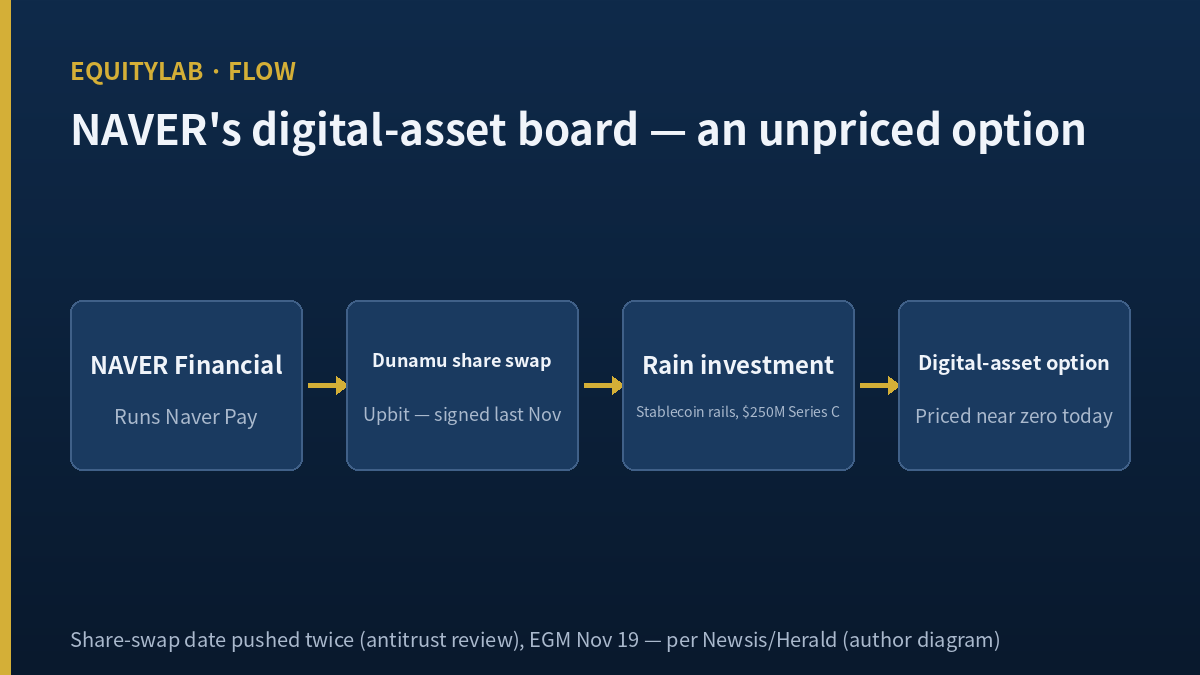
Here’s the real reason I picked this back up. The market sees a search company; the company is laying a second board in digital assets. Naver Financial is combining with Dunamu — the operator of Upbit, Korea’s largest crypto exchange — through an all-stock swap that Western coverage pegs at roughly $10.3 billion, in a deal both sides have now formally confirmed (The Block).
The path hasn’t been smooth. The stock-swap date has slipped from June 30 to September 30 to December 31, with the shareholder vote pushed to November 19, as the Korea Fair Trade Commission works through the combination review (Crypto Economy). Read alone, that looks like a negative — and Hana Securities framed “confirmation of the digital-asset new-business vision” as a precondition for the stock to re-rate (Hana Securities, Lee Jun-ho, May 20, 2026 report). In other words, it isn’t confirmed yet.
Here’s the picture I sketch. Dunamu’s digital-asset tech, plus Naver Pay’s payments-and-commerce user base, plus Rain’s cross-border rails. Bolt those together and you get a path from domestic simple-pay into cross-border settlement. This is still a “path,” not booked revenue — which is exactly why I call it an option rather than a conviction. And right now, NAVER stock carries that option at effectively zero. KB Securities put it plainly: at a ~14x 12-month-forward P/E, “new-business value is essentially unpriced” (KB Securities, Lee Ji-eun, July 7, 2026 report). I see that free option as the thing propping up my downside.
The option takes time, no argument. The company’s outline is to pursue a separate listing (IPO) within a year of closing the Dunamu combination, but with the swap slipping twice, that timeline has gone hazy (Crypto Economy). Layer on that legislation setting the regulatory foundation for the digital-asset business is flagged for the back half of the year, and the shape of Korea’s stablecoin rules is itself a variable. So I hold this card not as “it pops this year” but as an asymmetry: the loss is already in the price, the gain isn’t in yet. That’s why I keep using the word option.
To size why this matters at all: Dunamu runs Upbit, which dominates Korean crypto trading, and folding it into Naver Financial through a ~$10.3B all-stock swap doesn’t add a product line — it changes what Naver Financial is. Western trade coverage has framed the combination as one of the largest crypto-adjacent deals to come out of Korea, with a possible IPO of the merged entity as the exit the market is watching for (Yahoo Finance). Pair the domestic exchange leader with a payments base already moving ₩24.2 trillion a quarter, and the stablecoin rails NAVER bought into via Rain start to look less like a venture punt and more like the plumbing for a cross-border settlement business. None of that is in the 14x multiple. I don’t need it to be — I just need it to exist as optionality while I hold.
What the sell-side sees in NAVER stock, and the gap the market won’t buy
The Street’s numbers on this name sit well above the tape. Laid out:
- Hana Securities (Lee Jun-ho, May 20): Buy, ₩350,000 (~$250) — “advertising and commerce results are comfortable”
- KB Securities (Lee Ji-eun, July 7): Buy, ₩330,000 (~$236) — “new-business value essentially unpriced”
- Hanwha Investment (Kim So-hye, July 1): Buy, ₩300,000 (~$214) — “range-bound in the near term”
All three carry Buy calls, at 1.6-1.9x the current price. I’m not copying those figures onto my own scorecard — a brokerage’s number belongs to the brokerage. But three named analysts putting fair value near double the tape while the market shrugs and leaves the stock at its low — that gap itself is what a transactional searcher wants confirmed, and it’s why I can’t put this name down. When everyone is selling and named research is standing on the other side, I read that as a signal, not noise.
Shareholder returns back up the interest. For fiscal 2025 the company set a dividend of ₩2,630 ($1.88) per share, ₩393.6 billion in total, per its disclosure history — more than double the prior year’s ₩1,130. On the Q1 call the CFO flagged a share buyback-and-cancellation (with size to come in a filing). Tracing the dividend line through the filings, it sat flat at ₩1,205 (2023) and ₩1,130 (2024) before jumping to ₩2,630 (2025) — which reads less like a one-off and more like the start of a shift in the payout posture. Foreign ownership holding around 35% is, to me, another sign that at this price the selling hand and the holding hand are splitting.
On valuation, the peer lens is what makes the discount legible to me. Alphabet, the closest global mirror for a search-plus-ads-plus-cloud platform, has spent the past two years re-rating back up after its own AI scare; large-cap US internet platforms with double-digit growth rarely sit at a low-teens earnings multiple for long. Domestically, Kakao is the other Korean internet name investors bracket NAVER against, but Kakao doesn’t carry the same search-ad franchise or the payments scale. So when I see NAVER at ~14x forward earnings and 1.0x book with a growing payments arm and an unpriced digital-asset build, the number that looks wrong to me isn’t the growth rate — it’s the multiple. I could be early, and a cheap thing can stay cheap; but “cheap versus its own history and versus global peers” is the setup I keep buying, not fighting.
If I put rough odds on it — and these are my personal markers, not math — my base case, maybe half the weight, is that the spend rate peaks over the next two prints, margins stabilize in the 16% area, and the Dunamu close in December pulls the digital-asset option onto the board; in that world the discount narrows toward where the sell-side already sits. Perhaps a third of the weight is the drift case: AI monetization stays a couple of quarters out, commerce keeps costing more than it returns, and the stock grinds sideways in a range while I keep collecting a doubled dividend and adding slowly. The rest is the tails — a genuine re-rating if the stablecoin/settlement story lands faster than anyone models, or a real break if the Dunamu deal collapses and the AI spend never converts. I’m positioned for the first two and watching the third.
Where I could be wrong on NAVER stock
I’ve written mostly conviction so far, so let me set down honestly where I lose. Skip this and it’s cheerleading, not a journal.
First, a number that nags at me: ROE of 7.4% (Kiwoom). I usually want a double-digit return on equity, and NAVER is under that today. The AI-pressured net income explains most of it, but whatever the cause, the plain fact is that capital efficiency is ordinary right now. So my picture is conditional — not “it earns great today” but “the pressured profit normalizes and the option attaches.” If the condition doesn’t fill, a 1.0x book isn’t cheap; it’s fair.
The path I see as most likely is that through Q2 and Q3 the infrastructure-spend rate peaks and the net-income decline narrows, and if the Dunamu combination actually advances in that window, the market starts to re-price. Against that base case, three things break me.
One, the generative-AI monetization gap. Hanwha estimates Q2 operating profit ~6% below consensus and sees “at least two more quarters of a gap” before generative AI pays off (Hanwha, Kim So-hye, July 1). If revenue keeps arriving later than the GPU cash goes out, the net-income drop stops being a quarter or two and becomes structural — and my “spend equals future revenue” read is just wrong.
Two, commerce. NAVER held domestic share, but the recurring knock is that it can’t beat Coupang’s logistics head-on (Seoul-market coverage). If free shipping and membership defense keep marketing spend grinding down profit, that 35% commerce growth gets re-rated as “growth you paid for.”
Three, the Dunamu deal slipping a third time or falling apart. That would take the option I described below zero. The first two are earnings problems; this one is a story problem.
So my breakpoint isn’t a single price line — it’s the weight of three things, and they don’t weigh the same. Earnings is heaviest: whether operating margin holds the 16% area through Q2 and Q3 is the spine of this, and if that snaps, no amount of good news elsewhere keeps me adding. Dunamu progress is next — it’s the trigger that lets the story re-price. Lightest is the first quarter of visible AI revenue, because that was always going to take time and its absence today doesn’t break the thesis. Put simply: while the heavy end holds, I let the light end arrive slowly; if the heavy end goes, good news at the light end is no comfort to me.
How I’m holding NAVER stock right now
I’ve been accumulating NAVER in the ₩180,000s and I’m keeping that stance. My reasons stack three deep: the earnings-versus-price mismatch of a record top and operating line against a 52-week low; the shareholder return of a doubled dividend and a buyback-and-cancellation at 1.0x book; and the Dunamu/stablecoin option the tape prices at zero. Flip side — if AI monetization keeps slipping and commerce proves to be growth-you-paid-for, my picture breaks.
NAVER reports on a calendar fiscal year, so the Q2 print lands in the summer and the year closes in December alongside the Dunamu date. One caveat I’d flag for a dollar-based holder specifically: buying a KOSPI name means carrying won exposure on top of the equity call. Everything above is priced in won and converted at ₩1,400/$ for reference; if the won weakens against the dollar while I’m right on the stock, some of that gain leaks out in translation, and if it strengthens, it adds to the return.
This isn’t me telling you to do anything. It’s my own bet, put in public, and I’ll be watching the Q2 print and the Dunamu date right alongside you. How would you read this mismatch?