Why JYP Entertainment Stock Halved Despite Margins Above Majors
I keep a short list of companies whose profitability I would happily own and whose share price keeps telling me I am wrong. JYP Entertainment stock went on that list in August 2026. The Korean label behind TWICE and Stray Kids reported an operating margin of 18.89 percent for fiscal 2025. Universal Music Group, Warner Music Group, SM Entertainment and HYBE all reported a lower one for their own most recent completed year. Over the twelve months to August 26, 2026, the shares fell 51.75 percent.
That gap is the whole reason I opened the file. A company can be cheap because it earns badly. This one is not earning badly. So I went looking for what the market is pricing that the margin line does not show.
The two numbers I am holding against each other
18.89 percent operating margin, fiscal 2025, consolidated, from the company’s audited annual filing. Above what Universal, Warner, SM and HYBE reported for their own latest full year.
Minus 51.75 percent share price over twelve months to the August 26, 2026 close of 40,050 won, which leaves the market value near 1.42 trillion won, roughly 1.03 billion dollars.
Contents
What JYP Entertainment Stock Costs and What It Earns
JYP Entertainment trades on KOSDAQ, the junior board of the Korea Exchange, under the code 035900. KOSDAQ sits alongside the main KOSPI board and carries most of the country’s smaller technology, biotech and media names, so a Korean label of this size lists there and not on the senior board. I could not verify an American depositary line for this company, and I am not going to write that none exists on the strength of a failed search. At a market value near 1.03 billion dollars this is a company an American reader reaches through a broker with direct Korea Exchange access, and the size of the position such a broker can fill is a more practical limit than the valuation debate.
Here is what the price and the balance sheet look like as I write.
| Item | Value | Basis |
|---|---|---|
| Close | 40,050 won | August 26, 2026 (Wed) |
| Market value | 1.42 trillion won | 35,533,084 shares |
| 250-session high and low | 88,500 / 38,150 won | adjusted closing prices |
| Against that high and low | minus 54.75 / plus 4.98 percent | my arithmetic, using the close above |
| One month / twelve months | minus 14.79 / minus 51.75 percent | adjusted price returns |
| Liabilities to equity | 34.01 percent | June 30, 2026, consolidated |
Price and index fields come from a Kiwoom-sourced market database refreshed on August 26, 2026, cross-checked against Alphasquare. The two percentages against the 250-session high and low are computed by me from the close in this table, not copied from the vendor screen, which shows 45.3 and minus 54.7 and plus 5.0. Share count differs by 592 shares between the market database and the company’s own investor relations page, which is why I round the market value to the nearest ten billion won.
Ownership behind JYP Entertainment stock is concentrated and unusually static. Korean aggregators put the founder and three related parties at 15.95 percent of the register, though without a stated reference date, which is why I am not building any argument on that number. The treasury position interests me more. Korean press reported in February 2026 that the company holds 2,399,433 of its own shares, 6.75 percent of the count, and that none of that block has been retired since 2018. At the August 26, 2026 close it is worth roughly 96.1 billion won. An amendment to Korea’s Commercial Act working its way through would oblige listed companies to retire treasury stock on a fixed timetable, which would convert a dormant block into a mechanical reduction in shares outstanding. Retiring the whole block would raise owner earnings per remaining share by about 7.24 percent on arithmetic alone, holding profit flat, which is a real number and a slow one. I could not confirm the enactment date, so I am filing that as something to watch and not something to model. Foreign investors held 14.50 percent as of the same close.
One vendor field I decided not to use
The screen offers a trailing price-to-earnings figure of 8.86 times. Its revenue, operating profit and net income fields are identical to the fiscal 2025 annual accounts down to the last won, which means the figure underneath that multiple is last calendar year and not the last four reported quarters. Add the four quarters from the third of 2025 through the second of 2026 and owner-attributable net income comes to 108.63 billion won, which puts the same market value at 13.10 times. I am not claiming one is correct. I am saying that if you quote 8.86 you are quoting 2025, and I would rather build on the segment lines than on either multiple.
The Operating Margin Sits Above Universal, Warner and HYBE
I pulled the most recent completed fiscal year for twelve listed peers in recorded music, artist management and live entertainment. Every figure below stays in the currency the company reports in. I have not converted anything, because converting eleven income statements at one exchange rate would add a second reference date to every row and buy nothing.
| Company | Fiscal year end | Revenue | Operating income | Operating margin, computed by me from the two figures in this row |
|---|---|---|---|---|
| Tencent Music (NYSE TME) | Dec 31, 2025 | CNY 32,902m | CNY 9,795m | 29.77% |
| NetEase Cloud Music (HKEX 9899) | Dec 31, 2025 | CNY 7,759m | CNY 1,611m | 20.76% |
| JYP Entertainment (KOSDAQ 035900) | Dec 31, 2025 | KRW 821,854m | KRW 155,246m | 18.89% |
| Universal Music Group (AMS UMG) | Dec 31, 2025 | EUR 12,507m | EUR 1,998m | 15.98% |
| SM Entertainment (KOSDAQ 041510) | Dec 31, 2025 | KRW 1,174,935m | KRW 181,311m | 15.43% |
| Warner Music Group (NASDAQ WMG) | Sep 30, 2025 | USD 6,707m | USD 1,006m | 15.00% |
| YG Entertainment (KOSDAQ 122870) | Dec 31, 2025 | KRW 545,404m | KRW 52,880m | 9.70% |
| Amuse (TSE 4301) | Mar 31, 2026 | JPY 69,655m | JPY 6,124m | 8.79% |
| Live Nation (NYSE LYV) | Dec 31, 2025 | USD 25,201m | USD 1,324m | 5.25% |
| Avex (TSE 7860) | Mar 31, 2026 | JPY 146,571m | JPY 4,086m | 2.79% |
| HYBE (KRX 352820) | Dec 31, 2025 | KRW 2,649,870m | KRW 45,898m | 1.73% |
| FNC Entertainment (KOSDAQ 173940) | Dec 31, 2025 | KRW 102,369m | KRW minus 614m | minus 0.60% |
| Cube Entertainment (KOSDAQ 182360) | Dec 31, 2025 | KRW 87,228m | KRW minus 7,581m | minus 8.69% |
Peer revenue and operating income come from a single financial data vendor, one page per company, and I did not second-source them. The JYP row instead comes from the company’s own regulatory filing, and that vendor shows JYP operating income 38 million won lower than the filing does, a difference of about 0.02 percent that does not move the margin. Three fiscal years do not end in December: Warner closes in September and Amuse and Avex close in March, so their most recent completed year is a different window from the rest. I left out Believe, which was taken private, and I did not use Sony, whose music business is not separately listed.
What the table cannot tell you
Two warnings belong next to it. SM Entertainment’s fiscal 2025 net income was inflated by a one-off gain booked on associates and joint ventures in its first quarter, so nobody should read down that column as operating performance, and I have left net income out of the table for exactly that reason. HYBE’s 1.73 percent operating margin sits next to a net loss for the same year, which is a different kind of company profile from a thin but positive year. And for several rows the vendor does not state in words whether net income is attributable to owners or includes minority interests, which is one more reason I built this comparison on the operating line and stopped there.
Two Segments Did All the Damage in the Second Quarter
The margin above is a full-year figure, and the market is not trading a full-year figure. It is trading what happened in the quarter to June 30, 2026, so I read the company’s own segment note for that quarter. JYP publishes five revenue lines with year-on-year changes attached, and in this quarter the signs split three against two.
Recorded music came in at 37.0 billion won and grew 36.7 percent. Streaming and digital came in at 19.7 billion won and grew 71.6 percent. Advertising came in at 13.6 billion won and grew 20.5 percent. Merchandise came in at 43.9 billion won and fell 34.5 percent. Concerts came in at 39.9 billion won and fell 35.7 percent. The three that grew add to 70.3 billion won. The two that fell add to 83.8 billion won, which is 54.38 percent of the 154.1 billion won those five lines total. Consolidated revenue for the quarter was 183.14 billion won, so the five named lines account for 84.14 percent of it and the remaining 15.86 percent is not broken out in the note.
The two that fell are the two that need a stage
Recordings and streams sell wherever the artist happens to be. Concerts require a body on a stage, and merchandise is mostly sold beside that stage. In this company the two lines with the most operating leverage are the two bolted to a touring calendar, and in the June quarter that calendar was between tours. The TWICE world tour closed with three Seoul dates from July 10 to 12, 2026. The Stray Kids tour that replaced it opened in Seoul on July 25, 2026. Both events landed outside the quarter in question. Management says the same thing in its results note, pointing at a year-earlier quarter that carried a large Stray Kids touring season, and I could not find anything in the segment shape that contradicts that reading. The September quarter puts two Tokyo dates, two Nagoya dates and two Osaka dates back inside the window.
The September quarter carries product as well as dates. Stray Kids released an album on August 7, 2026, a seven-member group called OURBIRTHDAY debuted on August 19, 2026 as the label’s first new girl group in four years, and NMIXX is scheduled for a formal Japanese debut on December 9, 2026. Korean reporting has been inconsistent about whether the August album is a full-length or a tenth mini album, so I have not labeled it either way. For my purposes the point is narrower. All of it lands after the quarter that produced the numbers in this article, which means the June quarter is a poor guide to what the next two look like, in either direction.
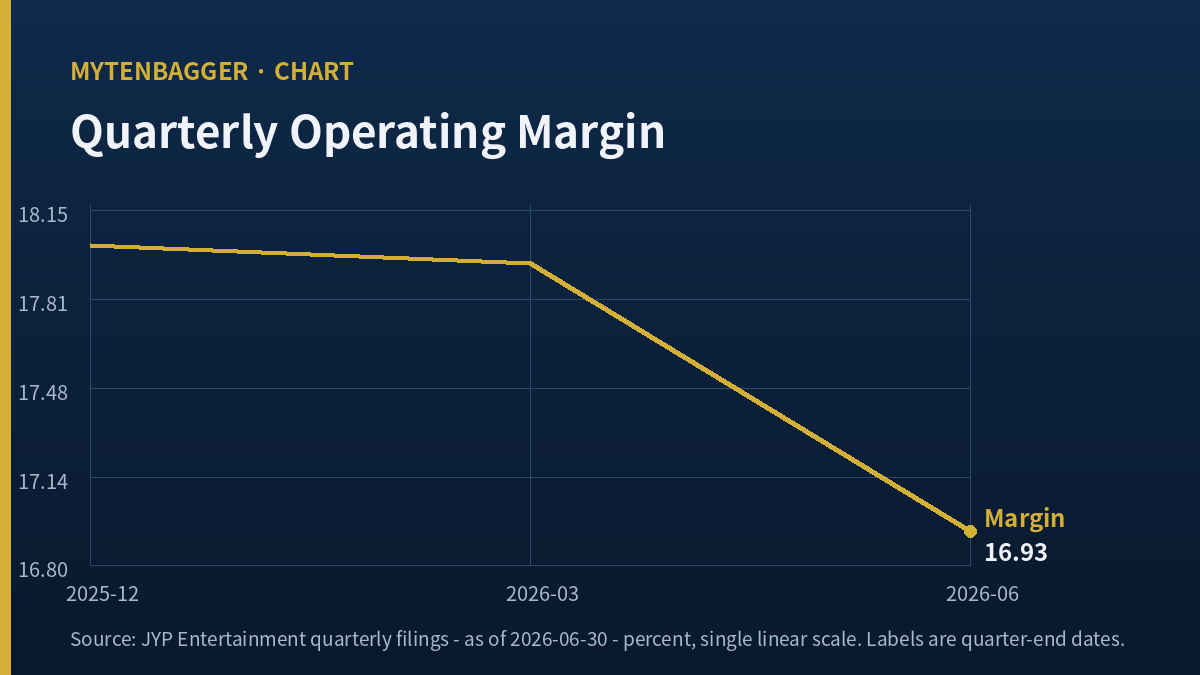
Quarterly profitability tells the same story from the other side. Operating margin was 18.02 percent in the December 2025 quarter, 17.95 percent in the March 2026 quarter and 16.93 percent in the June 2026 quarter, each reading below the one before it. For the first half of 2026 as a whole, revenue rose 3.51 percent while operating profit fell 11.26 percent. Stretch the frame back and the same tension shows up in the annual accounts. Revenue compounded at 33.44 percent a year from 345.89 billion won in 2022 to 821.85 billion in 2025, while operating profit has not returned to the 169.44 billion won it reached in 2023. So the level is high and the slope is down, and those two facts point in opposite directions for anyone deciding what to pay. I have watched the same split — output rising while each unit of it earns less — in another Korean content producer.
Where I Stand on JYP Entertainment Stock and What Breaks It
At a market value near 1.42 trillion won it sits outside the band where I take a stance, so I am watching it and writing down why.
What I am watching in JYP Entertainment stock is narrow. Whether concerts and merchandise together clear 83.8 billion won in the September 2026 quarter. Six Japanese dates fall inside that window. If the stage comes back and those two lines still do not clear the level they printed while the calendar was empty, then the drop was not a scheduling gap and I have to read it as something else. Korea’s statutory deadline for the third-quarter report is November 15, 2026, which falls on a Sunday, so the filing lands on November 16, 2026 or later.
Sell-side coverage has been moving one way. Between July 21 and August 14, 2026, Park Jun-hyung at SK Securities cut his valuation twice, from 92,000 won to 75,000 won and then to 66,000 won, while trimming his 2026 operating profit estimate to 162.8 billion won. Jeong Ho-yoon at Korea Investment and Securities cut from 95,000 won to 75,000 won on July 28, 2026 and took his 2026 operating profit estimate from 184.0 billion won to 170.0 billion won, lowering the multiple he applies from 25 times to 20. Lee Hwan-wook at Yuanta and Hwang Ji-won at iM Securities both moved to 60,000 won in mid-August. Every one of them kept a buy rating, and Jeong wrote in the same note that the shares had reached what he called an extreme of valuation appeal. Im Do-young at Daol has warned that revenue growth turns negative from 2028 while leaving an 80,000 won valuation in place. Korean coverage of these notes is where I read all of it, and the wording above is my paraphrase in English, not a translation of any published quotation.
What that coverage adds up to is a narrow band rather than a fight. The 2026 operating profit estimates I could read run from about 162.8 billion won at the low end to roughly 171.3 billion won at the high end, where the top of that range dates from a January 2026 note, which is a spread of only five percent between houses that have set valuations more than 30 percent apart. In other words, the disagreement among these analysts is not really about how much the company earns next year. It is about what a won of those earnings should be worth once the touring calendar and the contract structure behind the biggest group both stop being predictable. That is a harder thing to model than a revenue line, and it is why I treat the range of valuations as a measure of uncertainty, not as a forecast I could act on.
Seven ways this piece is wrong
- The one that hurts. I compared a level across companies while the market prices a slope. A margin that is high and falling every quarter may deserve the multiple it received, in which case my whole comparison is answering a question nobody asked.
- Fiscal years do not line up. Three of the twelve peers close outside December, so their most recent completed year covers a different stretch of the same industry cycle.
- Eleven peer rows rest on one data vendor and one page each, unverified against filings.
- Operating profit is defined differently across jurisdictions, and Korean filers may present items inside it that a United States filer would put below it.
- The segment boundaries belong to the company. I could not confirm whether goods sold at a venue count as merchandise or as concert revenue, and if that line moves, so does 54.38 percent.
- Second-quarter figures are a preliminary release, and the company states they may differ from final reported results. Two TWICE members signed with other agencies in August 2026 while saying group activity continues, and I have no visibility into what that does to the economics of that intellectual property.
- Half-year net income fell 49.25 percent, far more than operating profit did, and I could not identify what changed below the operating line. I dropped the figure from my argument rather than guess at it, which does not make it go away.
Part one
I read the words “Part 1” in the tour announcement and moved past them for most of an afternoon. Then I noticed I had been treating 18 announced shows as if it were a finished tour, and comparing it against 81 shows that were finished. The earlier tour was not announced at 81 either. Once I saw that, a comparison I had been ready to build a paragraph on turned into a sentence about timing instead, which is all the evidence actually supports. The habit I want to keep is checking whether a number I am about to compare is a total or a running count. The last time I looked at this industry the problem ran the other way, with a record quarter already banked and a price that refused to price it.
Prices, market value and return figures reflect the August 26, 2026 close as I checked them at the time of writing. Korean won is the reference currency here, and the one dollar figure in this article uses roughly 1,384.80 won per dollar, the Seoul market close on that same date as reported by Businesskorea, so treat it as approximate. Company financials are consolidated and drawn from Korean regulatory filings, with second-quarter figures preliminary by the company’s own statement. Segment figures and tour scale come from the company’s investor relations note published on August 14, 2026, results reporting from Korean business press and Korean investment coverage, valuation changes from a Korean market daily and a Korean financial newspaper, and the tour schedule from Korean entertainment press.

- SM Entertainment Equity Rose 64% While the Share Count Fell
- Korea Ratings Valuation: 4.3 Times Sales Against Moody’s
- Why HD Construction Equipment Shares Fell on Q2 Earnings Day