Krafton Stock: The 4-Million-Copy Hit That Grows a $250M Bill
I don’t own Krafton stock, and I’m not chasing the 16% rebound at $160 (₩242,500). The record first quarter is real and so is Subnautica 2’s 4-million-copy launch — but the same hit is inflating a $250M earnout claim, and operating margin gave up 12 points in a year. Half of my decision weight sits on the August Q2 print. Until then, I watch.
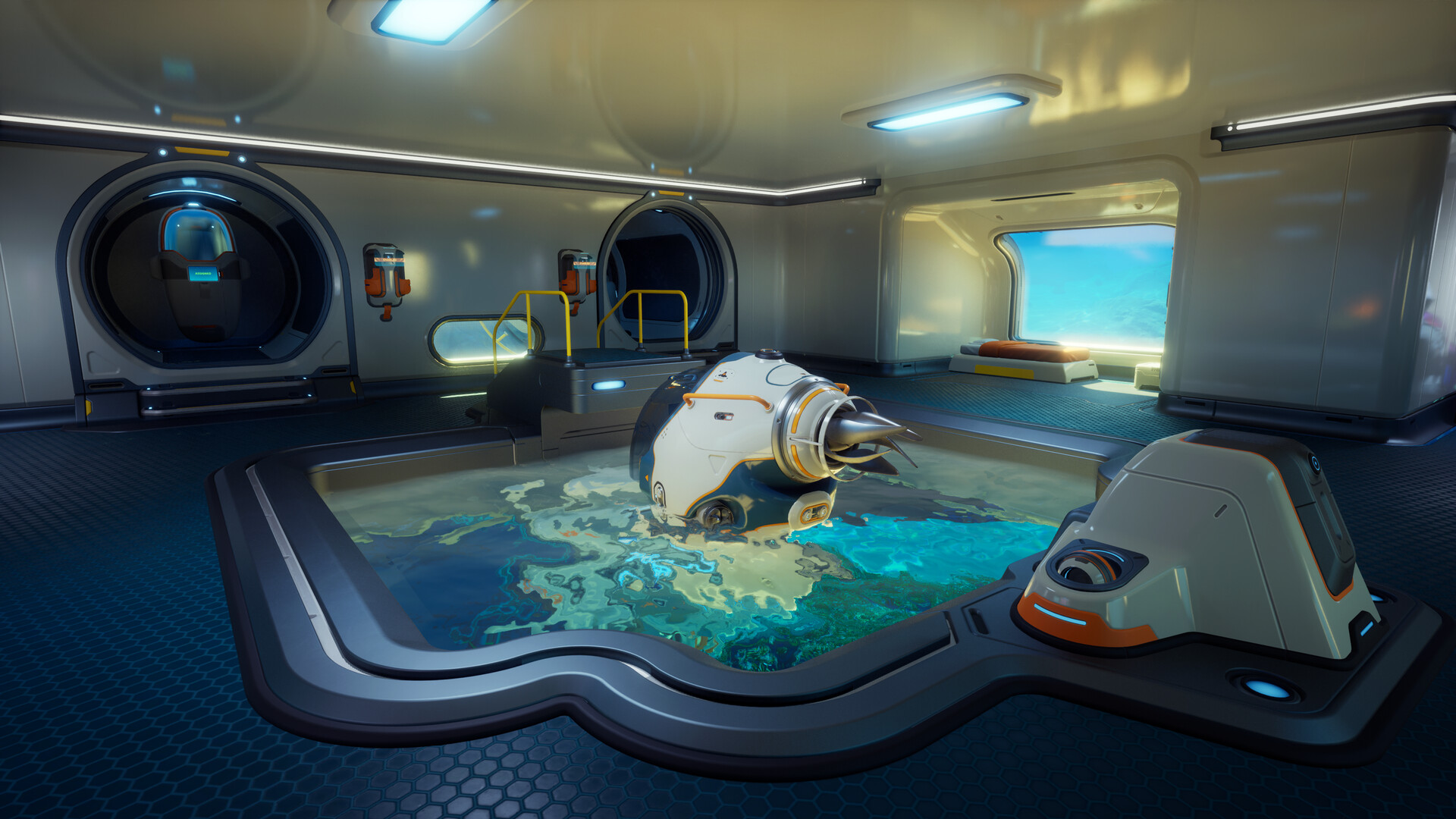
Last month I spent a late night on Steam scrolling Subnautica 2 reviews, deciding whether to buy the sequel. What I actually ended up thinking about was Krafton stock. This is the game where, because of a contract Krafton signed in 2021, every additional million copies sold makes the bill from the studio’s ousted founders bigger. A hit and a lawsuit growing from the same root — I’ve held Korean gaming names before, but I can’t recall a setup quite like this one. Honestly, it left me conflicted.
Then, from late June, Korean sell-side previews started stacking up: second-quarter operating profit set to beat consensus across the board, targets moving higher. The stock has climbed about 16% in a month to the $160 zone (Kiwoom screening data). The transactional question — should I chase it now — is exactly what I sat down to answer. My answer, for now, is no. Here’s the whole ledger of why.
Contents
Krafton Stock’s Round Trip — From a January Freeze to a 16% Rebound
Krafton (259960) trades on the KOSPI — Korea’s main stock index, roughly its S&P 500. Market cap is about $7.4B (₩11.2T, derived from 46.1M shares × ₩242,500; all conversions in this post at ₩1,520/$).
A quick sizing note before the story. Foreign investors hold about 43% of the float (exchange data via Kiwoom screening), so this is not some untouched local name — it’s a KOSPI heavyweight that global money already trades. The 52-week band runs $131 to $237 (₩199,300-₩359,500); at $160 the stock sits roughly a third below the top of that band and about 22% off the bottom (both derived). What follows is how it traveled that band this year, because the round trip is the setup.
In January this name looked frozen. Jung Eui-hoon at Eugene Investment & Securities — a Korean brokerage — cut his target from ₩460,000 to ₩390,000 on January 9, and the reasons bit: PUBG’s PC average concurrent users had slid to a fourth-quarter low of 640,000, and mobile revenue rankings in China were fading. The stock sat at ₩229,500 (about $151). I read that report and shelved the whole Korean gaming sector. A one-IP company with the IP’s traffic rolling over — that was my January logic, and I moved on.
That judgment aged in halves. What followed, in order: on February 9 the company announced its largest-ever shareholder return program — over ₩1 trillion (~$660M) across 2026-2028, the first dividend in company history (₩100B, ~$66M, per year for three years), plus over ₩700B (~$461M) of buybacks with full cancellation, starting with a ₩200B (~$132M) first tranche on February 10. That’s 44%-plus larger than the prior three years’ ₩693B combined, per a February 9 report in Korea’s Aju Business Daily. On April 30, Q1 landed: revenue $902M (₩1.37T) and operating profit $369M (₩561.6B), both all-time quarterly records per the company’s release. In three months Krafton earned 53% of its entire 2025 operating profit (derived against the ₩1.05T full-year figure, Kiwoom screening data).
And then May 15: Subnautica 2 early access. Two million copies in the first twelve hours, four million in five days — Gematsu tracked the four-million milestone, and Korean outlet MTN put the revenue at roughly ₩130B (~$86M). The traffic argument flipped too: per FinancialToday’s June 30 preview roundup (a Korean financial outlet), PUBG PC daily peak concurrents recovered from 800,000 to the one-million range. Both legs of my January thesis got knocked out. I’ll say it plainly: I misread the traffic bottom, and it stung a little to tally that.
Krafton Stock’s Engine — Record Q1, and a Q2 the Street Expects to Beat
The re-rating case currently rests on one simple claim: Q2 comes in above consensus. The numbers, side by side:
| Metric | FY2025 | Q1 2026 | Q2 2026 (est.) |
|---|---|---|---|
| Revenue | $2.19B (₩3.33T) | $902M (₩1.37T) | consensus $737M (₩1.12T) |
| Operating profit | $694M (₩1.05T) | $369M (₩561.6B) | consensus $211M (₩320.8B) |
| Operating margin | 31.7% | 41.0% (derived) | 28.6% (derived from consensus) |
| Sell-side Q2 OP estimates | $231M-$285M (₩351.2B-₩433.7B) — Yuanta / Kyobo / Hana, all above consensus | ||
Sources: company Q1 release; FY2025 from Kiwoom screening data; consensus and broker estimates per FinancialToday’s June 30 roundup (Korean outlet) | As of July 2026 | USD at ₩1,520/$. Margin cells derived from revenue and OP.
Two things in that table do the actual arguing. First, the Q1 column: a 41% operating margin (derived) in a quarter is the kind of print software investors recognize — for reference, that’s the neighborhood where the very best US platform businesses operate, and Krafton did it while its full-year 2025 margin was sliding. Second, the estimate row: the entire named Korean sell-side sits 9% to 35% above consensus (derived from the table), which is unusual — previews usually hug the consensus they help form. Either three analysts are early, or the consensus machine hasn’t caught up to a quarter that contains a four-million-copy launch. August tells us which.
The Korean sell-side went further than the consensus row suggests. In that June 30 roundup, Choi Ji-hoon at Yuanta modeled Q2 operating profit of ₩351.2B, Kim Dong-woo at Kyobo ₩420.5B, Lee Jun-ho at Hana ₩433.7B — against the ₩320.8B consensus — with targets at ₩380,000, ₩390,000 and ₩460,000 respectively. Kim Hye-young at Daol kept a buy call and her sector-favorite tag on July 1, arguing the discount unwinds when five unannounced titles get revealed at Gamescom in late August. The company confirmed on June 23 that it will show five new games at Gamescom in Cologne, August 26-30, including a new PUBG Studio title. The gap between $160 and those targets is a fact worth recording. But those are their numbers. Mine don’t exist yet — mine get made in August.
One thing I noticed pulling apart Daol’s model: her Q2 revenue estimate of ₩1.3T implies last year’s second quarter was only in the ₩660B range (derived from her stated 95.6% growth rate). So half of that dazzling growth print is this year performing — and half is last year’s quarter being weak. A year ago this was a company whose Q2 miss knocked the stock down. Checking the base before admiring the growth rate is basic hygiene with a name like this.
The return program deserves a US-investor translation too. The headline dividend is symbolic more than material: ₩100B a year against a $7.4B market cap works out to a yield of roughly 0.9% (derived) — nobody owns this for income. The substance is on the other side: ₩700B-plus of buybacks with full cancellation is roughly 6% of the current market cap retired over three years (derived), on top of a ₩200B tranche that already started in February. For a company that never paid a dividend in its life, the February 9 package reads less like a payout and more like a signal — management publicly marking, for the first time, that the cash pile has a shareholder claim on it. I note it, I like it, and I don’t weight it anywhere near the Q2 print.
The Other Side of Krafton Stock — Three Bills I Keep Counting
Here is why I still haven’t bought. Three bills, in order.
Bill one — an earnout that grows with the hit
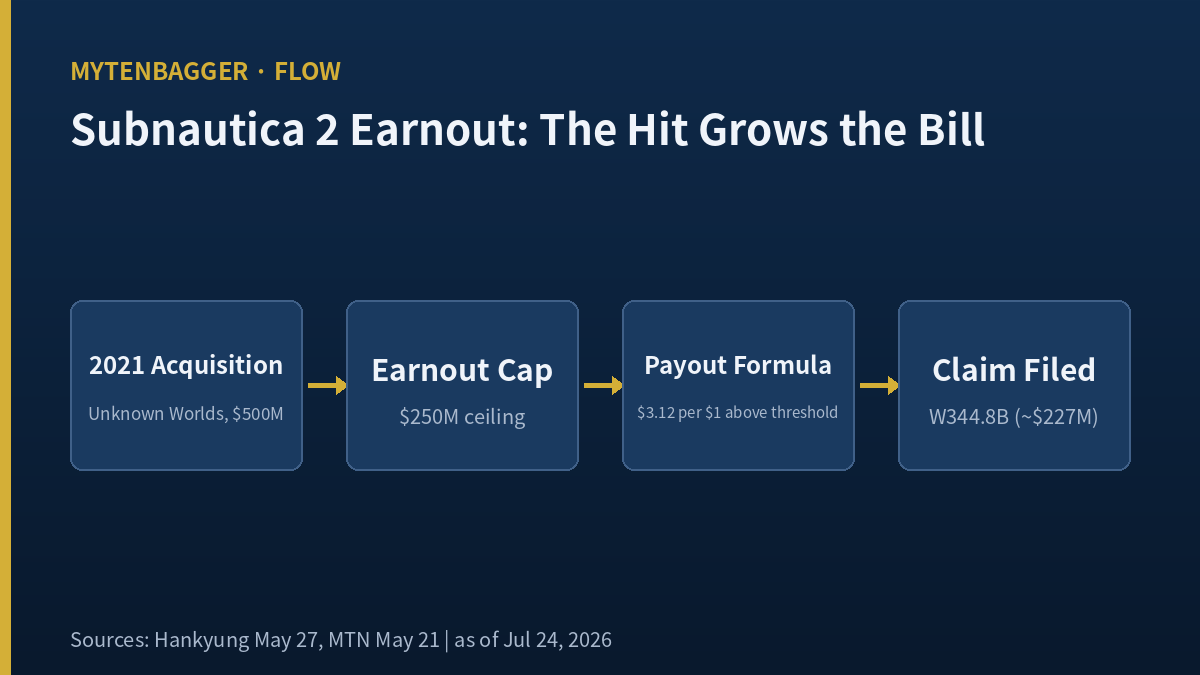
Unknown Worlds, the Subnautica studio, was Krafton’s $500M acquisition in 2021, with an earnout — a performance-linked payout to the studio’s leadership, capped at $250M. In 2025 Krafton fired the studio’s three leaders ahead of that payout and delayed the game; the founders sued. In March 2026 the Delaware Court of Chancery — the same venue US investors know from famous executive-pay fights — ruled against Krafton on the dismissal, ordering CEO Ted Gill reinstated and extending the earnout window by nine months, per PC Gamer. Korean press (Hankyung, May 27) reports the founders’ representative, Fortis Advisors, has since claimed ₩344.8B (~$227M) from Krafton, under a formula that pays $3.12 per $1 of revenue above the contract threshold.
Read that structure twice, because it’s the strangest thing about Krafton stock right now: the four-million-copy headline and the $227M claim are not separate stories. They are the front and back of one contract. The better Subnautica 2 sells, the larger the payout the founders can claim. Markets kept filing these under “good news” and “bad news” all spring; my ledger files them on one line. For scale — even the full $250M cap is about 3% of the $7.4B market cap. The company doesn’t break on this bill. What actually worries me is what the court record says about how this management team handles the studios it buys. Fortune ran the ruling under a headline about the CEO asking ChatGPT how to avoid paying the $250M bonus — it didn’t work. Scars like that live in the multiple long after the check clears.
For readers who don’t live in M&A land: an earnout is deferred acquisition money — “hit these performance marks and we pay you the rest.” It exists precisely so a buyer doesn’t overpay upfront for a studio’s promises. Which is what makes the fired-before-the-payout fact pattern so corrosive: the court found the buyer breached the contract as the marks came into view. Every future studio founder negotiating with Krafton has now read that opinion. In an industry where the acquisition pipeline is the growth story — Krafton has been buying studios and content companies for years, the ADK ad-and-anime group being just the latest — the reputational tax on future deals is the part no line item captures.
If you want the US analogue: this rhymes with Activision firing Infinity Ward’s Jason West and Vince Zampella in 2010, right before major Modern Warfare 2 royalties came due — years of litigation, a settlement, and a lasting case study in how not to manage an acquired studio. Activision survived it just fine as a stock, which is worth remembering before anyone prices this as existential. But it took years and a Call of Duty money machine to paper over, and Krafton has exactly one machine of that kind. I first lumped Krafton’s lawsuit together with its margin problem; on a second pass I split them. The earnout is a capped, one-time settling of an old contract. The margin slide below has no cap. That second one is the bill I actually watch.
Bill two — twelve points of margin, gone in a year
Per Korean tech-business outlet Bloter’s July 9 analysis, operating margin fell from 43.64% in 2024 to 31.70% in 2025 — revenue grew from ₩2.71T to ₩3.33T (about $1.78B to $2.19B) while nearly twelve points of margin evaporated. The cost-side events line up: consolidation of ADK, the Japanese ad-and-anime group Krafton acquired last year (Bloter flags the expense burden); the company’s first-ever all-staff voluntary redundancy program in November 2025 (per Korean IT daily DDaily); and a stated plan to invest ₩100B (~$66M) in GPUs under an “AI-first” pivot (per Korean wire News1). I understand the direction. But where Q2’s margin lands matters more to me than any sales milestone — it tells me whether 31.7% was a floor or a waypoint.
Bill three — still one IP paying for everything
The same Bloter piece lays out the concentration: the PUBG franchise alone generated over ₩1T (~$658M) in Q1; 82.3% of 2025 revenue came from Asia; a single major publishing partner accounts for 41.6% of revenue. India’s 2022 ban of the local PUBG variant is the standing reminder of what regulatory risk does to a one-IP company. A $2B-revenue business hanging on one franchise, one region, one partner — that is why record earnings haven’t bought a record multiple.
Concentration itself isn’t a death sentence — Activision rode Call of Duty as its dominant engine for a decade and shareholders did fine. The difference is that Activision’s franchise lived mostly on US and European consoles under stable regulators, while PUBG’s economics run through Asian mobile markets where a single government decision — India in 2022, China’s licensing regime any year — can turn revenue off like a switch. Same concentration, very different tail risk. That’s the discount, and it’s not irrational.
Which is the real reason Subnautica 2 matters. Not the $86M of launch revenue — the fact that it’s the first credible crack in that concentration: an exploration game, not a shooter; premium packages, not mobile items. Behind it, the five Gamescom reveals — per the company’s June 23 announcement: a PUBG Studio title, open-world FPS “No Law”, tactical arena “Project Zeta”, co-op adventure “Age Twister”, and a dark-fantasy action RPG announced under the Korean title 타래: 언바운드 (“Unbound”). A slide of logos is not revenue, though. The sales curves after August will make that call, not the press release.
Three Paths From Here
One more piece of context the chart doesn’t explain by itself: the stock printed ₩288,500 (~$190) in early May — that’s the price recorded in a May 6 Kiwoom brokerage note that raised its target to ₩340,000 — and then slid all the way to the ₩199,300 low before this rebound. The slide overlapped with the loudest weeks of earnout coverage and the margin debate, though I won’t pretend the market signed a confession; nobody gets to claim one clean cause for a 30% drawdown. What I take from it is simpler: this name currently swings 25-30% on narrative alone, in both directions, within a single quarter. Position sizing has to respect that before any thesis does.
Three scenarios, probabilities strictly my own opinion.
Path one — August clears both tests (my odds: 50%)
Q2 operating profit lands above the ₩320.8B consensus, inside the Korean sell-side’s ₩351.2B-₩433.7B range, and Gamescom gives the PUBG Studio title a face — a genre, a window, something to model. The debate then migrates from one-IP discount to multi-IP re-rating, and the first test above is May’s ₩288,500 (~$190) area, where the stock traded before the June slide. The previews already lean this way. And honestly, so does the data I’ve collected — which is exactly why I’m being careful. The moment the answer I want and the data agree is the moment my account has historically punished me for skipping the verification step.
Path two — sales fine, margin doesn’t cooperate (my odds: 30%)
Revenue delivers but ADK, payroll, and GPU spending keep grinding the margin, an earnout provision shows up in the quarter, and PUBG traffic softens again the way Eugene’s January note described. The stock goes back to being what it was last year: a company printing record revenue while the shares sit in the low-$140s box, roughly the ₩210,000-₩220,000 range it just left.
Path three — the ugly one (my odds: 20%)
A Q2 miss stacked with the earnout resolving at the high end and a fresh regulatory headline out of India or China. That combination retests the 52-week low of $131 (₩199,300, exchange data). I keep this probability low but not zero, because this company’s real shocks have consistently come from outside the income statement — a courtroom in Delaware, a ministry in New Delhi. If this path plays out, the interesting question flips: with the earnout capped and paid, the lawsuit overhang actually dies, and a sub-$131 print with the legal bill settled would be a cleaner setup than today’s. I’d rather study that version of Krafton than chase this one. But that’s a bridge for later; I’m not pre-committing to catch a falling quarter.
My Breakpoints for Krafton Stock — Weighted, Not Equal
Four breakpoints, and I refuse to weight them evenly. The reasoning: Gamescom is anticipation and the lawsuit is a capped settlement, but the Q2 print is the fact-check on the entire recovery narrative — the one gauge that re-prices how I read the other three.
So half my weight rides on the August Q2 report. Above the ₩320.8B consensus and the story stands on numbers; a slide under ₩300B and the whole preview season was wrong, which would make the remaining three barely worth reading. The other half splits three ways. Gamescom, August 26-30: does the PUBG Studio title get a genre and a launch window, or stay a logo. The earnout endgame: what the ₩344.8B claim actually resolves to, and how it hits the financials — I want the disclosure, not the commentary. Return-program follow-through: the February ₩200B tranche moving on to actual cancellation as promised. Two strong answers up front plus two quiet ones at the back, and I take the position. If the heavyweight breakpoint fails, the other three don’t matter — I stay out no matter how good Cologne looks.
Where I Land — Not Chasing at $160
On the record, then: Krafton stock is back on my first-tier watchlist, and I own none of it. I’ve admitted the January misread — I shelved the sector right before the traffic bottomed — but repeating the opposite mistake, buying a 16% rebound on preview enthusiasm, isn’t how I want to fix it. What the company has earned (a record $369M quarter), what it may owe (a bill capped near $250M), and what it must still prove (a Q2 margin and a real second franchise) all get measured in one month: August. If the print clears consensus and the new titles have faces, I’m in. If not, this post stays in my journal as the reason I passed.
Related journal entry: NAVER at its 52-week low — pricing the AI fear
Sources I leaned on: Krafton’s Q1 2026 results release (Korean), Aju Business Daily on the ₩1T shareholder-return program (Korean), FinancialToday’s Q2 preview and broker roundup (Korean), PC Gamer on the Delaware ruling, Fortune on the ruling’s back story, and Gematsu on Subnautica 2’s sales milestone.