Samsung Heavy Industries Stock: $10B in Orders, Zero Dividend
The 30-Second Version
Samsung Heavy Industries stock closed at ₩22,900 (about $15.07) on July 24 — down 3.2% on the day it posted a 59% jump in quarterly operating profit. The profit, $214 million, missed consensus by 13%. Meanwhile the order book just crossed $10 billion for the first year since 2021, anchored by America’s first floating LNG plant. I’m not buying yet. This company hasn’t paid a dividend in eleven years, and a $988 million retained deficit explains why. I’m watching three gates instead — all of them dated within the next two quarters.
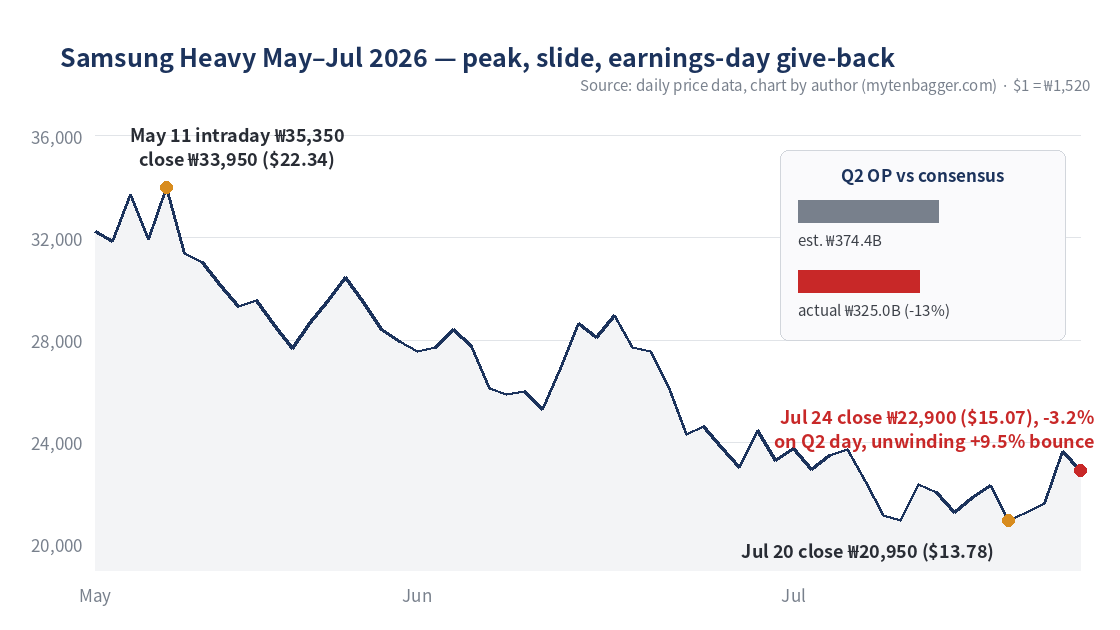
On the afternoon of July 24, Samsung Heavy Industries — the Geoje-based shipbuilder trading on Korea’s KOSPI under ticker 010140 — released preliminary second-quarter results. Revenue of ₩3.23 trillion ($2.13 billion at the ₩1,520 per dollar rate I use throughout this journal). Operating profit of ₩325 billion ($214 million), up 58.7% from a year earlier. The shares touched ₩23,850 intraday, then finished at ₩22,900, giving back roughly a third of the prior day’s 9.5% bounce (my math). A market that receives a feast and puts down its chopsticks is telling you something. My read: the problem isn’t on the table. It’s under it. This entry is my record of looking under the table.
Contents
Samsung Heavy Industries Stock Fell on Its Own Earnings Day
The numbers first, precisely. According to EBN, a Korean industrial trade outlet, consolidated Q2 revenue came in at ₩3.2307 trillion ($2.13 billion), up 20.4% year over year and 11.3% quarter over quarter. Operating profit was ₩325 billion ($214 million), up 58.7%. Net income was ₩222.8 billion ($147 million), up 4.9%. For the first half, revenue reached ₩6.133 trillion ($4.03 billion, +18.5%) and operating profit ₩598.1 billion ($393 million, +82.4%). Operating margin, by my calculation, stepped up from 9.4% in Q1 to 10.1% in Q2. The company’s long-promised drivers — overseas production blocks ramping up, the reactivated second dock — are finally showing up in the margin line.
The problem was the bar. Seoul Economic Daily (Korean) reported the street consensus at ₩3.2767 trillion in revenue and ₩374.4 billion ($246 million) in operating profit. The actual print missed the profit line by ₩49.4 billion — 13%, my math. Against the two most recent named estimates I tracked — ₩364.6 billion from Sangsangin Securities analyst Lee Seo-yeon three weeks before the print, ₩361.2 billion from KB Securities analyst Jeong Dong-ik a month before — the miss runs 11% and 10% respectively (my math). When a 59% profit jump reads as a disappointment, that tells you exactly how high the expectations propping up Samsung Heavy Industries stock have climbed.
| Q2 2026 (consolidated) | Actual (prelim.) | Consensus | KB Securities | Sangsangin |
|---|---|---|---|---|
| Revenue | $2.13B | $2.16B | $2.12B | $2.22B |
| Operating profit | $214M | $246M | $238M | $240M |
| Operating margin | 10.1% (my math) | 11.4% (my math) | 11.2% | 10.8% |
Actual = July 24 preliminary filing via EBN. Consensus = as cited by Seoul Economic Daily. KB = Jeong Dong-ik (June 24). Sangsangin = Lee Seo-yeon (July 3). Won figures converted at ₩1,520/$; margins are my division of each profit by each revenue.
Zoom out to the annual arc and the miss carries less weight. Fiscal 2025 finished with roughly ₩10.65 trillion in revenue and ₩862.2 billion ($567 million) in operating profit — an 8.1% margin — per the internal data I keep. This year the company earned $393 million in the first half alone; if the second half merely repeats it, the annual pace is about $790 million (my simple math), against company revenue guidance of ₩12.8 trillion ($8.4 billion) that management told Aju Business Daily (Korean) it would comfortably hit. The income statement is climbing a staircase. The consensus miss means the market had drawn the next step half a stair too high — not that the staircase collapsed.
Where the Miss Came From — Two Named Suspects
A preliminary filing tells you the gap; it doesn’t tell you the cause. But the suspects were named in advance. KB Securities’ June 24 note (Korean) flagged two: a possible provision tied to a Supreme Court ruling on performance-incentive pay (TAI), and roughly ₩40 billion ($26 million, my conversion) in derivative losses from legacy Russia projects expected to land in Q2. I don’t yet know whether these two items explain all of the ₩49.4 billion gap, part of it, or none of it. That’s the first line item I’ll check in the half-year report due in August.
It helps to remember how a shipbuilder’s income statement actually works, because it explains both the miss and why I don’t overweight it. Yards recognize revenue on percentage-of-completion: the dollars hitting this quarter’s top line were priced when the contracts were signed, one to three years ago, and the margin you see today is the blended average of that backlog vintage — not of the orders being announced this month. The Delfin award signed in June has barely begun its journey through that ledger, while earlier FLNG work is only now adding progress-based revenue — Sangsangin’s analyst cited exactly that FLNG progress recognition as a driver of the Q2 margin step-up. That cuts in both directions. It means the current 10% margin still carries older, cheaper tonnage inside it, with better vintages queued behind. It also means that when analysts model the margin ramp a quarter or two early, the stock pays for their impatience on days like July 24. I try to price the vintage, not the announcement.
Here’s where I’m trying not to get shaken out of my framework. The direction of the margin is up. A double-digit quarterly operating margin was unthinkable when this yard was crawling through the order drought and the capital impairment of the late 2010s. Earnings trajectory: intact. Earnings velocity: below plan. I filed this quarter under “verify,” not under “thesis broken.”
Samsung Heavy Industries Stock and the $10 Billion Order Book
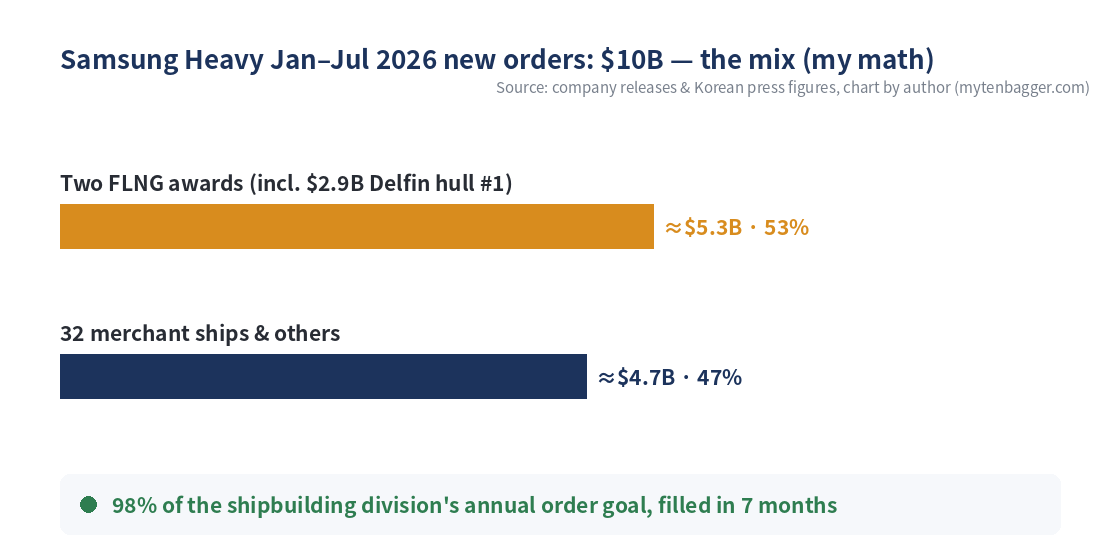
The order side of the ledger needs no apology. Per company disclosures, new orders reached $10 billion by early July — 72% of the $13.9 billion annual target — and kept running past that mark through July, with the shipbuilding division alone at 98% of its annual goal, as management told Korean media on results day. The Seoul Economic Daily’s English edition notes this is the first $10 billion order year since 2021: 34 awards through July 9, comprising 32 merchant vessels and two FLNG units.
The two FLNGs are the pillars. Eni’s Coral Norte unit at ₩3.6356 trillion ($2.39 billion), then the headliner: on June 2 the company disclosed a $2.9 billion contract — about ₩4.33 trillion per Herald Business (Korean) — to build the first floating LNG production unit for Delfin Midstream’s project off Louisiana, the first project of its kind in US waters. Splash247 called Delfin the US FLNG pioneer; Natural Gas Intelligence reported the contract put the wider project near its final investment decision. Delfin plans multiple units of identical specification — three in the base concept — and follow-on negotiations are underway. Korean daily Money Today framed the full series as worth up to ₩13 trillion (about $8.6 billion, my conversion) if every option lands.
What I watch in this $10 billion is the mix, not the total. Of the ₩15.05 trillion booked through July 9, the two FLNG awards account for roughly ₩8 trillion — 53%, my math. Thirty-two merchant hulls lay the floor; floating production units raise the ceiling. Management’s own results-day language, via Aju Business Daily, pointed the same direction: productivity gains from its “3X” digital program and “visible results in US businesses including floating data centers (FDC)” in the second half. Five years ago, winning orders meant filling this yard. This year, it means repricing it — at least on the order ledger. There’s an irony worth recording, too: the last $10 billion year, 2021, was the drought-recovery vintage whose economics the company has spent years digesting, and the deficit now standing between shareholders and their first dividend is, in my reading, partly the residue of that era. Whether the 2026 vintage writes a different ending is precisely what gates one and two below are designed to test.
One more mix detail I keep on the watchlist: of the $13.9 billion annual target, what remains open is mostly offshore — and management explicitly told reporters it expects additional offshore awards in the second half. Each incremental FLNG-class win tilts the backlog vintage further toward the high-margin end; each quarter without one leaves the merchant floor carrying more of the load.
The Moat Behind Samsung Heavy Industries Stock: FLNG Series Economics
I classify this moat specifically: a technology-and-track-record moat in floating LNG production, not a generic “shipbuilding supercycle” tailwind. FLNG is a narrow, deep market — enormously complex topsides engineering married to a hull, delivered to customers who cannot afford a failed startup. Samsung Heavy has spent a decade stacking build history there, which is why Korean media call it the segment’s strongest player and why Delfin handed it the full EPC scope, solo, for America’s first floating LNG plant. This is not the commodity end of the business where Chinese yards compete on price per hull.
There’s an American subplot here that a US reader will appreciate: America’s first floating LNG export unit will be built an ocean away from Louisiana, on an island off Korea’s southern coast. That’s not politics; it’s industrial capacity. US yards — think Huntington Ingalls, the largest American military shipbuilder — are consumed by naval work, and no US commercial yard builds vessels in this class. Singapore’s Seatrium competes in offshore conversions, but large new-build FLNG has run through Korean yards. I tried to pull current valuation multiples for those two comparators to frame a proper peer table and could not verify them to my standard by press time, so I’m not quoting any — but the structural point stands without numbers: for this product, the realistic supplier set narrows to a few Korean yards, and this one holds the segment’s headline track record.
Series economics compound the moat, in my reading. Build three identical units and the tuition paid on hull one comes back as margin on hulls two and three; run the EPC alone and that learning curve accrues to one ledger instead of leaking to consortium partners. That’s why I value the Delfin award beyond its sticker. And I’ll flag my own caveat: this is my interpretation of a structure, not yet a fact proven in any income statement.
The cracks, recorded with equal care. First, FLNG series margins are unproven — revenue is only beginning to flow through percentage-of-completion accounting, and Q2 just demonstrated the lag between order quality and earnings quality. Second, Delfin units two and three are negotiations, not contracts; ₩13 trillion is the language of hope, not of ledgers. Third, the floating data center story the company keeps promoting — Sangsangin’s analyst expects a lead position in that market in the second half, per E-Today (Korean) — is still a stage where expectation runs ahead of contracts. I stopped prepaying for stories a long time ago.
Eleven Years Without a Dividend — the $1 Billion Deficit Gate
Now for what’s under the table. Samsung Heavy has not paid a dividend since 2014. Eleven years. Set that against the Korean shipping-and-shipbuilding complex I’ve covered this year — HMM retiring treasury shares, HD group yards polishing quarterly payouts — and the silence stands out. The reason is arithmetic, not attitude. As Korean outlet Bloter documented in June, the company still carried a retained deficit of ₩1.5013 trillion ($988 million) as of Q1 — the scar tissue of its loss years, only partly cauterized by the simultaneous capital reduction and rights offering of 2021. The company’s stated position: dividends will be considered “once distributable profits are secured.” The same report counted zero corporate value-up disclosures between January 2025 and May 2026.
One structural note for readers used to US corporate law: under Korean rules, dividends are paid from distributable profits calculated on the parent-only books, and that calculation starts by absorbing the accumulated deficit. So this is not a company that earns money and refuses to share it. It’s a company whose earnings are still repaying its own past, every quarter, before a single won can legally reach shareholders. While Korea’s value-up program has re-rated banks and tobacco names around it — I’ve watched that repricing happen name by name in this journal — this yard doesn’t yet possess the vocabulary of shareholder returns at all.
The arithmetic of the gate, then. The deficit shrank 26.5% year over year. Hold quarterly net income at the Q2 level of $147 million and erasing $988 million takes six to seven quarters — my simple math, with the honest caveat that consolidated net income and the parent-only deficit are not the same ledger, and that resuming payouts is ultimately a board decision. But the direction is unambiguous: this gate is becoming a matter of time. When the timeline gets a number, that event matters to me as much as Delfin unit two. Only the house that has finished the dishes after the feast can hand out gift envelopes.
The Bear Case on Samsung Heavy Industries Stock
The chart has been speaking the bears’ language for ten weeks. From the May 11 intraday peak of ₩35,350 ($23.26) — closing peak ₩33,950 — the shares have stepped down without a meaningful rally, hitting ₩20,950 ($13.78) on July 20. A single-day 9.5% rebound on July 23 recovered ₩23,650; the earnings print gave about a third of it back the next day (my math). On June 23 the stock had already dropped 7.25% in one session on combined foreign and institutional selling, which Korean outlet JKN attributed to profit-taking on short-term overheating and valuation strain rather than any specific bad news. Peak-to-now on closing prices: minus 32%, my math.
The valuation half of the bear case: on the internal data I keep, trailing earnings multiple sits near 36.9x and book multiple near 3.9x. Borrow KB’s 12-month forward EPS estimate of ₩1,453 and the forward multiple at ₩22,900 compresses to about 15.8x (my math) — but that compression is only as good as the estimate, and the estimate just aged badly by 10% in a single quarter. The sell-side objectives on record — Sangsangin at ₩43,000 ($28.29), KB at ₩35,000 ($23.03), both Buy calls — sit 52% to 87% above the market (my math). You can read that gap as upside, or you can read it as estimates that haven’t finished coming down. After this earnings print, I’d rather test the second reading before trusting the first.
Two paths from here, in narrative form rather than probabilities. The path up: the August half-year report shows the miss was mostly one-off items, Delfin unit two crosses from negotiation into a disclosed contract, and Q3 holds the margin above 10% — in which case the 15.8x forward multiple (my math) starts looking like an early-cycle price for a yard whose flagship product faces only a handful of realistic competitors, and the first credible dividend signal puts a floor under the multiple. The path down: Q3 misses consensus again and the Delfin follow-on slips into next year — in which case the market goes back to quoting this company at its trailing 36.9x, and the sell-side objectives come down to meet the price rather than the price rising to meet them. Every fork in both paths sits inside the next two quarters. That’s why I’m counting calendar days, not assigning percentages.
How I’m Approaching Samsung Heavy Industries Stock: Three Gates
My position: I don’t own it, and I’m not buying it here. At ₩22,900 the market values the company near ₩20.2 trillion — about $13.3 billion, or 22,900 won times 880 million shares, my math — placing it in the KOSPI’s upper tier. Orders point up. Margins point up. What keeps me out is simpler: this price demands a level of earnings delivery the company hasn’t yet produced twice in a row. So I stage the decision through three gates, in order.
Gate one — the August half-year report. I want the anatomy of the ₩49.4 billion miss. How much was the TAI provision and the Russia derivative hit — one-off by nature — and how much is recurring cost creep? Mostly one-off, and I move to gate two. Structural, and I stop here.
Gate two — Delfin unit two becomes a contract. Follow-on negotiations must cross from talks into a disclosed award, ideally within the year. The moment a second identical unit is signed, the FLNG moat converts from story to backlog, and series economics start being testable. If it slips past year-end or dies, I recalculate the entire “up to ₩13 trillion” expectation first.
Gate three — a dated path out of the deficit. The deficit keeps shrinking on schedule, and — for the first time in eleven years — management puts a number on when shareholder returns resume, whether in a value-up filing or on an earnings call. The first dividend signal since 2014 changes what owning this stock even means, in my judgment.
One exception stays open. If the shares take another leg down to the low ₩20,000s — 40% below the closing peak works out to ₩20,370, or about $13.40 (my math) — I rebuild the valuation from forward earnings at that price regardless of gate status. Whether that math produces an entry or just another journal entry is up to the numbers on that day.
A practical note for US readers. Samsung Heavy trades on the KOSPI — Korea’s main board, the local equivalent of the S&P 500 universe — and I could not verify any US listing for it. Either route also stacks a currency bet on top of the equity bet: a won-denominated stock bought with dollars pays you twice or charges you twice, and at ₩1,520 to the dollar the won sits at historically weak levels. That cuts both ways and belongs in the position sizing, not in a footnote.
If all three gates open in sequence, I’ll pay up — even above today’s price — because by then the feast will have reached the ledger. If they don’t, watching this order rally from the doorway will have cost me nothing. However loud the party in the courtyard gets, I hand over my gift envelope only when I see the pantry door open.
This is my trading journal — a record of my own reasoning at a specific point in time, anchored to the filings, Korean press reports, and named analyst estimates cited above. Korean-language sources are marked as such; renderings from Korean are mine. Related entries in this journal walk the same yard cycle: HD Hyundai Heavy Industries, HD KSOE, HMM, and Pan Ocean, which books newbuilding slots on the owner side of that same cycle.