Meritz Financial Stock: A 25% ROE Machine Under Investigation
Every market has one company that value investors describe as “the Berkshire of” that country. In Korea, the label lands on Meritz Financial Group — and for once, I think the shorthand mostly earns its keep. Meritz Financial stock sits on the KOSPI, Korea’s main board, with a market value of about $13.3 billion (₩19.5 trillion at roughly ₩1,470 per dollar, the rate that prevailed during late July’s crash). It compounds insurance capital at a return on equity north of 20%, and it retires its own shares on a scale almost nothing else in Seoul matches. My problem is not the machine. My problem is that in 2026, prosecutors and tax investigators are both circling the man who built it — and I had to decide what that is worth as a discount.
The 30-second version
First-quarter net profit came to ₩680.2 billion (~$463 million), up 9.6%, at a 25.4% ROE. A ₩700 billion (~$476 million) buyback trust signed in March was 61% spent within three months. Against that: a prosecutors’ raid over alleged insider trading tied to the group’s celebrated 2022 restructuring, a special tax probe launched in May, and real estate financing exposure at the securities unit equal to 127% of its equity — more than double the industry average. I do not own the shares. The reason is not the earnings. That asymmetry is the whole story here.
Contents
Why Meritz Financial Stock Held Up on Korea’s Second-Worst Trading Day
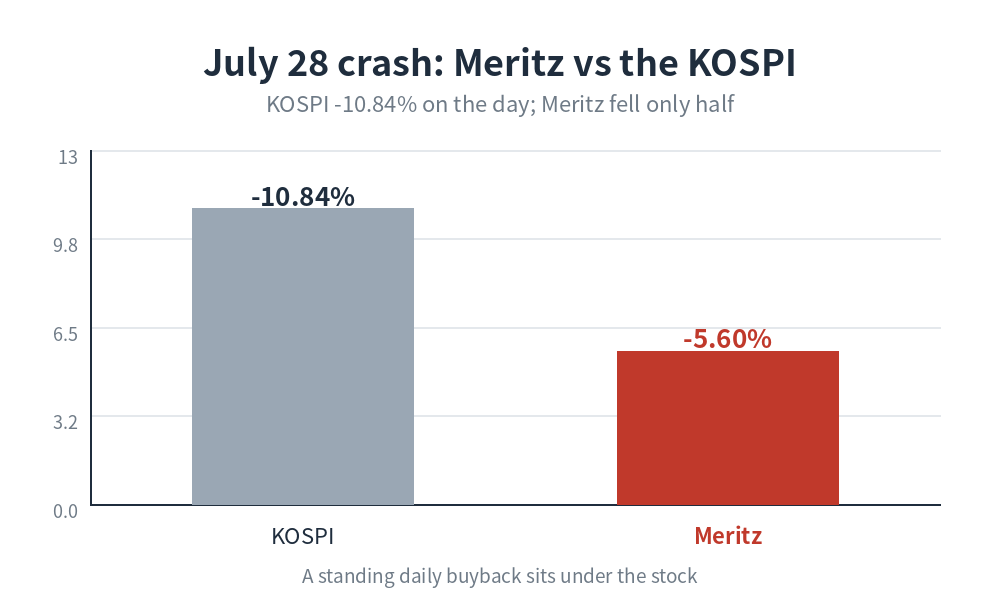
Start with a stress test the market ran for me. On July 28, the KOSPI fell 10.84% to 6,023.66 — the index’s second-largest daily drop on record, triggered by a shock from Chinese memory maker CXMT and violent enough to trip Korea’s circuit breaker, a mandatory trading halt that kicks in on an 8% plunge. The Kyunghyang Shinmun’s English desk called it “Black Tuesday,” with Samsung Electronics and SK Hynix leading the rout. Meritz Financial stock closed that day at ₩118,100 (~$80), down 5.6% — roughly half the index’s fall. The next day it slipped just 1.4% to ₩116,500 (~$79).
I read relative drawdowns on panic days as a report card. Yes, a financial name should fall less when semiconductors drag the index down. But context matters: this stock had traded as low as ₩98,000 intraday on June 26 and had climbed about 25% off that base in the month before the crash. A stock that just rallied a quarter of its value and then loses only half the index’s decline on the worst day in years is telling you something about who is standing under it. Part of the answer is the company itself: Meritz buys its own shares through a standing trust, nearly every day, with a mandate measured in the hundreds of billions of won.
Foreign ownership explains another piece. By my market data, foreigners hold only about 14% of this name — far below Korea’s big bank holding companies. On a day when overseas investors dumped nearly ₩4 trillion of Korean equities, the shareholder register here simply had less foreign money to flee. I count that as crash resilience, not as a bull case: the same register means less torque when foreign flows come back.
Inside the Machine: ₩680 Billion a Quarter, 25.4% ROE
Before the framing, the raw output. First-quarter 2026 consolidated net profit reached ₩680.2 billion (~$463 million), up 9.6% year over year, with operating profit of ₩854.8 billion (~$582 million), up 18.4%, on total assets of ₩144.4 trillion. The reported ROE: 25.4%. The mix tells you how the group is built. Meritz Fire & Marine, the non-life insurer, delivered ₩466.1 billion (~$317 million) on a standalone basis — up just 0.8%, but that flatness is the point; it is the ballast. Its regulatory solvency ratio, K-ICS — Korea’s analog to Europe’s Solvency II capital regime — stood at 240%, comfortably above the 150% mark Korean supervisors like to see, and its investment yield ran at 5.4%. Meritz Securities supplied the torque: ₩254.3 billion (~$173 million) of net profit, up 35.7%, on operating profit that jumped 72.5% as investment banking, trading, and retail all fired in the same quarter.
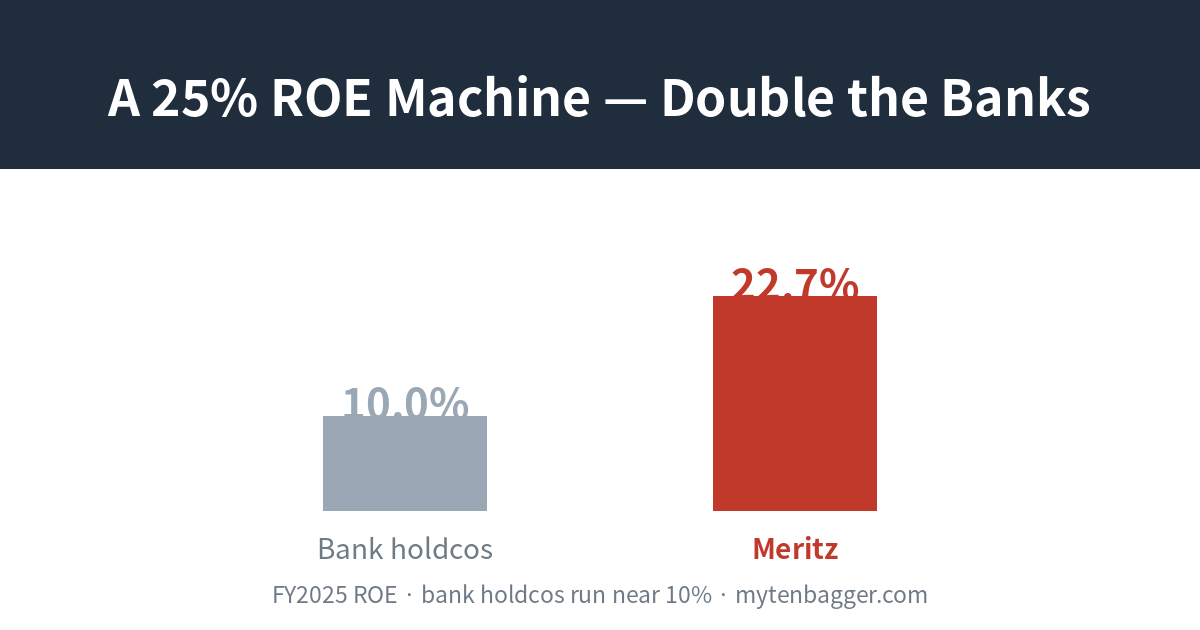
Zoom out and the pattern holds. Full-year 2025 net profit was ₩2.35 trillion (~$1.6 billion), a record, and the third consecutive year above the ₩2 trillion mark, at a 22.7% annual ROE. For scale: Korea’s big four bank holding groups — names like Shinhan and Hana that I have covered one by one on this site — typically produce returns on equity in the neighborhood of 10%. Meritz runs at roughly double that, quarter after quarter, and has for years. Insurance underwriting that prices risk properly plus a securities arm that eats volatility is a fundamentally different engine from spread lending, and the market knows it: this is one of the very few large Korean financial holding companies that trade meaningfully above book value.
The “Berkshire of Korea” Framing — and Where I Think It Breaks
The comparison gets made because the architecture rhymes. Like Berkshire Hathaway, Markel, or Fairfax, Meritz runs disciplined insurance underwriting as its capital engine — Meritz Fire & Marine ranks among Korea’s most profitable large non-life insurers relative to the capital it employs — and then lets a small headquarters allocate the proceeds wherever returns are highest, with zero sentimentality. When no external option clears the hurdle, it buys and cancels its own stock. In November 2025 the group extended its formal policy of returning 50% of consolidated net profit to shareholders for another three years, and vice chairman Kim Yong-beom keeps repeating the group’s one-line philosophy: every share held by every shareholder carries equal value. The 2022 restructuring that created this structure — folding Meritz Fire and Meritz Securities into the holding company as wholly owned units, an event S&P Global Market Intelligence logged as Asia’s largest insurance-sector takeover of late 2022 — is taught in Seoul as the governance reform done right, the anti-chaebol-discount playbook.
There is a policy backdrop that makes this more than a single-company story. Korea has spent the past two years running its Corporate Value-up Program — a government-led campaign, modeled loosely on the Tokyo Stock Exchange reforms that re-rated Japanese insurers and trading houses, to shame chronically-below-book Korean companies into returning capital. Meritz was executing the playbook years before the program had a name, which is why domestic commentary keeps holding it up as the exhibit. If you have watched Tokio Marine or the Japanese trading houses re-rate as buybacks became culture rather than exception, the Korean version of that trade runs straight through names like this one — and Meritz is the incumbent, not the convert.
Here is where I break with the shorthand. Berkshire’s moat survived its founder becoming a system: decades of decentralization, a board, a named succession. Meritz’s version is younger and far more concentrated in one person’s judgment. I classify this moat as a process moat — underwriting cost discipline plus ruthless capital reallocation, embedded in how the group operates — rather than a technology or market-power moat. Process moats are real, but they are only as institutional as the people who run them. That distinction stopped being academic in January.
Meritz Financial Stock Runs on a Buyback Conveyor
The numbers first, because they are the best part of the story. The group’s own quarterly filing — a Korean-language disclosure on the exchange’s system — lays out the logic with unusual candor: at a forward price-to-earnings ratio of 6.9x, management calculates the earnings yield on its own shares at 14.6%, comfortably above its 10% required return, so it keeps buying and canceling. The same filing reports cumulative total shareholder return of 170% since 2023.
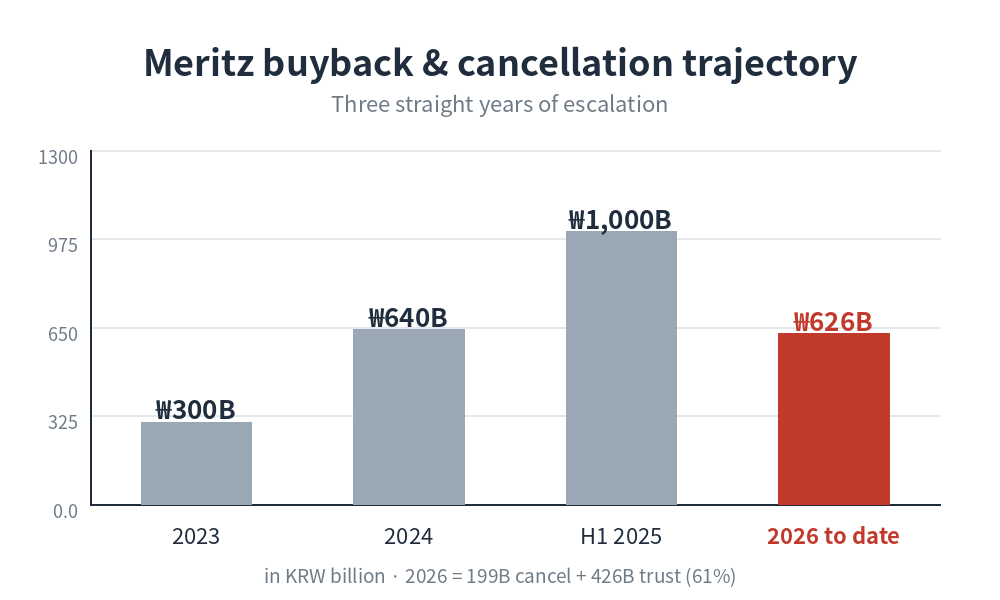
The 2026 ledger, assembled from company announcements and Korean press tallies: a ₩200 billion (~$136 million) buyback trust in February; cancellation of 1.654 million common shares worth about ₩199.4 billion (~$136 million) in March; then a fresh ₩700 billion (~$476 million) trust signed on March 26. By June, per Korean financial outlet Bloter’s count, that trust had already absorbed 3.857 million shares for ₩426.2 billion (~$290 million) — 61% utilization in three months, leaving roughly ₩270 billion (~$184 million) of dry powder. The run-rate history behind it: roughly ₩300 billion canceled in 2023, ₩640 billion in 2024, and about ₩1 trillion (~$680 million) in the first half of 2025 alone. Three consecutive years of escalating retirements — clearing the trillion-won mark in 2025 — is a cadence with almost no peer on the Korean market, and it means Meritz Financial stock carries a structural buyer living permanently in its own order book.
One caveat I would flag for anyone anchoring on that scarcity: it is being legislated away. Korea’s third Commercial Act amendment, passed this year, makes cancellation of repurchased treasury shares the legal default — Kim & Chang’s English briefing and the Seoul Economic Daily’s English report cover the mechanics. Meritz loses nothing directly; it was burning shares before burning was cool. But part of this stock’s premium came from being the only serious canceler in a market of hoarders. When the law makes everyone cancel, that particular scarcity gets distributed to the whole index. I think the premium’s foundation quietly narrows, even as the practice it rewarded goes national.
The Investigations Hanging Over Meritz Financial Stock
Now the other file on my desk. On January 8, prosecutors from the Seoul Southern District Prosecutors’ Office — the unit that handles Korea’s securities crime — raided Meritz Securities’ headquarters and the office of vice chairman Kim Yong-beom, according to a Korean-language report by the Seoul Economic Daily (my paraphrase from the Korean). The allegation, as Korean press describe it: trading on inside knowledge of the November 2022 restructuring and shareholder-return announcement — the very event that made this company famous — using family accounts, for gains reported in the hundreds of millions of won. Korea’s financial regulator referred the case to prosecutors in July 2025; raids on staff followed in September; January’s search reached the vice chairman’s floor. The shares fell about 6% the day the news broke. A former Meritz Fire president and an executive-level employee have also been named in Korean coverage. A raid is the start of a process, not a verdict, and none of the allegations are proven. I want to be precise about that.
Four months later came the tax office. In May, the Seoul Regional Office of the National Tax Service put its fourth investigation bureau — the unit reserved for non-routine, in-depth audits — into Meritz Securities, days after a similar move on a major bank group, per Korean press reports. Maybe it is a sector-wide sweep. But the picture of prosecutors and tax auditors working the same company in the same year is not one a shareholder gets to ignore.
A procedural note for readers used to the US enforcement pipeline: Korea’s securities cases typically travel from the Financial Supervisory Service’s market surveillance to the Financial Services Commission — the regulator whose referral in July 2025 started this clock — and then to the Seoul Southern District office, which functions as the country’s de facto securities-crime unit, the rough equivalent of the SDNY for Korean capital markets. Referral, staff raids, then an executive-floor raid is the standard escalation ladder, and the next public milestone is an indictment decision. There is no reliable clock on that step; Korean white-collar cases can sit between raid and charging decision for quarters. Which is precisely what makes the overhang expensive — it is open-ended by design.
And here is the uncomfortable symmetry I could not think my way around. I called the moat a capital-allocation process. The alleged conduct — if the allegations hold — amounts to the people closest to that process front-running its single most celebrated decision. The moat and the risk are not separate line items; they live in the same person. That is the real discount I had to price on Meritz Financial stock, and it is also the fastest thing to un-price: if the case ends without indictment, or stays confined to individuals, the process itself is already institutionalized in a published, three-year policy, and I would expect the discount to close quickly. I am holding both branches open.
Meritz Financial Stock and the 127%-of-Equity Real Estate Question
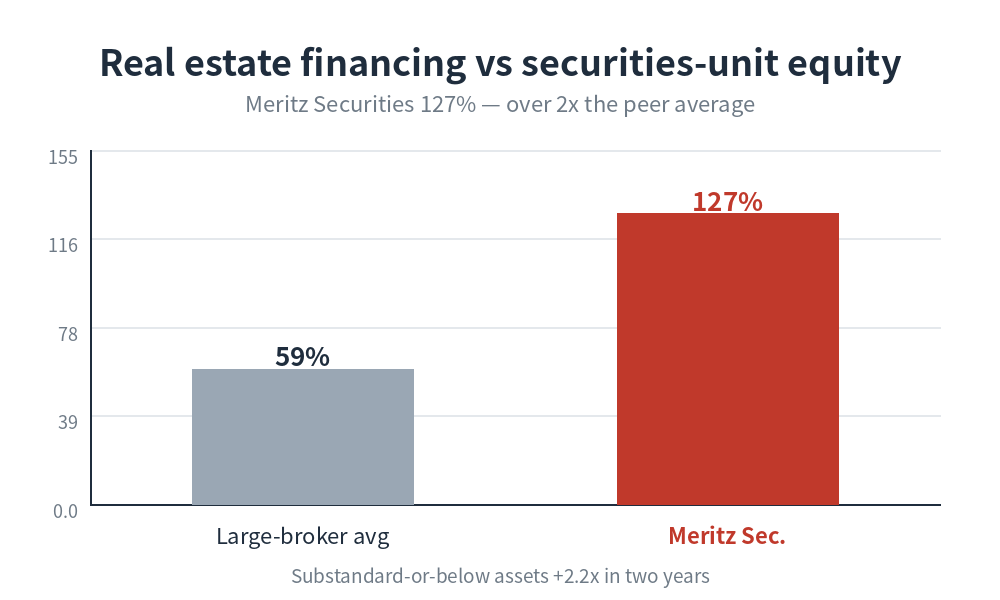
Even without the legal file, one balance-sheet number would have kept me cautious. Based on a June disclosure analyzed by Korean outlet Capital Markets News (Jabon), Meritz Securities’ real estate financing exposure stands near ₩9.6 trillion (~$6.5 billion), or 127% of the unit’s equity — against a 59% average for large Korean brokers. Substandard-or-below assets at the unit grew from ₩882.7 billion at the end of 2023 to ₩1.97 trillion (~$1.3 billion) by the end of 2025, a 2.2x rise in two years. The insurance side carries its own version: Korean press citing NICE Investors Service put Meritz Fire’s real estate project-finance loans at ₩10.1 trillion (~$6.9 billion) as of mid-2025 — 24% of invested assets — with the delinquency rate climbing from 1.8% in 2023 to 4.3% by June 2025, driven by stalled provincial developments.
For readers outside Korea: real estate project finance, usually shortened to PF, is Korea’s construction-lending complex — bridge loans and completion guarantees that funded the last building cycle and have been the economy’s slowest-burning credit worry since 2022. Meritz’s standing answer is that it lends senior, secured, and at high rates, and its realized losses so far have broadly backed that up. My pushback is about scale, not selection: when exposure reaches 1.3x your equity, being a good picker protects the median outcome, not the tail. In a scenario where Korean property turns down again, this is the group whose earnings power gets tested first. Read that sentence next to the 25% ROE; both are true at once, and the second exists partly because of the risk appetite behind the first.
What Meritz Financial Stock Costs, in Dollars and Multiples
The sell-side view, with names attached. Daishin Securities analyst Park Hye-jin, in a May 27 note summarized by Korean press, estimated 2026 profit attributable to shareholders at ₩2.31 trillion (~$1.6 billion) with a 12-month objective of ₩140,000 (~$95) — and, notably, kept only a Marketperform rating while writing that the stock had slipped below 1.6x book against fundamentals that deserve better. An analyst calling a stock too cheap and still declining to rate it higher is, in my reading, pricing the probes and the PF book as unquantifiable overhangs. Shinhan Securities’ Lim Hee-yeon, in an October 2025 note, carried a Buy rating with an objective of ₩149,000 (~$101) and assumed a 53.5% total return of profit to shareholders in 2026. Kiwoom’s Ahn Young-jun argued last summer that even flat earnings compound book value per share as long as the cancellations continue — the cleanest one-line version of the bull case.
My own arithmetic, all back-of-envelope and marked as such: 167.35 million shares at ₩116,500 puts the market cap near ₩19.5 trillion (~$13.3 billion). Against 2025’s record net profit of ₩2.35 trillion (~$1.6 billion) — the third straight year above ₩2 trillion — that is roughly 8.3x trailing earnings; against Daishin’s 2026 estimate, about 8.4x forward. Book value near ₩10 trillion implies around 1.9x book. For a US investor used to large banks trading at one to two times book with ROEs in the low teens, the relative math is friendly: a durable 22–25% return on equity at 8x earnings is not what expensive looks like. Which is exactly my point about the 14.6% buyback yield the company advertises — the earnings yield is that high partly because the market is charging for risks the multiple cannot see. If those risks dissolve, the yield was real. If they bite, the cheapness was the warning label.
How To Get Exposure — and Why I Have Not Taken Any
Access, for readers outside Korea: Meritz Financial has no US ADR.
Liquidity is workable but not deep by US standards. From my market data, recent daily volume has run between roughly 150,000 and 420,000 shares — call it $12–35 million a day at current prices. That is fine for a personal position sized like mine would be; it is worth knowing if you think in blocks. And the currency leg is not a rounding error this year: the won traded near ₩1,470 to the dollar during the July crash, so a dollar-based holder owns two trades at once — the company and the currency — and either can dominate a quarter’s return.
As for me: I have not bought, and the stock sits at the top of my watch list rather than in my account. Leaving a name with this earnings engine, this cancellation cadence, and this multiple un-owned is unusual for my process, so I forced myself to write down a sequence instead of a feeling. First, mid-August: second-quarter results, where I want the securities unit’s momentum (up 35.7% in Q1) to survive a quarter that contained a crash, and the substandard-asset curve to stop steepening. A crash quarter cuts both ways for a broker — panic volumes fatten brokerage commissions while trading books and bridge-loan marks absorb the hit — so the line I will actually read first is not the headline profit but the credit-cost and valuation-loss lines under it. Second, the trust: when the remaining ~₩270 billion runs out, I want to see the next contract signed without a pause, because execution continuity is my trust metric for this company. Third, the legal calendar: an indictment decision will tell me whether the key-man question is an organizational risk or a personal one. If those three land my way, in that order, I expect to update this piece and open a position. If they do not, the watch list loses a name. The 25% ROE machine is genuinely rare. I am just not willing to pay for the machine and throw in the mechanic’s court dates for free.
Related reading