Hana Financial Stock: The Won Writes the Buyback Budget
On July 16, Hana Financial stock touched 142,500 won — about $94 at the roughly ₩1,520-per-dollar rate tracked by Trading Economics — a fresh 52-week high on the Korea Exchange. It closed at 136,800 won (~$90), leaving a 4% upper wick on the daily candle. Two weeks earlier, on July 1, the same share closed at 116,600 won (~$77). That is a 17% move in two weeks of trading, in a $25 billion bank. I do not own it, I did not chase it today, and this journal entry is me writing down exactly why — and what would change my mind.
The 60-second map. Hana Financial Group (KOSPI: 086790) closed July 16 at 136,800 won (~$90), market cap about 37.5 trillion won (~$24.7B, my back-calculation from 274.4 million shares outstanding). Trailing P/E 9.7, price-to-book 0.84, fiscal 2025 dividend of ₩4,105 (~$2.70) per share — a 3.0% yield at this price. My stance: not owned, watching. Not because the franchise is weak, but because the price and the calendar are misaligned. Three dates sit on my scale: July 21 (the current buyback tranche expires), late July (first-half earnings and the second-half payout announcement), and August (the exchange rate and the confirmed Q2 capital ratio).
Contents
Hana Financial Stock: Anatomy of a 17% Two-Week Rally
First, the price path, precisely. The stock printed an intraday low of 107,600 won (~$71) on June 26. Then 116,600 won on July 1, 129,200 won (~$85) by July 10, and an intraday 142,500 won on July 16. From the June low to today’s high is a 32% swing in three weeks; over twelve months the share is up 48%. Moves that fast always have fuel, and my first job is to sort that fuel into two piles: the kind that burns out and the kind that keeps burning.
Fuel one — the Q2 preview
Korean business channel MTN reported on July 7 that Korea’s four major financial holding groups are expected to post combined second-quarter net profit above 5.62 trillion won (~$3.7B), putting first-half earnings near a record 11 trillion won. Within that group, Hana’s projected profit growth of 5.7% year-over-year outpaces Shinhan‘s 4.3%. Hana itself reported 1.1733 trillion won (~$772M) of net profit in last year’s second quarter, per the company’s own release covered by Korean outlet Insight Korea. Apply the reported growth rate and you get roughly 1.24 trillion won (~$815M) for this quarter — my own back-calculation from those two published numbers, not a figure any analyst printed. The drivers behind the sector preview, per the analyst from BNK Investment Securities quoted in the same MTN piece, are a still-rising margin trend and securities-affiliate fee income fully offsetting weaker bond gains. Two details in that sentence matter for Hana specifically: Korean sell-side desks have long filed it among the most bank-reliant of the big holding groups, so the first driver — the margin — does the heavy lifting here, while the second driver, the securities-fee offset, matters less than it does at KB or Shinhan with their bulkier non-bank lineups. Same sector tailwind, different exposure. KB, for scale, is projected around 1.76 trillion won (~$1.16B) for the quarter and keeps the profit crown; Hana competes on growth rate, not on size.
Fuel two — the buyback restart
Korean financial trade outlet Bloter reported on July 2 that Hana resumed open-market share purchases on July 1 after a pause that began in early June. Of the current 200 billion won (~$132M) tranche, 152.9 billion won — 76.4% — had been executed as of July 1, with a July 21 deadline for the remainder. When a company is in the market buying its own shares every day, that is short-term demand you can almost set a clock by.
Fuel three — a tax rewrite for dividends
This year is the first under Korea’s new separate taxation regime for dividend income. Large individual holders of high-payout Korean financials used to face progressive comprehensive taxation on dividends — a structural reason to sell before the record date. Softening that treatment shifts the demand curve itself; it is not an event that expires. Foreigners already hold about 68% of Hana’s float, so the marginal new buyer here is domestic income money. Of my three fuels, this one is the ballast — though I remind myself it lifts every Korean bank, so it is a reason to stay in the sector, not a reason to pick this specific share.
Q1 Scorecard — Profit Up, Capital Ratio Scratched
First-quarter net profit came in at 1.21 trillion won (~$800M), up 7.3% from a year earlier, as reported by Korean daily Joseilbo in late April. Net interest margin recovered to 1.82%, up 4 basis points from the prior quarter, per Bloter’s May 11 review. On the income statement alone, this was a clean quarter.
The scratch is on the capital line. The group’s CET1 ratio — the common equity Tier 1 ratio, the single number that governs how much a Korean bank can pay out — slipped from 13.38% at year-end to 13.09% in the first quarter. Risk-weighted assets jumped from 288.9 trillion won to 301.1 trillion won (~$198B), up 4.2% in one quarter. Two forces did that, per the same Bloter report: the won-dollar rate spiking into the 1,530s in late March, which inflates the won value of foreign-currency assets, and the phase-in of a Basel III transitional measure worth roughly 34 basis points of drag. I read bank holding companies capital-first, income-second, because the dividend and the buyback are both paid out of that CET1 wallet.
One more comparison axis gives the picture depth. In last year’s second quarter Hana ran an NIM of 1.73%, ROE of 10.76%, and CET1 of 13.39%, per the company’s release. So the margin is 9 basis points better than it was then — while the capital ratio is 30 basis points thinner. The business is earning more; the wallet is lighter. Management’s response is already on the record too: Hana Bank cut household loans by 0.3% in Q1 while growing corporate loans 1.8%, deliberately steering regulatory-relief capacity into higher-risk-weight corporate lending. That is a growth-versus-payout trade made from the same wallet, and I flag it here because it slows the very ratio recovery the payout case depends on.
The Throttle on Hana Financial Stock Is the Exchange Rate
Here is the frame I settled on for this name, and it is the reason this journal entry exists: not the net interest margin, not loan growth — the Korean won sets Hana’s buyback budget.
The frame has a reverse side. On Coway I looked at the case where the budget is the fixed part. Netmarble’s filing commits 49,999,750,000 won to open-market purchases, an amount built on a reference price of 85,000 won; run the same money at the August 5, 2026 close of 92,800 won and it buys 538,790 shares instead of 588,235, taking the resulting stake to 27.53% rather than the 27.60% written into the filing. At Hana the currency sets how large the budget can be. At Coway a rising price quietly shrinks what a fixed budget brings home. Either way the announcement is denominated in money and the result is denominated in shares.
The sensitivity is quantified. Daishin Securities analyst Park Hye-jin put Hana’s capital-ratio sensitivity at 2.5 basis points of CET1 per 10 won of currency move, with earnings sensitivity of about 10 billion won (~$6.6M) on the same increment, and estimated that a 100-won jump in the exchange rate can shave up to 0.3 percentage points off CET1 — as reported last November by Korean outlet Financial Post. Management’s stated comfort zone for CET1 is 13.0% to 13.5%. At 13.09%, Hana is standing on the bottom edge of its own range. The group’s outsized foreign-currency book is a legacy of its merger with Korea Exchange Bank, the country’s historic trade-finance and FX house — which is why, among Korea’s four major banking groups, Hana has long been tagged by the Korean press as the one that flinches first when the won weakens.
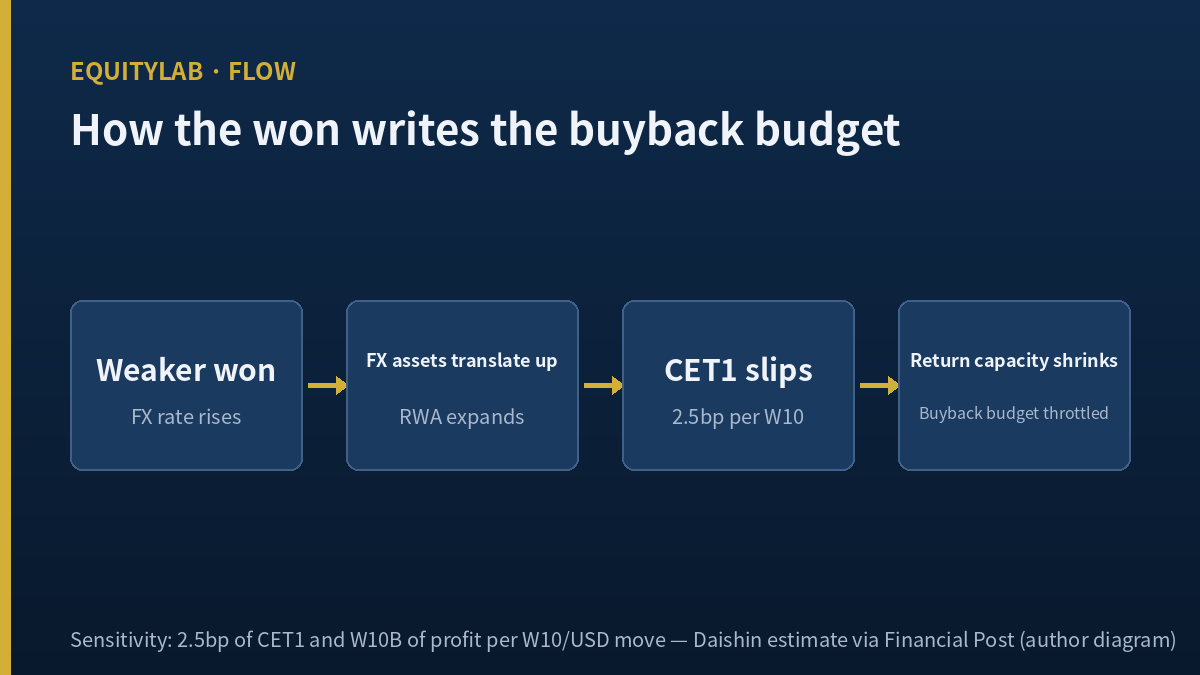
The relief valve is also quantified. Bloter’s May 11 piece laid out why the second quarter could recover to around 13.2%: the exchange rate cooled into the 1,450s by early May, and Korean regulators eased two capital rules — a lower risk weight on equity holdings and, more importantly for Hana, expanded recognition of structural foreign-exchange positions. That second item effectively carves the capital-like FX positions parked in overseas subsidiaries out of the currency-risk transmission chain, and the more FX-sensitive your balance sheet, the more that carve-out is worth. Put simply: when the won strengthens, the regulation tailwind compounds it, the capital ratio rebuilds, and the second-half buyback budget grows. The exchange rate is this stock’s throttle.
Run the same X-ray on KB or Shinhan and the picture is blurrier. Those two stand on several earnings legs — securities, insurance, cards — so a currency kick to one leg does not tip the body. Hana stands on one unusually thick banking leg, and that leg is planted on a foreign-currency floor. When I studied KB, I watched its earnings date first; with Shinhan, the capital-allocation contest. With Hana, I open the currency chart before I open the financial statements. For a US-based reader the irony is worth savoring: this is a stock whose won-denominated price you already convert to dollars — and whose fundamental engine is itself a dollar-won trade.
The Buyback Engine Behind Hana Financial Stock
The execution record this year, in order. A first 200 billion won (~$132M) tranche ran from March 3 and finished early on April 16. The second 200 billion won tranche started April 27 and must finish by July 21 — 76.4% done as of July 1, roughly 47.1 billion won (~$31M) left to execute, per Bloter. For the second half, Korean investment-industry forecasts compiled in the same report point to an additional 650 billion won (~$430M) of buyback-and-cancellation, which would lift the full-year repurchase program into the one-trillion-won (~$660M) range, alongside about 1.2 trillion won (~$790M) of dividends. On those industry numbers, the total shareholder return ratio climbs from 46.8% of profit in 2025 to 51.5% this year. I copy those figures with their label attached: they are sell-side and industry projections, not company guidance.
What is confirmed is the dividend trajectory: per-share payouts of ₩3,350 → ₩3,400 → ₩3,600 → ₩4,105 (~$2.70) across the last four fiscal years, per regulatory filings — three consecutive increases. Add the arithmetic of cancellation — fewer shares dividing the same profit — and you get the real mechanics of the Korean bank re-rating. It was never mainly a rate story. It is a share-count story. Combined, the projected repurchases and dividends approach 6% of Hana’s market cap in a single year. For context, that is the kind of all-in payout yield US bank investors associate with the sector’s most generous capital returners, offered here at 0.84x book.
My supply-demand journal keeps one more table: the buyback calendar laid against the price path. While tranche one executed, the stock based in the low-to-mid 120,000s through late April. During the June purchase pause, it slid from the 130,000s to that 107,600 intraday low. Purchases resumed July 1; the stock has since run 17% to a new high. Correlation is not proof — June also carried a broad market wobble — but three inflections landing on three seams of the buyback calendar is not something I am willing to file under coincidence. That is exactly why July 21, when this tranche expires, matters to me as much as any earnings date.
The Bear Case — When Payouts Outrun Earnings
This is the paragraph I force myself to write with the most care, because I like this story and that is precisely when I make mistakes. Ahn Tae-young, senior analyst at Korea Ratings — one of Korea’s three domestic credit assessment houses — warned that aggressive shareholder-return expansion without matching growth in earnings generation can erode a group’s fundamentals, arguing capital strength and payout ambition have to stay in balance. His caution, and the sector data behind it, were reported in May by Korean outlet Newsway: Hana’s risk-weighted assets grew 54 trillion won (~$36B) in a single year, and the won-dollar rate broke back above 1,500 that month, squeezing capital ratios across the industry. KB, Shinhan and Hana all posted lower CET1 in the same quarter.
Policy is a second drag. Seoul’s “productive and inclusive finance” push steers banks toward higher-risk-weight lending. The three Korean groups with New York-listed shares — KB, Shinhan and Woori — went as far as adding that policy to the risk-factor sections of their US regulatory filings, per the same Newsway report. Hana is absent from that list only because it has no New York listing; it stands under the same policy sky. And the final bear argument is the price itself: a 52-week high after a 48% twelve-month run, 15% above its own 120-day moving average. My entire method in this journal has been built on buying weighed-down prices — accumulating drawdowns, not celebrating breakouts. Today’s chart is the exact opposite of my hunting ground. The income argument has thinned with the rally too: at February prices near 100,000 won this share offered a dividend yield above 4%; at 136,800 won the same ₩4,105 payout is 3.0%. A hundred basis points of yield is what two weeks of price applause quietly ate.
Hana Financial Stock vs Global Peers: The 0.84x Book Question
Now the part a dollar-based reader will care about most. At Thursday’s close, Hana trades at 9.7 times trailing earnings and 0.84 times book value, on a trailing ROE of 9.2%. JPMorgan — the global benchmark for what a fully re-rated bank looks like — trades at 2.61 times book with a 1.73% dividend yield, per StockAnalysis data as of July 15. I am not arguing Hana deserves JPMorgan’s multiple; the profitability gap is real. The more honest comparison is Japan: Tokyo’s megabanks spent years below book value until governance reform, payout expansion and share cancellation dragged their multiples up — the same playbook Korea’s value-up program is now running, with Korean banks a few years behind on the same road. Hana at 0.84x book, cancelling shares on a schedule, is what the middle innings of that playbook look like.
Korean sell-side desks see the gap the same way. Mirae Asset’s Son Min-ho set a price objective of 145,000 won (~$95) and Kiwoom Securities went to the 150,000-won (~$99) range after Q1 results, per the Joseilbo report; in May, iM Securities put 150,000 won on the name, calling it — per Korean press headlines — the best pick among bank-heavy holding groups. Those objectives sit only 6~10% above today’s close, which tells me the easy part of the re-rating has been eaten. Investing.com’s consensus page tracks the same cluster of estimates if you want the running tally.
A quick word on the venue, since it shapes everything above. Hana trades on the KOSPI, the main board of the Korea Exchange (KRX) — the senior market where Korea’s large caps list, as opposed to the KOSDAQ, the growth-and-tech junior board. Foreign investors hold roughly 68% of Hana’s shares, which is high even by Korean big-bank standards; the marginal price-setter in this name has long been offshore institutional money, which is partly why a US-dollar lens on it is not a translation exercise but the native reading.
And a practical access note, because Hana is the awkward one of the four. KB, Shinhan and Woori all have NYSE-listed American Depositary Receipts; Hana does not. Company-side numbers are published in English on Hana Financial Group’s IR site.
My Three Scales for Hana Financial Stock
I set my checkpoints in calendar order, each one inheriting the result of the one before it.
First, July 21 — the buyback tranche expires. I watch whether the remaining ~47 billion won executes by the deadline, and what the tape does the day after the engine cuts out. In June’s pause the stock gave back more than 15% from its highs. This gap will be different — it runs straight into earnings week — but that makes it a cleaner experiment: can expectation alone hold a price that daily corporate buying was holding before? Those few sessions will show me this stock’s bare supply-demand face.
Second, late July — the payout announcement inside the earnings release. Last year the group reported first-half results on July 25. The headline profit number matters less to me than the second-half repurchase figure, and I have written my three branches down in advance so the day’s price action cannot write them for me. If the announcement beats the 650-billion-won industry expectation, I raise my attention level and move Hana to the top of my pullback watchlist even with the chart extended. If it lands near expectation, I proceed as planned to the August checkpoint. If it clearly falls short, I treat a retracement of this whole two-week rally as the base path and extend my patience accordingly.
Third, August — the exchange rate and the confirmed Q2 CET1. If the ratio prints around 13.2% as the Korean trade press projects, and the won holds below the 1,450 line, the throttle is open again. If the price is still sprinting at new highs when that confirmation arrives, I let it go without regret. If it has paused and pulled back, that is where I would begin building a position in tranches — starter size first, the way I have handled every Korean financial in this journal. For sizing, my own rule in names like this is three to four tranches with the first deliberately small, because the thing I am buying — a payout schedule throttled by a currency — can be repriced by a single bad month on the won, and I want dry powder for exactly that month rather than regret about it.
So, the summary I owe myself: I am not watching from the sidelines because I doubt this company’s engine. I doubt my own entry price after a 17% sprint. Let the currency gauge settle, let the second-half budget be printed in a filing rather than a forecast, let the price take one honest breath — my turn comes then. A 52-week high is something I applaud; it has never been something I chase. That lesson cost me real tuition in this market, and I intend to keep the receipt.
Related reading
- Meritz Financial Stock: A 25% ROE Machine Under Investigation
- KakaoBank Stock at Nubank’s Multiple, Half the Growth