Woori Financial Stock: The CET1 Turnaround I Bought in a Crash
I had July 28 circled on my calendar for a different bank — yet I ended the session buying Woori Financial stock. When I wrote up KB Financial earlier this month, I noted I was waiting for its second-quarter numbers due on the 28th before doing anything. The date arrived — and instead of an earnings session, Seoul handed me the worst tape of the year. A 465% debut surge in Chinese memory maker CXMT out of Shanghai set off panic about Korea’s two chip champions, the KOSPI tripped its eighth circuit breaker of 2026, and the index closed down 10.84% at 6,023.66. And yet the order I actually placed that afternoon wasn’t for a chipmaker or for KB. It was for Woori Financial stock — ticker 316140 in Seoul, WF for the American depositary receipt on the NYSE — the last of Korea’s big-four banking groups I had left uncovered in this journal.
The 30-second version of what I did today
On the day the KOSPI collapsed 10.84%, Woori Financial stock gave up 4.2% — closing at ₩31,750, roughly $21.60 at the crash-day exchange rate of about ₩1,470 per dollar. Four days earlier it had beaten consensus with a $683 million quarter (₩1,004.6 billion) and jumped 8.2%.
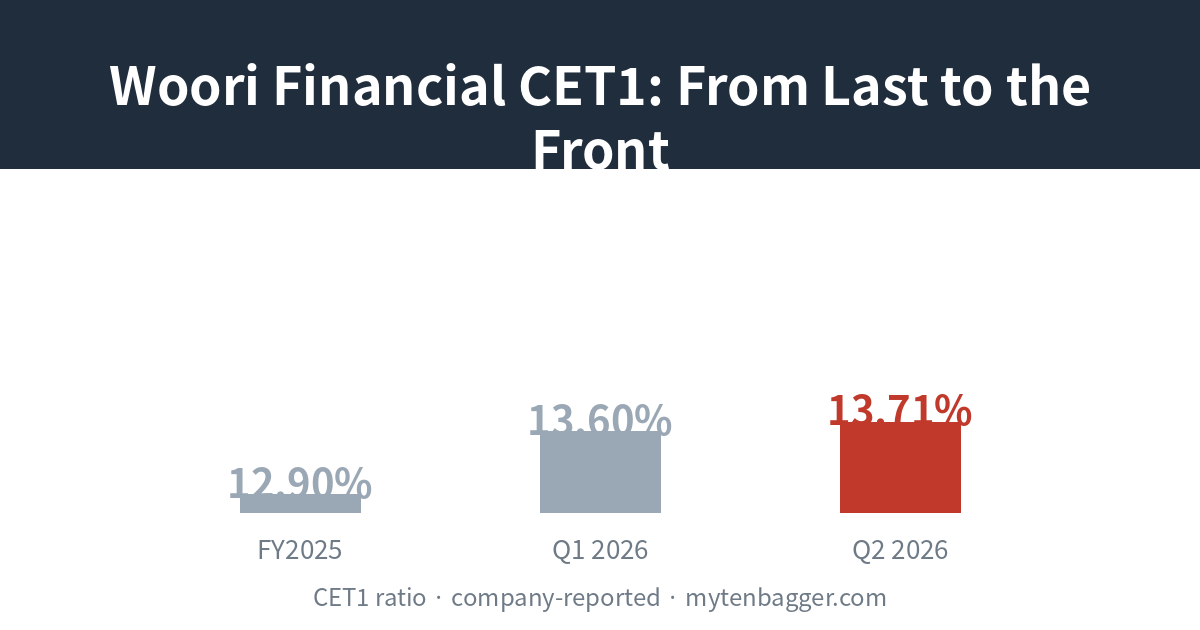
The group’s CET1 capital ratio — for years the worst among Korea’s big four — reached 13.71% in Q2, within three basis points of the leader. But a large slice of this year’s climb came from a land revaluation worth about $1.2 billion (₩1.79 trillion) that cannot legally fund dividends. I discount that slice.
I bought 30% of my planned position into the crash. The rest waits on a weighted scorecard I lay out at the end.
Contents
The Day Woori Financial Stock Fell 4% While the KOSPI Fell 11%
First, the tape, because non-Korean readers deserve the context. The KOSPI is the main board of the Korea Exchange in Seoul — the home of Samsung Electronics, SK Hynix, and most of the country’s blue chips, the rough equivalent of the S&P 500 for Asia’s fourth-largest economy. A circuit breaker halts all trading for twenty minutes when the index drops 8% from the prior close. On July 28 that breaker tripped mid-morning, and the selling barely paused for it: The Korea Times called it “Black Tuesday” as the index finished 10.84% lower at 6,023.66. Samsung Electronics lost more than 13%, SK Hynix nearly 15%, and by the close foreign investors had dumped over $3.2 billion (₩4.7 trillion) of Korean shares, per Korean end-of-day tallies; the Korea JoongAng Daily chronicled the chip-led selloff as it tripped the breaker. The trigger was CXMT — China’s memory challenger whose Shanghai debut ripped 465% higher and forced the market to reprice Chinese competition against Korea’s memory duopoly overnight. The won weakened to ₩1,469.90 per dollar.
Woori Financial stock closed that same session down 4.2% at ₩31,750 (about $21.60) — my back-calculation from the prior close of ₩33,150. Less than half the index’s fall. I see two reasons, and neither is mysterious. One: this was a semiconductor shock aimed squarely at chip earnings, and a bank that makes its money on lending margins and fees has no direct transmission line to DRAM pricing. Two: Woori had already played its own card. It reported second-quarter earnings on Friday, July 24, and on Monday the stock leapt 8.2% from ₩30,650 to ₩33,150 (again, my calculation from closing prices). Tuesday’s give-back took away only part of Monday’s earnings pop.
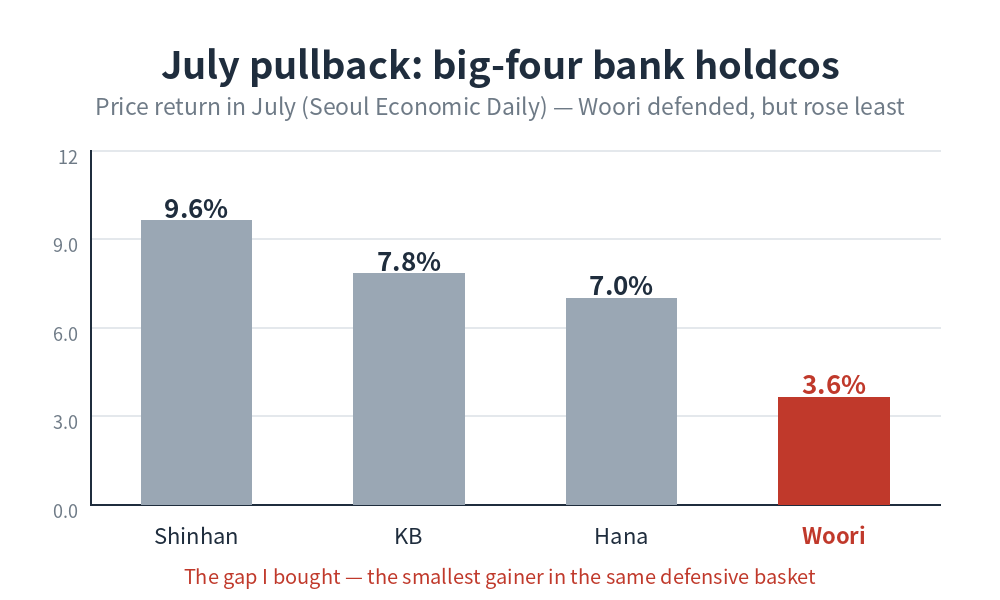
Zoom out one month and the pattern holds. Korean press tallies of July’s turbulent stretch showed all four major banking groups beating the index by wide margins — Shinhan up 9.60%, KB up 7.80%, Hana up 6.98%, and Woori up 3.62% — the defensive rotation story Korean brokerage desks have been pushing all month. Notice who sits last in that list. Even inside the defensive basket, Woori has lagged its three peers, and that laggard status is precisely what a Hana Securities analyst flagged after the earnings beat: the stock’s year-to-date gain trails the other holdcos badly, which makes its price appeal stand out now that the earnings have turned. What I bought on crash day is that gap.
Q2 Earnings: What Pushed Woori Financial Stock Through Consensus
The July 24 release is the reason this name moved from my watchlist to my order book. Attributable net profit came in at ₩1,004.6 billion — about $683 million — versus the Korean sell-side consensus of roughly ₩932.2 billion ($634 million), a 7.8% beat by my math. It marks Woori’s return to the “trillion-won club,” Korean shorthand for a quarter above ₩1 trillion, and it lands 7.4% above the same quarter last year and 66% above the first quarter’s ₩603.8 billion (my back-calculation). First-half profit of ₩1,609 billion (about $1.09 billion) set a company record for any six-month period. There is an English-language paper trail for readers who want the source material: the Motley Fool carries the full WF earnings call transcript, and the company posts its earnings decks on Woori Financial Group’s investor relations page (Korean site; the decks themselves are published in English as well).
The composition matters more than the headline. Per the company’s disclosure: first-half interest income rose 3.2% to ₩4,659.7 billion (about $3.2 billion), non-interest income jumped 20% to ₩1,063 billion ($723 million), the bank’s net interest margin improved seven basis points year over year, and quarterly fee income crossed ₩720 billion (about $490 million) for the first time ever. In a rate-cutting cycle, holding margin while bolting on a second engine of fees and insurance income is exactly the shape a bank bull wants to see.
| Metric (Q2 / H1 2026) | Reported | USD (≈₩1,470/$) |
|---|---|---|
| Q2 attributable net profit | ₩1,004.6B (+7.4% YoY) | ~$683M |
| H1 net profit (record) | ₩1,609B (+3.7%) | ~$1.09B |
| H1 non-interest income | ₩1,063B (+20%) | ~$723M |
| Non-bank share of profit | 22.3% (vs 6.9% a year ago) | — |
| Q2 CET1 ratio | 13.71% | — |
For the forward view I lean on two named Korean houses, and I flag that both write in Korean — what follows is my reading of their published work, not an English original. Sangsangin Securities analyst Kim Hyun-soo penciled in roughly ₩3.1 trillion (about $2.1 billion) of attributable profit for the full year in his pre-earnings preview. KB Securities analyst Kang Seung-gun models ₩3,303 billion ($2.25 billion) for 2026 and ₩3,628 billion ($2.47 billion) for 2027. The spread between those numbers tells me the earnings path still sits inside a wide band, so I anchor loosely on “around ₩3 trillion” and refuse to build the thesis on decimal precision.
One sector-level marker worth adding for perspective: Korea’s four largest financial groups together earned a record ₩11.34 trillion — roughly $7.7 billion — in the first half, per the Korea JoongAng Daily’s tally of the big four. This is not one bank having a lucky quarter. It is a sector printing record profits into a market that still prices most of it below book value.
The Non-Bank Pivot — and the Bargain-Purchase Illusion
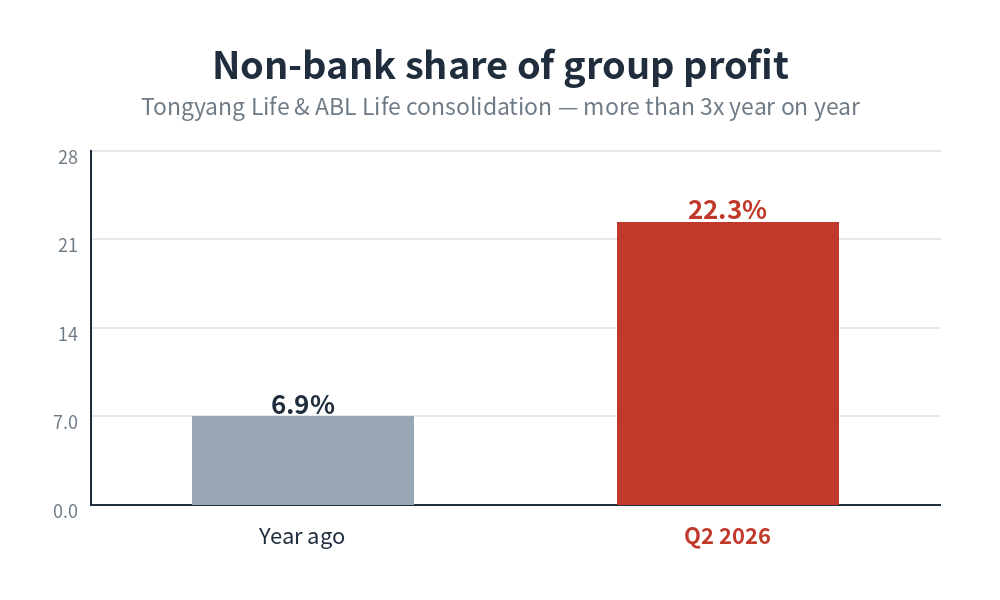
The single line I stared at longest: non-banking subsidiaries now contribute 22.3% of group profit, versus 6.9% a year earlier — more than a threefold jump. For years Woori was derided as the “bank-only” holdco of the big four, the one that shed its brokerage and insurance arms during its long post-bailout restructuring and never rebuilt them — until now. That reconstruction is finally flowing through the income statement: life insurers Tongyang Life and ABL Life came into the group last year, the rebuilt Woori Investment Securities is scaling, and on the same day as the earnings release, shareholders of Tongyang Life approved its conversion into a wholly owned subsidiary — meaning the insurance earnings stream now accrues 100% to the group.
But there is an accounting illusion sitting in the comparison base, and I want it on the record. By analyst Kim’s arithmetic, last year’s acquisition of the two insurers generated a one-off bargain-purchase gain of about ₩580 billion ($395 million) — the accounting windfall that arises when you buy assets below their fair value. Strip that inflated base out, and this year’s modest-looking 3.7% first-half growth becomes an underlying improvement of roughly ₩500 billion in recurring profit. Headline growth in the low single digits; recurring growth in the double digits. I judged this the strongest single argument on the bull side, because a comparison base normalizing after a one-off distortion is the kind of discount only visible to people who actually read the footnotes.
CET1: The Capital Reversal Behind Woori Financial Stock
Woori’s perennial discount had one root cause: capital. Among Korea’s four major groups it ran the lowest common equity tier 1 ratio — the core regulatory measure of loss-absorbing capital — which capped its dividends, constrained its acquisitions, and justified its bottom-of-the-pack price-to-book multiple. That ranking flipped this year. Korean financial press reporting traced the CET1 path from 12.90% at end-2025 to 13.60% in the first quarter, three basis points behind KB’s 13.63%; then the July 24 release printed 13.71% for Q2, a level management described as among the industry’s best. Set against the provisional Q2 figures the same Korean press cited for peers — KB at 13.74%, Shinhan at 13.43% — that self-assessment is hard to argue with. The group that spent years in last place is now contesting first, three basis points from the crown.
Two forces drove the reversal. Regulatory: Korea’s Financial Services Commission overhauled its approval process for internal credit-risk models in April, and Woori Bank’s newly approved model cut risk-weighted assets without a single share of new equity. Managerial: under Chairman Lim Jong-yong the group deliberately starved asset growth to feed capital — Woori Bank was reportedly the only major Korean bank to shrink its corporate loan book last year. With the ratio rebuilt, the bank pivoted and grew corporate lending 2.8% quarter-over-quarter in Q2, per the company. Contract the balance sheet to build capital, then redeploy once the buffer is in place — the sequencing reads deliberate rather than lucky.
Read the ingredient label on that 13.71%
Now the other side, because this is where careless bulls will get hurt. A June report in the Korean daily Asia Today — again, a Korean-language source, cited here in my paraphrase — broke down the first quarter’s 0.71-percentage-point CET1 jump and found that much of it came not from earnings but from a revaluation of land holdings, which added roughly ₩1,792 billion (about $1.2 billion) to book equity. The catch: under Korean rules, revaluation surplus does not count as distributable profit. It lifts the regulatory ratio and the book value, but it cannot legally fund a single won of dividends or buybacks. Reading the CET1 climb as a one-for-one increase in payout capacity is therefore an overinterpretation — the ratio is real for regulators, only partly real for shareholders. My handling: I buy the direction of the capital reversal and mentally discount about half its magnitude as accounting rather than cash generation.
Buybacks, Tax-Free Dividends, and the Payout Math
Alongside the earnings, the board added ₩150 billion (about $102 million) of second-half share buybacks and cancellations, lifting the full-year repurchase program to ₩350 billion ($238 million), and declared a quarterly dividend of ₩220 (about $0.15) per share — details confirmed in English by the Seoul Economic Daily’s report on the cancellation plan. Korean coverage of the release projects this year’s total shareholder return ratio at 46.4% of profit. And Woori’s payout carries a quirk most global investors have never seen: because the distributions are drawn from a capital-reserve reduction, they are entirely tax-exempt for shareholders under Korean rules. Against Korea’s standard 15.4% dividend withholding, the same nominal payout puts meaningfully more cash in the holder’s pocket — Korean press framed the effective return ratio as exceeding 50% once the exemption is counted.
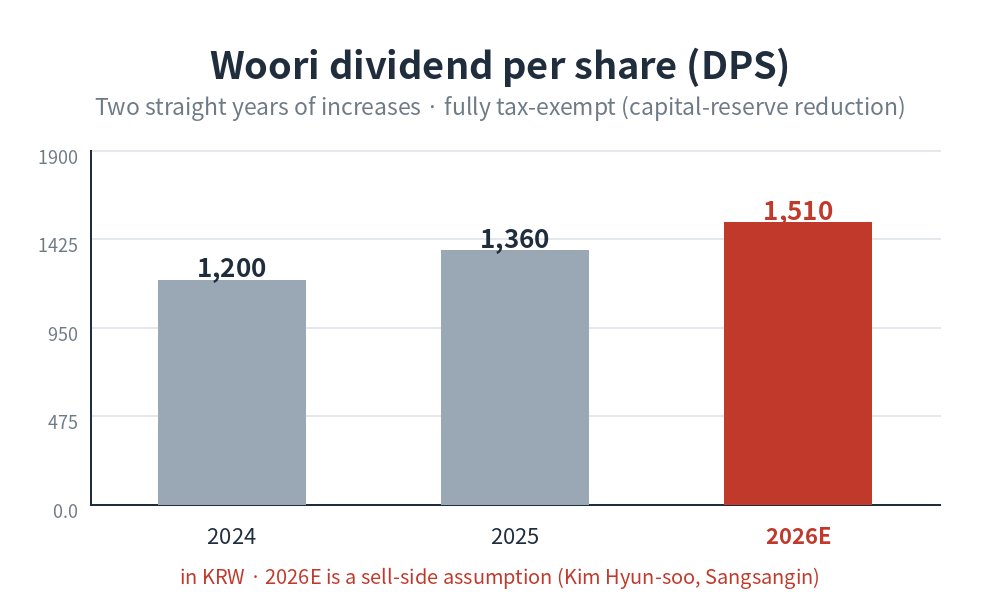
Price it. At the ₩31,750 close the market capitalization is about ₩23.1 trillion, or $15.7 billion — my cross-check of 728 million shares times price against the reported figure. Trailing price-to-book is 0.65x; trailing earnings multiple, 7.5x. Analyst Kim’s preview assumed ₩1,510 of dividends per share for the full year; against today’s close that is a 4.8% yield by my division — before layering on the tax exemption. The dividend track record runs ₩1,200 for fiscal 2024 to ₩1,360 for 2025 per regulatory filings, a 13.3% raise and the second consecutive annual increase, paid quarterly.
Here is where the global comparison earns its place. JPMorgan has traded above two times tangible book for years; Japan’s megabanks — MUFG, SMFG, Mizuho — spent the last three years re-rating from roughly half of book toward parity as Tokyo’s governance campaign forced capital discipline on them. Korea is running the same play under its Corporate Value-up Program, the government-backed push announced in 2024 to shrink the “Korea discount” through disclosure and payout reform. A banking group contesting the best capital ratio in its market, earning a record half, returning half its profit tax-free, still prices at 0.65 times book. Either Korean banks re-rate the way Japanese banks did, or the market is telling me something about this specific house — and the bear case below is where I look for that something.
The Bear Case Against Woori Financial Stock
I stack the opposing evidence in order of weight. First, the non-bank engine may be flattered rather than fixed. KB Securities’ Kang cut his valuation objective on the stock by 6.5% in early July — from ₩46,000 to ₩43,000, roughly $31.30 to $29.30 — precisely because the insurance and brokerage units are improving more slowly than he had modeled (he kept his buy stance, for the record; my reading of a Korean report). The 22.3% non-bank share is largely a consolidation effect from bolting on two insurers. It proves Woori bought earnings; it does not yet prove the acquired earnings can grow.
Second, the first quarter is a fresh memory. Q1 profit fell 1.9% year over year to ₩603.8 billion — the only decline among the big four, against gains of 11.5% at KB, 9.0% at Shinhan, and 7.3% at Hana, per Korean press summaries. One beat does not overwrite one miss; the sample size on “Woori has structurally turned” is exactly one quarter.
Third, capital has headwinds as well as tailwinds. The ABL Life merger and integration will keep absorbing money — the group has already injected about ₩1 trillion ($680 million) into Woori Investment Securities — and every won of investment-banking risk that brokerage takes on adds risk-weighted assets back to the denominator. So does the currency: the won at ₩1,469.90 inflates the won value of foreign-currency assets, mechanically pressuring CET1. And the crash itself carries tail risk for every lender — a 10.84% single-day index drop is the kind of event that can surface credit stress in brokerage margin books and leveraged corners of the economy in the weeks that follow. The 13.71% is printed; whether the recurring, non-revaluation portion of capital generation keeps it there is a question for the August business report.
My Scorecard for Woori Financial Stock — and How I Sized the Buy
I bought 30% of my intended position on crash day, in the ₩31,000s. Three things justified the first tranche to me: relative strength that held the drawdown to less than half the index’s, a consensus beat driven by fees and margin rather than one-offs, and a 0.65x book multiple that has not yet participated in the sector’s re-rating. But sizing is about the order of confirmations, not the loudness of conviction, so the remaining 70% answers to a weighted scorecard rather than to my mood.
| What I need to see | Weight | Pass condition |
|---|---|---|
| Non-bank recurring profit | 40% | Q3 shows insurance and brokerage earnings growing on their own, not just consolidating |
| CET1 quality and durability | 30% | August business report shows positive recurring capital generation excluding revaluation and model effects; ratio holds in the mid-to-high 13s through Q3 |
| Payout execution | 20% | The ₩150 billion second-half buyback actually starts executing |
| Macro aftershocks | 10% | Won stabilizes near ₩1,470 and no credit events surface from the crash |
My operating rule: above 70 weighted points I add the second tranche; below 40 I re-examine the whole position, first tranche included; in between, I collect the quarterly dividend and wait. More than half the weight deliberately sits on non-bank earnings and capital quality, because the story I paid for is not “a cheap Korean bank” — those have existed for twenty years — but “the worst balance sheet of the big four becoming the best.” If that narrative cracks, 0.65x book stops being an opportunity and becomes a fair verdict.
Two market paths, two responses. If the semiconductor rout drags on, the rotation of foreign money into low-multiple, high-payout financials — the pattern Korean desks documented all July — works in my favor, and I would consider accelerating tranche two. If chips V-bounce and the index rips back, banks likely lapse into neglect; in that world the stock marks time while the tax-free dividend pays me to wait for the August confirmations. The only move I have explicitly forbidden myself is deploying the full position on the strength of one day’s relative resilience, before the scorecard reports in.
Sources: The Korea Times — financial groups’ record earnings and returns · Money Today (Korean) — big-four CET1 comparison · Asia Today (Korean) — revaluation surplus and payout capacity · Newsway (Korean) — Q2 wrap, CET1 13.71%