SK Hynix Hit No.1, Then Fell 12.5%: Why I Didn’t Chase
My take in one paragraph. I have been carrying SK Hynix since the early HBM days in 2024, and I am still holding it. But when it became Korea’s most valuable company for the first time, I did not press the buy button — and the very next day it dropped roughly 12.5% and handed the No.1 crown right back to Samsung. The record earnings are real and the HBM near-monopoly is real. But “we have already sold out 2026” reads to me as a ceiling as much as a tailwind. With a U.S. listing on the way, this is a name every American investor will soon be able to own directly, so I want my own reasoning written down before the ADR hype arrives. I hold. I do not chase up here.
On June 22, 2026, something happened that had not happened in over 25 years: SK Hynix (000660.KS) overtook Samsung Electronics to become South Korea’s most valuable listed company. According to Reuters, SK Hynix shares closed up about 5.6%, lifting its market capitalization to roughly 2,080 trillion won (about $1.35 trillion) and pushing it past both Samsung and Micron to become the world’s most valuable memory chipmaker. Samsung had held that top spot since the year 2000.
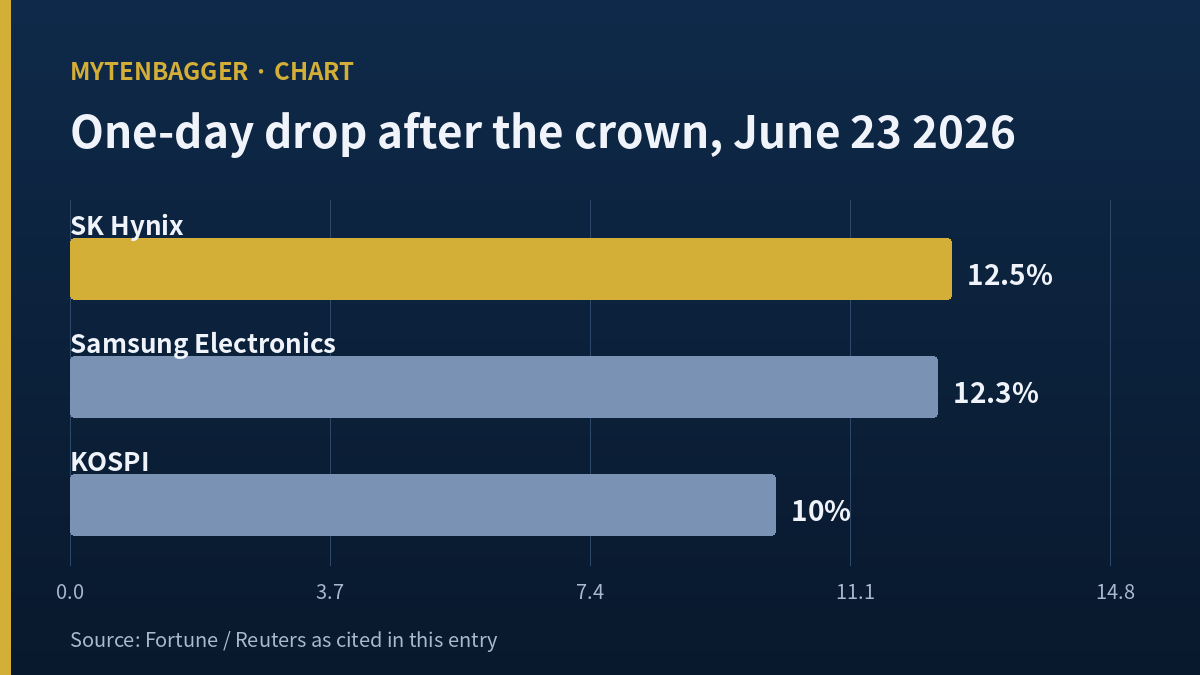
And then the script flipped. The next day, as Fortune reported, SK Hynix slumped nearly 12.5% in a broad tech sell-off, Samsung fell 12.3%, the KOSPI dropped about 10%, and Samsung quietly took the crown back. One day at the summit. I watched that round trip and, honestly, it confirmed the decision I had already made: I did not add at the top. If you searched “should I buy SK Hynix now” and landed here, I am going to walk you through why I would take a breath — using the numbers I actually looked at, not vibes.
Contents
When I Started Taking SK Hynix Seriously
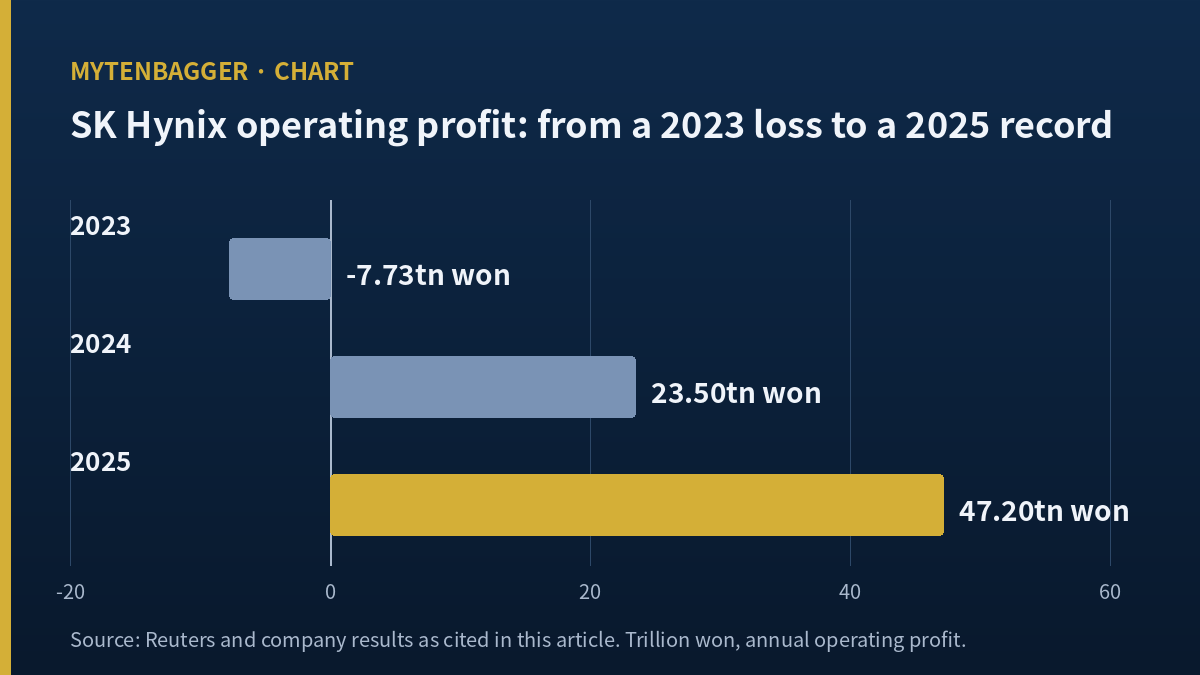
I will be honest about my own track record here, because that is the whole point of a journal. For a long time I treated SK Hynix as the “perpetual No.2” living in Samsung’s shadow. Through 2023 that looked right — that year a brutal memory downturn pushed the company to an annual operating loss of 7.73 trillion won, per Reuters. Memory was the textbook boom-and-bust commodity: prices rise, everyone adds capacity, prices fall. I had that lesson memorized.
What changed my mind was watching how HBM behaved differently. Unlike commodity DRAM, high-bandwidth memory is co-engineered with the customer’s AI processor from the design stage, which creates real switching costs and pricing power. SK Group Chairman Chey Tae-won put it bluntly in a book quoted by Reuters: in the past it did not matter whether memory came from Hynix, Samsung, or Micron because they were interchangeable; with HBM, if you swap out SK Hynix’s part, “the AI system may not function properly.” That is not a commodity. That is a component. So I built a thesis — “this might not be an ordinary memory cycle” — and I put weight behind it. So far, that call has worked. I want to say that plainly before I start poking holes in it, because the bear case only matters once you respect the bull case.
It is worth remembering how improbable this milestone is. In 2002, then-Hynix Semiconductor was on the verge of being sold to Micron, crippled by debt; its shares traded as low as 135 won in 2003, a literal penny stock — “Dongjeon-ju” in Korean. SK Group acquired it in 2012 over strong internal opposition, and Chairman Chey Tae-won’s bet was specifically that memory could be turned from an interchangeable commodity into an indispensable component. The recovery arc tells the same story in profit: a 7.73 trillion won operating loss in 2023, a then-record 23.5 trillion won operating profit in 2024 (per Reuters), and roughly 47.2 trillion in 2025. A company that nearly died is now, two decades later, the most profitable link in the AI hardware chain. I keep that history in front of me because it cuts both ways: it proves the upside can be enormous, and it proves this is a business that has been to zero before.
The Bull Case First — The Earnings Leave Little Room to Argue
Let me lay out the strong side in my own words. The first-quarter 2026 numbers the company posted on April 23 are, frankly, hard to argue with. From SK Hynix’s own earnings release:
- Revenue of 52.6 trillion won — the first time quarterly revenue crossed 50 trillion (company IR).
- Operating profit of 37.6 trillion won (about $25.4 billion), an operating margin of 72% — roughly double the prior quarter’s 19.2 trillion (company IR; USD via Reuters).
- Net profit of 40.3 trillion won, a 77% net margin (company IR).
- Net cash of 35 trillion won and 54.3 trillion won in cash and equivalents (company IR / earnings call).
The number that stopped me was not the headline profit — it was that 72% operating margin. For context, that sits above Nvidia’s roughly 65% and TSMC’s 58% in the comparable period (per Korean broker estimates relayed in local coverage). Sit with that for a second: a memory company out-margining the GPU king and the world’s leading foundry in the same quarter. The company I had dismissed as a No.2 was, for one quarter, the most profitable link in the AI hardware chain.
Supply backs it up. Goldman Sachs in April raised its 2026 DRAM supply-gap estimate from 3.3% to 4.9%, calling it the worst shortage in 15 years. On the earnings call, the company said its DRAM, NAND, and HBM are effectively sold out and it cannot fill every customer order. When the seller has that much leverage, pricing follows. That is the heart of the bull thesis, and I do not dismiss it.
The Data — What the Street Is Modeling, and Whether It’s Cheap
Wall Street’s Korean cousins agree on direction. After the Q1 print, more than ten domestic and global brokerages raised their targets at once. I do not adopt these as my own targets — I just record where the market thinks the ceiling is, as fact:
| Broker | Target (KRW) |
| SK Securities | 3,000,000 |
| Nomura | 2,340,000 |
| Goldman Sachs | 1,800,000 |
| Hana / Hanwha | 1,600,000–1,750,000 |
The spread between the low and the high is more than 1.4 million won — over 70% apart. I think that gap is the message. It is not a simple difference of opinion; it is a disagreement about how long DRAM price strength lasts and when HBM4 qualification clears. Bulls and bears are staring at the same variables and placing opposite bets. The 2026 full-year operating-profit consensus is reported above 250 trillion won (DS Investment is the most conservative at 223 trillion). Against 2025’s roughly 47.2 trillion, that is about a 5x jump in a single year. The bigger the number, the more I ask the same question: is this a price that only works if every assumption lands?
So I go to the multiple. Per a TradingKey analysis, annualizing Q1’s operating profit (about $26.7 billion) puts the trailing P/E near 8.4x, and applying the Street’s 2026 operating-profit range of roughly $140–150 billion drops the forward P/E to about 6.5x. On its face, 6.5x forward is not expensive — it looks cheap. But here is the trap: that 6.5x only exists if 2026 operating profit really does multiply ~5x off 2025. “Cheap” is not the accurate word; “cheap if the 5x fully lands” is. If the assumption cracks, the denominator shrinks and the same share price re-rates into the teens overnight.
That is why I weight the quality of the earnings over the multiple. The 72% margin was built on price: Q1 DRAM average selling prices rose in the mid-60% range and NAND in the mid-70% range, per IBK Securities estimates and the earnings call. A large share of the profit came from price, not volume — and price is more volatile than volume. It moves up fast and it falls fast. Half the reason the multiple looks cheap is the assumption that this price holds, and I cannot put 100% on that bet. To be fair, the balance sheet can absorb a wobble: 35 trillion won net cash, a 12% debt ratio, EBITDA of 41.3 trillion (79% margin). I am not questioning the company’s durability. I am questioning the price.
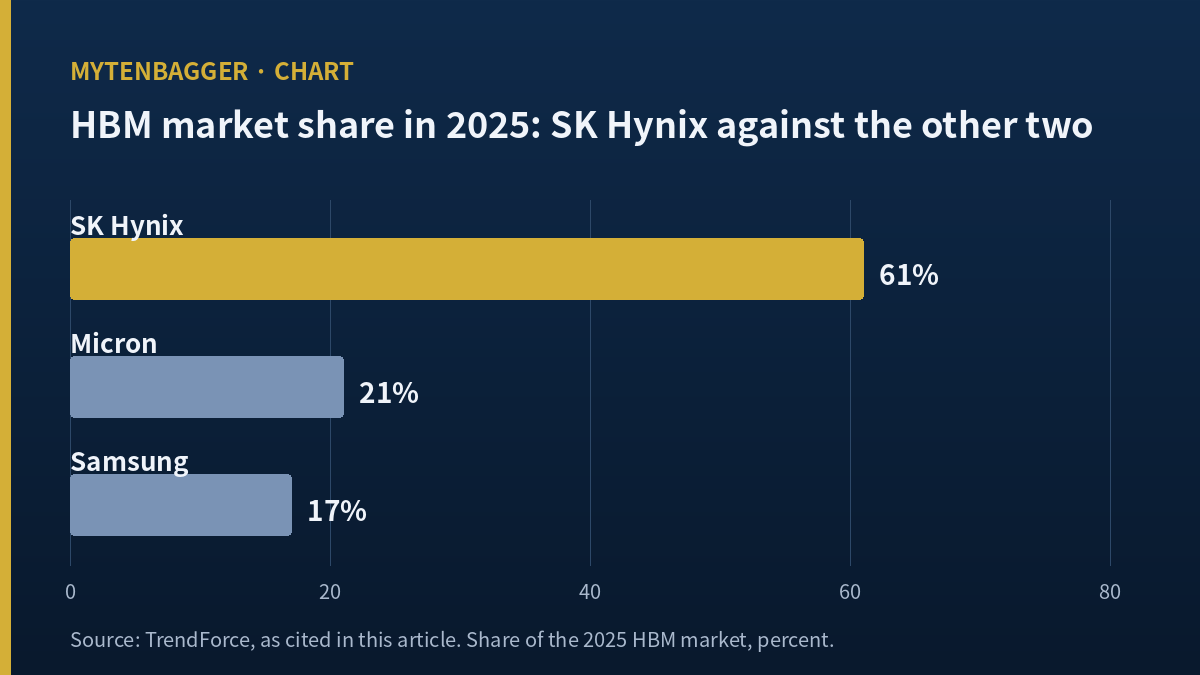
There is a second leg to the bull case that gets less airtime, and it matters more for sizing the long-term story. It is not only HBM — SK Hynix may be coming for Samsung’s DRAM crown outright. Bank of America estimates SK Hynix’s monthly DRAM output at about 589,000 wafers this year versus roughly 691,000 for Samsung, but with SK Hynix expanding output around 38% between 2025 and 2028 against roughly 17.5% at Samsung. That would narrow the production gap to under 10% by 2028, from about 23% in 2025 — striking, because Samsung’s larger manufacturing scale was long treated as an unbridgeable moat. On HBM specifically, SK Hynix held about 61% of the 2025 market versus Samsung’s 17% and Micron’s 21%, per TrendForce (Counterpoint puts it near 58% by revenue). So the structural read is uncomfortable for the bears: the company is not just winning the high-margin HBM niche, it is closing the gap on the commodity-DRAM base that was supposed to be Samsung’s permanent advantage. That is the part of the bull case I respect most — and the reason I hold rather than sell, even while I refuse to chase.
So I Split It Into Scenarios
When I hold a name, I draw the forks in advance. SK Hynix stands at three.
1) The lead holds. UBS and TrendForce (Jan 28, 2026) estimate SK Hynix takes roughly 70% of HBM4 volume for Nvidia’s next-gen “Rubin” platform. SK Hynix pairs with TSMC as a “one-team” for the 5nm base die and bonds it with its own advanced MR-MUF packaging. If that combination carries into the next generation, today’s consensus may even be conservative.
2) Samsung strikes back. This is the scenario I watch most closely. Samsung began HBM4 mass-production shipments first, in February, and on March 18 signed an MOU to be the primary HBM4 supplier for AMD’s next-gen MI455X accelerator — giving Samsung an independent channel that SK Hynix, heavily tied to Nvidia, lacks. Samsung’s HBM share is estimated to have climbed back toward 30% in Q1. The inflection point is widely placed in Q4 2026. If Samsung’s HBM4 clears Nvidia’s qualification with real volume, the market re-rates SK Hynix’s 2027 earnings before the numbers actually fall.
3) Cycle peak. Memory is still a cycle. IDC sees 2026 global PC shipments falling 11.3% on the memory price spike, and Apple’s Tim Cook warned that memory costs will pressure margins for several quarters. When the buyers start screaming, that is the classic late-cycle tell. And note the irony already playing out: BNK Investment cut its rating from Buy to Hold back in April, and Hana Securities’ analyst flagged, per KED Global, that “the point at which SK Hynix’s market cap overtakes Samsung’s could signal that market optimism is nearing a peak.” That call aged about one day.
I translate those three forks straight into the multiple. If (1) holds, the 250-trillion consensus is justified and 6.5x forward stays intact — in that world the stock is not expensive. If (2) happens, the problem is not 2026, it is 2027: as soon as the 70% HBM4-share assumption gets trimmed, the Street cuts next year’s estimate first. If (3) hits, it is the most direct of all — the moment ASP stops rising, the 72% margin denominator shrinks and the same price re-rates into double digits. So what I actually check every day is not the share price; it is three numbers: Samsung’s Nvidia HBM4 qualification, the direction of DRAM spot prices, and the pace of Big Tech datacenter capex. The No.1 ranking is an output, not an input.
Where My Thesis Breaks
Here is the part I genuinely keep in my notes — the exit conditions matter more than the entry. I trim my position if two or more of these confirm together: first, Samsung’s HBM4 passes Nvidia qualification with committed volume around Q4 2026; second, DRAM spot prices roll over on a quarterly basis; third, Big Tech datacenter capex visibly slips. One of those alone, I just watch. Two or more, I read as the cycle ending.
And the condition to add more: if SK Hynix clears HBM4 qualification first and long-term agreements (LTAs) grow enough that earnings de-couple from spot pricing, then this stops being a cycle stock and starts to look like a contract-based earnings stream. If that shift shows up in the disclosures, I look at it aggressively again. I am watching the LTA mix for exactly that.
Why I Stopped at the No.1 Milestone (The Differentiated Part)
After laying out the whole bull case, here are the three reasons I did not chase — the things the consensus tends not to say out loud.
First, “sold out for 2026” is a tailwind and a ceiling. That the company pre-sold its entire 2026 HBM volume is a powerful fundamental. But flip it: it also means there is almost no room to surprise further to the upside within this year. Stocks usually run on “room to get better.” In a company that is already sold out, I cannot find where that incremental room comes from. There is one path where “sold out” becomes a floor instead of a ceiling — the 3-to-5-year LTAs. If LTA volume grows large enough, “sold out” gets re-read not as exhausted upside but as locked-in, price-insulated earnings. I am watching how far that mix goes.
Second, the stock top usually arrives before the earnings top. In past semiconductor cycles, share-price peaks have tended to form one year to fifteen months ahead of the earnings peak. Right now earnings are at an all-time high. In a cyclical, the moment of “record results being reported” often overlaps with the most dangerous zone for the stock. The reversal proved the point faster than I expected — up 5.6% to No.1 one day, down ~12.5% the next.
Third, the No.1 headline summons the last buyer. “It beat Samsung” pulls in people who were not in the trade. ETF flows pile on — leveraged single-stock ETFs tied to SK Hynix have ballooned, and Korea’s own financial regulator publicly said he regretted letting them launch, per Fortune. The more flows crowd one side, the more I look for the exit on the other side first. The day after the crown, the stock fell 12.5%. One day does not define a trend, and I am not calling a top. But the day made it obvious why “don’t chase on the coronation day” is a rule worth keeping.
So, Where I Stand
To pull it together: SK Hynix is one of the few names where a thesis I built in 2024 — “this is not an ordinary memory cycle” — has actually paid off. The No.1 milestone was the reward for that call. But “the thesis was right” and “it is fine to chase at this price” are two different statements, and the 12.5% next-day drop drew the line between them in real time.
I am holding. Any add is gated by the break conditions above — Samsung’s HBM4 qualification and a DRAM price roll-over. Getting pulled in by the words “most valuable company” and hitting buy is something that, at least this week, I did not do. Whether this note looks smart or dumb in six months, I will come back and write that down too. What you do with it is up to you.
— Next entry: SK Square. Why the holding company that owns a fifth of SK Hynix trades at a steep discount to that stake, and how I read that gap.
Related reading