Maeil Dairies Stock in Korea’s First Zero-Tariff Dairy Year
Contents
Two dates on Korea’s customs timetable frame Maeil Dairies stock
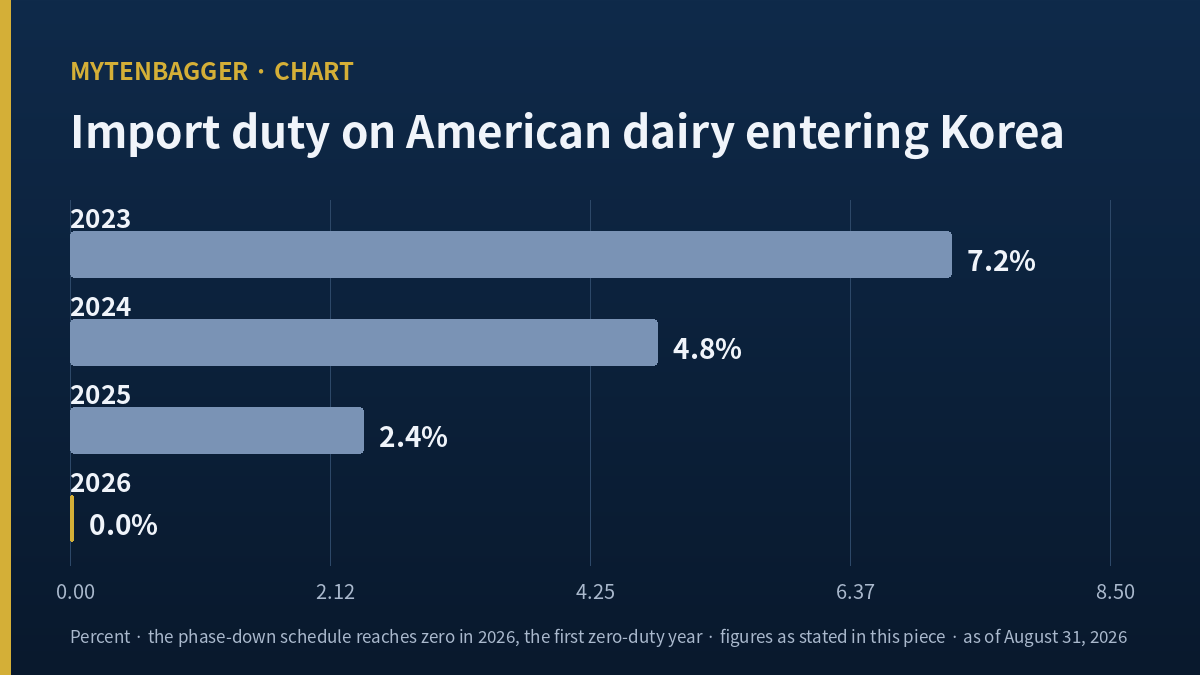
January 1, 2026. That is the day the import duty on American dairy entering South Korea reached zero, the last step of a phase-down that ran 7.2 percent in 2023, 4.8 percent in 2024 and 2.4 percent in 2025. July 2026. That is when the European line finished the same walk. I am writing at the end of August 2026, which means Korea is roughly eight months into the first year in which its two largest dairy trading partners ship in duty free.
Maeil Dairies (KOSDAQ: 267980) closed at 34,950 won on Monday, August 31, 2026, which puts the whole company at about 268 billion won, or roughly 196 million US dollars. KOSDAQ is Korea’s junior board, the venue for smaller and mid-cap names, and it sits alongside the larger KOSPI market where Samsung Electronics and Hyundai Motor trade. At that price the screen shows 4.85 times trailing earnings, 0.41 times book and a 3.76 percent dividend yield on a 1,300 won payout, about 0.95 dollars a share.
| What changed on the customs timetable | Where I read it |
|---|---|
| American dairy duty stepped 7.2 to 4.8 to 2.4 percent, then to zero on January 1, 2026 | Korean livestock trade press, January 2026 |
| European dairy duty finished its own phase-out in July 2026 | Korean trade press and Korea Herald |
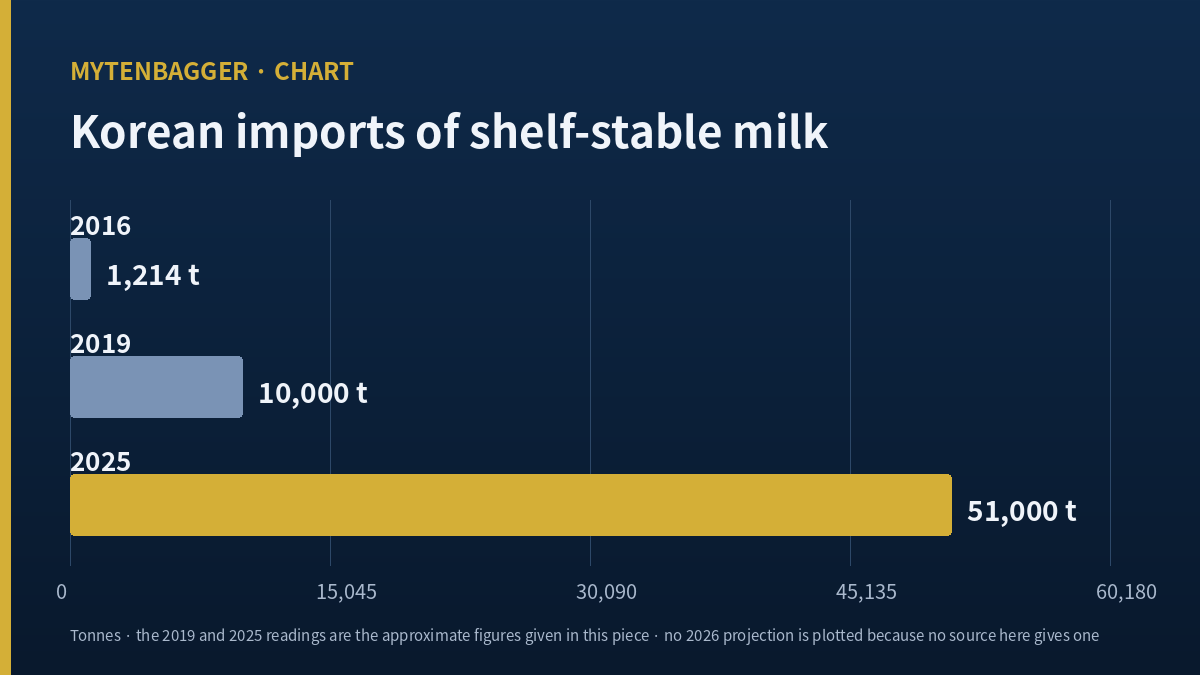
| Imported UHT milk grew from 1,214 tonnes in 2016 to about 51,000 tonnes in 2025 | Korea Herald and Korea Times, mid-2026 |
| Per capita white milk consumption fell to 22.9 kilograms in 2025, a four-decade low | Korea Dairy Committee, via Korean and English press |
| The farmgate price of raw milk was held unchanged for a third consecutive year in May 2026 | Korean livestock and financial press |
I do not own this company and I have no order working. What I wanted to test was a specific suspicion: that the discount here is a customs timetable, and that a peer table would tell me almost nothing about it.
What the tariff phase-down did to the shelf
A tariff line is abstract until you can see the volume that walked through it. Korea’s imports of ultra-high-temperature milk, the shelf-stable kind that survives a long sea voyage, ran at 1,214 tonnes in 2016. They passed 10,000 tonnes in 2019. In 2025 they came in at roughly 51,000 tonnes. That is about a forty-fold increase over nine years, by my calculation, and it happened while the duty was still being paid.
Roughly nine in ten of those tonnes are Polish. On Korean shelves that product sells for something like 1,500 to 1,900 won a liter against about 3,000 won for the domestic equivalent, so the imported carton lands at close to 60 percent of the local price, again my own arithmetic on the reported ranges. In consumer surveys reported by the Korean press, more than 60 percent of buyers who reach for the foreign carton name price as the reason.
Korea sells some of the most expensive milk in the world
The Korea Herald put Korean retail milk at 3.42 dollars a liter in early 2026, third-highest among 78 countries surveyed, against 3.04 in the United States, 2.06 in China and 1.82 in Japan. I find that single line more useful than any multiple I could quote, because it says the gap the imports are exploiting is wide and structural. A processor cannot close a 40 percent price gap by improving its own cost line by a few percent.
Two more doors open later
Australian dairy reaches zero duty in 2033 and New Zealand in 2034. Both countries are far larger dairy exporters than Poland. I am recording those two dates because they sit outside any forecast horizon a sell-side model would use, and because they mean the pressure described here does not have a natural end date inside this decade.
Demand for Maeil Dairies stock sits on a shrinking glass of milk
Koreans drank 22.9 kilograms of white milk per person in 2025. The prior year was 25.3, so the single-year decline is about 9.5 percent by my calculation. In 2021 the figure was 26.6 kilograms, and in the early 2000s it was around 31. The Korea Dairy Committee series that produces these numbers began in the late 1980s, and 2025 is the lowest reading it has recorded.
The United States Department of Agriculture’s Seoul post projects Korean raw milk production of about 1.93 million tonnes in 2026 against drinking-milk consumption of about 1.59 million tonnes. That surplus does not evaporate. It becomes inventory, powder, or waste, and somebody’s income statement absorbs it.
Self-sufficiency has been falling for two decades
Korean milk self-sufficiency was about 77 percent in 2001 and about 48 percent in 2020, according to Korean livestock trade press citing official series. I could not find a comparable figure for 2025 in a source I trust, so I am leaving the series there and noting the gap. The direction is what matters for this piece anyway, and the direction has been consistent for twenty years.
The cost side of Maeil Dairies stock is held flat, and that is a mixed blessing
In May 2026 Korea’s Dairy Committee held the farmgate price of raw milk unchanged for a third consecutive year, at 1,084 won per liter for drinking milk and 882 won for processing milk. The mechanism is arithmetic: negotiations only open when production cost moves more than four percent, and 2025 production cost came in 0.4 percent below the prior year.
For a processor this looks like relief. Maeil’s own raw milk purchase price still went from about 1,271 won a liter in 2023 to about 1,357 won in 2025, and raw milk accounts for roughly 68 percent of its input cost, according to Korean financial press. So it stopped a rise and did not deliver a fall.
The volume talks were still open on August 31, 2026
The harder part is that the Korean system fixes volume as well as price. Processors buy a base quantity whether or not the glass is being drunk, and the reduction talks covering the 2027 and 2028 seasons had not closed when I finished reading.
Those talks opened on June 30, 2026 with a July target that slipped to the end of August. If a cut is agreed, it applies from January 2027. So the outcome lands inside the window that any 2027 estimate for this company would have to cover, and no such estimate exists to be revised, which is a point I come back to further down.
The two sides do not agree on the starting figure
The processors work from a drinking-milk base quantity of about 1,941,000 tonnes. The dairy farmers argue the volume actually purchased is closer to 1,890,000 tonnes. That is a gap of roughly 51,000 tonnes before anyone discusses a percentage cut, by my subtraction, and it happens to be about the same size as the entire 2025 import of shelf-stable milk. Korean press reporting on the reduction scenarios puts the two sides between roughly 9,300 and 43,200 tonnes apart on the cut itself, depending on whose base is used and whether a 10 or 30 percent reduction is applied to the discretionary portion.
I am recording this as unresolved. I am not predicting the outcome, and I am dating the observation to August 31, 2026 because a piece that publishes later could easily be describing a settled question as an open one.
What the company itself did in 2026
None of the above stopped the operating line from improving. First-half 2026 revenue was 949.9 billion won, about 694 million dollars, up 3.6 percent on the same half of 2025. First-half operating profit was 39.2 billion won, about 28.6 million dollars, up 54.3 percent. Those are consolidated figures from the half-year regulatory filing submitted on Friday, August 14, 2026, and the growth rates are mine, calculated against the prior-year cumulative filing.
The company has also been moving weight away from the glass of milk. It entered two US Olive Young stores and the chain’s American online shop on Wednesday, July 22, 2026, with eight items spanning soy drinks, a chilled coffee line and collagen products under its Selex adult-nutrition brand. Selex itself passed 500 billion won in cumulative revenue as of May 2025, about 365 million dollars at my reference rate, according to Korean business press. Non-dairy revenue share and export revenue have both been reported as rising, though the figures I found for those two came from a single outlet and I am carrying only the direction, without the numbers.
Three Korean dairy names, going in different directions
Namyang Dairy reported second-quarter revenue of 258.0 billion won, up 11.2 percent, with operating profit of 1.3 billion won. Binggrae reported second-quarter revenue of 442.1 billion won, up 7.9 percent, and operating profit of 69.7 billion won, up 159.9 percent. Both are from Korean press coverage of the August 2026 filings. Binggrae’s jump is worth handling carefully: its drivers were a hot summer for ice cream and the integration of an acquired ice cream business, so reading it as evidence about Korean liquid dairy would be careless.
Seoul Milk, the unlisted cooperative that holds roughly 45 percent of the Korean white milk market, reported 2025 revenue of 2,100.8 billion won, down 1.13 percent, operating profit of 43.8 billion won, down 23.62 percent, and net income of 2.6 billion won against 43.0 billion won the year before. That last line is the one I keep. The market leader, with the best scale position in the country, took a roughly 94 percent cut to its bottom line by my calculation. This is not a share-loss story about one processor.
A peer table for Maeil Dairies stock, cut by one rule
I pulled dairy and dairy-adjacent listings from a single data provider so the definitions stay comparable, then applied one rule before looking at any value: I kept only rows whose snapshot date was July 1, 2026 or later. That rule removed Danone at June 12, Saputo at June 14 and Vinamilk at June 5, plus Glanbia, which carried no snapshot date at all. It is a blunt rule and it discarded the two Western names with the closest return profile to this company, which I will come back to.
| Company | P/E | P/B | ROE | Snapshot |
|---|---|---|---|---|
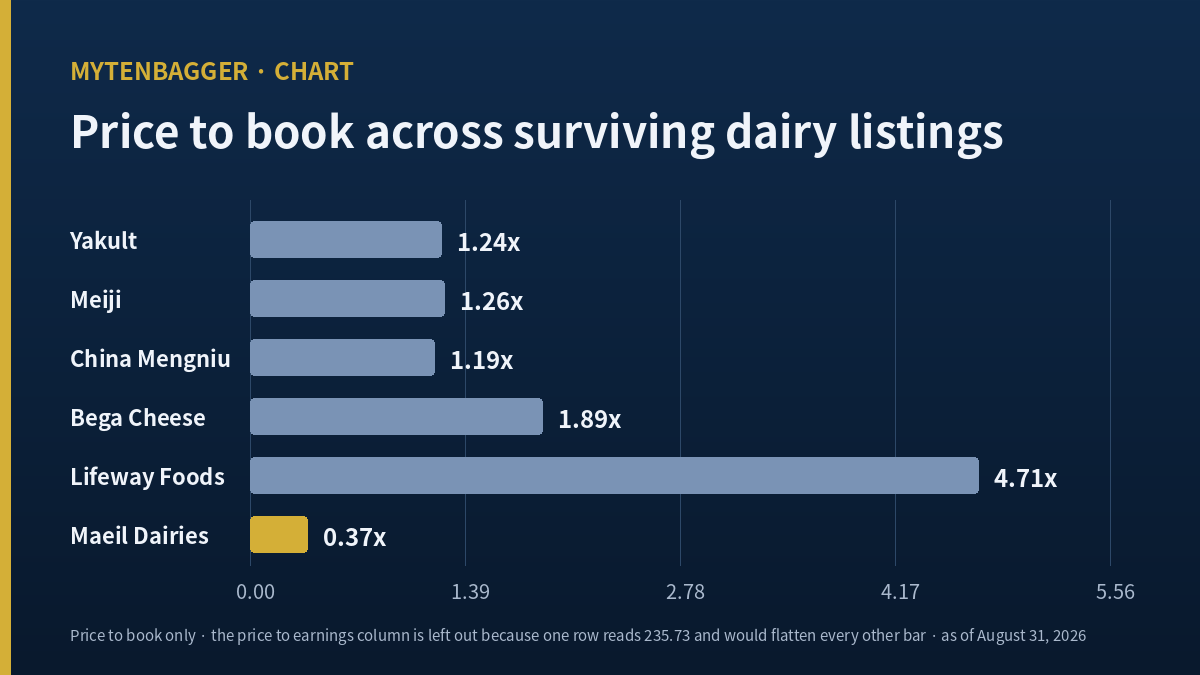
| Yakult Honsha (TSE 2267) | 18.51 | 1.24 | 7.74% | Jul 2, 2026 |
| Meiji Holdings (TSE 2269) | 29.40 | 1.26 | 4.82% | Jul 2, 2026 |
| China Mengniu (HKG 2319) | 36.60 | 1.19 | 3.41% | Jul 2, 2026 |
| Bega Cheese (ASX BGA) | 235.73 | 1.89 | 0.80% | Aug 11, 2026 |
| Lifeway Foods (NASDAQ LWAY) | 38.06 | 4.71 | 13.32% | Aug 31, 2026 |
| Maeil Dairies (KOSDAQ 267980) | 3.72 | 0.37 | 10.63% | Jul 22, 2026 |
The cut changed which continents survived
Applying one date rule left three Asian listings, one Australian and one American. I did not select for that. Nobody would build a dairy comparison set and choose to drop Danone and Saputo, and the fact that a mechanical freshness rule did the dropping is exactly why I am showing the rule before the table. Anyone who prefers the discarded rows can rebuild the set; the four excluded names and their stale snapshot dates are named above.
The Korean row comes from the same provider, so it is directly comparable to the five above it, and it differs from the Korean-market screen I quoted earlier, which shows 4.85 times earnings and 0.41 times book. Two providers, two earnings windows, two answers. Where the two disagree I have kept both visible instead of picking the friendlier one.
One row that I refuse to average
Bega Cheese carries a 235.73 P/E on a 0.80 percent return on equity. Averaging that into any band statement would produce a sentence that means nothing, so I have written no band statement in this piece. What I will say plainly is narrower: this company earns a higher return on equity than four of the five, and trades at roughly a third of the lowest book multiple among them.
Where my reading of Maeil Dairies stock could be wrong
Three places, and the first is the largest.
- The timetable is public and old. Nothing here would surprise anyone who reads a trade agreement. The zero date for American dairy was set years in advance, and markets discount timetables they can already read. If the 0.37 book multiple already carries everything I have described, then I have written a long explanation of a price that needed none.
- The cost side moved the other way. A third consecutive year without a farmgate increase is real protection for a processor’s margin, and this company has been shifting revenue toward adult nutrition, plant drinks and export channels for several years. First-half operating profit rose 54.3 percent while all of the pressure described here was already in force. A structural-decline thesis has to explain that number, and mine does not.
- My peer table is a product of one rule and one provider. Five rows survived a date cut, three of them Asian, one of them arithmetically unusable. Change the cut-off by six weeks and Danone, Saputo and Vinamilk return, and the return-on-equity comparison in particular would read differently, since two of those three sit close to this company on that measure.
Nobody is publishing forward numbers on Maeil Dairies stock
One named Korean house covered this company in the window I searched: a Meritz Securities analyst, on Wednesday, June 10, 2026, keeping a buy view. I could not retrieve the valuation figure, the multiple behind it, or any year-by-year estimate through either the original note or secondary coverage, so none of those appear here. The two other houses on the record published in October 2023 and January 2023. Across the aggregators I checked, 2026 and 2027 revenue, operating profit and earnings estimates are simply absent, and one of them returns an explicit note that analyst forecasts are unavailable.
So the only sell-side fact I can use is a ranking. In a Korean business magazine feature published on Tuesday, July 21, 2026, the same Meritz analyst was named the half-year’s leading food and beverage analyst, and the three names he put forward for the second half were KT&G, Orion and Samyang Foods. This company was not among them. That is a relative preference, and calling it a downgrade would invent an event that did not occur. I am recording the omission and nothing more. For a different version of the same coverage problem, my note on a Korean food company that publishes seven revenue lines and no profit lines covers what happens when the disclosure itself does the limiting and the analyst count has nothing to do with it.
Numbers I checked and then left out
Four, and I would sooner name them than let the piece look tidier than the reading was.
The first is a capacity figure. Korean financial press reported this company running its infant formula and baby food lines at about 25.65 percent utilization. That is a striking number and it points the same way as everything above, but I found it in one outlet and could not match it to a filing, so it is not carrying any weight here.
The second is the size of the Korean adult nutrition market. I wanted something to measure the 500 billion won cumulative Selex figure against and could not get one I trusted; the brand-share numbers I found were internally inconsistent on units. Without a market size, cumulative revenue since 2018 tells a reader almost nothing about position, so I left the comparison out entirely.
The third is market value itself. Two providers give this company 253.2 billion won and 267.8 billion won on dates a few weeks apart, a difference of about 5.8 percent by my calculation, most likely a treasury share treatment. I used the second figure throughout because it reconciles with the exchange share count, and I am naming the first so the discrepancy is visible.
The fourth is a peer I wanted and could not get. Fonterra, the New Zealand cooperative that will be shipping into Korea duty free from 2034, returned nothing usable from my data provider under either of its listing codes. Its absence from the table above is a hole, not a judgment.
My stance on Maeil Dairies stock, and what would prove it wrong
A milk carton is the wrong unit for this company and I had to be shown that by a customs table. I came in expecting to write about a cheap consumer stock with a good balance sheet, which is how the screen presents it, and I spent most of my reading time on trade timetables and per-capita consumption instead. The lesson I am keeping is that when a business sits behind a border, the border’s paperwork is a primary document about that business.
I do not own this and I have no order working. The company is well outside the top hundred Korean listings by market value, and observation is my default there. The stance I do hold is narrower than a view on the price: I think the 0.37 to 0.41 book multiple is better explained by a customs timetable with two more doors still to open, in 2033 and 2034, than by any claim that the Korean market has misread the accounts.
If this was already wrong, it was wrong at the point where I let a customs timetable stand in for a demand curve. Imports arriving and consumption falling are two facts; I connected them into one explanation without a source that measures substitution directly. The place that would show it is the 2027 disclosure of this company’s liquid dairy volume against the import series. If domestic volume holds while imports keep climbing, then the two lines were never trading against each other and the whole frame here collapses, leaving only the peer table. I would rather find that out and write why I was wrong than quietly update this page.
Two related notes sit alongside this one. A Korean confectioner whose cheapest input has not reached its income statement yet is the same timing problem seen from the cost side, and a Korean franchisor that raised capital spending while revenue fell is what it looks like when management spends into a shrinking line.
Prices and multiples reflect the August 31, 2026 Korean market close as checked at the time of writing, so the live quote can differ and is worth re-checking before it is used for anything. The Korean won is the reference currency throughout, and dollar figures are approximate, converted at about 1,368.6 won per dollar, the Seoul onshore daytime close on the same date as reported by Korean financial press. Where a figure is described as my own calculation, it was derived by me and does not appear in that form in the source. Sources used here: Korea Herald on imports and demand, Korea Times on the four-decade consumption low, Seoul Economic Daily English edition, Asia News Network on the tariff-free era, USDA Foreign Agricultural Service Korea dairy annual, DairyReporter on the 2026 global dairy outlook, the provider behind the peer table, the company’s own investor relations summary, Investing.com quote and dividend history, and Financial News on the third farmgate price freeze.