TheBorn Korea Capex Rose 3.4 Times as Revenue Fell in 2025
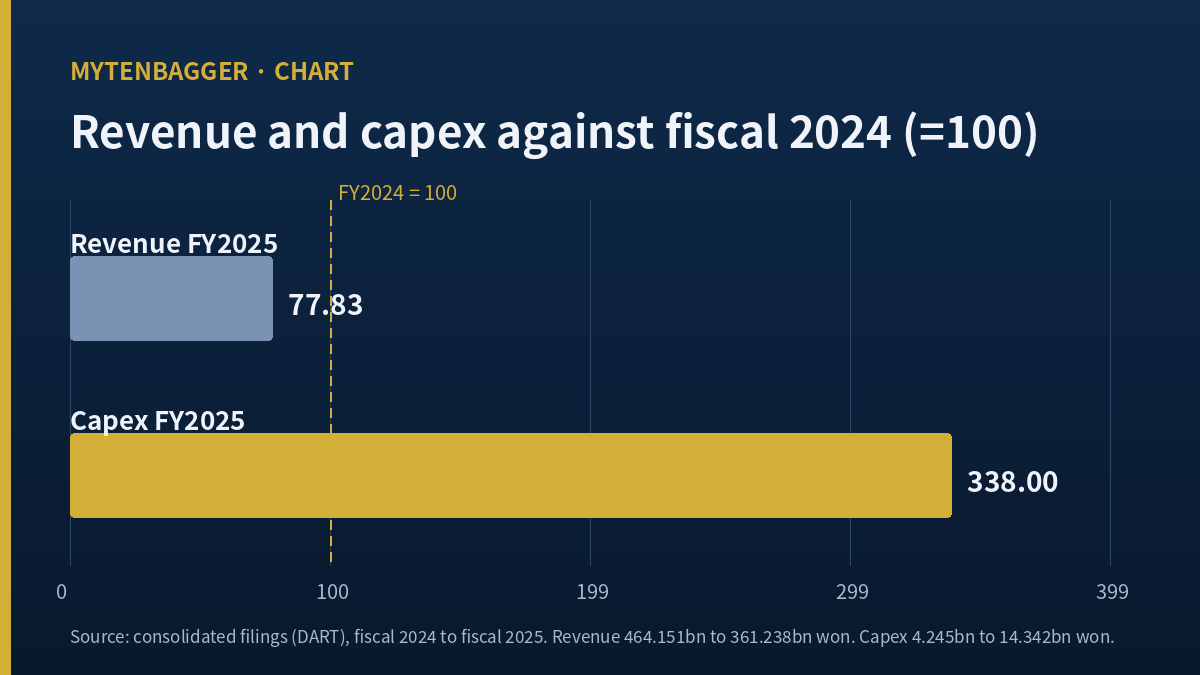
I came to TheBorn Korea stock through a cash flow line. In the twelve months of fiscal 2025 this Korean restaurant franchisor handed roughly 43.5 billion won (about $30.67m) to its franchisees in support payments, and spent 14.342 billion won (about $10.11m) on property and equipment. The second figure is 3.38 times what the company spent on the same line the year before. Revenue over those same twelve months fell 22.17%. All three facts sit in filings and press coverage from the same period, and I have spent most of this piece trying to hold them together instead of reading them one at a time.
My working position on TheBorn Korea stock is watch, at the 15,890 won close of Friday, August 14, 2026, which values the company at 235.6 billion won (about $166.11m). Korean won is the currency I work in here and the dollar figures are conversions for readers who price things in dollars.
| Line (consolidated, DART) | Fiscal 2024 to fiscal 2025 |
|---|---|
| Revenue | 464.151bn won to 361.238bn won ($327.26m to $254.70m), down 22.17% |
| Operating result | Profit of 36.023bn won to a loss of 23.679bn won ($25.40m to a $16.70m loss) |
| Operating cash flow | Inflow of 45.886bn won to an outflow of 29.004bn won ($32.35m in to $20.45m out) |
| Capital expenditure | 4.245bn won to 14.342bn won ($2.99m to $10.11m), a factor of 3.38 |
| Free cash flow | Inflow of 41.641bn won to an outflow of 43.346bn won ($29.36m in to $30.56m out) |
Contents
TheBorn Korea stock and the year the spending went up
A quick orientation for readers outside Korea. TheBorn Korea (KOSPI: 475560) runs 25 restaurant brands in Korea as a franchisor. It sells food, sauces and supplies into its own franchise network, operates some restaurants directly, and has a small hotel operation. It listed on the KOSPI, the main Korean exchange, in November 2024 at an offer price of 34,000 won. The August 14 close of 15,890 won is 46.7% of that offer price, a decline of 53.26%. The founder and chief executive is a television personality widely known in Korea, and his name attaches to several of the brands. That last fact is the reason this company had the year it had, and I will come back to it once.
What I want to establish first is that fiscal 2025 was not a year of retreat on the balance sheet. It was a year of retreat on the income statement and expansion on the cash flow statement, at the same time. Capital expenditure went from 4.245bn won to 14.342bn won. As a share of revenue that moves from 0.91% to 3.97%. In a business whose revenue was collapsing, the capital line went the other way.
I want to be careful about what that does and does not prove. A rising capital line can mean a deliberate build. It can also mean commitments made in a better year that came due in a worse one. I did not read the 2025 annual report in full and I did not find a disclosure that separates the two, so I am treating this as an observation with an open question attached, and not as evidence of intent.
What the 2025 cash flow statement actually says
The net loss reported in the consolidated filing for fiscal 2025 was 17.394bn won (about $12.26m). Korean press coverage of the same year carried a smaller net loss figure, and I did not resolve which measure that reporting used, so every net figure below comes from the filing. The free cash outflow for the same year was 43.346bn won. The outflow is 2.49 times the loss. Two decisions account for most of the difference between them, and both of them were the company’s to make.
The first is the support money. Korean coverage puts the franchisee support the company paid out across 2025 at roughly 43.5bn won. Maeil Ilbo reported that figure alongside the annual operating loss of 23.7bn won. If that number is right, and I am taking it from press coverage instead of from a line I read myself in the filing, then the operating loss for the year was smaller than the money voluntarily pushed into the network.
The second is the capital line already covered. Together they turned a year with a 17.4bn won accounting loss into a year with a 43.3bn won cash outflow. Equity fell from 267.587bn won at the end of 2024 to 245.998bn won at the end of 2025, and to 238.014bn won at the end of the first quarter of 2026. That is a decline of 29.573bn won (about $20.85m) across five quarters. The company also paid a dividend on fiscal 2025 of 500 won per share, up from 300 won, which on 14,826,935 shares is roughly 7.413bn won (about $5.23m) leaving the company in a loss year.
Four quarters of cash going out
The annual view understates how continuous this has been. Taking the four quarters from the second quarter of 2025 through the first quarter of 2026, and deriving each single quarter from the cumulative filings, operating cash flow ran out at 9.573bn won, 13.827bn won, 6.379bn won and 4.423bn won. That is four consecutive negative quarters adding to 34.202bn won (about $24.12m). The only positive operating quarter in my series is the first quarter of 2025, at an inflow of 0.775bn won, and that quarter came before the trouble started.
Capital expenditure across those same four quarters was 3.768bn won, 4.548bn won, 4.061bn won and 6.917bn won, adding to 19.294bn won. Put the two together and this company sent 53.496bn won (about $37.72m) of cash out the door over twelve months, against a market value of 235.6bn won at the August 14 close. That is 22.7% of the current market value in one year of cash outflow. The fourth quarter figures in that run are derived, since Korean filers report the fourth quarter only inside the annual statement, so treat them as arithmetic and not as a disclosed line.
What keeps this from being a solvency discussion is the balance sheet it started from. Total liabilities were 57.267bn won at the end of 2025 against equity of 245.998bn won, a debt to equity ratio of 23.28%, and interest expense for the whole of 2025 was 2.144bn won. This is a company with room to spend badly for a while. Whether it should is a different question, and it is the question I cannot answer from outside.
None of this is hidden. All of it is in the same set of statements. My point is only about which line a reader lands on first. Land on operating margin and you see a company recovering from a bad year. Land on free cash flow and you see a company that spent through the bad year on purpose.
TheBorn Korea stock in a quarter that spent more than it lost
The first quarter of 2026 makes the same point in miniature. Revenue was 79.605bn won. The operating loss was 4.195bn won (about $2.96m). Capital expenditure in the quarter was 6.917bn won (about $4.88m). The company spent 1.65 times its quarterly operating loss on property and equipment in the same three months. Operating cash flow was an outflow of 4.423bn won and free cash flow an outflow of 11.340bn won.
A US reader looking at a Korean small cap with a 5.3% operating loss margin will usually reach for a cost story. The cost story here is real, but the quarter’s cash went out through a line that has nothing to do with cost discipline. Capital expenditure was 8.69% of quarterly revenue in a quarter with an operating loss. That is a company that has decided the current revenue base is not the thing it is optimising for.
Fiscal years here run January to December, which lines up with the US convention, so the year labels compare directly. Korean quarterly filings report flow items cumulatively, so the single quarter figures above are the cumulative filing minus the prior cumulative filing. The fourth quarter of any year is the annual figure minus the first three quarters, which is a derived number and I have marked it as such wherever I use one.
One release, three percentages
On the evening of Friday, August 14, 2026, the company released second quarter figures. Revenue of 83.2bn won (about $58.66m) and an operating loss of 5.6bn won (about $3.95m), reported by Newsis and News1 the same evening. Edaily carried the first half totals from the same release.
Against the second quarter of 2025, revenue is up 12.15% and the operating loss is down 75.09%. Against the first half of 2025, half year revenue of 162.8bn won is down 11.95% from 184.903bn won. Against the immediately preceding quarter, the operating margin moves from a loss of 5.27% to a loss of 6.73%. Three comparisons, three directions, one release. What matters for the cash reading is the third comparison: the margin did not improve sequentially even though revenue did.
Edaily also reported that first half promotion spending fell to 6.8bn won from 24.4bn won a year earlier. That is a reduction of 17.6bn won in the line the company itself points to when it explains the 2025 loss. I looked at the arithmetic between that reduction and the improvement in the half year operating loss and decided not to build on it, because I used the same construction in a recent piece on a Korean bakery company and repeating a construction because the material allows it is a reflex worth breaking, and one I would rather break here than feed.
What limits a position in TheBorn Korea stock is the tape
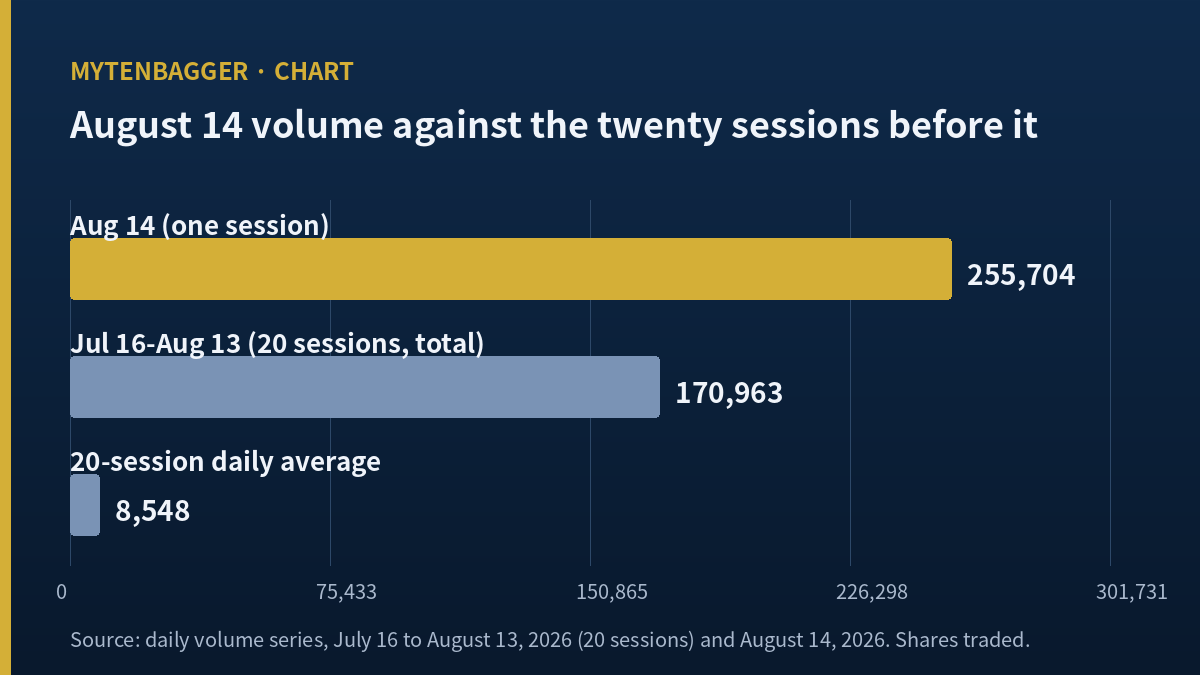
The part that is specific to this name is the tape. Over the twenty sessions from July 16 to August 13, 2026, the average daily volume was 8,548 shares. At the August 14 close that is roughly 135.8m won of turnover a day, about $96,000. On August 14 itself the stock traded 255,704 shares, roughly 4.06bn won or about $2.87m, which is 1.50 times the total volume of those twenty sessions combined. It is whether it can build and unwind a position without being most of the volume while doing so. I have written about accessibility from the angle of ownership concentration and comparability before; this is the first company in my coverage where the binding limit is simply how thin the book is on an ordinary day.
The comparison I did not build
The supply line is where I got this company wrong at the start. I opened this analysis expecting a franchising business, which is to say a royalty business, and I began sketching a comparison against US franchisors on that assumption. The Korean filings pushed back. Most of what this company books as revenue is goods sold into its own network. Fees collected from that network are the smaller side. A fee business and a wholesale business do not carry the same margin, the same working capital or the same reason to buy property and equipment. I had to rebuild my mental model of the business twice before the capital line made any sense at all, and that rebuild is the reason this piece is about cash instead of margin.
The closest US structural analogue I can name is Domino’s Pizza (NASDAQ: DPZ), which also runs a supply operation selling into its own franchised stores alongside the royalty stream. That is a structural statement and nothing more. I did not open Domino’s filings for this piece and I quote no figure from the company, so there is no multiple comparison, no margin table and no valuation bridge here. My criterion for a peer this time was a company that carries the same business label while earning through a different internal line, and once I found one that fit, the honest thing was to use it to explain the structure and stop there.
For scale only, and from the Korean side alone: revenue of 361.238bn won for fiscal 2025 is about $254.70m, and the market value at the August 14 close is about $166.11m. Those two numbers put this in the range a US investor would think of as a micro cap.
Seven arguments against how I read TheBorn Korea stock
Group one, against reading the capital line as a deliberate build
- Commitments made in 2024, when the company earned an operating profit of 36.023bn won, would naturally land as cash out in 2025. A rising capital line can be a lag and I cannot separate the two from outside.
- Small absolute numbers move by large factors. Going from 4.245bn won to 14.342bn won is a factor of 3.38, but the increase is 10.097bn won, which is 2.79% of one year of revenue. The factor is more dramatic than the money.
- A restaurant group that renews stores, builds a production facility or buys equipment for a supply operation will show exactly this pattern with no strategic content behind it.
- The company describes its direction as a move toward a broader food business, with global business to business sales of its sauces, acquisitions and content licensing. If that is real, capital spending is the expected accompaniment and my reading of it as unusual is just me arriving late.
Group two, against my measurements
- The second quarter figures I use are press reports of a company release rounded to the nearest 100 million won. They are not lines I read in a filing. The loss margin of 6.73% could move at the second decimal once the half year report is out.
- The 43.5bn won support figure comes from a single Korean outlet. I did not find the same total in a filing I read myself, and my whole cash argument leans on it being close to right.
- Over the year to August 14, 2026 this stock returned negative 39.81% and the median of the twenty companies in its sector index over the same window returned negative 39.79%. Everything I have described as specific to this company produced a one year outcome 0.02 points away from the middle of its sector. That is the strongest single argument that I have been reading company events into what was mostly a sector.
Price to earnings does not compute, because trailing earnings per share is negative 1,179 won. Price to book is 0.95 against a stated book value per share of 16,648 won. I could not pin down which quarter’s equity that book value is built from: multiplying it by the share count gives 246.839bn won, while equity at the end of the first quarter of 2026 was 238.014bn won and at the end of 2025 was 245.998bn won. The seven point checklist I run passes two of seven for this company, on revenue scale and on price to book, and fails the five profitability tests, which is what a loss making year produces by construction.
The line I will open first next time on TheBorn Korea stock
Capital expenditure, before revenue and before margin. Spending is a decision, and a decision can be reversed quietly in a way that a revenue trend cannot. If this company keeps putting money into property and equipment through a second full year of depressed revenue, that tells me something no quarterly margin comparison will. If the spending stops while the revenue stays down, that tells me something too, and it is the opposite thing. Either way the answer arrives on one line of one statement, which is a cheaper thing to watch than a story about a turnaround.
I have linked out three times in this piece to earlier work where a single line carried more than the headline did: a Korean poultry processor nobody forecasts, a duty free operator whose shortfall was mostly its sector, and a beverage company whose interest bill outran its debt reduction. This one belongs with them.
Prices and multiples here reflect the Friday, August 14, 2026 close as I checked them at the time of writing. This piece may post later, so figures can differ from live quotes, and August 14 was the last session before a three day market closure in Korea, which means these numbers age at the next open. Korean won is the working currency throughout and dollar figures are approximate, converted at about 1,418.3 won per dollar on that same date. Annual and quarterly financial figures follow the consolidated statements filed with Korea’s electronic disclosure system; the second quarter of 2026 comes from press coverage of the company release and is rounded to the nearest 100 million won.
Sources consulted: Newsis on the second quarter release, Edaily on the first half totals and promotion spending, News1 on the same release, Maeil Ilbo on the 2025 franchisee support total, Kukinews on brand level store counts, Financial News on founder shareholding, WiseReport company profile, Korea’s electronic disclosure system. Korean language sources throughout; translations and any arithmetic derived from them are mine.
- Asia Cement Valuation: Why Low P/E and P/B Point to One Number
- BGF Retail ROE and the Asset Turnover Behind Its Peer Ranking