KakaoBank Stock at Nubank’s Multiple, Half the Growth: My Check
KakaoBank stock sits on my watch list, not in my portfolio, and nothing moves before the August 5 earnings print. What I think I’m looking at is a growth-stock multiple — 21.9x trailing — carried by growth that is drifting down toward ordinary-bank speed. Two lines in the Q2 report decide my next step: the direction of net interest margin, and whether loan growth has any pulse left under Korea’s household-lending caps.
Korean bank stocks are having their best year in memory. KB Financial and Shinhan — the two biggest traditional banking groups — both printed fresh 52-week highs this summer, and the bank index is up double digits. Yet the one Korean bank that commands the richest multiple of them all sat the party out: on June 24, KakaoBank touched a 52-week low of ₩19,810, as reported by Korean outlet Asia Today. Cheap banks rallying while the expensive bank falls is not noise. Something structural is being repriced, and with second-quarter results due August 5, I wanted my read written down before the number hits.
Contents
KakaoBank stock next to Nubank — same multiple, different engine
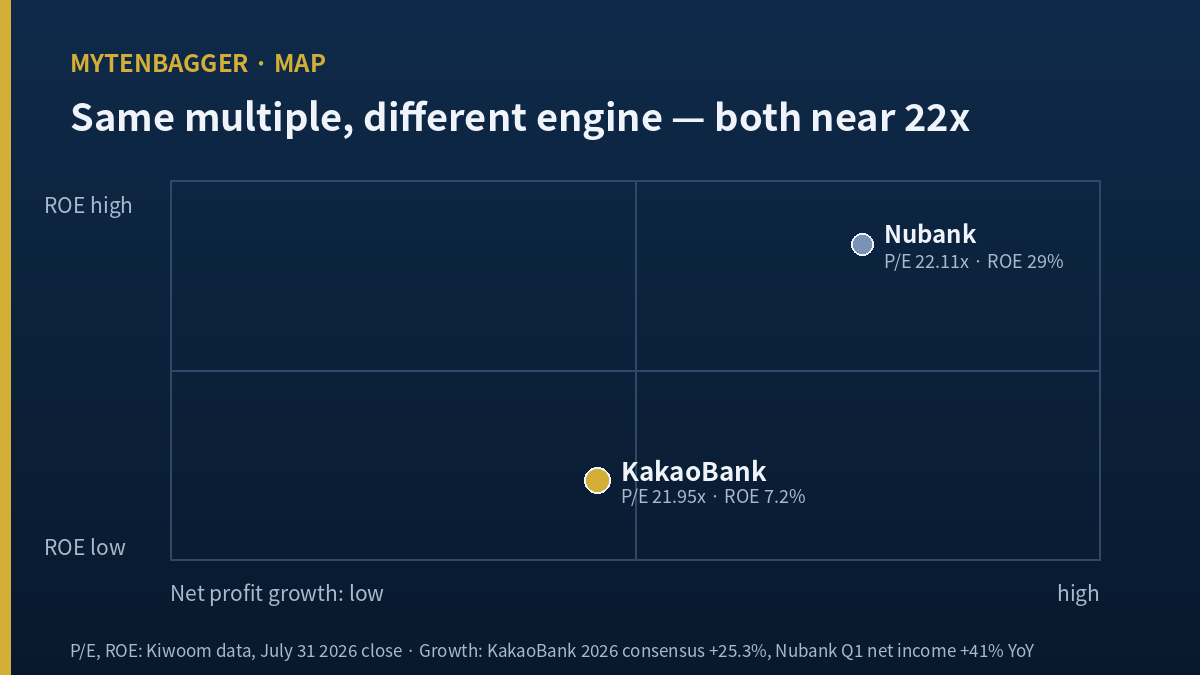
I don’t usually open with the conclusion, but one comparison carries this whole journal, so it goes first.
KakaoBank trades at 21.95x trailing earnings (Kiwoom data, July 31 close). Nubank (NYSE: NU), Brazil’s digital-banking giant and the global benchmark for the category, trades at 22.11x trailing — the same multiple to within a rounding error. Underneath, the engines are nothing alike. Nubank earned $871 million in the first quarter, up 41% year over year, on a 29% ROE, per the company’s official results release, serving more than 135 million customers. KakaoBank’s consensus for 2026 calls for net profit of ₩601.9 billion (about $423 million), up 25.3% — and even that includes a one-off gain booked in Q1. Its ROE is 7.2%, roughly a quarter of Nubank’s.
Two assets at the same price should be the same kind of asset. Here, one delivered 41% growth last quarter while the other forecasts 25.3% for the year — different measurement bases, same direction — on top of a four-fold gap in capital efficiency. The market isn’t being careless — the market caps explain the trade. Nubank is worth about $69.2 billion; KakaoBank about ₩10.54 trillion, or $7.4 billion. At one-ninth the size, KakaoBank’s multiple carries catch-up potential rather than delivered performance. The problem is that the catching-up has visibly slowed: the stock is down 24.8% over twelve months. That drawdown is the invoice the market sent for the slowdown.
There’s a structural reason the engines differ, and it’s worth naming because it doesn’t show up in any single quarter: the ceiling. KakaoBank’s 20.3 million monthly users sit inside a country of 52 million people — roughly two of every five Koreans already open this app every month. Nubank’s 135 million customers spread across Brazil, Mexico, and Colombia, a combined population several times larger, with penetration still climbing. One company is early in a large map; the other has largely finished conquering a small one. That is why “platform” arguments here lean so heavily on new categories — sole-proprietor lending, stablecoins, Thailand, Indonesia — rather than more of the same. When two of every five people in your country already bank with you, growth has to change shape or slow. Everything else in this journal is downstream of that sentence.
KakaoBank stock’s premium arithmetic — 1.56x book in a 0.7x sector
For readers new to KakaoBank stock: the company (KOSPI 323410) is Korea’s largest internet-only bank, born from the Kakao messenger ecosystem that sits on virtually every Korean phone. It has 20.3 million monthly active users — in a country of 52 million people — deposits of ₩69.4 trillion, loans of ₩47.7 trillion, and a delinquency ratio of 0.51%. There’s no US ADR; access runs through Seoul directly via brokers with KRX access like Interactive Brokers, or diluted through Korea ETFs such as EWY and FLKR. One market-structure note: KOSPI enforces daily price limits and, this year, has been led by a value-up dividend rally in financials — context that matters for what follows.
The rally context deserves one more beat, because it explains the exclusion mechanically. Korea’s market this year has been driven by the “value-up” theme — a policy push, modeled loosely on Japan’s governance reforms, nudging chronically cheap listed companies toward higher payouts and better capital discipline. Its natural winners are exactly the stocks that were cheapest against book value: traditional banks trading far below book with the fattest payout yields in the market. Money chasing that trade screens for low price-to-book and high payout — and KakaoBank fails both screens from the expensive side. It is, structurally, the one Korean bank that a value-up rally was never going to lift. That isn’t a flaw in the company; it’s a mismatch between the stock’s design and this year’s dominant trade. But mismatches still show up as twelve red months on a chart.
Now the arithmetic. KakaoBank trades at 1.56x book value. Korean bank stocks as a group trade near 0.7x on 2026 estimates, per Korean press tallies of the sector from mid-July. That’s a premium of more than double, and its justification has been the same since the 2021 IPO: this is a platform, not a bank.
Checked against current data, that claim splits evenly. For it: non-interest income hit ₩302.9 billion in Q1 — the first quarter above ₩300 billion — reaching 37% of operating revenue, and the user base and asset quality are in a different weight class from its size. Against it: most revenue is still interest, and the interest engine is capped. Korea’s regulators run an aggregate ceiling on household lending, and roughly 80% of this year’s system-wide quota was already used up by early July, per Korean press reporting from July 12. One Seoul brokerage, NH Investment & Securities, puts it flatly: traditional household-loan growth is stalled for the foreseeable future. Yuanta Securities estimates KakaoBank’s won-denominated loans grew just 1.1% quarter-over-quarter in Q2. A “platform” whose growth engine is a regulated loan quota — that is the structure underneath the 52-week low.
The sell side is split in an instructive way. KB Securities carries a buy with a ₩33,000 objective (July 2), built as 12-month forward book value of ₩14,959 per share times a target 2.2x price-to-book — an explicit re-rating bet, argued off sole-proprietor secured lending and stablecoins, per the published report. Kyobo Securities sits at ₩32,000 (May 12). Daishin Securities holds a neutral rating at ₩26,000 (May 6) — no re-rating, just the current multiple maintained. A 27% spread between the optimists and the neutrals tells you the disagreement isn’t about last quarter’s numbers; it’s about how much to pay for material that hasn’t converted to revenue yet. That spread is the risk profile.
A personal admission before going further. I was openly cynical about this company right after its IPO — “a bank wearing a platform multiple” was my line. Watching it now, I think my cynicism aimed at the wrong thing. The multiple was never the problem; the durability of the growth justifying it was. Meanwhile the company did half its homework: non-interest income to 37%, overseas stakes turned into listed assets, a dividend policy built from nothing. Fairness requires I redo my half of the homework too. That’s this journal.
The three lines I’ll read on August 5
Q2 consensus sits at ₩135.3–135.5 billion in net profit (about $95 million), up roughly 7% year over year, per Korean press tallies. That looks like a collapse from Q1’s record ₩187.3 billion (+36.3%) — but the optics deceive. Q1 included a one-off: an after-tax gain of ₩67 billion from the Jakarta listing of Superbank, the Indonesian digital bank KakaoBank holds a stake in. Strip it, and Yuanta’s math says Q2 actually runs +11.4% quarter-over-quarter on an underlying basis, per Newspim’s preview coverage. Headlines on the day may well say “profit plunges.” Writing the real baseline down in advance is how I avoid trading someone else’s headline.
Line one: net interest margin. NIM rose 13 basis points sequentially in Q1, and Yuanta estimates another 10bp to 2.10% in Q2. When loan volume is capped, margin is the only lever left — the funding side makes it plausible, since deposits exceed loans by more than ₩21 trillion and skew toward low-cost demand accounts. A lender barred from taking deposits has no such cushion and buys the same input in the bond market, which is where I traced a Korean card issuer’s funding cost.
Line two: the composition of loan growth. If households are capped, what fills the space? Sole-proprietor loans reached ₩3.4 trillion in Q1, up ₩348 billion from year-end. That line growing is the difference between “capped” and “cornered.”
Line three: fee and platform income. Yuanta models +10% quarter-over-quarter (mortgage securitization fees, advertising). Whether that 37% non-interest share was a peak or a base gets answered here.
One cost item belongs in the same frame: inclusive-finance obligations. Mid-to-low credit borrowers make up 32.3% of the loan book (45.6% of new lending) under policy commitments, and Yuanta pencils in ₩62 billion of Q2 provisioning. The margin lever and the policy cost travel together — reading NIM without provisions, or provisions without NIM, gets this bank wrong in either direction. A side observation worth its own sentence: holding delinquency at 0.51% while a third of the book is mandated mid-to-low credit lending is quietly impressive underwriting. Whatever the growth debate concludes, the credit engine itself has not been the problem — which is precisely why the argument stays about the multiple, not about solvency.
KakaoBank stock’s next story — the stablecoin, priced at zero

July’s 6.5% bounce in the stock had a catalyst. On July 23, the three Kakao financial affiliates — Kakao, KakaoPay, and KakaoBank — signed a strategic MOU with Circle, the USDC issuer, to explore won-denominated stablecoin use in global payments, remittances, and merchant settlement. The CEO attended the signing in person. This followed the May 6 earnings call, where management said outright it was preparing “from issuance to payments” for a won stablecoin, alongside a capital-company M&A review. Words are becoming installations.
Here’s how I handle that material: interested, and priced at zero. Korea’s stablecoin legislation isn’t finished, and an MOU is not revenue. But the direction deserves a note in the file, because this company’s overseas moves have a habit of turning into accounting entries. The Superbank stake went all the way to a Jakarta IPO and came back as a ₩93.3 billion pre-tax valuation gain in Q1. In Thailand, the company won a virtual-bank license in June 2025 — the first Korean bank re-entry in decades — and holds 10% of an SCBX-led consortium with a published plan to lift that to 24.5%, pending the Bank of Thailand’s operating approval. When the domestic loan quota closed one door, the doors that actually opened were offshore and on-chain.
For calibration, one more American peer: SoFi trades at a $21 billion market cap and roughly 34x trailing earnings, and just printed record quarterly revenue of $1.2 billion. Across the digital-finance category — Nubank at 22x with 41% growth, SoFi at 34x with record revenue, KakaoBank at 21.9x with a consensus +7% quarter — the multiples aren’t what separates these three companies. The freshness of the evidence behind each multiple is.
And the dividend, briefly, because it explains the rally exclusion better than anything else. KakaoBank paid ₩460 per share for 2025 — a third straight annual increase (₩80 → ₩150 → ₩360 → ₩460) at a 45.7% payout ratio, with a stated 50% payout target for 2026. Impressive trajectory; the yield is still just 2.08%. So the stock occupies an awkward middle: **not enough growth to be a growth stock anymore, not enough yield to join a dividend rally.** Korea’s bank run this year has been precisely a dividend and value-up trade. The bank that sat out the party was the one that fit neither invitation.
One more layer a dollar-based reader carries that a Seoul reader doesn’t: currency. Everything this bank earns, pays out, and gets valued in is won. At ₩1,424 to the dollar — the July 31 Seoul close, and a historically weak level for the won — a US holder is implicitly making a second bet that the won doesn’t weaken further. The interesting wrinkle: the very catalysts on this stock’s left pan cut both ways on that bet. A won stablecoin with international settlement rails, if legislation lands, is partly a bet on won internationalization; the Thai and Indonesian stakes earn in third currencies entirely. This is the rare Korean financial where the growth options are partially a hedge on its own currency exposure. I don’t size positions off that observation, but for an EWY-style holder deciding between Korean banks, it’s a real difference from the traditional groups, whose earnings are almost purely domestic-won.
And I should be honest about what August 5 cannot tell me, because pre-earnings journals tend to overpromise. The print will answer the margin question and the loan-mix question. It will say nothing about when Korea’s National Assembly finishes stablecoin legislation — still being debated, with no date I’d write down — and nothing about when the Bank of Thailand grants operating approval. Those two clocks are external, political, and slow. Which means even a clean beat on Wednesday leaves this thesis roughly half-verified: engine confirmed, map still pending. That asymmetry between what earnings can prove and what the premium actually prices is, more than any single number, why my default posture here stays patient.
KakaoBank stock on a balance scale — how my judgment tilts
Instead of scenario branches, this one gets a scale — the logic here is weighing, not forking.
| Left pan — what defends the premium | Right pan — what erodes it |
|---|---|
| NIM upcycle (Q1 +13bp; Q2 est. 2.10%) | Household-loan quota ~80% used by early July |
| Non-interest income at 37% (first ₩300B+ quarter) | Still interest-led; loans est. +1.1% QoQ |
| Overseas turning real (Superbank IPO, Thai license, Circle MOU) | Stablecoin pre-legislation — zero revenue today |
| Payout headed to 50%; three straight dividend raises | 2.08% yield — too thin for the dividend trade |
| KB Securities ₩33,000 / Kyobo ₩32,000 | Daishin neutral at ₩26,000 — split is real |
Sources: individual citations in the body | As of 2026-07-31
Chart position goes on the scale too. At ₩22,100, the stock sits essentially on its 20-day and 60-day moving averages (-0.3% and -1.1%), 15.6% above the ₩19,110 low — not a name in free fall, but one that has spent two months building a floor after the June low. The drawdown from the 250-day high of ₩29,650 works out to 25.5% (derived directly from those two prices). Note what that means: the market has removed part of the premium, not all of it. The un-removed part is exactly the downside that a bad August 5 print could still claim.
My scale tilts slightly to the right pan today. Hence: watching, not buying. But nearly everything on the left pan is in motion — margins rising, overseas stakes maturing, legislation pending — which is why this scale gets re-weighed on August 5 rather than filed away.
What breaks my read, and what would make me buy
A watching stance still needs kill conditions. My current hypothesis: the premium will keep compressing faster than the growth story can refresh it — multiple contraction outrunning evidence.
The hypothesis breaks — bullishly — if the August 5 print shows NIM at or above the 2.10% estimate and fee income growing double digits. That would mean two engines under the multiple instead of one, and I’d move from watching to working out an entry. The hypothesis hardens if NIM rolls over or loan growth undershoots even the +1.1% estimate: then 21.9x becomes a growth multiple with no growth attached, and the name drops down my list entirely. In between, I re-weigh quarterly against two external clocks — Korea’s stablecoin legislation, and the Bank of Thailand’s operating approval.
On sizing, my note to self is about sequence rather than levels. If August 5 clears both bars — NIM at estimate, fees double-digit — I still don’t need to own this the same week. The re-rating case (KB Securities’ 2.2x book) hangs on material that matures over quarters: legislation, a Thai license activation, sole-proprietor book growth. Evidence that slow allows an entry paced to its own calendar: print first, legislation second, Bangkok third — never all three paid for at once. What I refuse to do is pay the premium in advance of the evidence twice; I did that mentally in 2021 by shorting the idea in my head, and being wrong in the opposite direction taught me the same lesson: this stock punishes conviction that runs ahead of its data, in both directions.
The structure rhymes with cases I’ve written before: the “orders certain, margin timing uncertain” frame from my Hanwha Aerospace journal, and the trigger-waiting posture of the Hanwha Ocean piece — except here even the top line is regulator-capped, which is the heavier version of the problem.
Writing this exposed an old habit of mine: once I turn cynical on a company, I keep seeing the old company long after it has changed. The 2021 IPO-era KakaoBank and today’s — different non-interest mix, different overseas balance sheet, different dividend policy — are not the same business. So this time the frame gets reset, and the August 5 numbers get read fresh. Three days from now the scale gets re-weighed, and the next entry in this journal records which way it moved.

Figures: price, market cap, PER, PBR, ROE, and dividend data from Kiwoom data as of the July 31, 2026 close. The 25.5% drawdown is derived directly from the ₩29,650 250-day high against the ₩22,100 close. Q1 results per company disclosure (May 6) as reported by Korean press; Q2 consensus figures are pre-announcement press tallies ahead of the August 5 report. Nubank and SoFi market caps and multiples are aggregator data as of July 31; Nubank Q1 figures are from the company’s official release. USD conversions use ₩1,424.0 per dollar, the Seoul FX market daytime closing rate on July 31, 2026 (cross-checked across Newspim and Money Today); US-listed peers are quoted natively in dollars.
Related reading