Studio Dragon Stock: More Episodes, Each One Smaller
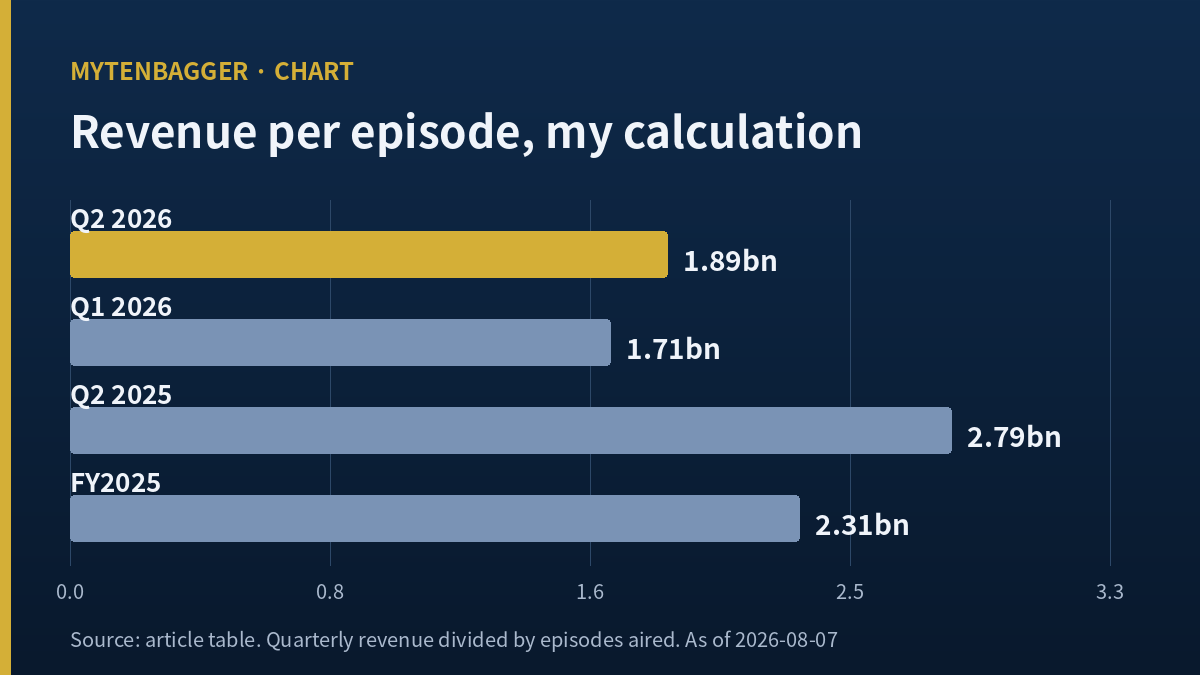
Here are two divisions I ran before I looked at anything else about Studio Dragon stock. In the second quarter of 2026 the company reported 145.3 billion won of revenue across 77 broadcast episodes, which works out to 1.89 billion won per episode. A year earlier it reported 114.5 billion won across 41 episodes, or 2.79 billion won per episode. The company publishes both numbers every quarter. It does not publish the division.
That division is the whole reason I spent a morning on this name. The headline out of Seoul on August 6, 2026 was a swing to profit, and it was a real one. What the headline does not carry is that the money arrived because the studio delivered nearly twice as many hours of television, each of which brought in about a third less than it did a year ago.
Three inputs, one profit number
| What moved | By how much | Who put a number on it |
|---|---|---|
| Episodes aired | 41 to 77 | The company, in both quarterly releases |
| Cost per title | Lower, amount not given | NH Investment and Securities, direction only |
| Amortization basis | Rewritten this quarter | Nobody has sized the earnings effect |
Figures as disclosed on August 6 and August 7, 2026. Korean won throughout.
Volume is the word I keep returning to, and it is a word I have been careless with before. When I look at a production company my eye goes to titles and ratings, and I have almost never counted how many hours actually went out the door. This quarter the count was the story, and I only saw it because I divided one disclosed number by another.

Contents
What Studio Dragon stock is standing on after Q2
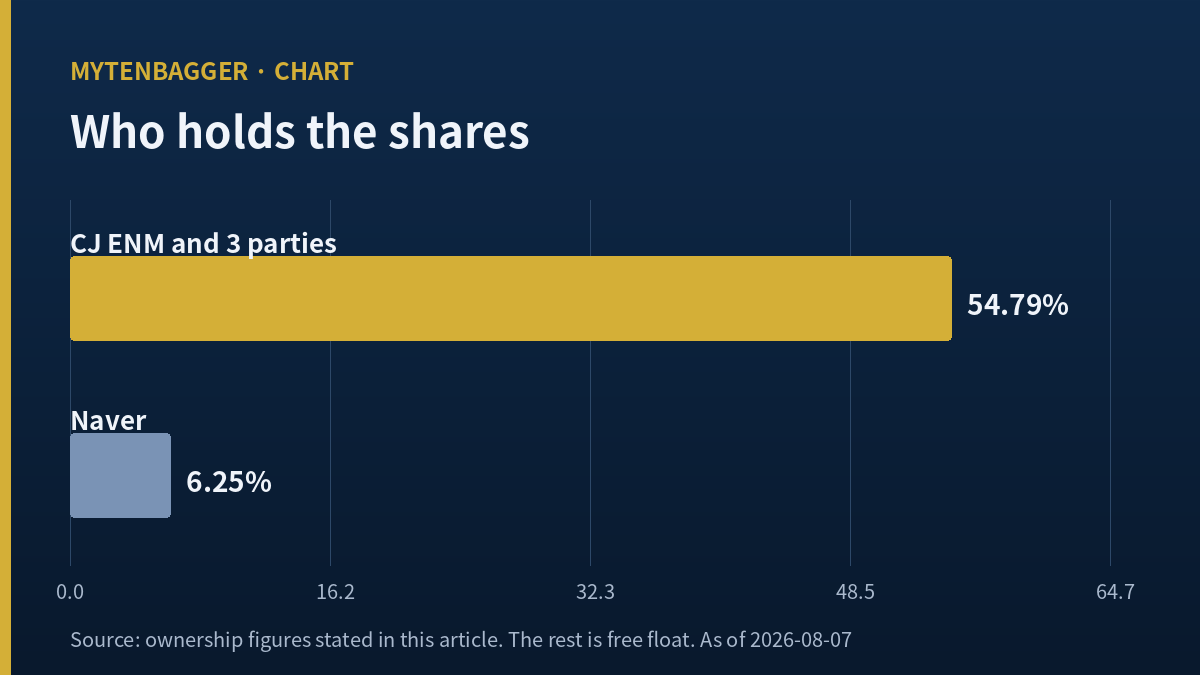
Studio Dragon is a drama production house listed on KOSDAQ, the junior board of the Korea Exchange that sits alongside the main KOSPI market and skews toward technology, biotech and media names. It writes and produces series, then sells them to broadcasters and streaming platforms. CJ ENM and three related parties hold 54.79 percent of the shares, and Naver holds another 6.25 percent, so the free float is a little under half the company.
The second quarter numbers, as released on August 6, 2026: consolidated revenue of 145.3 billion won, up 26.9 percent from 114.5 billion won a year earlier. Operating profit of 15.4 billion won against an operating loss of 2.9 billion won in the same quarter of 2025. Net profit of 13.0 billion won against a 3.7 billion won net loss. Operating margin of 10.6 percent. At roughly 1,416 won to the dollar, that quarter is about 103 million dollars of revenue and about 11 million dollars of operating profit.
Inside the revenue line, licensing and distribution sales came to 126.9 billion won, up 37.3 percent from 92.4 billion won, while broadcast programming fees were only 15.5 billion won and other revenue 2.9 billion won. So roughly seven of every eight won this quarter came from selling finished content onward, not from network commissioning fees. Domestic revenue was 92.7 billion won, which the company described as up 226.7 percent.
The quarter before, and the year before
The first quarter of 2026, released on May 7, 2026, showed revenue of 155.3 billion won (up 16.0 percent), operating profit of 6.4 billion won (up 50.1 percent) and net profit of 6.6 billion won (up 177.0 percent). The mix ran the other way that quarter: programming fees of 48.4 billion won (up 45.5 percent) and licensing sales of 104.5 billion won (up only 6.4 percent).
Fiscal 2025 closed with revenue of 530.7 billion won (down 3.5 percent), operating profit of 30.4 billion won (down 16.6 percent) and net profit of 10.3 billion won (down 69.2 percent), on 230 episodes produced. Overseas revenue was 335.5 billion won and domestic 195.2 billion won. Add the two 2026 quarters and the first half brings 300.6 billion won of revenue, 21.8 billion won of operating profit and 19.6 billion won of net profit. Half a year of operating profit already equals 71.7 percent of the whole prior year by my calculation, and half a year of net profit is 1.9 times the prior full year. The second of those says as much about how low 2025 finished as about how 2026 is going.
I divided revenue by episodes myself
A drama studio sells hours. The company reports how many it delivered, so the arithmetic is available to anyone who wants it. Second quarter episodes went from 41 to 77, an increase of 87.8 percent. Revenue went from 114.5 billion won to 145.3 billion won, an increase of 26.9 percent. Same direction, and one of them moved more than three times as fast as the other.
| Period | Revenue | Episodes | Per episode, my calculation |
|---|---|---|---|
| Q2 2025 | 114.5bn won | 41 | 2.79bn won |
| Q2 2026 | 145.3bn won | 77 | 1.89bn won |
| Q1 2026 | 155.3bn won | 91 | 1.71bn won |
| FY2025 | 530.7bn won | 230 | 2.31bn won |
Revenue and episode counts are the company’s own disclosures in each quarterly release, with the fiscal 2025 line as reported by Korean press. The right hand column is my division of the first two and is not a metric the company publishes. All amounts in Korean won.
Per episode revenue fell 32.4 percent year over year in the second quarter. The first quarter moved the same way, from 2.27 billion won to 1.71 billion won, a drop of 24.8 percent. I want to be careful with that first quarter figure: the company gave a growth rate of 16.0 percent for the prior year quarter and not an amount, so I recovered 133.9 billion won by dividing 155.3 by 1.16 and then split it across 59 episodes. If that growth rate was itself rounded, my recovered figure is approximate. The second quarter pair is firmer because both amounts were disclosed outright.
What the division shows and where it stops
What it shows: revenue grew because the studio delivered more hours, and each hour brought in less. Lee Hwa-jung at NH Investment and Securities, writing on August 7, 2026, credits the same two things when explaining the margin recovery, listing higher broadcast volume alongside lower production cost per title. If revenue per hour and cost per hour both came down, margin can still rise, and it did: 10.6 percent for the quarter. The margin came from smaller shows, not bigger ones.
Where it stops: my per episode number treats all revenue as if it were generated by the hours aired in that quarter, and that is not how this business books money. Roughly seven eighths of second quarter revenue was licensing, which includes selling library titles produced in earlier years. Those sales are not tied to the 77 episodes that went out between April and June. So the division is not a price per hour of drama. It is evidence that volume and revenue moved at different speeds, and that is all I am claiming from it.
The accounting basis changed in the same quarter
This is where I stopped. Korean coverage on August 7, 2026 reported that the company rewrote how it amortizes broadcast rights held as intangible assets. The schedule now runs over 48 months, with 64 percent of the charge recognized in the first seven months after a title airs, and titles pre-sold to streaming platforms move from a six month schedule to a four month one. Chief financial officer Lee Hye-mi framed the purpose as better matching of revenue and cost, so that the market can forecast results more accurately. The NH note describes the same change.
The stated purpose is reasonable and I have no reason to doubt it. Pulling the charge forward is not the shape of a company trying to flatter earnings, and smoothing the quarter to quarter swing that comes from a single large title is a sensible thing to want. My problem is not the direction. My problem is the timing. The change sits inside the first profitable quarter in a year, and while the company disclosed the change, nobody has published how much of the 15.4 billion won it accounts for.
Three inputs I cannot weigh against each other
Three things moved together in one quarter. Episodes aired rose 88 percent. Cost per title came down. The amortization schedule was rewritten. The first two are business outcomes and the third is a measurement method, and I have no basis on which to size any of them against the others. That is not the same as saying the quarter was bad. Not being able to attribute a result is different from doubting it. My honest position is that the quarter looks good and I cannot yet say what made it look that way.
I have been on the other side of this question before. When I went through the Doosan Bobcat quarter that beat on a tariff refund, the item behind the beat was disclosed with an amount attached, so it could be lifted out and the underlying business read separately. Here the equivalent disclosure does not exist. Same question, and this time no way to answer it.
What Korean brokerages have put on Studio Dragon stock
Coverage here is alive, which is worth saying because it is not always true of a company this size. It is also split.
Lee Hwa-jung at NH Investment and Securities kept a buy rating on August 7, 2026 and left a 32,000 won valuation unchanged. The note flagged that the 15.4 billion won operating result beat a 14.8 billion won consensus, and put the full 2026 year at 571.0 billion won of revenue (up 7.6 percent), 46.2 billion won of operating profit (up 52.2 percent), an 8.1 percent operating margin and 25 titles aired (up 31 percent). The same note says further expansion of programming slots looks limited given conditions in the broadcast and streaming market downstream.
Kim Jung-chan at Korea Investment and Securities got there earlier, on July 21, 2026, and did something I found more interesting. The rating stayed at buy while the valuation came down from 50,000 won to 38,000 won, a reduction of 24 percent, in a note that at the same time forecast second quarter operating profit of 15.2 billion won and said it would land about 11 percent above consensus. A good quarter was expected and the company was marked down anyway, citing a softening television advertising market and delays in the reshaping of the streaming sector.
Kim Hoe-jae at Daishin Securities published 2026 estimates on December 26, 2025 of 640.0 billion won of revenue (up 14 percent), 55.2 billion won of operating profit (up 82 percent), an 8.7 percent margin, at least 25 titles and at least 288 episodes. Two conditions came attached, and I would not skip over either: part of the upside depends on Chinese distribution reopening, and output remains well below the company’s own historical peak.
How far I actually read
Those three I read through Korean press summaries of the underlying notes, and I have attributed each to a named analyst with a date. Two more exist that I could not open: a Samsung Securities piece dated July 2, 2026 and a DB Financial Investment piece dated April 2, 2026. I saw their titles and publication dates and nothing else, so no analyst names and no figures from either appear above. Listing sources I only glanced at next to sources I read would make the list look stronger than it is.
One more gap worth flagging for anyone screening this from outside Korea. The indicator database I work from shows no forward earnings estimate, no forward multiple and no peer multiple for this ticker. Five or more Korean brokerages are actively publishing on it. None of that reaches my screen. A field being empty is not the same as the work not existing, and the distinction matters more here than it usually does.
Five ways I could be wrong about Studio Dragon stock
Ordered by how firmly I can check each one, not by weight.
One, falling revenue per episode may not be a bad sign. Replacing one large title with several mid sized ones spreads the risk of a flop. If cost per hour is falling faster than revenue per hour, profit improves, and the 10.6 percent margin points that way. This item survives because of interpretation, not missing data, so if I am wrong anywhere it is most likely here.
Two, the accounting change may have hurt instead of helping. Recognizing 64 percent of the charge in the first seven months front loads cost. In a quarter with heavy airing volume, the revised schedule could have pushed expense up. I have not established even the sign of the effect, let alone its size.
Three, the absolute level of first half results reads like a recovery. First half operating profit of 21.8 billion won is 71.7 percent of all of fiscal 2025, and first half net profit is 1.9 times the prior full year. If volume is genuinely coming back, the second half has room. The 46.2 billion won and 55.2 billion won full year estimates cited above rest on exactly that premise.
Four, the balance sheet is not the problem. Total liabilities sit at 27.68 percent of equity and interest coverage is 3.23 times. Book value per share of 26,623 won across 30,059,524 shares recovers about 800.3 billion won of equity, against a market value of 757.5 billion won. That is where the 0.95 price to book comes from. Trading below stated book with volume recovering is a coherent case, and it is not mine only because of the attribution problem above.
Five, I could not settle the overseas revenue direction. The company gave domestic revenue of 92.7 billion won for the quarter, described as up 226.7 percent, and did not break out overseas at all. Subtracting domestic from total leaves 52.6 billion won. Dividing 92.7 by 3.267 recovers 28.4 billion won of domestic revenue a year earlier, which leaves 86.1 billion won overseas in that quarter. If both steps hold, overseas fell. But first quarter overseas revenue rose 25.5 percent by the company’s own account, and recognition timing in this business swings hard between quarters, so I am not calling a direction from a subtraction.
My position on Studio Dragon stock and what would bring me back
I do not own the shares and I did not place an order this week. Not because the quarter was weak. Because I could not separate where the strength came from. Volume, smaller productions, and a rewritten cost schedule are all inside one number, and how that number splits decides whether it repeats.
On the volume half of it, a margin built on more hours runs into a ceiling on hours, and the ceiling was described by the analyst who kept a buy rating. Further programming slot expansion looks limited, that note said. Raising episode count by 88 percent is not something a studio does every quarter. If per episode revenue keeps sliding and the episode count cannot keep climbing, revenue has nowhere left to grow.
Two things would bring me back. First, a quarter where revenue per episode rises again, which is where a return to larger or better priced productions would show up before it shows up anywhere else. Second, two quarters reported on the new amortization basis, because a comparison needs two quarters counted the same way. Until then this quarter is a single point I cannot join to the ones on either side of it.
My thesis breaks like this. If the next quarter shows revenue and profit rising without an increase in episodes aired, then revenue per episode has recovered and my reading of this as a volume story was wrong. I would have to rewrite this piece. Note where that test comes from: not from company guidance and not from a brokerage estimate, but from a division I constructed. If it fails there is nobody else to hand it to.
So I am not filing this quarter under a swing to profit. I am filing it under the first quarter measured a new way. When a second reading exists on the same basis, I will change the label.
Related reading: the multiple attached to KEPCO Engineering, HYBE, which fell 16 percent on a record quarter
For a listed comparison I looked at Lionsgate Studios (NYSE: LION), another pure content producer that sells to platforms it does not own. On figures displayed for August 6, 2026 it traded at 13.02 dollars for a 3.78 billion dollar market value, on 2.63 billion dollars of trailing revenue and a trailing net loss of 198.9 million dollars, or 0.70 dollars per share, which leaves it without an earnings multiple at all. It pays no dividend, and 11 analysts carry an average valuation of 15.50 dollars. Dollar figures are quoted in their original currency. Prices and multiples for the Korean company reflect the August 7, 2026 close as checked at the time of writing. Won amounts are converted at approximately 1,416 won per dollar on that same date, and Korean won is the reference currency throughout. Korean market data from Kiwoom Securities.
Sources read for this piece: the company’s second quarter release and first quarter release, both in Korean; Seoul Economic Daily on the fiscal 2025 result; Bloter on the amortization change; Etoday summarizing the NH note; Hankyung on the Korea Investment note; Financial Post on the Daishin note; and Money Today for the August 7 won close. Where a Korean outlet is summarizing a brokerage note, the wording above is my paraphrase, not a translated quotation.
Related reading