Samsung Card Stock Has Absorbed An Eighth Of The Rate Move
What does a credit card company buy? I went looking for the answer before I looked at Samsung Card stock at KRW 46,150, and the answer turned out to be simple. The company does not manufacture anything. It borrows money, settles a cardholder’s purchase up front and collects later. So the input it buys is money, and the price of that input is an interest rate. What I could not find anywhere in the half-year filing was that rate. The total interest expense is there. The percentage is not.
So I divided it out myself. This piece is about that one division and about the question it failed to answer.
What the market moved
Three-year Korean financial-institution paper, as compiled by the Korea Financial Investment Association bond center, stood at 4.501 percent on September 2, 2026, against 3.337 percent at the start of the year. That is 1.164 points.
What the company actually paid
First-half 2026 interest expense of KRW 330.28bn over that period’s average total liabilities, annualized, gives 2.678 percent. The same arithmetic on the first half of 2025 gives 2.532 percent. The difference is 0.146 points.
The ratio between them
0.146 divided by 1.164 is 12.55 percent. Roughly an eighth of the market’s move has reached the income statement.
What this figure does not say
2.678 percent is not the company’s borrowing rate. Total liabilities include balances that carry no interest at all, such as amounts owed to merchants, so the level reads low. I used the direction and the size of the change, not the level. It also says nothing about when the remaining 87.45 percent arrives. The residual maturity schedule for borrowings and bonds decides that, and I did not open it.
Contents
What Samsung Card Stock Actually Pays For Its Money
My habit with a card issuer is to open the merchant discount rate first. How much of a KRW 100,000 purchase the acquirer keeps, and when the regulator resets that percentage. I started there again and stopped partway. Over the last three and a half years the line that moved most in this company’s accounts was not on the fee side.
The filed interest expense, four periods
On a consolidated basis in the Korean regulatory filings, interest expense was KRW 486.02bn in 2023, KRW 512.69bn in 2024, and KRW 597.01bn in 2025. The first half of 2026 came to KRW 330.28bn against KRW 280.53bn in the same half of 2025. Half against half, that is KRW 49.75bn more, or 17.73 percent.
Those two numbers agree with what the company published. Reporting second-quarter results on July 27, 2026, Samsung Card said financing costs rose by KRW 49.8bn, or 17.8 percent, in the first half. My figure pulled from the filed accounts differs by KRW 0.06bn. I confirmed that my arithmetic and the company’s disclosure land in the same place before I went any further.
Korean Card Issuers Cannot Take Deposits
This is the piece of the structure that a US reader will not have by default. In Korea, a credit card company is a specialized credit finance company, not a bank, and it is not permitted to take deposits. Everything it advances to cardholders, plus the balance of its card loans, is funded in the wholesale market. The instrument is called a specialized credit finance company bond. That bond market is this company’s cost of goods.
Asia Economy reported on September 3, 2026 that the three-year yield on this class of paper was 4.501 percent, with the start of the year at 3.337 percent and a July peak of 4.551 percent, all from the Korea Financial Investment Association bond center. A separate compilation published by Smart Economy on July 31, 2026 narrowed the credit band to AA+ and put the three-year yield at 4.469 percent on July 27, with the start of the year at 3.579 percent.
The two compilations disagree about January
3.337 and 3.579 are 0.242 points apart. I did not pick one. The first covers the whole class of financial-institution paper and the second covers a single credit band, so they were never measuring the same thing. As a move, the first gives 1.164 points and the second gives 0.890 points. I used the first because its reading is more recent. On the second, the ratio further down this piece becomes 16.40 percent instead of 12.55 percent. Either way only part of the market move has landed. Whether that part is an eighth or a sixth depends on which compilation you read.
One more piece of background, translated from the same Korean coverage: the policy rate went from 2.50 percent to 2.75 percent, the first increase since January 2023. A long downward path reversed.
The Rate Samsung Card Stock Carries Rose 0.146 Points
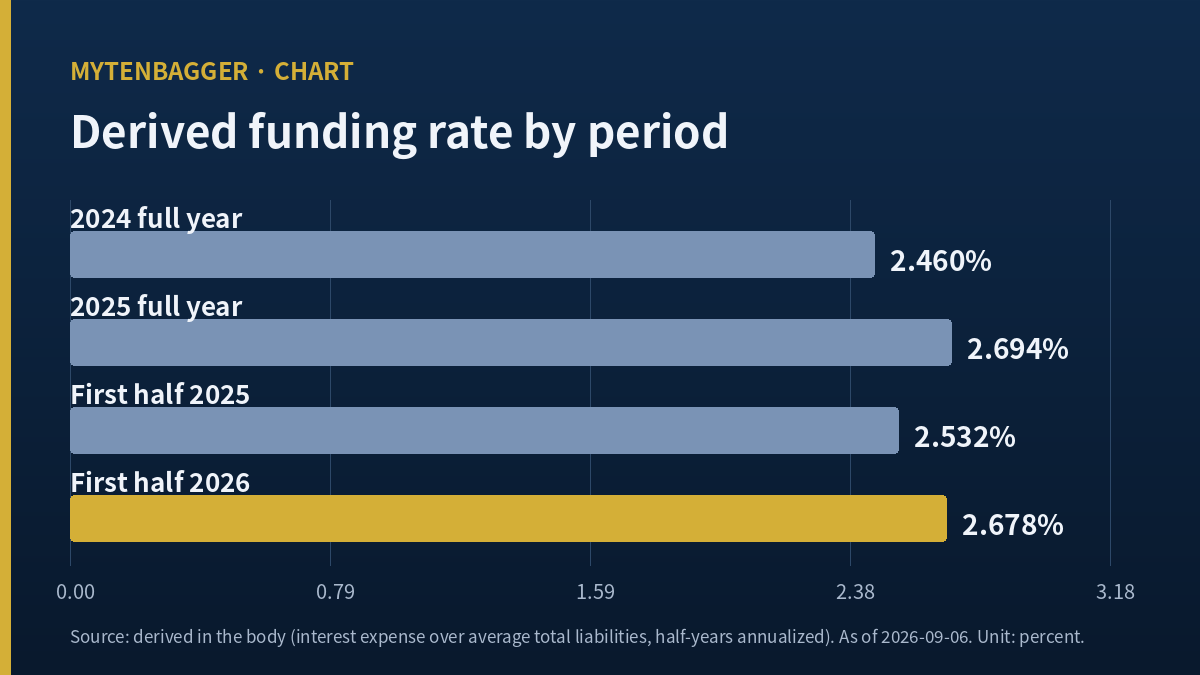
The method is plain. Take the interest expense for a period, divide by the average of opening and closing total liabilities, and double the half-year figures to put them on an annual footing. Liability totals come straight from the consolidated statement of financial position in the Korean filings.
| Period | Interest expense | Average liabilities | Derived rate |
|---|---|---|---|
| 2024 full year | KRW 512.69bn | KRW 20.84tn | 2.460% |
| 2025 full year | KRW 597.01bn | KRW 22.16tn | 2.694% |
| First half 2025 | KRW 280.53bn | KRW 21.72tn | 2.532% |
| First half 2026 | KRW 330.28bn | KRW 24.67tn | 2.678% |
Half against half the derived rate went from 2.532 to 2.678 percent, up 0.146 points. Year against year it went from 2.460 to 2.694 percent, up 0.234 points. Measured annually or measured semi-annually, the direction holds.
Why the arithmetic comes out this way
The reason is mechanical. A market yield prices paper being issued now. Interest expense prices every borrowing already on the books. A bond sold three years ago at a little over two percent keeps that coupon until it matures. So while the market moved 1.164 points, the average carried by the balance sheet moved 0.146. Put the other way, the 17.73 percent rise in financing costs visible in the first-half accounts is nearer the beginning of the repricing than the end of it.
What I cannot turn “nearer the beginning” into is a size. How many quarters the remaining 87.45 percent takes to arrive is set by the maturity ladder, and the residual-maturity table for borrowings and debentures was not something I opened during this research. So this piece describes a direction and stays silent on speed.
Where My Read On Samsung Card Stock Breaks
A one-sided piece is a research gap wearing the costume of a view. Here is the material that argues against me.
Credit quality improved while funding got worse
The company put its 30-day-plus delinquency ratio at 0.89 percent on July 27, down 0.03 points from the prior quarter. Smart Economy’s July 31 summary of first-half figures for the bank-holding-company card units gives an average of 1.46 percent, with KB Kookmin at 1.07, Shinhan at 1.21, Hana at 1.73 and Woori at 1.81. Samsung Card’s 0.89 sits 0.18 points below the lowest of those four. The two figures come from different sources and I did not confirm that the measurement bases match exactly. On direction alone, asset quality did not deteriorate while funding was getting more expensive.
The top line is growing, not shrinking
First-half operating revenue went from KRW 2,071.4bn to KRW 2,188.5bn, up KRW 117.1bn or 5.65 percent. The company reported 5.6 percent. The second quarter alone went from KRW 1,037.7bn to KRW 1,096.9bn, up 5.7 percent. Costs are rising into a business that is still expanding.
Two Korean houses are still positive
A July 13, 2026 note from Yoon Yu-dong at NH Investment and Securities carried a buy view and a KRW 68,000 valuation, and a June 25, 2026 note from Seol Yong-jin at iM Securities carried a buy view at KRW 63,000. The Korean Economic Daily consensus screen dated September 4, 2026 also shows KRW 63,000. Against the KRW 46,150 close, KRW 63,000 is 36.5 percent higher. I do not adopt any of those figures as my own. That the people who follow this company think the 2026-09-04 price is low is nonetheless evidence on the other side.
The company said this first
I should also record that my finding may not be a finding. In its July 27 release the company said, in Korean, that the burden of rising financing costs would persist through the second half of 2026 and that the operating environment for card issuers would remain difficult. Seol Yong-jin’s note said much the same, describing continued funding pressure from rising market rates and naming rate stabilization as the key to earnings capacity. The diagnosis is already public. What I added was a measurement of the gap in percentage points.
Two Houses Put The Quarter In The Same Place
This is the part I spent longest on. Both notes were published before results, and both estimated second-quarter net profit attributable to owners.
| Source | Dated | Q2 estimate | Versus actual |
|---|---|---|---|
| NH Investment, Yoon Yu-dong | 2026-07-13 | KRW 161.0bn | 4.22% high |
| iM Securities, Seol Yong-jin | 2026-06-25 | KRW 162.3bn | 4.99% high |
| Average of the two | both notes | KRW 161.65bn | 4.61% high |
| Company reported | 2026-07-27 | KRW 154.2bn | baseline |
The two estimates are KRW 1.3bn apart, a spread of 0.81 percent. They were standing in effectively the same spot. Both then missed high by something in the four percent range. I do not read that as two analysts being wrong. Both notes predate the release and were built from what was public at the time. What I read is a different thing. Two people working independently landed on the same figure, which suggests the information available then permitted only that figure. And between that figure and the reported outcome sat four percent and change.
One number from the iM Securities note is worth keeping. Its 2027 operating profit estimate is KRW 867.0bn. The trailing four-quarter operating profit already printed on the Korean vendor screen is KRW 853.7bn. The estimate for two years out is 1.56 percent above what the screen shows for the trailing four quarters. A house that follows this company closely is placing the profit of 2027 almost exactly where the profit of the last twelve months already sits. I have seen this pattern before in a Korean mid-cap that nobody had updated in months, and I wrote it up as a coverage problem at the time. This is not that. Here two houses did publish, recently, and still put the future where the present is.
Samsung Card Stock Against Two American Card Lenders
For a US reader the useful comparison is with lenders that also carry receivables on their own balance sheet and fund them in the market. I pulled two from the same data screen on the same day.
| Company | Price to book | Price to earnings | Implied return on equity | Dividend yield | Screen dated |
|---|---|---|---|---|---|
| Samsung Card (KOSPI 029780) | 0.58 | 8.28 | 7.00% | 6.07% | 2026-09-04 |
| Samsung Card, recomputed on filed equity | 0.60 | 8.28 | 7.25% | 6.07% | 2026-06-30 equity |
| Synchrony Financial (NYSE SYF) | 1.71 | 8.18 | 20.90% | 1.70% | 2026-09-05 |
| American Express (NYSE AXP) | 6.42 | 19.80 | 32.42% | 1.17% | 2026-09-05 |
The second row is my own recomputation. The Korean screen’s book value per share of KRW 79,986 does not tie to the filed equity of KRW 8,904.5bn at 2026-06-30, which works out to KRW 76,856 per share, a 4.07 percent difference I could not resolve; dividing market value by filed equity gives 0.60 instead of 0.58. I left both in the table.
The implied return on equity column is my own arithmetic, price to book divided by price to earnings, so it is internally consistent with the other two columns by construction. American Express publishes a return on equity of 34.38 percent on the same screen, which is 1.96 points above the 32.42 my division gives; the two do not have to agree because a published ratio uses average equity while mine uses whatever equity the price-to-book column embeds.
The line that does the work here is the first one. Samsung Card and Synchrony trade at almost the same earnings ratio, 8.28x against 8.18x. Their book ratios are 0.58x and 1.71x, a factor of 2.95x. Two companies can carry the same earnings ratio and a book ratio three times apart only if their returns on equity differ by roughly the same factor, which is what the third column shows. Synchrony’s TTM revenue is USD 9.91bn against net income of USD 3.44bn, a 35.51 percent margin. Samsung Card’s Korean vendor screen shows a 37.48 percent net margin on its own revenue construct. The margins are close. The equity bases are not.
I have written before about a Korean financial trading far below its book value and how little of the discount I could trace to anything specific. This case is less mysterious. At a 7 percent return on equity, a 0.58x book ratio is close to what the arithmetic asks for. The discount is not the puzzle. The return on equity is.
Currency note: the Korean figures in this piece use a rate of 1,350.4 KRW per USD, the Seoul market close on 2026-09-04, the same date as the equity close. At that rate the KRW 46,150 share price is about USD 34.18 and the KRW 5,346.9bn market value is about USD 3.96bn. I have used one rate for the whole piece.

Reaching Samsung Card Stock From A US Account
Practical constraints first. Samsung Card lists on the KOSPI, the senior board of the Korea Exchange, under 029780. Korea also runs a second board, the KOSDAQ, which carries smaller and technology-weighted issuers; this company is not on it. I found no American depositary receipt for this name, so a US-based holder would be buying the Seoul line directly through a broker with Korean market access.
Broad Korea funds are a poor substitute here. Anyone using that route should check the published holdings themselves.
Two more facts a foreign buyer should weigh. Foreign ownership of this company sits at 5.31 percent on the vendor screen, which is low for a KOSPI name of this size and means the register is domestic. And the controlling shareholder is Samsung Life Insurance with 71.86 percent, which leaves a free float of roughly a quarter of the shares before treasury stock is deducted. A single owner at that level sets the dividend policy, and I have watched that dynamic decide a payout at another Korean company whose parent effectively sets the payout.
The payout arithmetic, since the two published ratios disagree
The Korean vendor screen shows a payout ratio of 50.2 percent, computed as the KRW 2,800 dividend per share over KRW 5,575 of earnings per share. Newsfield reported on July 17, 2026 a payout of 46.3 percent, computed as total dividends of KRW 298.79bn over net profit. The ratio between those two payouts is 92.104 percent. The ratio of shares outstanding excluding treasury, 106,710,959, to total shares issued, 115,859,155, is also 92.104 percent. They agree to three decimals, because dividends are not paid on treasury stock and this company holds 9,148,196 shares, or 7.90 percent of the total. The same report quoted the company as saying it has no near-term plan to acquire, dispose of or retire treasury shares, which is why every per-share figure in this piece rests on a single unchanged share count.
One Number Would Change My View Of Samsung Card Stock
My position, stated plainly: I do not own this and I have no order in. I am watching. The market value of KRW 5,346.9bn puts this among the larger Korean listings, though I did not measure its exact rank, and on an unattended session I take the most conservative posture available.
The reason for watching reduces to one sentence. I established the direction of this company’s input cost and failed to establish its speed. Knowing only the direction makes every entry either early or late.
Listing what to check gave me five candidates: third-quarter financing costs, the path of Korean card paper yields, the delinquency ratio, whether treasury shares get retired, and whether the sell-side estimates get revised. I discarded four and kept one.
Why the four went
Third-quarter financing costs are an outcome. They report how much the number grew without saying across how many quarters the remaining 87.45 percent lands. The path of card paper yields is outside this company’s control and outside my forecasting. The delinquency ratio measures collection, not funding, so it answers a different question. Treasury retirement has already been addressed by the company in writing, and re-confirming a stated absence is not worth a quarter of waiting. Revised estimates are somebody else’s opinion changing, which is a different event from a fact changing.
The one I kept
The residual maturity schedule for borrowings and debentures. It appears in the notes to the annual report, and it states what share of the debt matures inside twelve months. A high share means the 0.146 points I derived converge toward the market move within a few quarters. A low share means the convergence stretches over years. Same direction, different speed, and speed is the variable that would move my judgment. I have set the check for after November 16, 2026, the statutory deadline for the third-quarter filing. Until that table is open, I am not putting a value on this one. I took a small position in an eight-times-earnings Korean name only once a payout commitment had been put in writing, and the trigger I am waiting for here is the same kind of thing: a document, not a price.

Prices and screen ratios are Korean vendor data on the 2026-09-04 (Friday) close. Financial statement figures are consolidated, from Korean regulatory filings through the 2026 half-year report, receipt number 20260814003715. The derived funding rate is interest expense over the average of opening and closing total liabilities, annualized for half-year periods, and is my own calculation. Foreign exchange is 1,350.4 KRW per USD at the Seoul close on 2026-09-04. There is a lag between when this was written and when it appears, so live quotes will differ.
Sources: Asia Economy, 2026-09-03, Korea Financial Investment Association bond center data | Herald Business, 2026-07-27, Samsung Card second-quarter results | Smart Economy, 2026-07-31, card issuer delinquency and bond yields | Newsquest, 2026-06-25, citing the iM Securities note | Biz Tribune, 2026-07-13, citing the NH Investment note | Newsfield, 2026-07-17, dividends and treasury stock | Korean Economic Daily consensus screen, 2026-09-04 | Synchrony Financial statistics | American Express statistics. Korean-language sources appear here as my own paraphrase, not as quotation. I did not read the original broker reports and worked from secondary coverage and screens.